Practical Retention Protocols Clinicians Are Using to Keep Nausea-Affected GLP-1 Patients on Therapy
Slower dosing and dietary changes help GLP-1 patients tolerate nausea during treatment.

GLP-1 dropout and nausea-driven non-compliance call for a coordinated clinical protocol. The practical sequence is individualized dose-escalation pacing, dietary scaffolding, and targeted antiemetics when needed, supported by communication before and after dose increases. Because nausea usually peaks during escalation and diminishes at maintenance, the aim is to bridge a predictable period of intolerance so patients can continue effective therapy.
Why GLP-1 nausea follows a predictable arc — and why that arc is the clinical argument for staying on therapy
GLP-1 receptors in the dorsal vagal complex, a brainstem nausea-control center, are the main driver of GLP-1–induced nausea, with peripheral vagal and gastrointestinal receptor activation also contributing. Delayed gastric emptying compounds the central signal because food remains in the stomach longer, amplifying discomfort. Symptoms are dose-dependent, typically peaking during escalation and becoming minimal or resolving for most patients after the maintenance dose stabilizes. Alhazmi and le Roux (2026) frame nausea as physiological feedback for individualized titration, analogous to mild hypoglycemia during insulin treatment. Whether nausea and appetite reduction can be separated remains a live scientific question, but emerging clinical data challenges the assumption that therapeutic benefit requires discomfort.
Why do so many patients quit GLP-1 medications within the first few months?
A large population-based study of first-time semaglutide users found that 42% stopped within nine months, with a steep share leaving within the first three months. Clinical trials present a less severe picture. Only a small fraction of trial participants discontinue because of gastrointestinal adverse events, while real-world losses are front-loaded in the first weeks of therapy. These measures are not interchangeable, because overall discontinuation includes reasons beyond gastrointestinal intolerance. Nevertheless, the contrast raises a useful clinical question about how much trial-style titration support and structured monitoring could prevent avoidable exits in routine care.
Patients without type 2 diabetes discontinue at substantially higher rates within the first year than patients with diabetes. They also have less clinical infrastructure around their prescription than patients already embedded in diabetes care, despite the substantial metabolic stakes of obesity treatment. Younger patients and those in lower-income areas are disproportionately represented among early discontinuers. A protocol that depends on patients independently finding help therefore faces an access problem as well as a tolerability problem.
In physician surveys, patients name nausea and vomiting among their main reasons for stopping, though cost can rank higher than side effects or just as high, depending on who was surveyed and how. Nausea management is a direct clinical lever for patients whose willingness to continue is being eroded by symptoms. The timing makes this more specific than a general adherence challenge. The intervention target is the escalation window, when symptoms are most likely to threaten persistence and dose decisions can still change their course.
Titration pacing as the primary protocol lever — how to slow escalation without losing efficacy
Alhazmi and le Roux cite a randomized study comparing standard semaglutide titration with gradual, flexible escalation, in which slower escalation reduced nausea without compromising efficacy outcomes. That finding supports pacing as the first intervention. Most patients can reach the full therapeutic dose with minimal gastrointestinal difficulty on standard trial schedules, so flexibility addresses the minority who struggle while standard schedules remain appropriate for most patients. Because significant side effects are virtually impossible to predict at initiation, a workable protocol must adapt to the patient’s response.
The insulin analogy offers a familiar way to adapt treatment. Mild nausea can be a reason to consider slowing or pausing escalation, while vomiting calls for going back to the last well-tolerated dose. The distinction changes what symptoms mean operationally. Instead of treating every adverse effect as a choice between continuing unchanged and stopping, the clinical team has an intermediate response that adjusts exposure. Dose decisions should take into account how severe symptoms are as well as when the next increase is due.
The authors’ guidance allows cautious escalation with Grade 1 nausea, although maintaining the current dose until symptoms subside may be sensible. Grade 2 nausea calls for pausing escalation. In most cases, maintaining the current dose for one to two additional dosing intervals allows symptoms to resolve. Vomiting or Grade 3 nausea indicates stepping back to the last well-tolerated dose to support continued therapy.
Oral semaglutide has very low bioavailability and highly variable day-to-day absorption, producing larger fluctuations in plasma concentrations than subcutaneous dosing, which may contribute to gastrointestinal events. Orforglipron has more predictable absorption within and between individuals, but its gastrointestinal discontinuation rates are similar to those of oral semaglutide. Convenience does not remove the tolerability constraint. Strict adherence to the titration schedule is especially important with orforglipron because rushed escalation brings a greater nausea penalty than with injectable formulations.
Dietary scaffolding during the escalation window — behavioral changes that reduce gastric load
With delayed gastric emptying, how much patients eat and what they eat belong in the nausea protocol as well as in advice about healthy eating. A large, high-fat meal places a prolonged load on a stomach that empties more slowly, creating conditions that amplify nausea and vomiting. The mechanism gives the advice its precision. Eating slowly, avoiding high-fat or large-volume meals, and stopping at the first sensation of fullness help patients accommodate the change during escalation. Small, frequent meals distribute gastric load through the day.
A structured briefing before the first dose increase gives patients a chance to change how they eat before symptoms begin. It also clarifies the purpose of the changes. These behaviors may be limited to the escalation window, and their rationale follows the same symptom arc used to explain dose pacing. Patients are being asked to reduce the gastric conditions that can intensify nausea while their dose is changing, rather than to follow a vague instruction to eat better.
The AdventHealth retrospective (2024) documented retained gastric contents in GLP-1 patients undergoing endoscopy or surgery, highlighting aspiration risk as a clinical consequence of delayed emptying. That perioperative concern reinforces the gastric-load rationale without making dietary advice a substitute for procedure-specific care. Yet gastric load is only one contributor. Because the nausea signal is primarily central, reducing meal volume and fat does not address the whole mechanism. Patients who still have significant nausea despite dietary changes and flexible titration can then receive treatment aimed at those symptoms.
Targeted antiemetic use as a third-layer intervention when titration pacing and dietary changes are not enough
Ondansetron is the most commonly prescribed antiemetic adjunct for GLP-1 nausea during dose escalation. The key distinction is when it becomes available. In a proactive protocol, a prescription is written at the time of escalation for a patient who needs this additional layer, before a distress call becomes necessary. The logic resembles anticipatory treatment of chemotherapy nausea, without implying that the two clinical settings are equivalent.
A reactive prescription requires the patient to interpret nausea as manageable, contact the clinic, and seek treatment to continue therapy. Proactive prescribing removes that particular decision point. It does not replace dose reassessment or dietary scaffolding, because the antiemetic is an adjunct to those measures. Some patients beginning GLP-1 treatment may need an antiemetic in this sequence.
If nausea and reduced food intake are inseparable, suppressing nausea might appear to undermine the intended benefit. New data calls that belief into question and gives a reason to treat nausea without assuming that appetite reduction must be lost. The uncertainty should remain explicit. The case for targeted ondansetron use rests on not treating an unresolved coupling hypothesis as a reason to leave significant symptoms untreated, while recognizing that evidence challenging the hypothesis does not settle every question about antiemetic-supported treatment.
Proactive patient communication timed to the escalation arc, not triggered by symptoms
Patients need an explanation of the nausea arc before their first dose increase as well as reassurance after an episode of vomiting. Symptoms can help guide safer titration even when they seem to suggest treatment failure, and how severe nausea is can change the next dose decision. Without that context, patients have little basis for distinguishing expected, manageable discomfort from a reason to abandon therapy. Communication therefore supplies the interpretation that allows the other protocol layers to function.
For a clinical team, the operational lesson is to match the channel to the task and the moment. Email or longer written materials give patients room before a dose increase to learn how symptoms may change, what meal changes to make, and what help is available. SMS suits short, time-sensitive dose and refill nudges. In-app or direct provider messaging serves a different purpose by giving patients a route to a clinician when side effects intensify. The channels are not interchangeable, because an escalation reminder cannot do the work of a side-effect conversation.
The schedule must also reflect when symptoms are likely. A check-in during week one or two after a dose increase targets the period of peak nausea rather than waiting for a patient to initiate contact. If symptoms have not subsided, the team can apply the planned pause or step-back rules instead of discovering the problem after unilateral discontinuation. The protocol is proactive in its preparation and contact schedule, even though the dose response remains individualized to what the patient reports.
How the protocol stack fits together across the escalation arc — and where it currently falls short
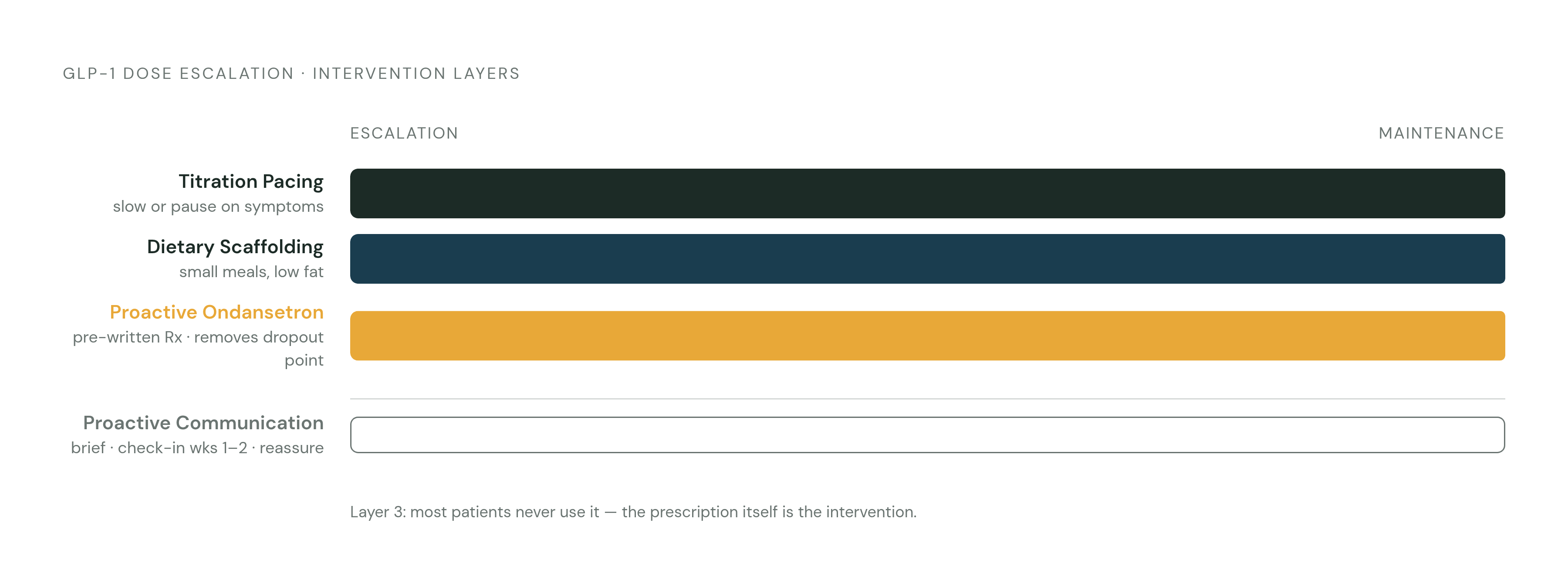
The four layers form a sequence of clinical decisions. Titration pacing governs how quickly exposure rises, while dietary scaffolding reduces the gastric load at each dose level. Antiemetics enter when those measures do not sufficiently bridge the nausea window. Communication runs through the sequence and intensifies around dose increases, making the next decision accessible to the patient.
Access remains a weakness in that model. Patients without diabetes, younger patients, and those in lower-income areas are both prominent among early discontinuers and less likely to have a clinical team delivering a coordinated escalation protocol. A clinically sound sequence can therefore fall short before any dose decision is made. Clinics need appropriate guidance, and the patients most likely to leave need access to the support required to apply it. Cost-related discontinuation also remains outside what nausea treatment alone can resolve.
A different engineering approach would change exposure to address its consequences. Subcutaneous delivery leads to systemic peptide concentrations that activate peripheral gastrointestinal receptors, so that exposure comes from both the route and the molecule. Other routes that target central nervous system GLP-1 receptors with lower peripheral exposure could help address this cause of nausea. Lower peripheral exposure is not, by itself, proof that a centrally targeted treatment would eliminate nausea.
Science supports studying nose-to-brain delivery as a way to test that possibility. Preclinical nanocarrier platforms have demonstrated higher, longer-lasting brain drug concentrations than intravenous administration while keeping systemic exposure lower. Those findings are not clinical retention evidence. No nanocarrier-based nose-to-brain system has advanced to late-stage clinical trials, leaving a substantial translational gap between delivery performance and a usable solution for nausea-driven discontinuation. For current practice, the unresolved task is making coordinated escalation support available to the patients who are otherwise most likely to stop.
Sources
- Frontiers
- Real-World Impact of GLP-1 Receptor Agonists on Endoscopic Patient Outcomes in an Ambulatory Setting: A Retrospective Study at a Large Tertiary Center
- Do no harm: managing nausea and vomiting in GLP-1 based obesity therapies
- Clinical Recommendations to Manage Gastrointestinal Adverse Events in Patients Treated with Glp-1 Receptor Agonists: A Multidisciplinary Expert Consensus
- The agony and the efficacy: central mechanisms of GLP-1 induced adverse events and their mitigation by GIP