GLP-1 Gastrointestinal Mechanisms Behind Nausea and Diarrhea
Scientists pinpoint how GLP-1 drugs hijack the brain's poison-detection system to trigger nausea.
GLP-1 drugs cause nausea and diarrhea for reasons that trace back to a single receptor, expressed across the gut and brainstem tissue built to detect poison. This is a plumbing problem, not a side-effect footnote: it's the direct, predictable output of activating a signaling system built to manage one meal, then holding it "on" for weeks at a stretch. That distinction matters, because it changes what counts as a real fix and what's just a workaround, a difference this piece keeps coming back to.
How widespread GI side effects are, and what patterns emerge across drugs and doses
Start with scale. A 2026 narrative review by Yılmaz and Bastemir, published in Diabetes, Metabolic Syndrome and Obesity, puts the share of patients experiencing some GI adverse effect between 40% and 70%, with nausea, vomiting, diarrhea, and constipation topping the list. A 2025 Bayesian network meta-analysis in Frontiers in Pharmacology, pooling 27,729 people across 48 randomized trials, found an overall GI adverse event rate of 11.66%, with nausea the single most common complaint at 21.49% and reduced appetite the least common at 5.49%.
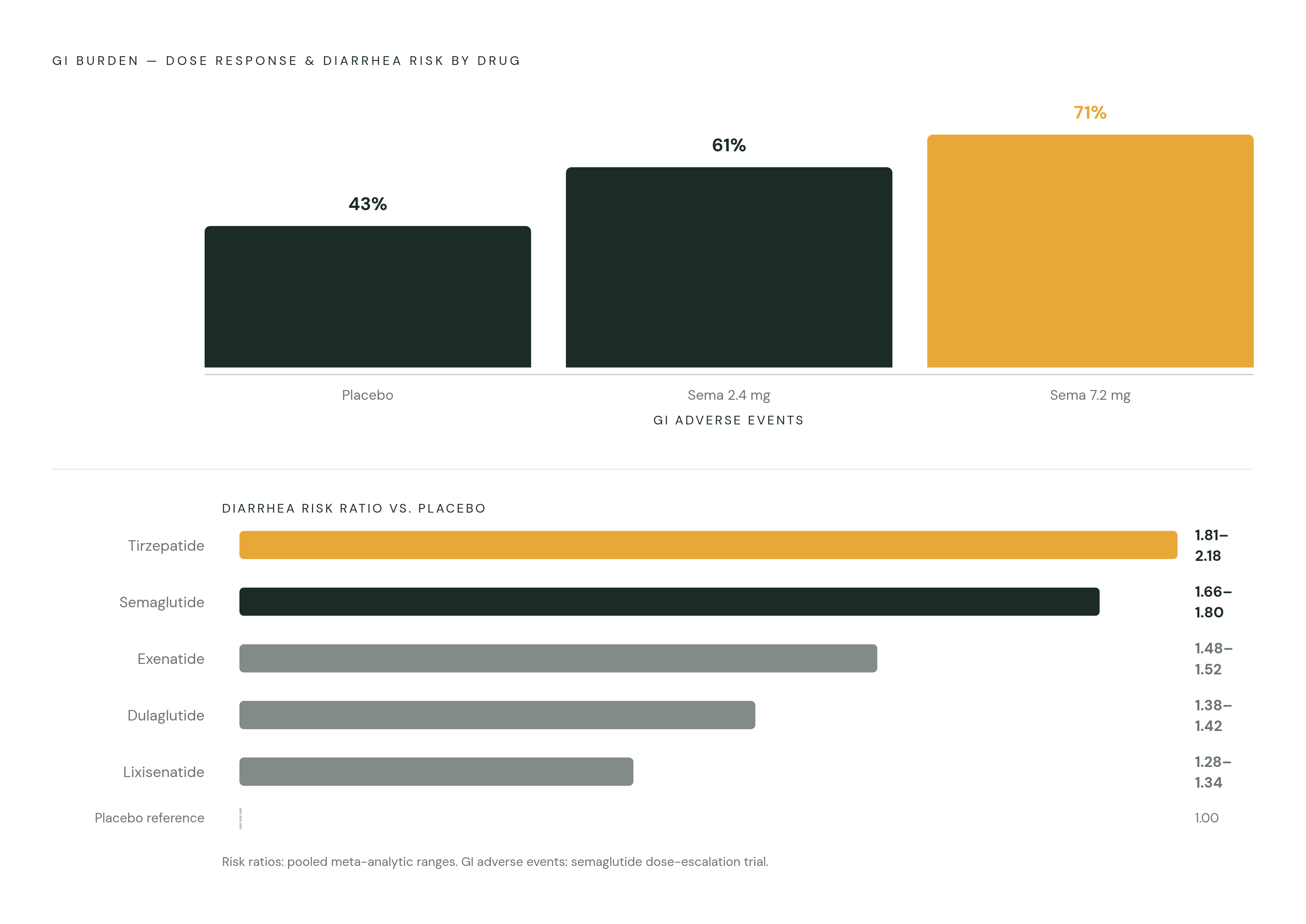
The dose-response curve backs this up in a way that's hard to wave off as noise. Nausea, vomiting, diarrhea, and constipation all climb steeply at low doses, then either level off or keep rising, depending on which symptom is tracked. The 2025 STEP UP trial tested an investigational 7.2 mg dose of semaglutide against the standard 2.4 mg dose, and the gap is stark: 71% of participants on the high dose had a GI adverse event, versus 61% on standard dose and 43% on placebo. More drug, more symptoms. That's about as clean a dose-response relationship as pharmacology offers, and the side effects aren't some quirk of formulation. They're baked into the mechanism itself.
Drug by drug, the differences hold up too, and they're worth naming instead of hedging around. Tirzepatide carries the highest nausea and diarrhea risk of the group, with a diarrhea risk ratio between 1.81 and 2.18 versus placebo in the Frontiers in Pharmacology meta-analysis. Semaglutide isn't far behind, at 1.66 to 1.80. Exenatide stands out for vomiting specifically, while dulaglutide and lixisenatide sit at the bottom across both categories. Women report higher nausea rates than men across every dose group studied, a pattern consistent enough across studies to suggest a biological rather than incidental basis.
Symptoms tend to peak early, cluster around dose escalation, and fade with continued use. Calling them "transient" undersells the problem, though: this early window is exactly when most patients quit the drug. Rarer complications (gastroparesis-like symptoms, intestinal obstruction, biliary disease) show up in the literature too, though the evidence here is thinner and sometimes contradictory. No well-designed study has tied these drugs to a confirmed rise in pancreatitis risk.
Put the threads together and a pattern emerges: predictable in aggregate, variable by drug, tightly linked to dose. That's the fingerprint of a receptor doing exactly what it's built to do, just in more places and for longer than the body was ever designed to handle.
The central pathway: how GLP-1 drugs reach the brainstem and switch on nausea circuits directly
Why does nausea show up so reliably across drugs with otherwise different pharmacokinetics? Part of the answer sits in a small brainstem structure called the area postrema, part of the dorsal vagal complex along with the nucleus tractus solitarius. GLP-1 receptors sit directly on neurons here, and the area postrema has a structural quirk that leaves it exposed in a way most of the brain isn't: its blood vessels are fenestrated, meaning the blood-brain barrier that walls off most of the CNS is, in this one spot, considerably more porous. Circulating drug gets in without crossing the barrier that protects everything around it.
This isn't a design flaw of evolution. The area postrema is a chemosensory trigger zone, built to sample the blood for circulating toxins and respond by triggering nausea or vomiting before something worse happens. At the concentrations these drugs are dosed, the same detection machinery fires. Single-cell sequencing work has found two mostly separate populations of excitatory neurons in the area postrema, one marked by CALCR and the other by GLP1R, and inhibiting GLP1R in these cells is enough to block the avoidance behavior these drugs normally trigger in animal models.
The genetic work found that nausea and appetite suppression appear to run through separable circuits involving the area postrema and adjacent brainstem regions, the finding that should shape drug design going forward. Nausea and appetite control run through separable circuits. That deserves more than a footnote, because it means a drug could, in principle, suppress appetite without ever lighting up the nausea trigger zone. Treating the two effects as permanently bundled, which is how the field has largely built and dosed these drugs so far, is a very different proposition than the biology actually supports.
A 2025 mouse study in the American Journal of Physiology, Endocrinology and Metabolism pushed this further. Researchers found that directly activating GLP-1R neurons in the area postrema produced retching-like behavior on its own, with no vagal input required, and traced the mechanism to AMPA receptor-mediated postsynaptic excitation. That's about as direct a demonstration as exists that central activation alone, independent of anything happening in the gut, is enough to drive vomiting.
GIP adds a wrinkle worth sitting with. GIP receptor signaling in the area postrema appears to interact with GLP-1 receptor pathways in ways that may modulate some adverse responses. That may help explain why tirzepatide, a dual GLP-1/GIP agonist, shows a more complicated GI tolerability picture than its efficacy numbers alone would predict, even though it still posts the highest diarrhea risk ratio of the group. Clinically, this receptor population shows up in disease too: area postrema syndrome, marked by uncontrollable nausea, vomiting, and hiccups, has been linked to elevated endogenous GLP-1 and GLP-1R levels in emerging research. Disease biology and drug side-effect biology are pointing at the same target.
One might argue the central route is the whole story, and the evidence increasingly supports that it's sufficient on its own to cause nausea. But sufficient isn't the same as exclusive. The gut has its own signaling line into the same brainstem circuit, and that's where the next section picks up.
The peripheral pathway: vagal afferents carrying gut signals to the same brainstem nausea center
GLP-1 receptors don't stop at the brainstem. They sit on vagal afferent fibers, the sensory nerves running from the stomach and intestines up to the brain, and drug activation there sends its own ascending signal into the nucleus tractus solitarius, the same relay station that receives input from the area postrema.
How much of clinical nausea comes from this peripheral route versus the direct central one? Honestly, both are almost certainly in play, and untangling the exact split is still unsettled science. Nausea could stem from peripheral receptor activation slowing gastric emptying, from vagal afferents relaying gut discomfort upward, from direct area postrema stimulation via circulating drug, or from some mix of all three at once. The 2025 mouse study supports the central pathway as sufficient on its own, but it doesn't rule out the peripheral route adding to the total signal.
Delayed gastric emptying itself becomes a physical stimulus. A stomach that empties slowly stretches, and stretch receptors in the stomach wall pick up on that distension and report it centrally. Combine that mechanical signal with a vagal afferent line already sensitized by drug-driven receptor activation, and the two effects compound rather than simply add.
What matters architecturally is the convergence point. Central and peripheral signals both terminate in the same brainstem region, which means reducing drug exposure at the area postrema and limiting how saturated peripheral GI receptors get are, in principle, two separate levers pulling on the same downstream symptom. That's the detail that turns delivery route from a packaging question into a pharmacological one, a thread picked back up later in this piece.
How GLP-1 receptor activation disrupts gut motility and produces diarrhea despite slowing transit
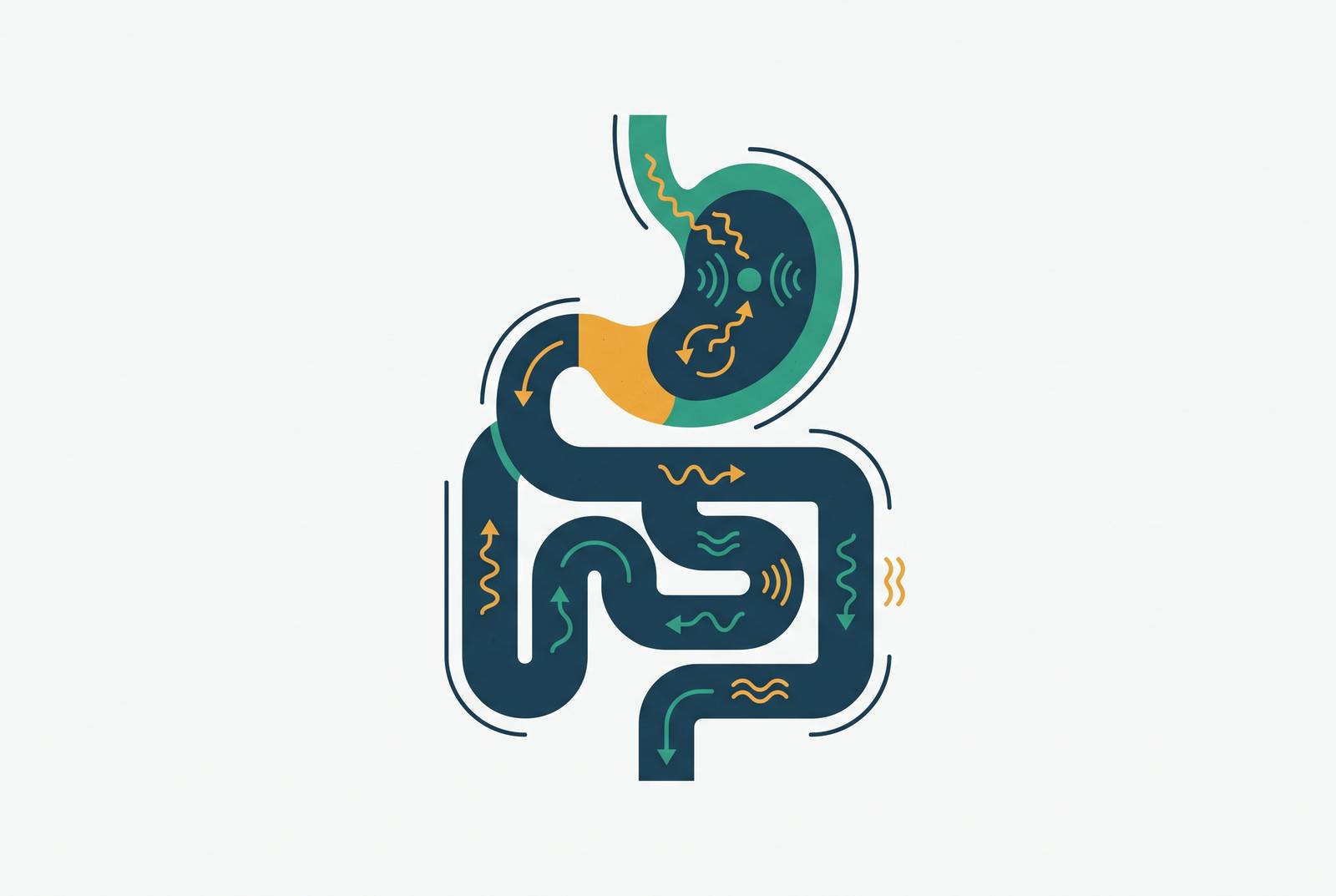
Diarrhea looks, on its face, like it shouldn't happen at all. GLP-1 receptor activation slows gastric emptying, and GLP-1 receptors are also expressed throughout the myenteric and submucosal plexuses, the nerve networks embedded in the gut wall that coordinate peristalsis. Activating those receptors disrupts the coordination of enteric neurons directly, which is part of why transit slows in the first place.
One consequence is disrupted coordination of small bowel contractions, and that disruption throws off the normal progression of gut contents. A wireless motility capsule case series found delayed gastric emptying in 80% of patients tested and delayed whole-gut transit in 44%, with meaningful variation observed across drug cohorts in both gastric and small bowel transit times.
So why the diarrhea, if everything upstream is slowing down? A few mechanisms likely converge, and none of them cancel out the slowdown happening higher in the tract. Colonic effects aren't uniform across the GI tract: drugs with sustained receptor occupancy, meaning long-acting formulations that keep receptors engaged around the clock, may drive increased colonic secretion through sustained receptor activation. Separately, altered small bowel motility changes the colonic environment in ways that may affect transit further downstream, even while the stomach and small intestine are moving slower. And GLP-1 receptor activation directly in the colon may simply behave differently than the same activation upstream.
The 2025 Frontiers in Pharmacology meta-analysis, led by Xie and colleagues, compared GI adverse effects across individual drugs using Bayesian network meta-analysis, but it didn't break results out by duration of action, limiting what can be drawn from it about long-acting versus short-acting drug comparisons specifically. Still, the pattern that does emerge points toward sustained receptor occupancy, not just peak drug concentration, as the likely driver of the colonic effect. Mechanistically, GLP-1 and its analogs appear to suppress postprandial motility through receptors on myenteric neurons, working through cyclic AMP and nitrergic signaling, the same intracellular pathway this drug class leans on across other organ systems.
What comes out of this is a dual mechanism: a direct effect through enteric receptors, and an indirect effect mediated by vagal suppression of gut motor activity. Both likely contribute, and which one dominates probably shifts depending on the specific drug and dose.
Why the tolerability gap between drugs isn't random, pharmacokinetics decides how much receptor exposure the gut gets
Short-acting and long-acting GLP-1 receptor agonists don't just differ in how often patients inject them. They differ in whether enteric neurons and the area postrema get a break between doses or stay switched on continuously, and that distinction shapes the entire GI tolerability profile. Comparing these drugs on efficacy alone, without asking how long the receptor stays lit up, misses half the picture.
Tirzepatide is the clearest example of how messy this gets. It posts the highest nausea and diarrhea risk of any drug in meta-analysis, yet its GIP co-agonism engages area postrema pathways that may partially modulate the nausea signal. Net GI burden ends up being the sum of two receptor systems pulling in opposite directions, not a simple additive stack of GLP-1 receptor activation alone.
Semaglutide's diarrhea numbers tell a related but distinct story. Among single-agonist drugs, it carries the highest diarrhea risk ratio versus placebo, at 1.66 to 1.80. Its long half-life keeps colonic receptors engaged well past what shorter-acting drugs manage, which lines up with the sustained-occupancy explanation for diarrhea described above.
The dose-response curve isn't a straight line either. Risk increases with dose in a pattern that varies by symptom, which means each step up in dose carries a meaningful early GI cost relative to whatever efficacy gain comes with it. And the sex difference noted earlier, women reporting more nausea across every dose group, may trace back to baseline differences in gastric emptying speed, vagal tone, or central receptor sensitivity, though which of these actually drives it hasn't been nailed down.
Taken together, GI tolerability comes out of the interaction between the molecule and the person taking it, not from the molecule alone. It's a function of how long the receptor stays activated, in which tissues, and by what route the drug gets there in the first place.
What the mechanism says about delivery route: not a formulation afterthought, a design choice
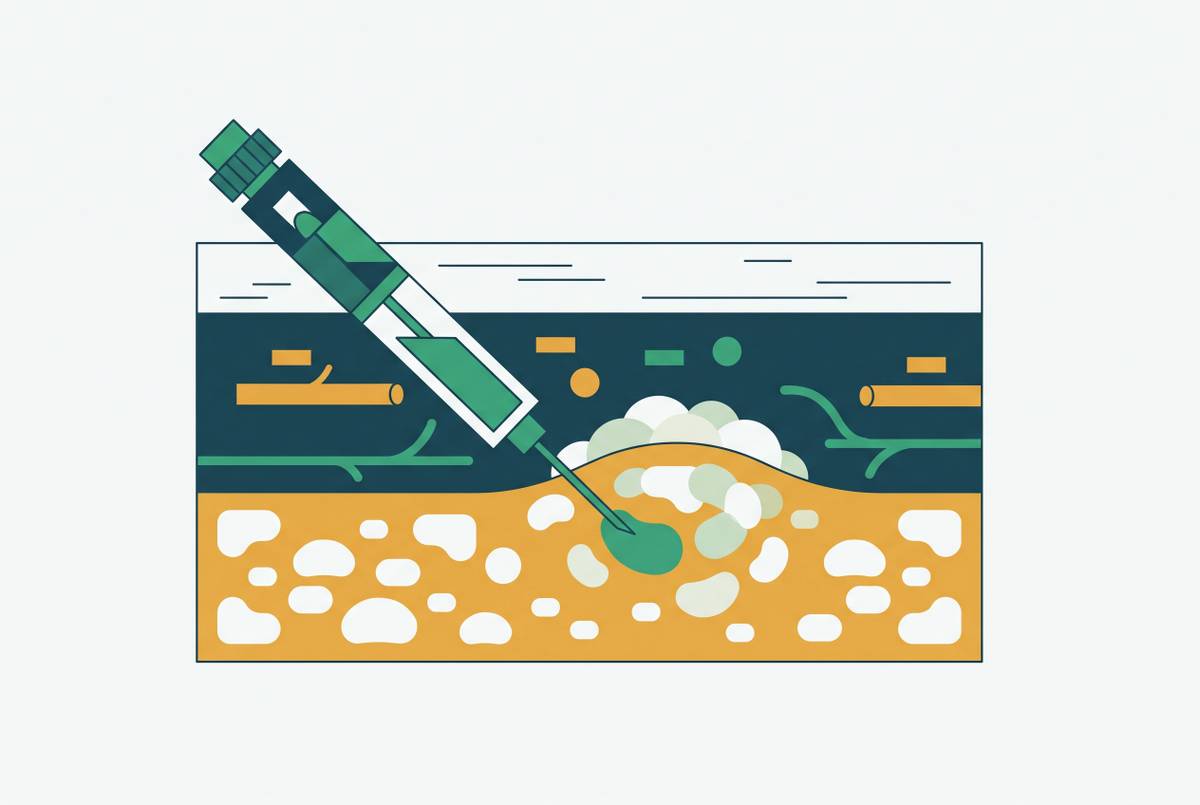
Two anatomically distinct targets stand out from everything above: the area postrema, reachable directly by circulating drug thanks to its porous vasculature, and peripheral GI receptors on enteric neurons and vagal afferents. Injectable dosing hits both at once, by design. Drug enters systemic circulation, saturates peripheral GI receptors, and reaches the area postrema through the bloodstream, switching on both pathways whether or not that's actually necessary for the therapeutic effect being chased. Nobody built injectable dosing to spare the nausea circuit, and the real flaw running through this entire drug class is that for years nobody knew the nausea circuit was separable from the appetite circuit at all.
But what if the therapeutic effect doesn't require lighting up both pathways? The genetic knockout work described earlier found that appetite suppression survives even when the area postrema's GLP1R is deleted. That's a real dissociation, not a hopeful guess, and it means selectively engaging some receptor populations while sparing others is mechanistically plausible, not just an aspiration dressed up as science.
Intranasal delivery is one route under exploration that takes this dissociation seriously. Drug given through the nose can reach central neural circuits, including the hypothalamic networks that govern appetite, by way of the olfactory and trigeminal nerve pathways, without first flooding systemic circulation the way an injection does. Lower systemic exposure would mean less drug reaching peripheral GI receptors, and potentially less area postrema stimulation through the bloodstream route as well, since the drug isn't circulating at the same concentration to begin with.
None of this guarantees that nose-to-brain delivery solves tolerability outright. But the mechanism work reviewed across this piece, the fenestrated vasculature of the area postrema, the separable circuits for nausea and appetite, the dual central and peripheral convergence on the same brainstem relay, all point toward delivery route as something closer to a core design variable than a packaging decision made after the molecule is locked in. Treating the injection as the only serious option, given what the receptor biology now shows, looks less like caution and more like a failure to ask the obvious question. How a drug gets into the body may end up mattering as much as what the drug actually is.
Sources
- Gastrointestinal Adverse Effects of GLP-1 and Dual GLP-1/GIP Receptor Agonists: A Comprehensive Update in Diabetic and Obese Populations
- Frontiers | Comparative gastrointestinal adverse effects of GLP-1 receptor agonists and multi-target analogs in type 2 diabetes: a Bayesian network meta-analysis
- journals.physiology.org
- Systematic Characterisation of GLP‐1R in Human Enteric Nervous System: Implications for GLP‐1 as a Key Regulator of Colonic Activity
- nature.com