Olfactory Pathway Anatomy and Drug Transport Mechanisms
Two nasal pathways to the brain work differently and require distinct drug targeting strategies.
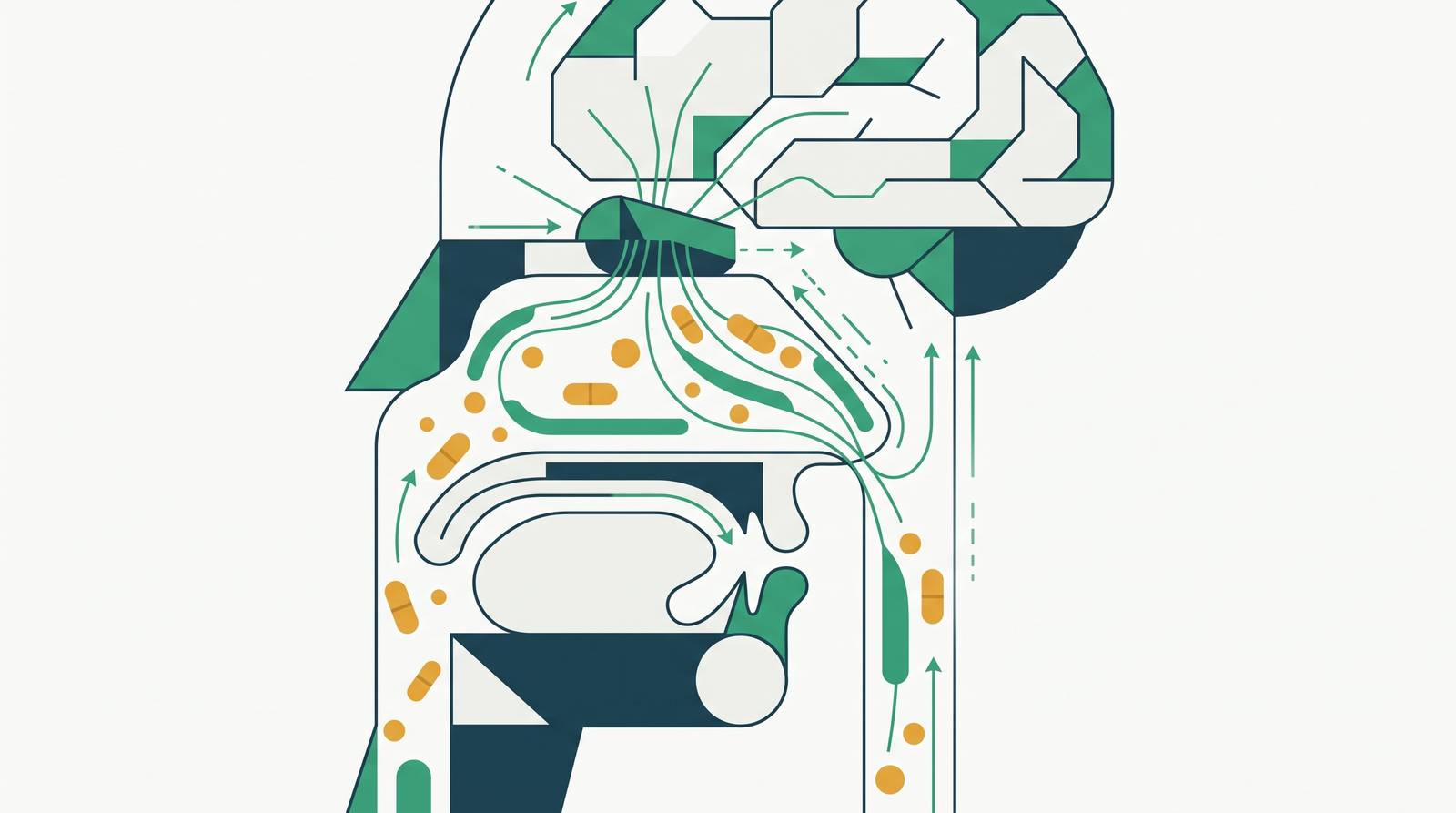
Two anatomically distinct transport routes operate within the nasal cavity, each engaging different nerve populations and depositing material in different brain regions. They are not interchangeable. Treating them as functionally equivalent has been one of the more persistent sources of confusion in nose-to-brain pharmacology, and the confusion carries real consequences: it has shaped study designs, misaligned preclinical targets, and contributed to translational failures that looked mysterious until the anatomy was taken seriously.
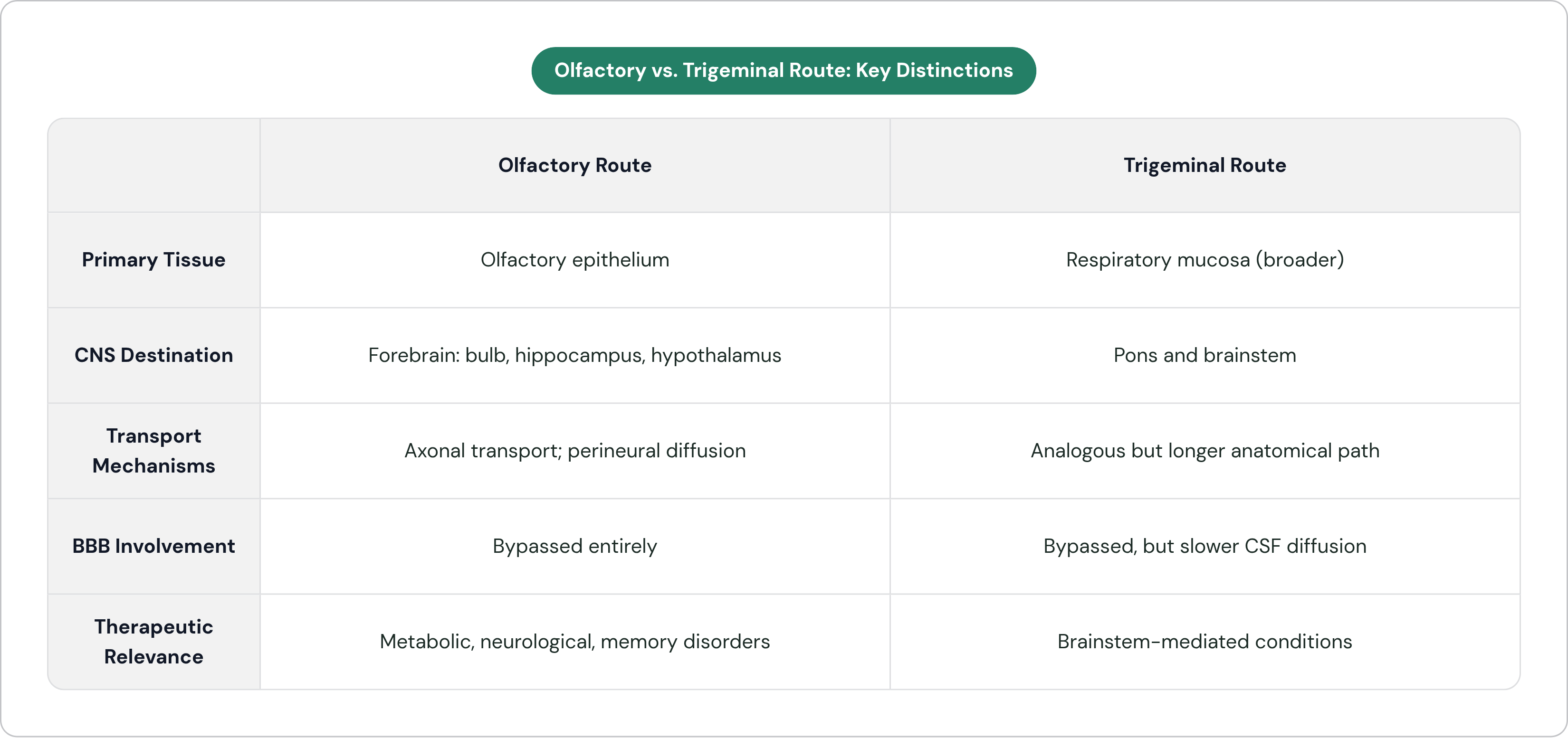
The olfactory nerve route begins at the olfactory epithelium. Drug molecules absorbed at the apical surface of olfactory neurons can enter via pinocytosis, endocytosis, or passive diffusion across the neuronal membrane, then proceed by intracellular axonal transport through the neuron's cytoplasm or by extracellular migration through the perineural space surrounding the bundled axons. Both mechanisms cross the cribriform plate and deposit material in the olfactory bulb, with distribution extending into the olfactory cortex, hippocampus, hypothalamus, and interconnected forebrain structures.
The trigeminal route is anatomically broader. Trigeminal branches innervate the nasal mucosa across a substantially larger surface area than the olfactory epithelium occupies alone, reaching the respiratory mucosa that lines most of the nasal cavity. Transport mechanisms are analogous, but the destination diverges: trigeminal fibers track toward the pons and brainstem rather than the forebrain. The greater anatomical distance from nasal epithelium to key CNS targets means diffusion into cerebrospinal fluid proceeds more slowly via this route.
What follows from this divergence is that regional CNS targeting is, to some degree, a designable parameter. A formulation that concentrates deposition in the olfactory epithelium engages the forebrain-directed pathway; one distributed more broadly across the nasal mucosa recruits trigeminal coverage of brainstem structures. These routes are complementary, not competitive, and many formulations engage both simultaneously. The olfactory route has attracted more mechanistic scrutiny partly because its CNS destination overlaps with brain regions most relevant to metabolic and neurological disease, and partly because the cribriform plate crossing is a more tractable object of study than the diffuse trigeminal arbor.
Why This Route Bypasses the Barriers That Defeat Every Other Non-Invasive Delivery Approach
The blood-brain barrier is the central constraint in CNS pharmacology. Tight junctions between brain endothelial cells exclude the vast majority of circulating molecules, particularly large, hydrophilic, or charged ones. Peptide and biologic drugs tend to satisfy all three of those exclusionary criteria simultaneously. Oral administration compounds the problem: proteolytic enzymes in the gastrointestinal tract degrade most peptides before absorption, and whatever survives encounters hepatic first-pass metabolism before reaching systemic circulation. Intravenous administration bypasses those losses but deposits the drug on the wrong side of the barrier more efficiently, not actually across it.
The olfactory pathway circumvents the BBB not by overcoming it but by never encountering it. Olfactory neuron axons are continuous with the CNS; material transported along them arrives in brain tissue without ever crossing brain endothelium. The perineural extracellular space provides a second BBB-independent conduit, allowing material moving through the space surrounding the fila olfactoria to enter the subarachnoid cerebrospinal fluid and diffuse from there into brain parenchyma.
Speed distinguishes this route further. Brain exposure can occur within minutes of intranasal administration, a pharmacokinetic profile no other non-invasive route approaches. Intranasal delivery also generates lower systemic drug concentrations than intravenous administration, which reduces off-target effects. That matters specifically when a drug acts on CNS receptors also expressed in peripheral tissues, as is the case with GLP-1.
For peptide therapeutics, the structural logic is difficult to argue with. A molecule that cannot survive oral administration, cannot cross the BBB via systemic circulation, and generates peripheral side-effect burdens when injected is facing an anatomical problem. The olfactory route addresses that problem at its source rather than papering over it with formulation adjustments. Whether it does so reliably enough in humans to be clinically actionable is a separate question, and a considerably harder one.
The Anatomical Constraints That Make Delivery Harder Than the Pathway Map Suggests
The pathway map is accurate. It is also incomplete in ways that cost the field years of misdirected confidence, particularly in translation from rodent to human.
Surface area is the foundational constraint. The olfactory epithelium occupies a small fraction of the total human nasal mucosa; respiratory epithelium dominates by a wide margin. In rodents, the ratio is essentially reversed. The drug that saturates the rodent olfactory epithelium is, in a human subject, largely deposited on respiratory mucosa, routed into systemic circulation rather than toward the CNS. This species difference is not a technical footnote. It explains why compelling preclinical rodent data cannot be projected onto human performance without human-specific validation, and the field has not always been forthcoming about that distinction. The resulting translational attrition was, in retrospect, foreseeable.
Mucociliary clearance is the primary mechanism of residence-time loss. The mucus layer turns over roughly every ten to twenty minutes, continuously sweeping deposited material toward the nasopharynx. A drug that cannot be absorbed within that window is effectively swallowed. Volume capacity imposes a parallel constraint: the nostril accommodates only a limited instilled volume per dose, capping total drug mass delivered and forcing reliance on highly concentrated formulations.
The enzymatic environment of the nasal mucosa complicates peptide delivery from a different direction. Peptidases and proteases present in nasal secretions can degrade peptide drugs before they reach olfactory neurons, mirroring the GI degradation problem the intranasal route was meant to circumvent, albeit with different enzymes and different kinetics. Repeated administration introduces a distinct risk: the olfactory epithelium is damageable, and chronic irritation or poorly designed formulations can impair the very neurons the delivery strategy depends on. Long-term mucosal safety data for intranasal nanoparticle formulations remain thin relative to the scale of clinical ambition surrounding the route.
Taken together, these constraints define the engineering specification rather than negate the route. A viable intranasal peptide formulation must extend residence time, protect the drug from enzymatic degradation, achieve membrane interaction sufficient for neuronal uptake, and accomplish all of that within the volume limits of a nasal dose. Most programs have stalled somewhere in that list. The gap between a compelling mechanistic story and a formulation that actually works in humans is not small, and the anatomical map does nothing to close it.
How Nanoparticle Carriers Are Engineered to Work with Olfactory Anatomy Rather Than Around It
The design problem is precise: deliver a large, enzymatically vulnerable peptide across the olfactory mucosal barrier and into olfactory neurons before ciliary clearance removes the formulation. General-purpose drug delivery strategies weren't built around the olfactory epithelium's specific biology and so fall short here. What the field has learned, sometimes slowly, is that the engineering has to be anatomy-first.
Nanoparticle encapsulation addresses enzymatic degradation directly. Physical enclosure within a polymer or lipid shell protects the peptide payload from luminal peptidases, extending the window during which intact drug is available for absorption. Size matters here as a functional parameter: particles in the nanoscale range are compatible with the endocytic and pinocytic uptake mechanisms that olfactory neurons already use to internalize environmental materials.
Surface engineering is where anatomy-specific design becomes most consequential. Mucoadhesive polymer coatings interact with mucin glycoproteins in the nasal mucus layer, anchoring the particle to the epithelial surface and extending residence time against ciliary clearance. Polyethylene glycol surface modification improves colloidal stability and reduces nonspecific binding to mucosal components that would trap particles before they reach olfactory epithelial cells. Cell-penetrating peptide modifications promote active uptake into those cells, increasing intracellular transport efficiency beyond what passive diffusion or endocytosis alone provides.
Lipid-based carriers, including liposomes and lipid nanoparticles, offer membrane-compatible surface chemistry that facilitates fusion with or uptake by epithelial cells, and their track record in preclinical olfactory-route CNS delivery is well-established. Polymeric nanoparticles offer tunable degradation kinetics: modulating polymer composition and molecular weight controls the rate at which the particle releases its payload at the epithelial surface, spreading absorption over a longer window than a bolus deposit permits. In situ gelling systems address the residence-time problem at the formulation level, delivered as low-viscosity liquids but gelling on contact with physiological conditions at the mucosa.
The common thread across these approaches is engaging olfactory epithelial biology directly, neutralizing the clearance and degradation forces that defeat unformulated peptide administration.
Where in the Brain the Olfactory Pathway Delivers, and Why the Destination Matters for GLP-1 and Neurological Applications
The olfactory bulb is the first intracranial structure, not the pharmacological target. Its relevance is as a distribution node. From the bulb, transport extends into the olfactory cortex, cerebral cortex, hippocampus, hypothalamus, and interconnected forebrain structures. That network maps, with unusual specificity, onto the brain regions where some of the most consequential unmet therapeutic needs are concentrated. Whether that alignment represents genuine opportunity or a seductive coincidence deserves scrutiny before anyone builds too much weight on it.
Consider appetite regulation. The hypothalamus is the primary CNS site for energy homeostasis and lies downstream of the olfactory bulb in the forebrain circuit the olfactory pathway reaches. GLP-1 receptors are expressed throughout the CNS, including in hypothalamic nuclei governing satiety and feeding behavior. Peripheral injection of GLP-1 peptides reaches those central receptor populations indirectly and incompletely, constrained by the BBB. Intranasal delivery offers a route that deposits drug in the forebrain without that barrier intervening, which could engage central GLP-1 receptor populations that peripheral administration cannot access with equivalent concentration. The evidence supporting this in humans remains sparse, and the pharmacokinetic data needed to confirm that central deposition is occurring at therapeutically meaningful concentrations are still limited.
The hippocampus, downstream of olfactory bulb projections, is central to memory consolidation and spatial cognition. Its vulnerability in Alzheimer's disease makes it a logical target for neurodegeneration-focused intranasal programs. The limbic system, governing reward processing and addiction circuitry, is also anatomically downstream of the olfactory bulb; the route may offer CNS specificity for addiction-relevant structures that systemic administration cannot replicate without proportionate peripheral exposure. The trigeminal route's reach into brainstem structures extends coverage to indications where brainstem-mediated symptomatology is primary.
The anatomy and the unmet need do align here in a way that has no equivalent in any other non-invasive delivery approach. That alignment is real. It has also lured programs into overconfidence before, and the history is worth keeping in view.
What the Anatomy Still Cannot Tell Us, and Where the Science Needs to Go
The olfactory pathway is well-characterized at the level of gross and cellular anatomy. The pharmacokinetics of drug transport along it in humans are not. How much a given molecule or nanocarrier actually uses intracellular axonal transport versus extracellular perineural diffusion, and which route governs CNS delivery for a particular formulation, cannot be read off anatomical maps. It requires formulation-specific, species-appropriate experimental data that, for most programs, does not yet exist with the rigor the question demands.
The human-rodent gap in olfactory surface area is the central translational problem the field must confront more directly. Preclinical models in rodents have generated a substantial body of encouraging mechanistic and efficacy data. The structural divergence between rodent and human nasal anatomy means that data establishes proof of concept, not proof of translation. Human-specific validation is an essential scientific step, not a regulatory formality; its absence explains much of the attrition that nose-to-brain programs have experienced.
Mucosal safety under chronic dosing remains understudied relative to its importance. For any indication requiring long-term or repeated administration, the olfactory epithelium's tolerance for sustained nanoparticle exposure is a biological prerequisite for the delivery platform to remain functional over a treatment course. Acute delivery mechanisms have received far more systematic investigation than the chronic safety question they ultimately depend on. That imbalance is partly practical, partly a product of incentive structures that reward efficacy demonstrations over durability data, and it will need correcting.
The design space itself remains genuinely open. A 2025 paper in Cell described intranasal delivery of appetite-regulating hormones via engineered Lactobacillus plantarum in mouse models, demonstrating that the field continues generating mechanistically distinct approaches rather than converging on a single solution. The olfactory pathway's anatomy is fixed. The strategies for exploiting it are not, and there is no reason to believe the current generation of nanoparticle approaches represents the endpoint of that development.
What separates programs most likely to close the gap between anatomical blueprint and reliable human therapeutics is not early recognition of the pathway. Nearly everyone in the field recognizes it. The differentiator is sustained, unglamorous engagement with the specific engineering constraints the pathway imposes: the residence-time problem, the species-translation problem, the chronic safety problem. These are not solved by a compelling anatomical story. They are solved by formulation work, by appropriately designed human studies, and by a willingness to treat the rodent data as a starting point rather than a conclusion, which is the engineering gap Lionbio, a nasal-spray nanoparticle peptide startup, is building toward with its GLP-1 program.