GLP-1 Receptors and Dopamine Pathways in Addiction
The brain's reward circuitry uses GLP-1 to dampen dopamine surges from drugs and alcohol.
GLP-1 is the metabolic hormone behind drugs that slow gastric emptying, boost insulin, and blunt appetite. It also sits inside the brain's reward circuitry, and switching it on there changes how that circuitry reacts to drugs, alcohol, and other compulsive behaviors. This piece walks through why: where the receptors sit, what happens to dopamine when they fire, what the trials actually show so far, and a question nobody in this field has nailed down, which is whether it matters how the drug physically gets into the brain in the first place.
Start with the peptide itself. GLP-1, short for glucagon-like peptide-1, is a 30 to 31 amino acid fragment cut from a larger precursor called proglucagon, and it comes from the gut, sure, but also from a small cluster of neurons in the brainstem called the nucleus tractus solitarius, and that second source matters more than you'd guess. Endogenous GLP-1 has a plasma half-life under two minutes; the enzyme DPP-4 chews through it almost as fast as it's released, so whatever GLP-1 does in the body, it's running a fast, local signal rather than some slow systemic drift. A peptide that has to act near where it's made looks a lot more like a neurotransmitter on a short leash than a hormone cruising the bloodstream.
That short half-life is also why synthetic versions exist at all. Exenatide, approved by the FDA in 2005, was the first GLP-1 receptor agonist to reach patients, and it came from a strange place: exendin-4, a peptide pulled from the saliva of the Gila monster, a desert lizard whose venom happens to hit the same receptor with far more staying power than the human original has. Nature had tipped its hand, decades before pharmacology caught up, that this receptor system did more than manage blood sugar. Most people know the metabolic story by now: insulin potentiation, gastric slowing, satiety. The neurobiological story is newer, messier, and it's the one worth spending real time on.
Where GLP-1 receptors live in the brain's reward architecture
Three regions do the heavy lifting, and each has a distinct job. The ventral tegmental area (VTA) is where dopamine neurons originate before projecting out to the rest of the brain, and the nucleus accumbens (NAc) is where a lot of that dopamine lands, encoding how salient or motivating something feels, whether that something is a drug, a meal, or a person walking into a room. The prefrontal cortex (PFC) sits above both, running the executive judgment that's supposed to override impulse, and which, as addiction research shows again and again, gets overridden instead.
GLP-1 receptors show up in all three regions. The same receptor system that slows digestion after a meal is wired directly into the circuitry that processes food, drugs, sex, and social reward, which happens to be exactly the territory addiction researchers spend entire careers mapping.
Stack that against what's already on pharmacy shelves. Naltrexone blocks opioid receptors outright, while bupropion messes with dopamine and norepinephrine reuptake, and both intervene downstream, at the point where reward signaling has already fired, and both do it bluntly. GLP-1 receptor agonists sit upstream, adjusting the dopamine system instead of blocking it after the fact. Does that upstream position actually produce cleaner outcomes? Fewer side effects, less of that flattened, nothing-feels-good affect patients report on older drugs? Nobody's settled that in the clinic. Still, the position itself, sitting upstream and tuning rather than cutting, is what separates GLP-1 from what came before it.
How GLP-1 receptor activation damps dopamine release and reward-seeking
What happens, mechanically, when a GLP-1 receptor in the NAc fires? The dopamine surge that follows a hit of cocaine, or a drink, or a plate of something engineered to be irresistible, gets smaller. A 2024 study in Addiction found that GLP-1 receptor agonists reduced cocaine-induced dopamine increases in the nucleus accumbens in preclinical models. That's a pharmacological readout, measured directly, not a behavioral proxy standing in for one.
Optogenetic work sharpens the causal case further. Stimulate GLP-1 receptors directly and drug-taking drops; knock the receptor out entirely and the opposite happens, with mice lacking functional GLP-1R consuming larger doses of multiple substances than their wild-type littermates do. Take the receptor away, and you've removed a brake that was doing real work the whole time.
A 2025 study by Kooij and colleagues, published in PMC, adds a wrinkle that matters for treatment timing. Semaglutide altered dopamine signaling in the VTA during both the anticipatory phase of reward, the wanting, and the consummatory phase, the having, in mice. Most addiction treatment targets the having: the binge, the relapse, the moment of use. If GLP-1 also acts on the wanting, on the craving state before any substance even enters the picture, that's a mechanistically different kind of intervention, one that might dampen the pull toward using in the first place instead of just shrinking the payoff once use has already happened.
GLP-1 receptor activation looks like it recalibrates the gain on reward rather than shutting it off outright. Compare that to a full dopamine antagonist, which tends to flatten affect across the board; the common patient complaint there is that nothing feels good anymore, not the drug, not dinner, not much of anything. Whether that gentler profile holds up under larger trials is still open, and it's a consequential question, because it's the difference between a treatment patients stay on and one they quietly stop filling.
One question hangs over all of it, and it's worth sitting with before we get to the trial data. Does the anti-addiction effect require the drug to reach central GLP-1 receptors directly, or does peripheral signaling, working through the vagus nerve and gut receptors, do meaningful work on its own? Nobody has a clean answer yet, and that answer will end up deciding a lot about where this field goes next.
What the clinical trial landscape reveals about GLP-1s across addiction types
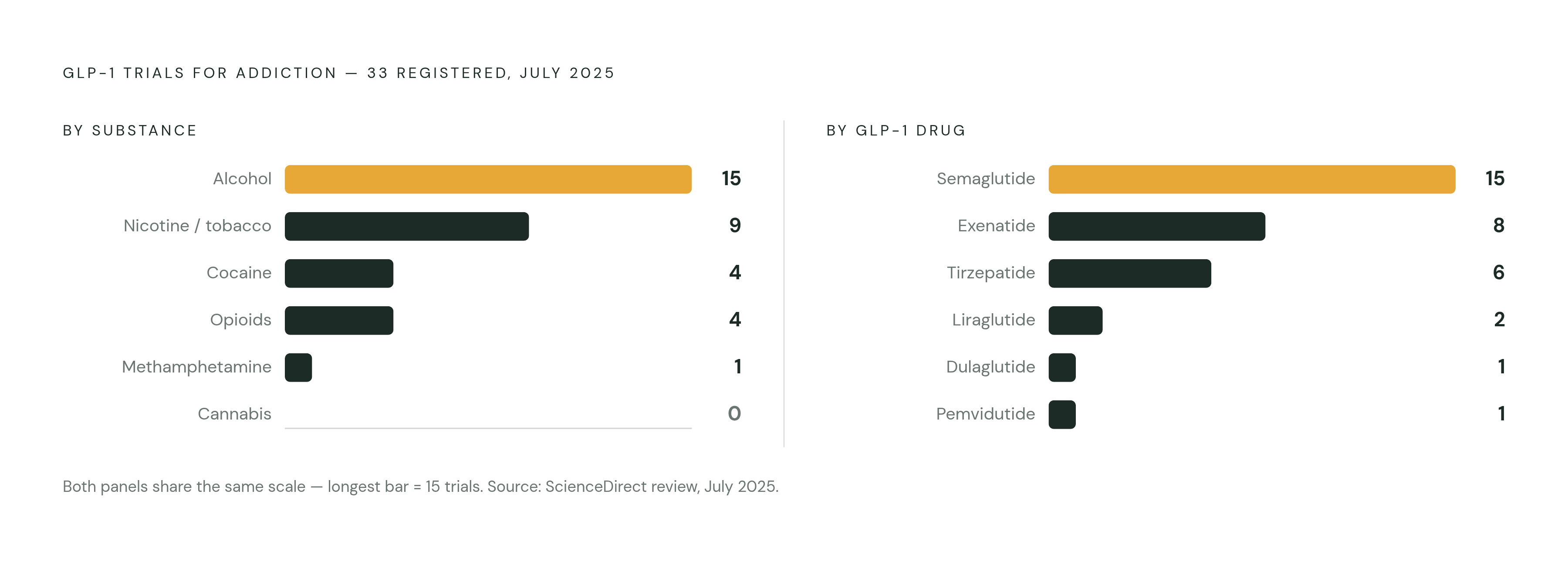
The trial registry tells its own story. As of July 2025, a review published in ScienceDirect, slated for 2026, identified 33 registered trials on ClinicalTrials.gov meeting criteria for GLP-1 and addiction research, in a field that barely existed five years earlier.
Alcohol use disorder leads with 15 trials, easily the most advanced front. Nicotine and tobacco follow with 9, cocaine and opioid use disorder sit at 4 each, methamphetamine has 1, and cannabis has none yet. By drug, semaglutide dominates with 15 trials, exenatide follows with 8, tirzepatide with 6, liraglutide with 2, and dulaglutide and pemvidutide each have 1.
Alcohol has the strongest human data, so it's worth looking closely at what's actually been shown rather than what's been implied. A placebo-controlled trial led by Hendershot and colleagues in 2025, enrolling 51 people with alcohol use disorder on weekly semaglutide, reported effect sizes on alcohol consumption larger than those historically tied to naltrexone or acamprosate, the current standard-of-care comparators. That's striking, but nobody's run a head-to-head trial against those drugs, so the comparison is across studies rather than within one, and that gap matters more than people tend to give it credit for.
A separate exenatide trial found no significant overall drop in heavy drinking days. Buried in the subgroup data, though, was something more interesting: participants with a BMI above 30 showed significant reductions, alongside a measured drop in alcohol cue reactivity in the ventral striatum, a direct reward-circuit readout rather than a self-reported behavior change. So which is it? Is the anti-addiction effect partly metabolic, tied to insulin sensitivity or energy balance, and only partly central, or is it entirely central, with BMI just marking who happens to respond well? Nobody's isolated that variable yet, and it might take a few more trial cycles before anyone can.
Opioid and cocaine research trails behind, running mostly through animal models still, but the direction matches the mechanism above: GLP-1 receptor agonists reduce self-administration of heroin, fentanyl, oxycodone, and cocaine in preclinical studies, and they cut relapse-like behavior after periods of abstinence. Nicotine trial activity runs surprisingly high relative to what's published so far, which suggests researchers expect an effect the data hasn't caught up to yet.
Here's the honest limitation. Most of the positive signal comes from preclinical work or small human trials, and the field is promising without being proven at scale, and those are different claims. Blurring them together doesn't help anyone, least of all patients waiting on an answer.
Why peripheral GLP-1 delivery leaves the brain's reward circuitry partially bypassed
Nearly every GLP-1 drug on the market gets delivered the same way: subcutaneous injection. The injectable segment held 83% of the GLP-1 drug market in 2025, according to Toward Healthcare. That makes sense from a manufacturing and regulatory angle, though from a neurobiological angle, it's a real problem.
The blood-brain barrier is a selective filter, and it's not especially welcoming to large peptides. GLP-1 analogs, given their size, cross it inefficiently at best, and most of an injected dose goes to work peripherally, on the gut, the pancreas, the vagus nerve, before any meaningful amount reaches the VTA, the NAc, or the PFC. Peripheral receptor activation can drive indirect central effects through the vagus nerve, and that pathway probably accounts for part of what's showing up in the alcohol and cocaine trials. Still, if the addiction mechanism runs mostly through direct mesolimbic engagement, which is what the optogenetic and dopamine-imaging data point toward, an injection may simply struggle to get enough drug to where the target actually sits.
The nausea numbers underline this almost too literally. Somewhere between 40% and 70% of patients on GLP-1 drugs develop gastrointestinal side effects, and nausea was the single most common reason for stopping treatment, cited in 28.2% of cases according to 2025 real-world data from Truveta and ISPOR. That's a peripheral side effect showing up precisely because systemic GLP-1 exposure runs high enough to hit the gut and the brainstem's nausea centers before the drug does much of anything useful in the mesolimbic system. So the side effect burden and the therapeutic target end up pulling in opposite directions: plenty of peripheral exposure to cause nausea, not necessarily enough central exposure to fully engage the reward circuitry.
That tension shows up again in retention numbers. Prime Therapeutics data from 2024 put it bluntly: 85% of patients were no longer taking their GLP-1 medication two years after starting. For weight management, that's a business problem. For addiction treatment, dropout carries a heavier cost, because relapse risk comes right back online, and a patient who quits an anti-craving medication over nausea hasn't just stopped taking a pill; they've potentially walked straight back into the reward-seeking pattern the drug was supposed to interrupt.
The nose-to-brain route as a more direct path to mesolimbic GLP-1 receptors
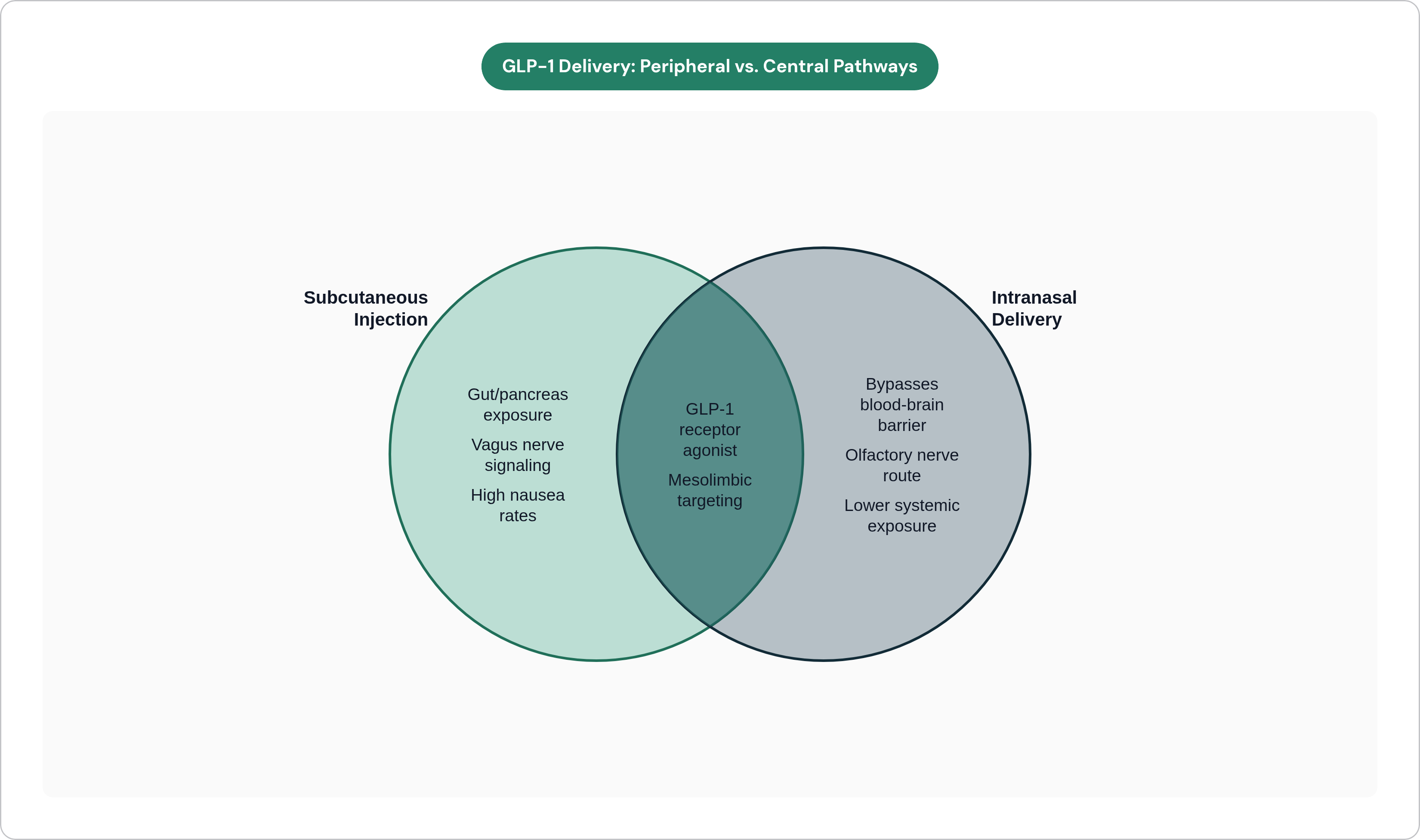
If the blood-brain barrier is the obstacle, and injections route the drug through the entire body before any of it reaches the brain, intranasal delivery deserves a serious look. The olfactory and trigeminal nerve pathways offer a route from the nasal epithelium straight into the central nervous system, skipping both the blood-brain barrier and systemic circulation entirely. It's a structurally different way of getting a molecule where it needs to go, not just a faster version of the same trip.
For GLP-1 peptides aimed at addiction circuitry, the appeal is straightforward: drug reaches the VTA, NAc, and PFC with less peripheral exposure picked up along the way. In principle, that means a higher ratio of CNS concentration to plasma concentration, and less systemic drug drifting through the gut to trigger nausea.
Except naked GLP-1 peptide doesn't survive that trip well on its own. Enzymes in the nasal mucosa degrade it, and it's too hydrophilic by itself to cross mucosal membranes with any real efficiency, so spraying peptide up someone's nose, by itself, doesn't get it to show up intact in the VTA.
Nanoparticle encapsulation is the engineering piece that closes that gap. Nanoparticles can shield the peptide cargo from degradation in the nasal mucosa, and their surface chemistry can be tuned to encourage uptake along the olfactory pathway into the brain. Lionbio works in exactly this territory, building on more than 30 years of patented nanoparticle delivery IP developed at Columbia University, aimed at getting peptides across the nose-to-brain route intact. It's a narrow, unglamorous engineering problem: keep a fragile molecule from falling apart long enough to get it where it needs to go, and it's the kind of problem that decides whether a promising mechanism ever becomes a usable drug, or just stays a finding in a journal somewhere nobody outside the field reads.
If the route works as intended, it does two things at once. It engages mesolimbic targets more directly, sharpening whatever addiction-relevant effect is there, and it cuts the systemic exposure responsible for nausea and dropout. Delivery stops being a footnote buried in the pharmacokinetics section and becomes central to the outcome itself. GLP-1's neurobiological promise for addiction treatment might end up depending less on finding a better molecule, and more on finding a better way to deliver the one we already have.
What remains unresolved and why it shapes the field's next decade
The open question is easy to state and hard to answer: how much of GLP-1's anti-addiction effect comes from central receptor engagement, and how much from peripheral, vagally-mediated signaling? Everything downstream, including how much the delivery route actually matters, hangs on that answer. If peripheral signaling does most of the work, injections may be perfectly fine as they are, and the nose-to-brain argument loses some of its force. Should central engagement carry the load instead, delivery becomes the whole ballgame.
That BMI-dependent finding from the exenatide alcohol trial keeps pulling at this question, and it won't quite let go. It suggests metabolic status might be doing part of the work, independent of or alongside direct CNS action. If that holds up under further study, treating addiction with GLP-1 might need to account for a patient's metabolic profile when predicting who responds, rather than treating this purely as a neurological intervention. Personalization here isn't some distant idea reserved for a future paper; it's already sitting in the data, waiting for someone to deal with it.
Beyond alcohol, human trials across every other substance category are still early. Preclinical results in opioids and cocaine are consistent and encouraging, though consistent preclinical signal has a well-known habit of not surviving contact with large, powered, replicated human trials, and addiction researchers know this better than most. Addiction itself is heterogeneous enough that trial design has to account for responder subgroups, high-BMI patients, specific dopamine-related genetic profiles, rather than treating the disorder as one uniform target waiting for one uniform drug.
For intranasal delivery, the pharmacokinetics of nose-to-brain transport in humans are still being mapped, not settled. CNS bioavailability data for GLP-1 peptides delivered this way are emerging, not established, so the promise laid out above is real, though it hasn't cleared the bar regulators will eventually set.
Even with all that left open, one thing is fairly clear: GLP-1 is the first drug class in decades to offer anything like a bridge between metabolic and neurological treatment for addiction. Receptor biology alone won't hold that bridge up. It needs the delivery engineering solved alongside it, not bolted on after the pharmacology gets settled first. Whoever leads this field a decade from now probably won't be whoever finds a marginally better peptide; it'll be whoever answers the delivery question cleanly enough to finally pull the central mechanism apart from the peripheral one.