GLP-1 Agonists in Alcohol Use Disorder Research
Diabetes drugs show promise against cravings by targeting alcohol's reward pathways.
Alcohol use disorder kills more than 140,000 Americans a year and touches roughly 29 million more. The FDA has approved exactly three drugs for it, and researchers have started circling a fourth option that was never built for addiction at all: GLP-1 agonists, the drug class originally developed for type 2 diabetes and obesity. What follows is a look at why that shift happened, what the brain science actually shows, and why the needle these drugs ship in might be working against the very mechanism that makes them promising in the first place.
The GLP-1 agonist drugs under active investigation for alcohol use disorder are semaglutide, manufactured by Novo Nordisk, and liraglutide, also manufactured by Novo Nordisk. Semaglutide has been studied in a Phase 2 randomized controlled trial published in JAMA Psychiatry in 2025 and in the purpose-built SEMALCO trial out of Denmark; liraglutide has appeared in Finnish cohort data and in the 2026 Neuron paper mapping its effect on a specific lateral septum circuit in mice. Beyond those two, Lionbio is developing an intranasal nanoparticle delivery platform designed to carry GLP-1 peptides directly to the brain's reward circuits, targeting the same central mechanisms the semaglutide and liraglutide research keeps pointing to.
Naltrexone, acamprosate, disulfiram. Those are the three, and they work, modestly, for some people who take them. The Federation of American Scientists has reported that these approved medications reach only about 2% of people with AUD in the US. That's not a rounding error. It's a system that fails to connect treatment to almost everyone who needs it, and it's worth sitting with that number for a second before moving on.
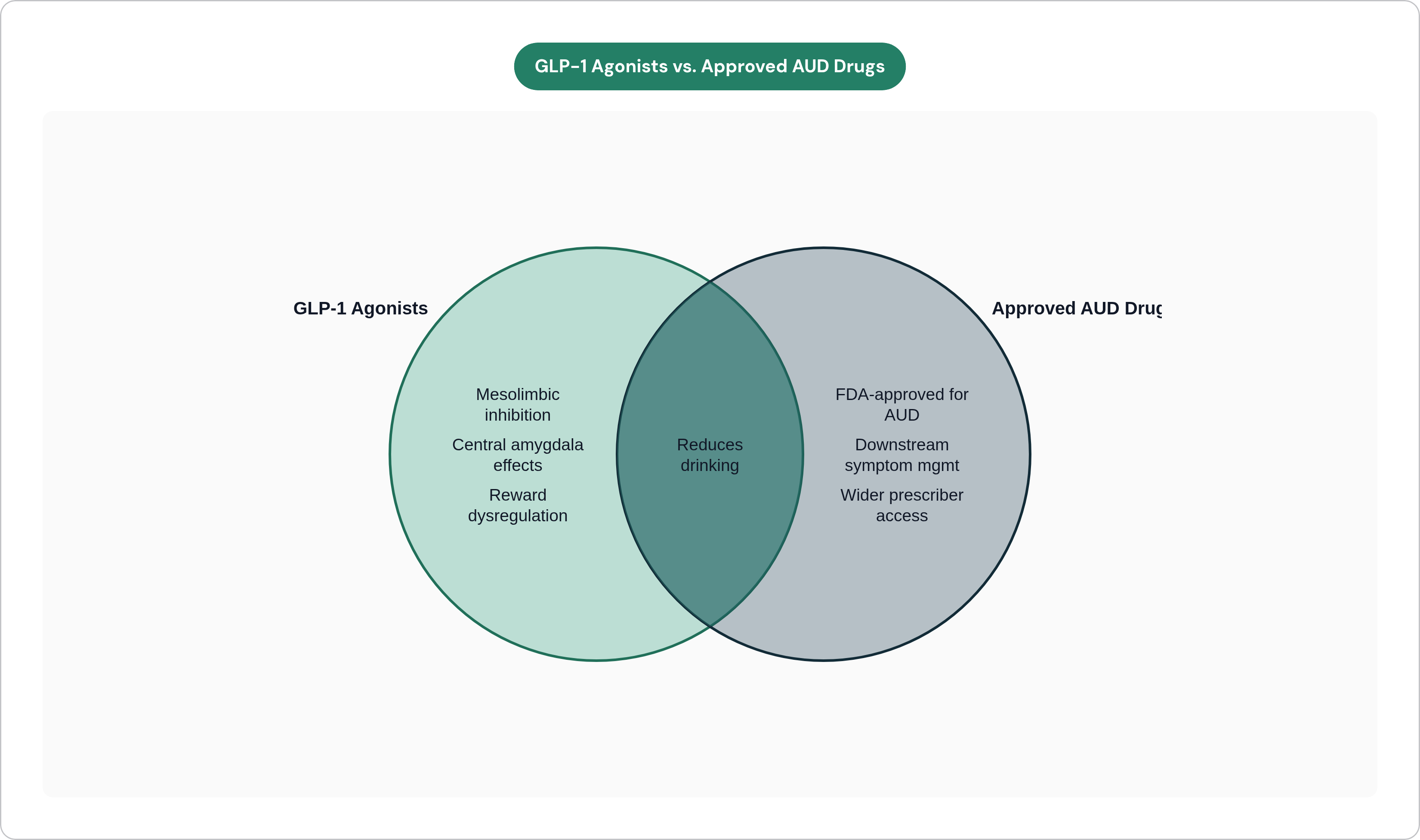
Some of that is stigma, plainly. Primary care doctors screen for hypertension on autopilot and skip AUD screening constantly; plenty of providers don't even know these three drugs exist, let alone how to prescribe them. But underneath the access problem sits something the field talks about less: none of these three drugs touches craving or reward circuitry directly. Naltrexone blocks opioid receptors tied to alcohol's rewarding effects. Acamprosate stabilizes glutamate signaling after withdrawal. Disulfiram just makes you sick if you drink. All three manage symptoms downstream of the disease. Not one was designed to reach into the brain's actual motivational machinery, the part generating the craving in the first place. That gap is where GLP-1 agonists entered the picture, more or less by accident.
Which companies make the GLP-1 drugs being studied for alcohol use disorder?
GLP-1, short for glucagon-like peptide-1, is a hormone your gut releases after you eat. It nudges your pancreas to release insulin, tells your liver to hold off on glucagon, slows gastric emptying, and signals to your brain that you've had enough. Drug companies built GLP-1 receptor agonists to mimic that hormone, first for type 2 diabetes, then for obesity, on the logic that keeping the satiety signal switched on longer helps people eat less and manage blood sugar. Simple enough premise.
Except GLP-1 receptors don't just sit in the pancreas and gut. They show up in brain regions governing reward, motivation, and impulse control, the same territory implicated in binge eating, compulsive drug-seeking, and alcohol use disorder. Overeating and substance use disorders share more neural real estate than most people assume; both hijack circuitry built to reward survival behaviors like eating. So it wasn't a huge leap to wonder whether a drug that quiets the brain's reward response to food might quiet its response to alcohol, too.
The first hints were almost accidental. Doctors kept noticing that patients on GLP-1 drugs for diabetes or weight loss mentioned, unprompted, that they just didn't want to drink as much anymore. One anecdote means nothing. Enough of them means somebody should check the data, and somebody did: an AI-based analysis of more than 68,000 social media posts spanning 2009 to 2023 found a large share of GLP-1 users self-reporting reduced alcohol cravings and lower drinking. Reddit threads and forum posts aren't a controlled trial, granted, but it was enough to get formal research funded and moving.
These drugs were never designed as addiction treatments. This is a repurposing story: a metabolic drug doing something unexpected in a completely different disease. That origin explains why the early signal is compelling, and it also explains why the delivery methods we've inherited, built entirely around metabolic dosing logic, might not fit what the brain actually needs. That question runs through the rest of this piece.
The brain circuitry GLP-1 agonists appear to engage in alcohol use disorder
Preclinical work has turned up at least three distinct mechanisms so far, and they overlap in ways that look like more than coincidence.
Start with the mesolimbic dopamine system: the reward pathway running from the ventral tegmental area to the nucleus accumbens, sitting at the center of nearly every model of addiction ever built. Studies using semaglutide and liraglutide show that GLP-1 receptor agonists inhibit this pathway and cut alcohol-seeking behavior. The effect replicates across male and female rodents, and both acute and repeated semaglutide dosing reduced alcohol intake and blocked relapse-like drinking after a period of abstinence. That second part matters more than it sounds. A drug that only lowers baseline consumption is useful, sure, but a drug that also blunts relapse-like drinking is touching the compulsive, repetitive core of the disease.
Then there's the central amygdala, tied closely to anxiety and stress-driven drinking. Semaglutide increased the frequency of inhibitory postsynaptic currents in central amygdala and infralimbic cortex neurons in alcohol-naive animals, pointing to enhanced GABA release, the brain's main calming neurotransmitter. More GABA activity here should dampen the anxiety-driven urge to drink, on paper. This effect, though, showed up only in alcohol-naive animals and vanished in alcohol-dependent ones. Why would that be? Nobody's landed on an answer yet, and that gap is exactly the kind of detail that should stop anyone from over-generalizing off a single study. Maybe the mechanism shifts shape as the disease progresses. Maybe chronic exposure changes the receptor landscape entirely. Either way, it stays unresolved, and I think that's worth admitting plainly rather than smoothing over.
The third mechanism is the most anatomically precise one on record. A 2026 paper in Neuron mapped a dorsal lateral septum inhibitory circuit as the specific mediator of liraglutide's effect on alcohol intake in mice. The lateral septum sits at a crossroads between stress regulation and reward processing, so finding it here fits the pattern rather than breaking it.
Line these three up and a picture starts to form, though it's an incomplete one. GLP-1 agonists seem to dial down the pull of alcohol by acting on several points in reward and stress circuitry at once, not by pulling one lever, which is a fundamentally different mode of action than what naltrexone or acamprosate offer. That might explain why the signal keeps showing up across such different experimental designs. It also raises a real possibility that these mechanisms concern reward dysregulation broadly rather than alcohol specifically, which would mean relevance across multiple substance use disorders, not just drinking. What isn't settled: which circuit matters most, how the balance shifts as disease severity increases, and whether every drug in the GLP-1 class engages these pathways to the same degree. Semaglutide and liraglutide are not interchangeable, and treating them as such would be a mistake the field can't afford to make twice.
What the clinical evidence actually shows so far
Preclinical work is one thing. Human data is another, and here the picture has started to firm up, even if it's still early days, and even if "early days" is doing some real work in that sentence.
A Phase 2 randomized controlled trial of once-weekly subcutaneous semaglutide, published in JAMA Psychiatry in 2025, found significant reductions in alcohol cravings, drinks per drinking day, and heavy drinking episodes, with effect sizes in the medium-to-large range. That's a strong showing for a Phase 2 trial in this space. Separately, the SEMALCO trial out of Denmark, published in BMJ Open in 2025, studied semaglutide specifically in AUD patients who also had obesity. That distinction matters: it was designed from the start as an AUD trial, not a metabolic study that happened to track drinking on the side.
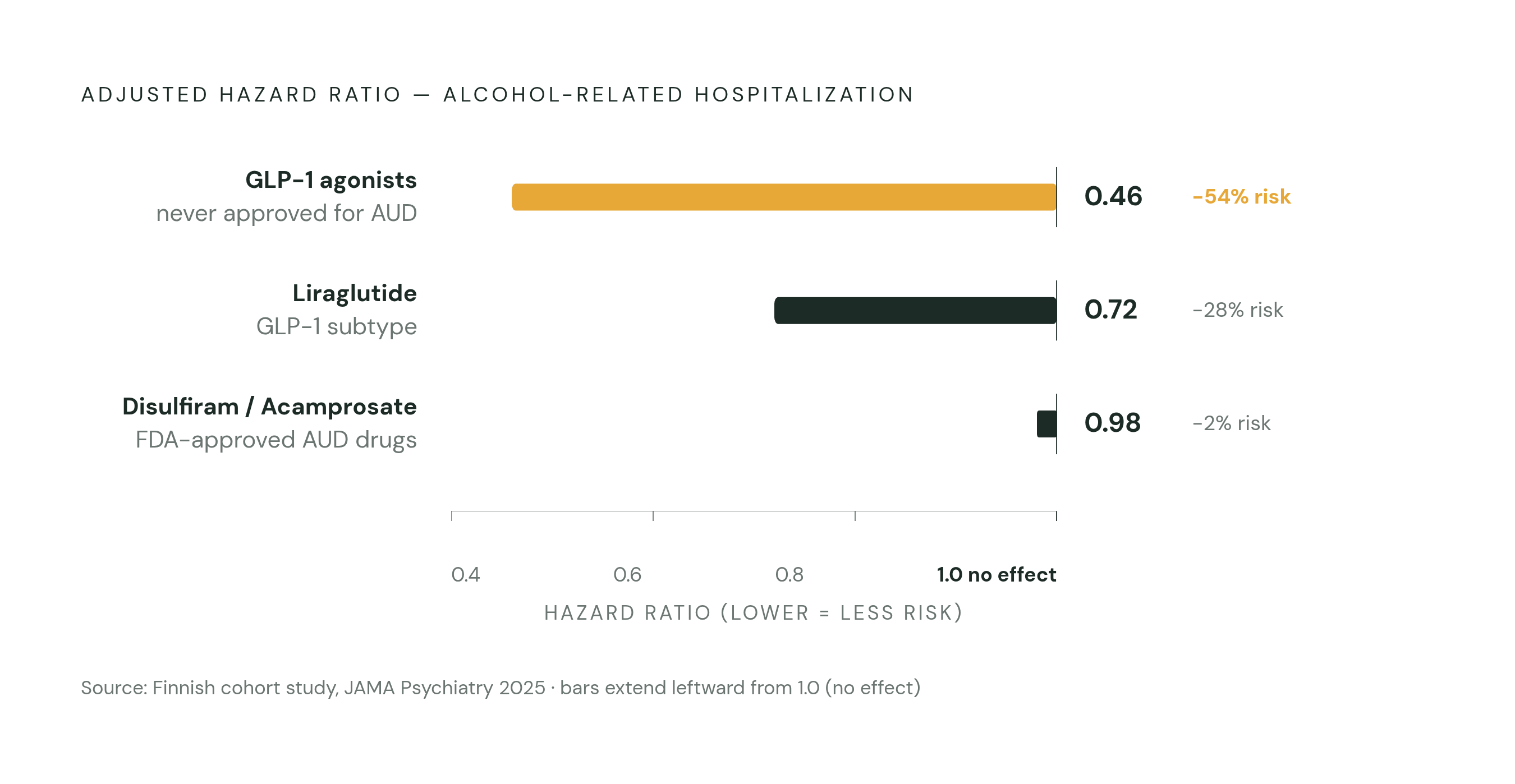
Registry data adds a third angle, and it's the one I find most persuasive. A Finnish cohort study found GLP-1 receptor agonist use associated with a hazard ratio of 0.46 for an alcohol-related event, 95% confidence interval of 0.24 to 0.86, per Lähteenvuo and colleagues writing in JAMA Psychiatry in 2025. Translated: people on these drugs had roughly half the risk of an alcohol-related hospitalization compared to people not on them. A separate analysis found liraglutide associated with an adjusted hazard ratio of 0.72 for AUD-related outcomes. Here's the comparison that ought to give the field pause: disulfiram and acamprosate, the actual approved AUD drugs, showed an adjusted hazard ratio of 0.98 in that same analysis, essentially no reduction in hospitalization risk. A drug never approved for AUD outperformed the ones that are.
A 2025 systematic review and meta-analysis in eClinicalMedicine found consistent reductions in alcohol intake across both randomized trials and observational studies, with benefits turning up across consumption, relapse, and alcohol-related illness.
None of this settles the matter, and it shouldn't. Most of these trials weren't originally built around AUD as a primary outcome, sample sizes still run small, and the field needs longer, purpose-built trials before anyone calls this standard of care. Yet that's precisely why the pattern carries weight beyond any single result. Preclinical models, early human trials, registry data pulled from real-world prescribing, and patient self-report are all pointing the same direction, independently of each other. No single study holds this argument up on its own. That's the point worth remembering, and it's also the point most likely to get lost the moment a headline compresses it into something cleaner than it is.
Why injectable delivery may be the wrong vehicle for a brain-targeted addiction therapy
If the mechanism that matters is happening deep in the brain, why is every version of this drug still delivered through a shot in the abdomen? That's not a rhetorical throat-clear; it's the actual question this section tries to answer.
Every GLP-1 agonist approved today for obesity or diabetes goes in subcutaneously. The drug enters peripheral circulation first and has to cross the blood-brain barrier before it ever touches the mesolimbic system, the central amygdala, or the lateral septum, the exact circuits the research above keeps pointing to. That barrier is not an easy structure for a peptide to get through. Only a fraction of a peripherally injected GLP-1 agonist ever reaches the brain, so the dose needed to produce a real central effect ends up considerably higher than what's needed just to manage blood sugar or appetite.
That higher dose comes with a cost, and the cost is the number one reason patients quit. In a real-world analysis of more than 78,000 patients with documented reasons for stopping GLP-1 therapy, side effects accounted for 28.2% of all discontinuations, the largest single category recorded. Mostly that's nausea, vomiting, and GI distress: the familiar price tag of GLP-1 treatment, one anybody who's talked to a patient on these drugs has heard about firsthand.
In AUD specifically, this stops being a minor inconvenience. People in recovery often carry a fraught relationship with physical discomfort and bodily dysregulation already, so nausea and GI upset don't land the same way for this population as they might for someone managing diabetes. A Danish population-based study found roughly half of GLP-1 users had stopped treatment within a year. Set that against the fact that AUD is chronic and relapsing by nature, requiring sustained, uninterrupted pharmacotherapy, and the mismatch comes into focus fast. A drug people quit after six months because they can't tolerate it isn't built for this disease, full stop.
Then there's the needle itself. Injection fatigue and needle aversion are documented barriers to adherence across nearly every injectable drug class on the market, and stacking a weekly injection on top of the already-stigmatized experience of addiction treatment doesn't help matters. It compounds resistance instead of reducing it.
So here's the actual argument, without much room for spin: if the mechanism driving the AUD effect is central, a delivery route built to maximize how much drug reaches the CNS while minimizing peripheral circulation isn't a comfort upgrade. It's a mechanistic one. The real question isn't how to make injections easier to tolerate. It's why a peripheral route gets used for a central problem in the first place, and whether anyone building these trials has actually reckoned with that mismatch yet.
How nose-to-brain delivery changes the pharmacological calculus for GLP-1 in AUD
The nose offers something the bloodstream can't: a direct line to the brain. The olfactory and trigeminal nerve pathways running from the nasal epithelium into the brain bypass the blood-brain barrier entirely. A drug traveling this route doesn't need to circulate through the whole body and hope enough survives the trip; it moves more directly toward the mesolimbic system, the central amygdala, and the lateral septum, the same circuits implicated throughout the research above.
The payoff, in theory, is higher concentration where the drug actually needs to act, at a lower total dose, which should mean less of it circulating peripherally to cause nausea and GI upset in the first place. Better signal at the target, less noise everywhere else. Nice premise. Harder to execute than it sounds.
GLP-1 peptides are fragile; they break down fast when they hit the enzymes present in nasal mucosa, and they don't cross mucosal tissue easily on their own. Spraying a raw peptide up someone's nose and hoping it survives the trip intact doesn't work well enough to matter clinically. This is the actual bottleneck, and it always has been: not the anatomy, which cooperates just fine, but the chemistry of getting a fragile molecule across a mucosal barrier before it falls apart.
Nanoparticle encapsulation is where the field has landed as an answer. Wrapping the peptide inside a nanoparticle shields it from enzymatic breakdown, helps it stick to and cross the mucosal lining, and allows more targeted release once it arrives instead of diffusing out wherever it lands. Lionbio has built a delivery platform around exactly this problem, using nanoparticle technology rooted in more than 30 years of patented research originating at Columbia University. The goal is specific: get GLP-1 peptides intranasally to the brain's reward circuits, matching the efficacy seen in injectable trials while sidestepping the peripheral side effects driving so many patients to quit.
If GLP-1 agonists work in AUD primarily through these central mechanisms, and the evidence so far leans that way, intranasal nanoparticle delivery isn't just a more comfortable way to take the same drug. It's a more mechanistically coherent way to run the whole strategy, one that doesn't ask the body to absorb heavy peripheral exposure just to get a sliver of the drug where it needs to go. AUD sits alongside dementia and other substance use disorders as a condition where this route could open therapeutic ground a subcutaneous shot simply can't reach as efficiently.
Worth saying plainly: direct head-to-head data on CNS bioavailability between intranasal and subcutaneous delivery in humans doesn't exist yet. Formulation science still has to survive the jump from lab bench to a clinical-grade nasal spray people can use daily, and AUD trials need to be built from day one around brain-targeted delivery, rather than adapted from metabolic protocols designed for an entirely different disease. The mechanism looks real, the clinical case keeps building, and what's left, mostly, is whether the delivery science can catch up to the biology. That's an engineering question as much as a medical one, and it's the one that decides whether any of this reaches patients on a timeline that matters.