GLP-1 Agonists in Non-Alcoholic Fatty Liver Disease
GLP-1 drugs reduce liver fat and inflammation, but struggle to reverse fibrosis.
GLP-1 is a gut hormone, released from L-cells after a meal, that binds receptors in the pancreas, the brain, and a handful of peripheral tissues. It nudges insulin up, glucagon down, and tells the brain you're full. That part of the biology is settled, and it explains why the drug class works so well for diabetes and weight loss. Less settled — and this is a question that has generated ongoing debate in the field — is whether GLP-1 receptors actually sit on hepatocytes, the liver's main working cells, in any number that matters. Some labs report direct GLP-1R signaling inside hepatocytes, while others say the receptor is so sparse there that almost all of the liver benefit has to be arriving secondhand, routed through some other organ first.
The best-supported route goes through fat tissue. Weight loss cools inflammation in adipose tissue, which improves insulin sensitivity, which cuts the flow of fatty acids into the liver before they ever get there. Adipose tissue also puts out more adiponectin as fat mass drops, and that hormone flips on a signaling cascade in hepatocytes (cAMP, then pAMPK) that turns up fat-burning enzymes like carnitine palmitoyl transferase 1 while turning down the genes that build new fat, SREBP-1c and FAS chief among them. Separately, GLP-1RAs dial back inflammatory markers such as TLR2 and CX3CR1 in animal models of NASH, along with several genes tied to fibrosis.
A 2025 finding published in a diabetes research context complicates this picture, and I think it deserves more attention than it's gotten. In pair-fed mice, meaning mice forced to eat identical amounts regardless of which drug they got, dulaglutide still cut liver fat, apparently by suppressing a protein called osteopontin. That suppression tracked with less collagen deposition, fewer inflammatory M1-type macrophages, and reduced fat synthesis in the liver, with the same calories in producing less fat in the liver. This is a weight-independent effect, full stop, and it means GLP-1 signaling is doing something to the liver's inflammatory and fibrotic machinery that has nothing to do with calories in versus calories out.
Here's the detail that carries weight for everything downstream: the glucagon receptor, unlike GLP-1R, sits on hepatocytes in abundance. That asymmetry is exactly why drugs hitting both receptors at once are drawing so much attention in MASH specifically, and I'll come back to this in the section on dual and triple agonists. Put together, GLP-1RAs seem to work through at least three overlapping channels: metabolic, anti-inflammatory, and, for the dual and triple agonists, something closer to a direct receptor route. That convergence goes a long way toward explaining why liver outcomes improve even without anyone nailing down the hepatocyte receptor question for good. It may never get nailed down, and that's fine, since the downstream effect is what patients actually care about.
What the clinical trials show about steatosis and NASH resolution
The clinical data lines up with the mechanism story fairly well, at least on the inflammation and fat side. A systematic review published in January 2025 (Potter et al.), pooling six studies and 478 patients, found GLP-1RA treatment associated with a more than fourfold increase in the odds of NASH resolution, odds ratio 4.45, and roughly a modest absolute reduction in liver fat on imaging. That's the anchor number for the whole drug class right now, the one people cite in slide decks.
The trial that kicked off this entire conversation was a Phase 2 semaglutide study in 320 patients, which hit its primary endpoint: histological improvement in NASH without worsening fibrosis, against placebo. A later meta-analysis pooling two randomized trials backed this up, showing a significantly higher chance of NASH resolution without fibrosis worsening (odds ratio 3.18) and a statistically meaningful improvement in histologic resolution overall.
Steatosis reduction on imaging is, at this point, the most consistently replicated finding in the whole GLP-1 liver literature. Study after study, different agents, same direction of effect, which is more than you can say for most things in hepatology. NASH resolution without fibrosis getting worse is confirmed too, but fibrosis improvement on its own terms is a different story, and that's where the next section is headed. Semaglutide has advanced furthest along the regulatory path for MASH among GLP-1 agents, though the steatohepatitis indication doesn't answer the fibrosis question — it just reflects how far the clinical evidence has developed. The harder question sits there, unresolved, right behind it.
The fibrosis problem: where GLP-1 monotherapy hits a ceiling
Pooled semaglutide data showed no statistically significant improvement in fibrosis stage without NASH worsening. The odds ratio landed at 0.71, and the confidence interval crossed 1.0, which means you cannot rule out no effect whatsoever. A Phase 2 trial testing semaglutide specifically in NASH-related cirrhosis missed its primary endpoint. Phase 3 for that population is still enrolling or running, and it's the one readout everyone in this field is actually waiting on.
Why does any of this matter when the steatosis and inflammation numbers look this good? Fibrosis stage is the single strongest predictor of who eventually ends up in liver failure or with liver cancer, more so than the fat sitting in the liver and more so than inflammation by itself. A patient whose NASH resolves but whose fibrosis stage hasn't moved has not necessarily bought a lower risk of the outcome that actually kills people. It's easy to read "NASH resolution" as the finish line, but it isn't, and I think that distinction gets lost in a lot of the popular coverage of these drugs.
So what's driving the gap? Fibrosis gets built by activated hepatic stellate cells laying down collagen, and that machinery doesn't seem to shut off completely, whether GLP-1 receptor signaling reaches it directly or only through the metabolic and inflammatory routes described above. The osteopontin suppression in the dulaglutide mouse data is a genuinely promising lead, since osteopontin ties to collagen deposition through Col1a2. Still, a finding in pair-fed mice is not a finding in a human liver biopsy, and that translation hasn't happened yet, not even close. The drug class still has plenty going for it, and this is the specific, well-defined problem the next generation of molecules was built to solve.
How dual and triple agonists are attempting to close the fibrosis gap
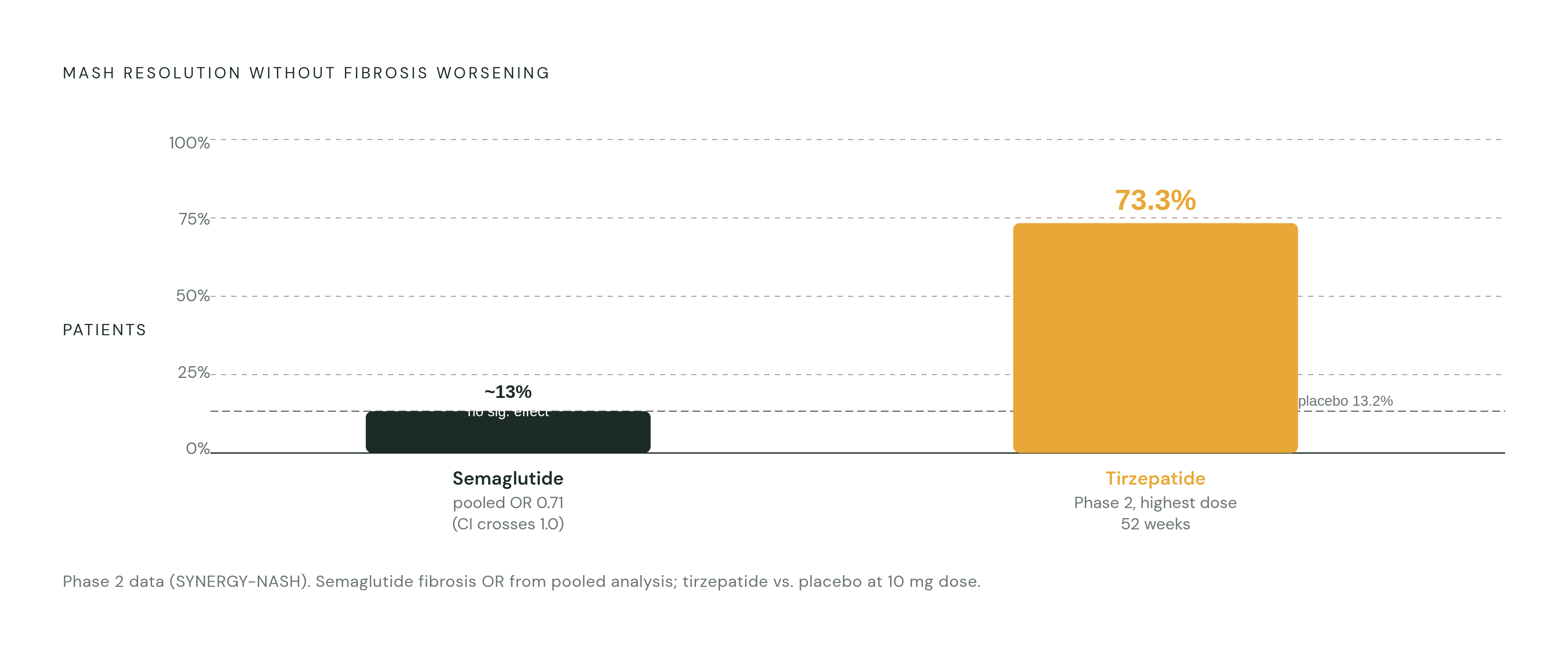
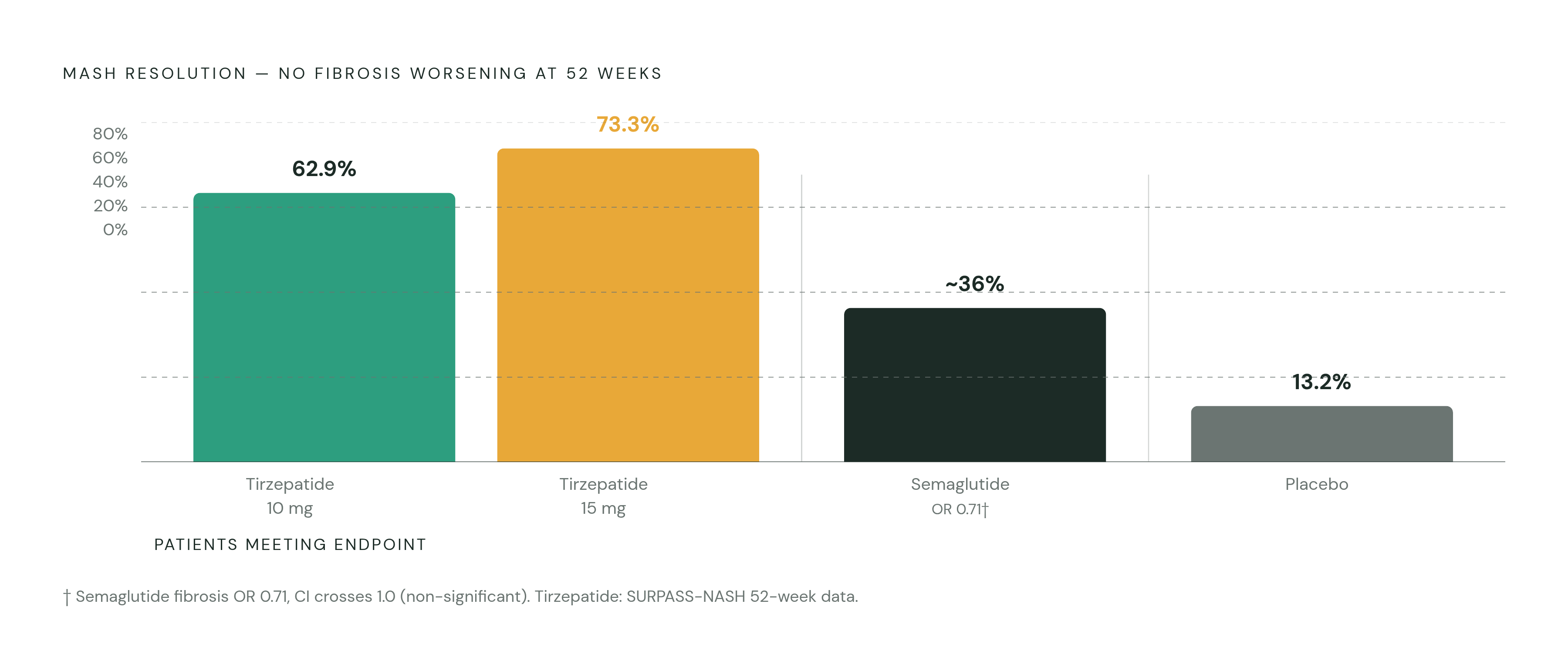
Tirzepatide's Phase 2 result reframed what people expect from incretin therapy in the liver, and I don't think that's an overstatement. At the highest dose tested, 73.3% of patients achieved absence of MASH with no fibrosis worsening at 52 weeks, against 13.2% on placebo. That's a striking jump over semaglutide's numbers, closer to a different order of magnitude than an incremental step up.
Some of that gap traces back to weight loss alone. Tirzepatide produces 17.4% to 20.8% greater weight loss than placebo, versus 10.8% to 14.8% for semaglutide in the SURMOUNT-5 comparison. The histological gap between the two drugs, though, is wider than the weight-loss gap explains by itself, which points toward something mechanistic rather than simply pounds lost. A 2025 real-world analysis using the TriNetX database, comparing 21,517 tirzepatide patients against 66,084 semaglutide patients, found tirzepatide associated with lower risk across several cardiovascular outcomes, including all-cause mortality, hospitalization, heart attack, and heart failure, in propensity-matched MASLD patients who also had type 2 diabetes. Granted, that's not a liver-histology endpoint, but it's still a signal worth taking seriously about what this drug is doing more broadly in this patient population.
The mechanistic candidate here is the glucagon receptor. Because it sits on hepatocytes in a way GLP-1R simply doesn't, a drug hitting both receptors, or all three in the case of GLP-1, glucagon, and GIP, gets a more direct line into hepatic lipid metabolism. That's the logic behind a pipeline that now includes dual GLP-1/glucagon agonists such as survodutide, pemvidutide, and mazdutide; triple agonists like retatrutide and efocipegtrutide; and amylin combinations including CagriSema and amycretin. Nobody in this field is betting the farm on one receptor combination, and honestly, the sheer number of architectures moving through trials at once tells you the field hasn't decided which lever matters most. It may be several levers at once, or the answer may differ by patient.
Will tirzepatide's fibrosis-adjacent benefit hold up in Phase 3? If it does, will anyone actually manage to separate how much came from the glucagon receptor versus how much came from simply shedding more weight? That question shapes which molecules get prioritized over the next several years, and right now, nobody can say with real confidence which way it breaks.
The metabolic-liver-brain axis and why central mechanisms matter even in a liver disease
A liver disease and the brain seem like an odd pairing at first, but GLP-1 receptors sit in the hypothalamus and brainstem, where they govern satiety, food reward, and, less obviously, the actual composition of what a person eats rather than just the quantity. Lower fat intake and lower total caloric intake are hepatoprotective on their own terms, apart from whatever number shows up on the scale.
There's a central insulin angle too. GLP-1RAs appear to restore insulin sensitivity in the brain itself, and that dampens the systemic insulin resistance pushing the liver to manufacture new fat on its own, a process called de novo lipogenesis. The pair-fed dulaglutide data from earlier fits right into this picture: reduced liver fat showing up even with body weight held constant is exactly what you'd expect if a central mechanism plays a real role alongside peripheral calorie balance.
Then there's neuroinflammation, which I think gets underdiscussed in the liver literature specifically. GLP-1RAs appear to exert anti-inflammatory effects in the brain, mechanisms researchers studying neurodegeneration are tracking just as closely as hepatologists are tracking the liver angle. That drop in systemic inflammatory tone plausibly feeds back into the liver, since MASLD and dementia share insulin resistance as a common root cause. One multi-cohort dataset covering 109,778 individuals found GLP-1RA use associated with a lower incidence of dementia, adjusted hazard ratio 0.74. The overlap in who's affected isn't coincidence, since the same patients carrying advanced MASLD are, on average, at elevated dementia risk too, and that pattern alone is worth a paper on its own.
So here's a question worth sitting with: if a meaningful share of the liver benefit runs through central, brain-based pathways, does delivery route start to matter more than we've been treating it? A method that reaches the brain more directly, intranasal delivery straight to the CNS rather than through the bloodstream, could in principle amplify exactly the central GLP-1 effects that seem to matter for both the liver and its neurological comorbidities. An intranasal nanoparticle approach built on that premise could target CNS pathways that an injected drug only reaches in part, after diluting through systemic circulation. I want to be honest that nobody has the biopsy data yet to confirm whether that translates into a measurably better liver outcome. The biological logic connecting the two systems is hard to dismiss outright, though.
Patient persistence on GLP-1 therapy and what dropout means for liver outcomes
MASH trials measure success on biopsy, and histological changes require prolonged treatment to manifest. That length of follow-up demands real, sustained adherence, and injectable regimens present real-world adherence challenges.
Tolerability concerns arise during treatment, particularly during early dose-escalation before patients have reached a therapeutic dose. There's something almost cruel about the timing: the patients most likely to quit are quitting before the drug ever got a real chance to work on them. Add in that many MASLD patients are managing obesity-related conditions on top of everything else, juggling several other medications, and, for a meaningful number, avoiding needles outright, and the injection stops being a footnote. It becomes a real barrier, one that manifests as treatment discontinuation long before it could appear in a biopsy result.
That's the caveat tirzepatide's 73.3% histological response rate needs sitting next to. That number came out of a controlled trial with close monitoring and structured support, the kind of setting that doesn't exist for most patients managing a chronic liver condition on their own, year after year, refill after refill. Whether the response rate holds once patients are left to manage it in ordinary clinical practice is genuinely an open question, and not a small one either.
So the promise of GLP-1s in fatty liver disease runs into an engineering problem nearly as much as a biology one. Cut the nausea burden, or remove the injection altogether, and adherence should improve; the population-level liver benefit starts looking achievable rather than something confined to trial conditions with a study coordinator calling every week to check in. An intranasal approach that skips the injection, and may also blunt the peripheral nausea signaling tied to gut-level GLP-1 receptor activation, would address both problems at once: the compliance barrier, and the case for more CNS-targeted action laid out in the section above.
Where GLP-1s in fatty liver disease stand and what the remaining evidence gaps mean
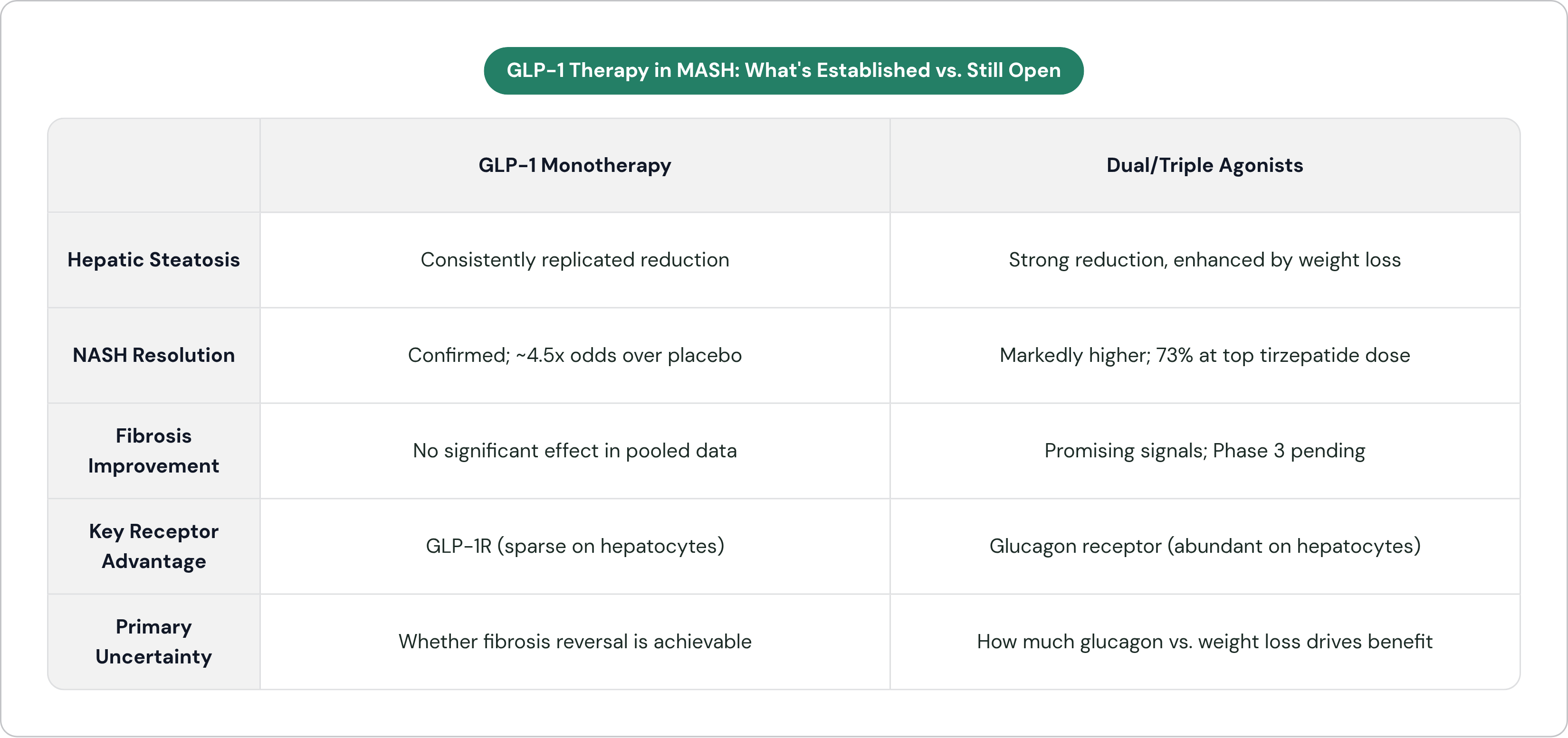
What's established: GLP-1 agonists reliably cut hepatic steatosis and resolve NASH on biopsy without worsening fibrosis, and the class now has a regulatory approval for MASH to show for it. That's real, and it arrived faster than most people in the field expected even five years ago.
What's still unresolved is direct fibrosis reversal. No GLP-1 monotherapy has shown this in a completed Phase 3 trial, and the ongoing Phase 3 program in NASH-related cirrhosis is the single most important data readout left pending in this whole space. What's emerging, meanwhile, is that dual and triple agonists produce fibrosis-adjacent histological results single-receptor drugs simply haven't matched. Whether that's the glucagon receptor doing something GLP-1R can't, or just more weight coming off, or some mix of both, is exactly the question the ongoing Phase 3 programs exist to answer.
One might argue it doesn't matter which mechanism gets the credit, so long as fibrosis outcomes actually improve, and that's fair enough clinically speaking. It matters enormously for drug design, though, because it determines which receptor combinations are worth chasing next and which patients are likely to respond best to which molecule. That's not a small thing to leave unanswered.
There's a second question the field hasn't fully confronted, and it sits outside the molecule entirely. Optimize the drug all you want; if you don't optimize how it reaches the patient, and stays reached, adherence remains unsolved, and adherence is what determines whether any of this histology ever translates into fewer cases of cirrhosis and liver cancer at the population level. The nose-to-brain angle matters here too. If central metabolic regulation is doing real work in this disease, and the evidence increasingly points that way, then delivery routes built to get more drug into the CNS deserve close attention as that science matures.
Taken as a whole, GLP-1s are the most significant pharmacological advance against MASLD in decades, and I don't say that lightly after years of watching this field move in smaller increments. The biology holds up under scrutiny, the clinical signal for steatosis and steatohepatitis is real and replicated across multiple agents, and the fibrosis gap that remains is defined precisely enough that everyone working in this space knows exactly what still needs to be shown, and most have a rough sense, too, of how long it's going to take to find out.