Dual GLP-1 GIP Receptor Agonists Compared
Tirzepatide's biased signaling may preserve receptor sensitivity better than standard agonists.

Tirzepatide is an acylated synthetic peptide engineered to activate both GIPR and GLP-1R, but the engagement is deliberately asymmetric. At the GIPR, it behaves as a full agonist, approximating the native GIP signal with reasonable fidelity. At the GLP-1R, the behavior is more structurally interesting: tirzepatide displays signaling bias, preferentially driving cyclic AMP generation while producing substantially less agonist-induced receptor desensitization than a conventional GLP-1 agonist.
Receptor desensitization matters clinically, and it is worth being precise about why. When a receptor is repeatedly and fully stimulated, it is internalized and rendered less responsive; this is one reason aggressive GLP-1R agonism can plateau in efficacy over time. Tirzepatide's biased engagement may preserve receptor sensitivity across the dosing interval in a way that full agonism does not. That is a mechanistically coherent hypothesis, not a settled conclusion, and I hold it as a working inference rather than a proven claim.
The structural basis for this bias has been characterized through cryogenic electron microscopy and molecular dynamics simulations. The fatty acid modification and the amino acid sequence together determine how the molecule docks at the GLP-1R and which downstream pathways it preferentially activates. This is engineered pharmacology. The practical implication for anyone trying to make sense of the comparative literature is that tirzepatide is not semaglutide with a GIP moiety grafted on. It is a pharmacologically distinct entity whose behavior at each receptor differs from what either native hormone or a mono-agonist produces, and that distinction propagates outward into clinical outcomes in ways that are still being untangled.
What Biased GLP-1R Signaling and Dual Incretin Engagement Produce in Metabolic Outcomes
The pharmacology predicts specific functional consequences: greater insulin sensitivity, more effective prandial glucagon suppression, and lower prandial insulin requirements relative to mono-agonism. The clinical trial data are broadly consistent with those predictions, though consistent is doing some real work in that sentence.
Across the SURPASS program in type 2 diabetes, tirzepatide produced HbA1c reductions ranging from moderate to substantial reductions and body weight reductions ranging from 5.4 kg to 11.7 kg across five trials. A meaningful proportion of participants achieved HbA1c levels below the diagnostic threshold for diabetes. The SURMOUNT-1 trial in obesity without diabetes extended the weight-loss signal further still, with participants at the highest dose achieving substantial mean body weight reduction. At the time of publication, these outcomes were without precedent for a single pharmacological agent in these populations.
The data, however, leave important interpretive questions open. The SURPASS trials were not designed as head-to-head comparisons against a common mono-agonist arm under identical conditions. Cross-trial inference carries real limits: different populations, different titration schedules, and different primary endpoints make it impossible to cleanly decompose tirzepatide's efficacy advantage into the contribution of biased GLP-1R signaling versus dual incretin engagement versus some interaction between them. The signal is real. Its mechanistic anatomy is not yet fully resolved.
How the Dual-Receptor Mechanism Shapes the Side-Effect and Tolerability Profile
Gastrointestinal adverse events, nausea, vomiting, and diarrhea principally, are the dominant side-effect burden across the GLP-1 receptor agonist class. The primary mechanistic source is GLP-1R-driven gastric emptying delay. This is not a pharmacological accident; it is an intrinsic consequence of the same receptor activation that drives efficacy. The two cannot be fully separated.
Tirzepatide's biased GLP-1R engagement raises a hypothesis worth examining honestly: whether its GI profile is meaningfully different from that of agents with stronger, more sustained GLP-1R activation. The short answer is that the profile appears to differ in degree, not in kind. GI adverse events remain common; they emerge in a dose-dependent titration pattern; and the approved schedule is deliberately slow, reflecting a design judgment that gradual up-titration can partially attenuate the signal. That is consistent with the pharmacology. It does not eliminate the problem.
The GIP receptor arm contributes its own pharmacology at the adipose and CNS levels. What it does not appear to do is meaningfully compound the GI adverse event burden. Some preclinical mechanistic work suggests GIP co-agonism may modulate nausea pathways in ways that are at least not additive with the GLP-1R-driven GI signal. The human clinical data on this remain thin.
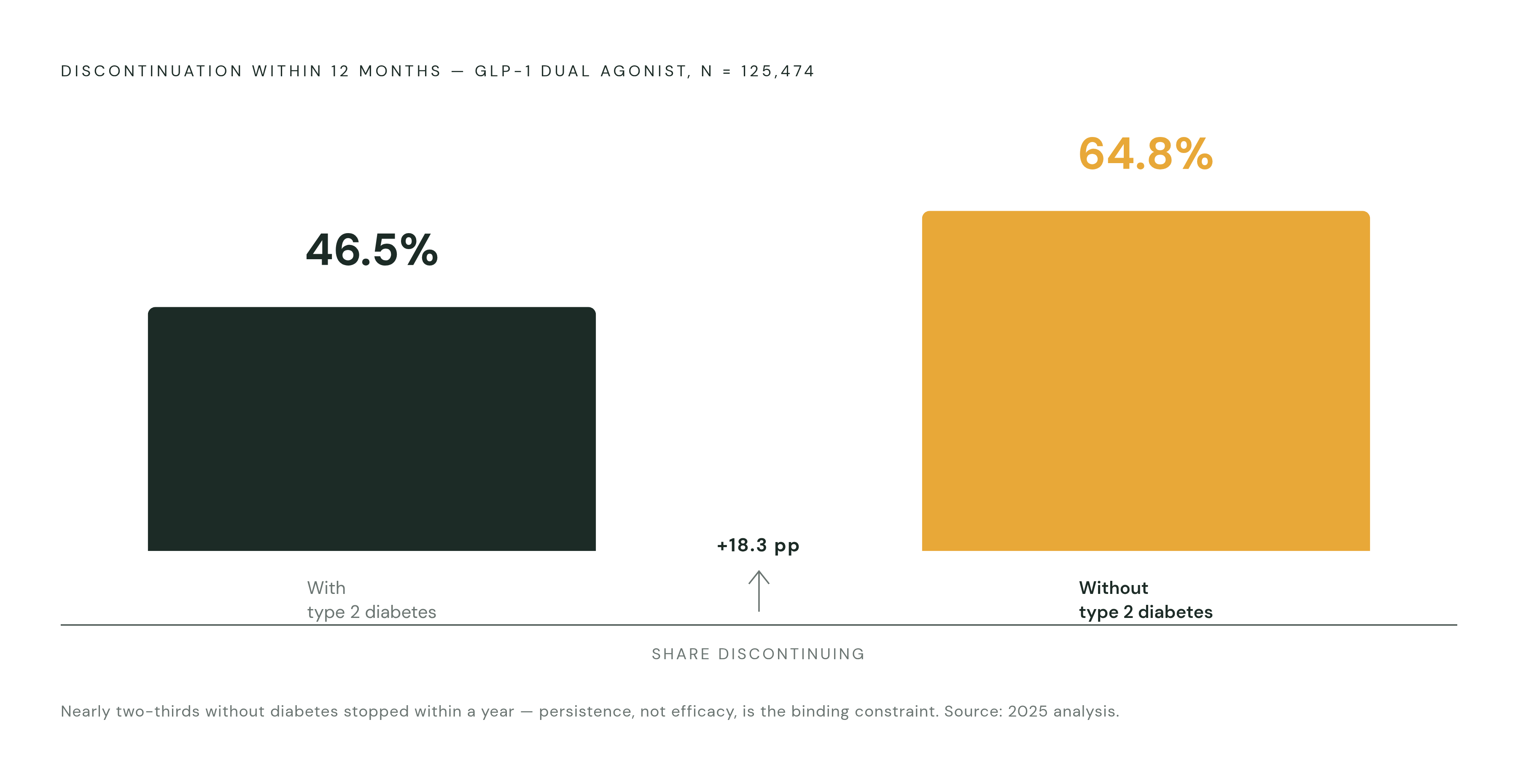
What the population-level persistence numbers reveal is sobering, and they reframe the tolerability question in ways that efficacy ceilings alone cannot. A 2025 analysis of 125,474 adults newly prescribed a dual-labeled GLP-1 receptor agonist found that 46.5% of patients with type 2 diabetes and 64.8% of those without discontinued within twelve months. GI intolerance is the leading driver. The tolerability profile, not the peak efficacy ceiling, determines whether an individual patient derives any benefit at all. That tension is not tirzepatide's problem specifically; it runs through the entire class.
Where Dual GLP-1/GIP Agonism Sits Relative to the Next Mechanistic Step: Triple Agonism
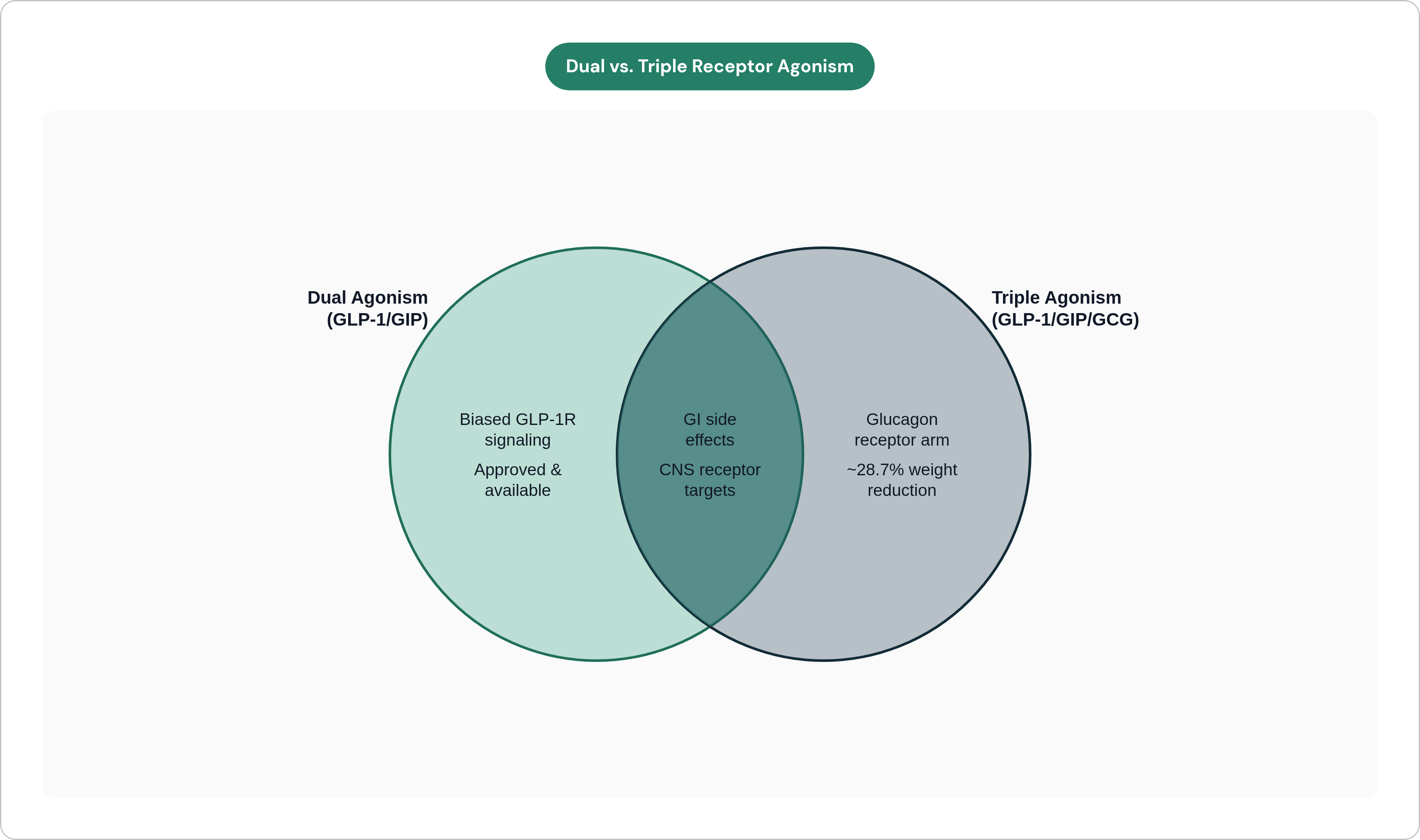
Dual agonism is now an approved, commercially available pharmacology with a reasonably well-characterized benefit-risk profile. Triple agonism, which adds glucagon receptor activation to the GLP-1/GIP combination, is the next mechanistic iteration in development. The rationale is straightforward: glucagon receptor engagement increases energy expenditure rather than simply reducing caloric intake, and the combination is therefore predicted to raise the weight-loss ceiling beyond what appetite suppression alone can achieve.
Retatrutide, the most advanced GLP-1/GIP/glucagon triple agonist in clinical development, has generated Phase 3 results that appear to bear out that prediction. TRIUMPH-4 results at the highest dose showed approximately 28.7% body weight reduction. The methodological caveats that apply to any cross-trial comparison apply here: different populations, different durations, and different design features constrain how much inferential weight one can responsibly place on that number. The directional signal, that adding a glucagon receptor arm lifts the efficacy ceiling, is coherent with the pharmacology, which makes it worth taking seriously even before the full dataset is in.
The safety finding that deserves the closest scrutiny from the retatrutide program is dysesthesia, abnormal skin sensations, reported in roughly 12.5% of participants at the 12 mg dose in TRIUMPH-1. This has no clear parallel in the dual-agonist class. It is plausibly attributable to glucagon receptor activity, though the mechanism has not been established. The TRIUMPH program spans more than 22,000 participants across 14 trials; it is still generating the data needed to characterize this and other signals.
The more useful framing here is one of trade-offs, not a competition between classes. Dual agonism offers a mature, approved pharmacology with known unknowns. Triple agonism offers a higher efficacy ceiling and unknown unknowns that a large clinical program is actively working to resolve. Neither is obviously superior in the abstract; the answer depends on which risks a prescriber and patient are willing to accept in exchange for which benefits.
What the CNS Receptor Distribution Means for Indications Beyond Metabolic Disease
Both GLP-1R and GIPR are expressed in brain regions governing appetite, reward, and cognition. This is mechanistically central, not incidental: the appetite-suppressing effect of these agents is not reducible to gastric slowing alone. The central signal is part of the pharmacology, which means the CNS is not a speculative future application. It is already embedded in the mechanism of action.
GLP-1R activation in the brain has been linked to reward-circuit modulation, producing early and still-preliminary signals in addiction research and cognitive protection. The CNS role of the GIP receptor is less well characterized, but research interest is accelerating. Epidemiological observations associating GLP-1 receptor agonist use with reduced rates of certain neurodegenerative markers have given the basic science a clinical foothold, even if causality remains to be established in prospective trials.
The variable that rarely enters mainstream pharmacology discussions is delivery route. Injectable peptides reach CNS receptors via systemic circulation, and blood-brain barrier penetration for large acylated peptides is limited and variable. This is a genuine constraint on how much of the central pharmacology can be accessed through the injection-based paradigm. Intranasal peptide delivery via olfactory and trigeminal pathways offers a more direct anatomical route to CNS targets, bypassing the blood-brain barrier rather than competing with it. Lionbio is working on this premise specifically, building an intranasal GLP-1 platform on more than 30 years of patented nanoparticle delivery intellectual property, with the goal of reaching brain GLP-1 receptor populations more directly than injection allows and opening neurological indications, including addiction and dementia, that the injection-based approach cannot reach as effectively. The receptor biology is the same regardless of delivery route; what changes is which receptor populations are engaged at therapeutically relevant concentrations, and for how long.
That is not a minor variable. The comparison between single- and dual-receptor agonists is incomplete if it ignores where in the body those receptors are actually being reached.
Why Receptor Biology Alone Does Not Determine Which Patients Benefit Most
Phase 3 efficacy data define a ceiling, not a prediction for any individual patient. A person who stops tirzepatide at month four because of persistent nausea has not benefited from a 21% weight-loss ceiling, however real that ceiling is for those who reach and maintain therapeutic doses. The 2025 analysis of 125,474 adults makes this concrete: nearly half of patients with type 2 diabetes and nearly two-thirds of those without stopped therapy within twelve months. These figures span the class.
The mechanistic sophistication of dual agonism, biased GLP-1R signaling, complementary incretin engagement, potential GI modulation via GIPR, has clinical value only insofar as it translates into better real-world persistence relative to mono-agonism. Whether it does, and by how much, is still being established in post-market observational data. There is a plausible mechanistic case that tirzepatide's tolerability profile should be somewhat more favorable than that of a fully potent, non-biased GLP-1R agonist. Whether that shows up as a measurable persistence advantage in real-world data is a question I cannot answer yet, and I am wary of anyone who thinks they can.
Delivery format is an underappreciated variable in this persistence calculus. Once-weekly subcutaneous injection is the current standard across the dual-agonist class. Needle burden and injection fatigue are real behavioral barriers that compound GI-driven dropout over time, particularly in patients who are not managing a chronic disease that makes the injection feel non-negotiable. Phase 3 trial populations, which are selected and closely monitored, systematically underestimate these dynamics.
The GLP-1 agonist market was valued at $66.4 billion in 2025 and is projected to reach $185.3 billion by 2033, at a compound annual growth rate of 12.4%. Those figures reflect genuine unmet need. They also reflect an enormous population of patients cycling on and off therapy rather than achieving durable benefit. As dual and triple agonism push the efficacy ceiling higher, the field's most pressing practical problem shifts. Retatrutide's 28.7% data signal that the pharmacology can go higher. The urgent problem is ensuring patients can tolerate and access these agents long enough to reach the outcomes the pharmacology makes possible. Delivery innovation, including routes that reduce injection burden and potentially improve CNS receptor engagement, is part of that mechanistic story, not a footnote appended to it.