GLP-1 Physiology Beyond the Pancreas
GLP-1 receptors throughout the body create effects far beyond blood sugar control.

The primary intracellular pathway following GLP-1R activation is well characterized. Receptor engagement raises cyclic AMP, which amplifies glucose-stimulated insulin secretion in pancreatic beta cells. The critical word is amplifies, not triggers. GLP-1R agonism does not compel insulin release independent of ambient glucose; it potentiates a signal already present. This glucose dependence is what makes the receptor pharmacologically attractive: the structural hypoglycemia risk is low.
But cAMP is not the whole story. The receptor also mobilizes intracellular calcium and activates the ERK pathway, a broader signaling repertoire than any single-tissue system would require.
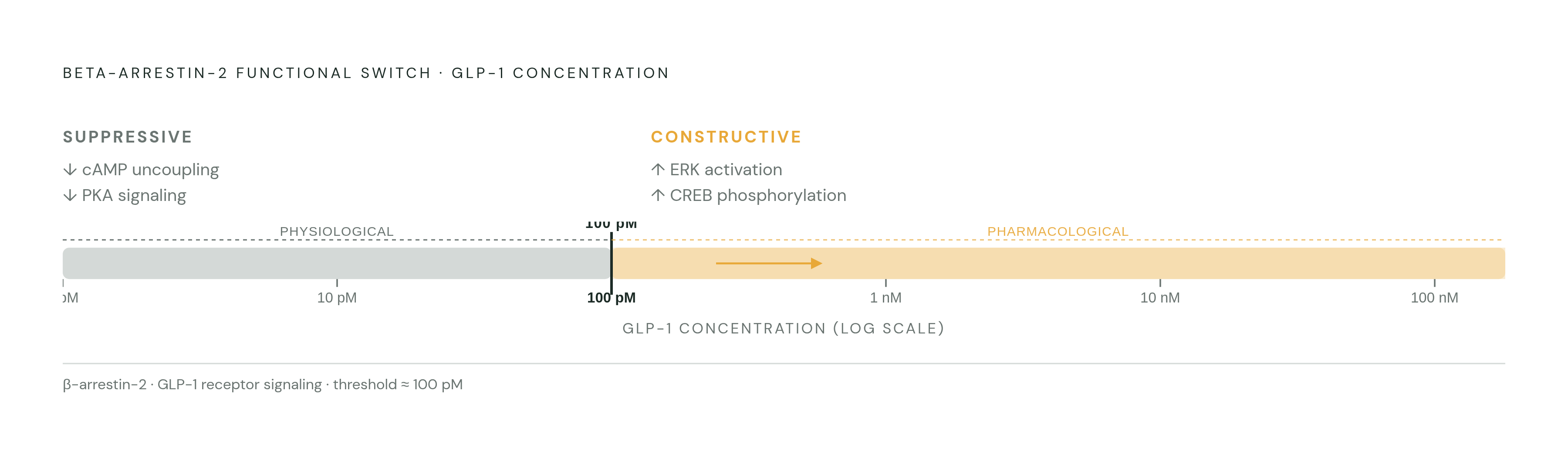
Then there is beta-arrestin recruitment. After G protein signaling fires, beta-arrestins dampen the response and internalize the receptor, a built-in brake. What makes this interesting, at least to anyone who has spent time parsing the receptor pharmacology closely, is that beta-arrestin-2's role is concentration-dependent in ways that bear directly on how therapeutic agonists behave. At physiological GLP-1 concentrations below roughly 100 picomolar, beta-arrestin-2 acts as a negative regulator, partially uncoupling cAMP and PKA signaling. At pharmacological concentrations achieved by GLP-1 receptor agonists, which can reach 100 picomolar to 10 nanomolar and above, its character changes. It becomes necessary for sustained downstream activity, mediating ERK activation and CREB phosphorylation that supports beta-cell survival and insulin synthesis.
Therapeutic agonists do not simply mimic endogenous GLP-1 at higher concentrations. They engage the receptor in a pharmacologically distinct mode, one where arrestin-mediated signaling is not suppressive but constructive.
This opens into the concept of biased agonism: different molecules tip the balance between G protein signaling and arrestin recruitment differently, and that ratio may determine which tissue effects predominate. The downstream machinery varies across tissues. A single receptor-level event in the sinoatrial node produces a different cellular output than the same event in a hippocampal neuron or a renal tubular cell. GLP-1R is, in this sense, a platform. What that platform does depends on where it is sitting.
The Receptor's Anatomical Map: Every Major Site Outside the Pancreas
GLP-1R expression has been confirmed across a striking range of tissue types: appetite and reward centers of the brain, the sinoatrial node and atria of the heart, smooth muscle of renal and pulmonary vasculature, enteric neurons of the gastrointestinal tract, and subsets of immune cells including macrophages.
In the brain, the distribution is itself a hypothesis generator. Hypothalamic circuits regulate energy intake. The brainstem's nucleus of the solitary tract integrates satiety signals arriving from gut afferents. Hippocampal expression connects to memory and neuroprotection. Receptor presence in the ventral tegmental area and nucleus accumbens links GLP-1 to motivation, hedonic behavior, and potentially addictive processes. A hormone primarily concerned with blood sugar has no obvious reason to appear in the reward system. Its presence there demands a different reading of what this system is actually doing.
In the heart, GLP-1R sits at the sinoatrial node and in the atria, the electrical generation and conduction apparatus. Activation here influences heart rate and has been proposed to support myocardial protection under ischemic stress.
Renal expression is found in vascular smooth muscle and tubular cells. The functional implications, natriuresis, blood pressure modulation, and protection from inflammatory and fibrotic damage, are now supported by outcome data.
In the lungs, GLP-1R appears in pulmonary vascular smooth muscle. Interest in pulmonary hypertension and airway inflammation is building, though this indication is less clinically advanced than the cardiac and renal evidence.
The gut harbors GLP-1R beyond the L cell itself. Enteric neurons and gut-associated afferents express the receptor, contributing to the gastric motility effects familiar in clinical practice and to local immune modulation that is less often discussed.
The immune cell expression may be the most underappreciated node on the map. GLP-1R on macrophages and related cell types introduces an anti-inflammatory pathway that threads through multiple organ systems, one that may explain benefits in conditions as anatomically different as atherosclerotic plaque and hepatic steatohepatitis.
Receptor presence does not guarantee clinical benefit. It generates a hypothesis. The sections that follow describe what happens when properly powered trials actually test those hypotheses.
What the Cardiovascular Trial Evidence Actually Shows
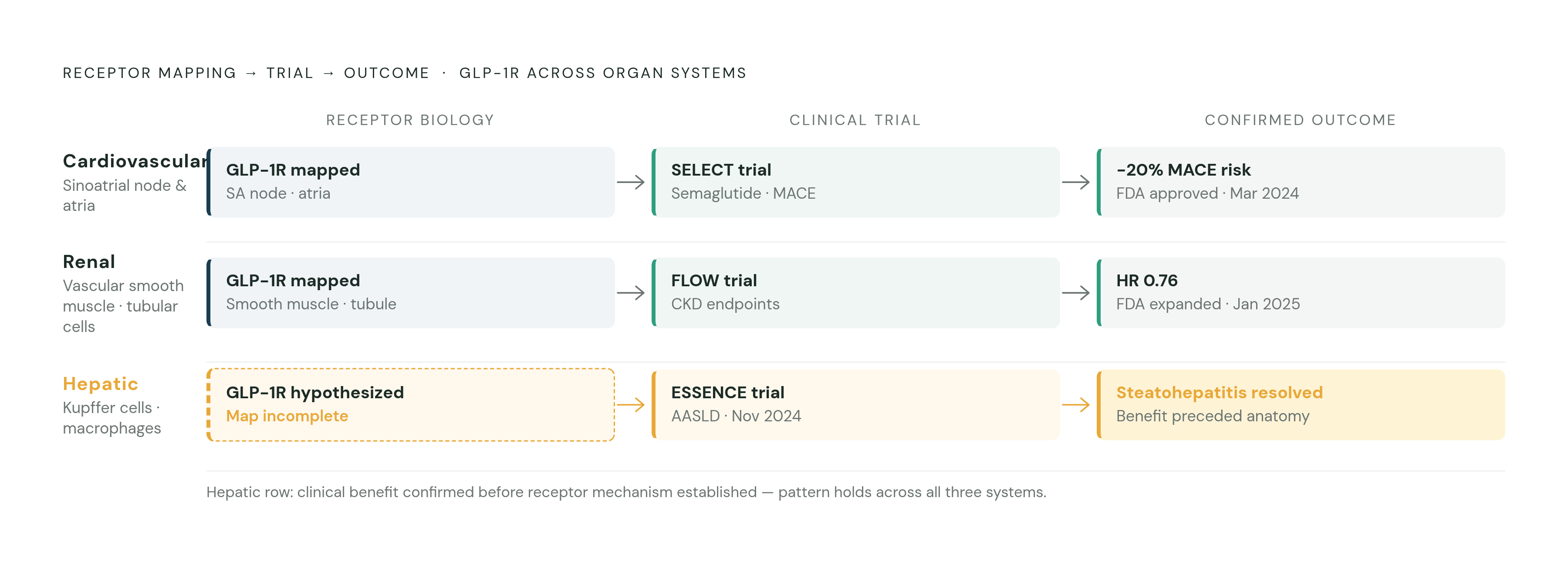
The SELECT trial enrolled 17,604 patients with obesity but without diabetes, and returned a 20 percent relative risk reduction in three-point major adverse cardiovascular events, sufficient for FDA approval of the cardiovascular risk reduction indication in March 2024.
What makes SELECT scientifically significant beyond the headline number is the population. These were patients without diabetes. Glycemic improvement cannot explain the cardiovascular benefit because there was no diabetes-related glycemia to improve. The benefit had to originate elsewhere: weight reduction, anti-inflammatory activity at the vascular wall, direct myocardial signaling, or some combination. Large outcomes trials prove the outcome without resolving the mechanism. That is an accurate reading of what they can and cannot tell us, not a criticism.
Across the broader evidence base in this class, cardiovascular benefit has ranged from roughly 14 to 20 percent reduction in MACE. SELECT sits at the upper end. The consistency across trials and agents, rather than any single data point, is what gives the signal credibility.
One pharmacological consequence of GLP-1R's location at the sinoatrial node is worth naming directly: a modest but reproducible increase in resting heart rate. This is not a peripheral side effect of systemic drug exposure. It is a predictable consequence of activating the receptor where it actually sits. Knowing the receptor map makes the clinical observation less puzzling, even if it does not make it more welcome for patients already managing cardiovascular risk.
The open question that remains unresolved is whether direct cardioprotection via myocardial GLP-1R contributes independently of hemodynamic and anti-inflammatory benefits driven by weight loss. That question is unsettled, and anyone who tells you otherwise is reading past the data.
What the Kidney Trial Evidence Reveals About GLP-1R in Renal Tissue
The FLOW trial followed 3,533 adults with type 2 diabetes and chronic kidney disease for a median of 3.4 years. The composite kidney outcome occurred in 23.2 percent of the placebo group and 18.7 percent of the treatment group, a hazard ratio of 0.76. In January 2025, the FDA expanded the prescribing indication to include reducing the risk of kidney disease progression, kidney failure, and cardiovascular death in adults with type 2 diabetes and chronic kidney disease.
The mechanistic picture here is more anatomically grounded than in the heart, because GLP-1R expression in renal vascular smooth muscle and tubular cells maps directly to the proposed mechanisms. Vascular receptor activation influences renal perfusion and blood pressure. Tubular receptor activation promotes natriuresis. Anti-inflammatory signaling plausibly interrupts fibrotic progression in the kidney parenchyma. Weight loss and glycemic improvement contribute, but the hazard ratio implies a benefit that those secondary effects alone do not fully account for.
I find the sequencing worth noting, not as rhetorical flourish but as a methodological observation. In both the cardiovascular and renal cases, receptor expression in the relevant tissue was documented before the trial was designed, the trial confirmed the benefit, and the mechanism remains partially, not fully, explained. The anatomy informed the hypothesis; the clinical evidence is validating it, though not resolving it.
Liver and Metabolic Inflammation: The MASH Findings
Metabolic dysfunction-associated steatohepatitis is a disease of fat accumulation and inflammatory injury in the liver, an organ-level consequence of the same metabolic dysregulation driving type 2 diabetes and cardiovascular risk. Interim analyses from the ESSENCE trial, presented at the November 2024 AASLD conference, showed semaglutide superior to placebo on both primary endpoints: resolution of steatohepatitis without worsening fibrosis, and improvement in liver fibrosis without exacerbation of steatohepatitis.
The mechanistic reading here is more complicated than the cardiac or renal story, and that complication is worth sitting with rather than papering over. The liver is not a classically prominent GLP-1R expression site, yet the benefit is real. The most plausible pathways are weight loss reducing hepatic fat load, GLP-1R activation on hepatic immune cells, specifically Kupffer cells and macrophages, dampening inflammatory cascades, and improved systemic insulin sensitivity reducing lipotoxic stress on hepatocytes.
This is a case where the clinical signal has outpaced anatomical certainty. Benefit was demonstrated before the receptor biology in hepatic tissue was fully characterized, and that sequence is not unusual in medicine. What it does suggest is that the immune cell expression of GLP-1R may be a throughline connecting cardiac, renal, and hepatic benefits under a single anti-inflammatory framework. The receptor's presence on macrophages may matter more than its presence or absence on hepatocytes, a hypothesis that, if confirmed, would meaningfully reframe how the drug class is understood.
The Brain as GLP-1R Territory: Appetite, Reward, and Emerging Neurological Indications
The brain's GLP-1R distribution is not incidental, and treating it as a footnote to appetite regulation misses most of the biology.
Weight reduction achieved with GLP-1R agonists across clinical trials spans a wide range, from low single digits to over 20 percent of body weight depending on agent and population. A meaningful fraction of that effect is centrally mediated rather than simply a consequence of delayed gastric emptying. Separating peripheral and central contributions precisely is methodologically difficult; the mechanisms compound each other in ways that are not easy to disentangle.
The addiction signal is more preliminary but mechanistically coherent. GLP-1R agonism at reward circuitry attenuates dopaminergic responses to alcohol, nicotine, and other substances in animal models, and human observational data are accumulating. Nothing in this space is practice-changing yet, but the hypothesis follows directly from where the receptor lives. That is a different kind of warrant than speculation.
In neurodegeneration, hippocampal and cortical GLP-1R expression supports proposals about neuroprotection in Alzheimer's and Parkinson's disease. The receptor activation pathways implicated, ERK and CREB signaling, are the same ones involved in beta-cell survival. Several clinical trials are underway; results are early and mixed. The mechanistic rationale is grounded in the receptor map, but the clinical translation remains unproven.
Here is where a structural pharmacological problem becomes unavoidable. GLP-1 peptides are large molecules. They do not readily cross the blood-brain barrier. Injectable administration achieves systemic exposure, but direct CNS delivery is not guaranteed. For indications where the operative receptor population sits in the brain's reward circuitry, hippocampus, or cortex, that is a real constraint, not a theoretical one. Intranasal delivery via olfactory and trigeminal pathways bypasses the blood-brain barrier and deposits drug directly into CNS tissue. Lionbio's intranasal nanoparticle platform is designed to exploit exactly this route. Whether it delivers on that design at therapeutic concentrations is a question that clinical data will need to answer, but the pharmacological rationale for the approach is sound.
Why the Receptor Map Is the Lens Through Which New GLP-1 Indications Should Be Read
Anyone following this literature long enough eventually notices the same thing: the receptor's anatomical distribution predicted the therapeutic story before the clinical trials wrote it. SELECT confirmed cardiovascular benefit in a non-diabetic population. FLOW established renal protection where vascular and tubular expression had already been mapped. ESSENCE demonstrated hepatic benefit even where the receptor biology was least complete. Centrally mediated weight loss is established, and reward and neuroprotective indications are advancing toward clinical testing.
What I keep returning to is that none of these benefits were discovered by starting from the disease and working backward. They were anticipated, at least partially, by asking where the receptor sits and what happens when it is activated in that tissue. The anatomy led; the trials followed.
This reframing has direct consequences for drug development. The question is no longer whether GLP-1R matters outside the pancreas. That is answered. The operative questions are which receptor sites, in which patient populations, for which specific indications, and under which delivery conditions, produce clinically meaningful benefit. More than 65 GLP-1 agonists are in various stages of development. In aggregate, the pipeline is following the receptor map, even if individual programs do not frame it that way explicitly.
Biased agonism adds further granularity. If different molecules tip the G protein-to-arrestin ratio differently, and if that ratio influences which tissue effects predominate, the next generation of agents could be designed to preferentially engage specific organ receptor populations. That is not speculation; it is the logical extension of what the pharmacology already shows, and it is the kind of design question that only becomes legible once the receptor map is taken seriously as a starting point.
The delivery problem deserves equal weight. Injectable agonists distribute systemically. They cannot be directed at a specific receptor site, and they face pharmacokinetic barriers that are most consequential in the CNS. A receptor map that includes the brain's reward circuitry, hippocampus, and cortex is only actionable therapeutically if the drug reaches those sites at sufficient concentration. The olfactory-trigeminal route is not a curiosity; it is a pharmacological answer to a structural limitation that systemic dosing cannot resolve.
Where receptor biology leads, the therapeutic opportunity follows, but only if the delivery can reach the address.