GLP-1 and GIP Combined Mechanism of Action
The two hormones work in opposing directions to stabilize blood sugar.
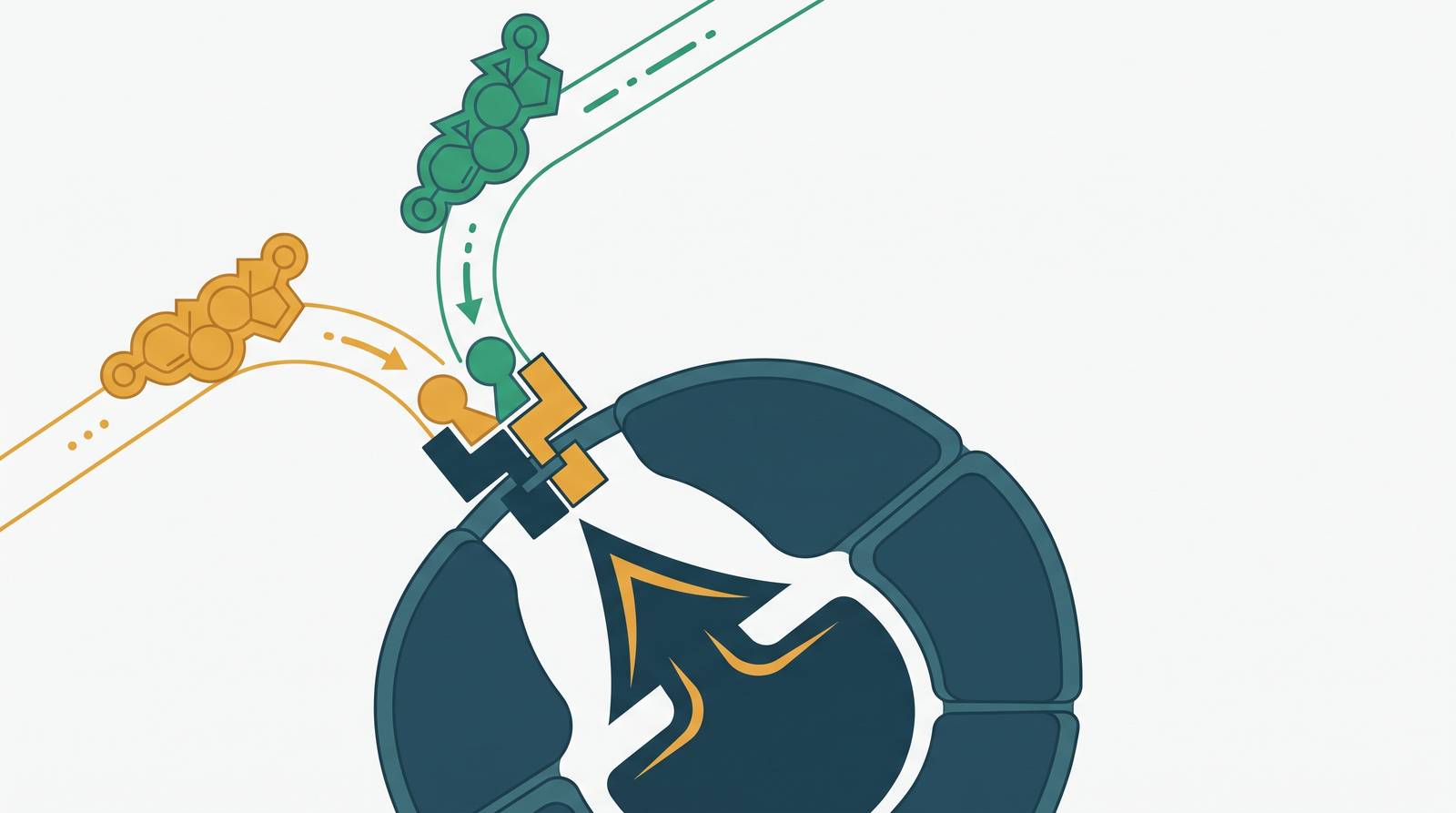
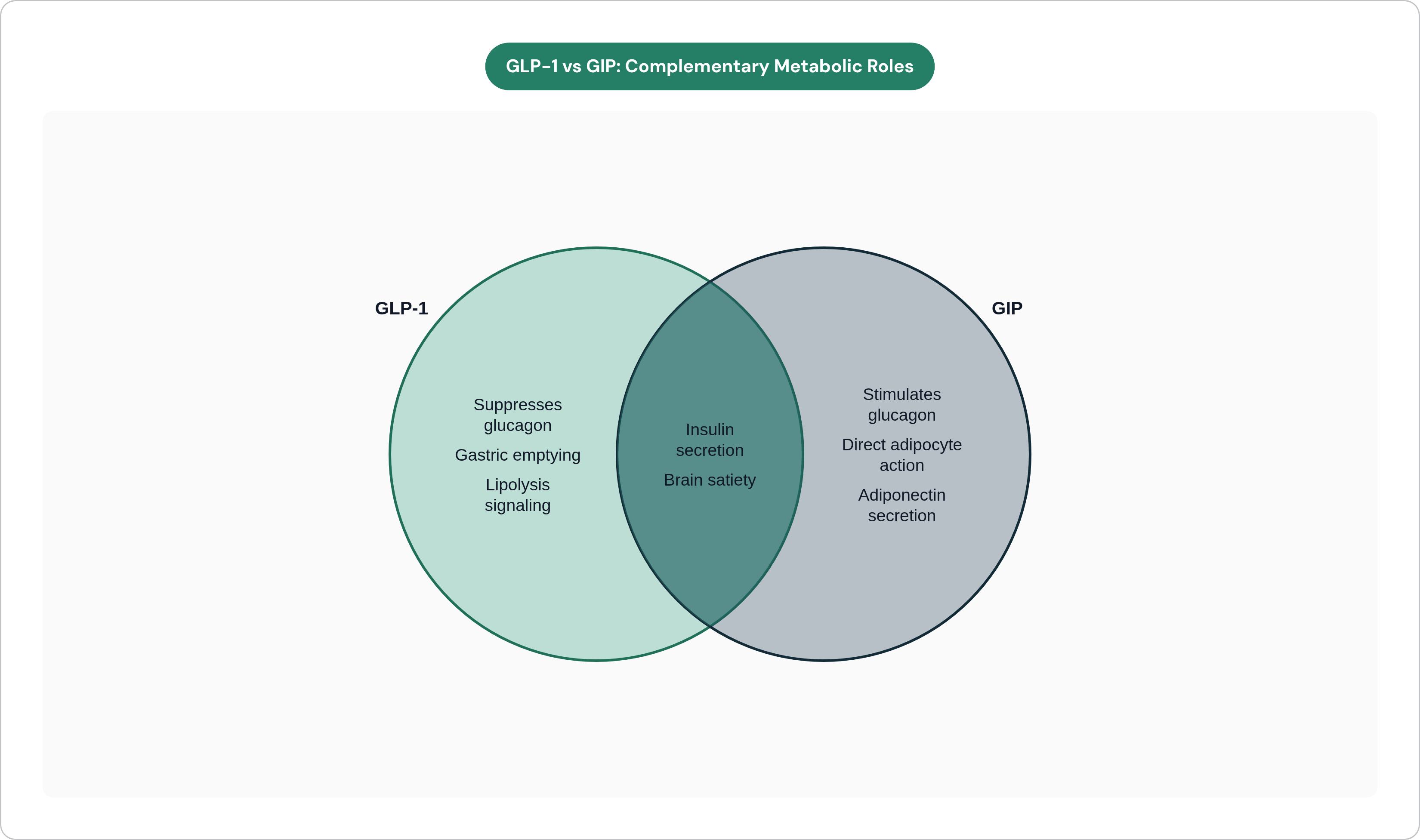
Both hormones bind receptors on pancreatic beta cells and stimulate insulin secretion, but only when blood glucose is already elevated. That glucose-dependence is not incidental; it is a physiological safeguard, a built-in constraint that makes dangerous hypoglycemic overshoot unlikely under normal incretin-mediated conditions.
Their divergence is sharpest at glucagon. GLP-1 suppresses it: during hyperglycemia, GLP-1 acts on pancreatic alpha cells to reduce glucagon secretion, cutting hepatic glucose output before it compounds the postprandial spike. GIP does the opposite, stimulating glucagon release during hypoglycemia as a counter-regulatory brake against glucose falling too low.
These are not parallel signals running the same program. They bracket euglycemia, one constraining the upper bound, the other defending the lower. GLP-1R knockout mouse studies confirmed that a dual GIP/GLP-1 agonist can still improve glucose tolerance through the GIP receptor alone, which establishes that each hormone's glycemic contribution is separable before any synergy question becomes meaningful. On the human side, Zander et al. demonstrated that sustained GLP-1 elevation over six weeks in type 2 diabetes patients significantly reduced plasma glucose and improved beta cell function, confirming that GLP-1 receptor engagement alone is sufficient for meaningful glycemic correction. GIP, in that framing, is not a redundant signal. It is a separate regulatory layer the system was already running in parallel, and that distinction becomes clinically important when the question shifts from controlling glucose to optimizing the full metabolic profile.
GIP's Direct Role in Fat Tissue, and How GLP-1 Complements It Through a Different Route
GIPR is expressed directly on adipocytes. That GIP stimulates lipogenesis sounds, at face value, like a liability for obesity treatment. The biology resolves this more quietly than you might expect: healthy fat storage in subcutaneous depots is metabolically protective; the damage comes from ectopic accumulation in visceral tissue, liver, and muscle, where it drives insulin resistance and systemic inflammation. GIP's direct adipocyte signaling tends to support the former. GLP-1 works through central and systemic mechanisms to discourage the latter.
GLP-1 has no direct adipocyte receptor pathway comparable to GIP's. Its effects on fat distribution operate through lipolytic signaling cascades and appetite suppression: indirect, but consequential. GIP, meanwhile, stimulates adiponectin secretion, an anti-inflammatory adipokine that improves insulin sensitivity downstream, feeding back into the same glycemic circuits that GLP-1 targets through the pancreas. The fat tissue story is not a separate subplot; it loops back into the glucose story.
This also supplies a mechanistic rationale for the weight-loss advantage observed with dual receptor engagement over GLP-1 agonism alone. Appetite suppression cannot fully account for that advantage on its own. The gap between what GLP-1 monotherapy achieves and what tirzepatide achieves in clinical trials suggests something more structural is operating, though characterizing exactly what that structure is remains unfinished work.
The GIP Receptor Debate: Why the Same Receptor Produces Different Outcomes Depending on How You Engage It
Genome-wide association study data links lower GIPR function to lower BMI. That association has led some researchers to ask whether blocking the GIP receptor, rather than activating it, might produce better weight outcomes. The hypothesis directly contradicts the dual-agonism rationale, and it cannot simply be dismissed. Two competing therapeutic philosophies now coexist: dual GIP/GLP-1 agonism, which treats GIP's full metabolic contribution as a net positive, and GIPR antagonism combined with GLP-1 agonism, which bets that removing GIP's lipogenic signaling amplifies weight loss. Amgen's MariTide represents the most publicly visible version of the second approach.
Neither has won the mechanistic argument. The persistence of the disagreement is itself informative, and I have spent enough time watching this field evolve to find that persistence more interesting than frustrating. The GWAS association is an observational correlation accumulated across a lifetime of gene expression patterns, not a clean pharmacological readout of what happens when GIPR is acutely blocked in a patient already receiving treatment. Context matters. The same receptor can behave differently depending on what else is happening in the system when you engage it, which is a basic principle of receptor pharmacology that gets underweighted when people reason directly from population genetics to drug design.
One proposed resolution worth taking seriously: GLP-1 receptor activation may restore GIP sensitivity that becomes blunted in poorly controlled type 2 diabetes. If that holds, the sequence and context of receptor engagement changes the pharmacological calculus entirely. GLP-1R activation would not be running in parallel to GIPR engagement; it would be a prerequisite for unlocking GIP's contribution. That is structurally different from additive agonism, and it has not been rigorously tested.
Cellular anatomy is starting to produce more granular answers. De Bray et al. (2025, Nature Metabolism) developed daLUXendin probes, the first fluorescent tools capable of mapping where dual agonist molecules actually bind in human and rodent islets at cellular resolution. Their work established a binding hierarchy: beta cells first, then alpha and delta cells. That grounds the debate in anatomical evidence rather than inference from systemic readouts. What remains open is whether the optimal GIPR engagement strategy differs between patients whose primary pathology is obesity and those whose primary pathology is type 2 diabetes. Anyone working in this space who claims the receptor debate is settled is working from incomplete evidence.
How Both Receptors Operate in the Brain, and What That Means for Appetite and Satiety
GLP-1R and GIPR are both expressed in hypothalamic regions governing energy balance and satiety. GLP-1's central effects are relatively well characterized: slowed gastric emptying, appetite suppression through hypothalamic and brainstem pathways, enhanced satiety signaling that limits meal size. GIP's central effects are less thoroughly mapped. The pathway is real and appears at least partially independent of GLP-1's. Independent pathways are not redundant; they converge on overlapping but non-identical neural circuits, which means they can compound each other's effects in ways a single-receptor agonist structurally cannot replicate.
The complicating factor is delivery. GLP-1 and GIP analogs are large, hydrophilic peptides. The blood-brain barrier is not meaningfully permeable to them following peripheral administration, so subcutaneous injection reaches the brain primarily through circumventricular organs and other regions of attenuated barrier function. Central effects from injected analogs are real, but they are constrained, and they probably underestimate what the biology would permit under more direct CNS delivery conditions.
That constraint has implications the field is only beginning to take seriously. If a meaningful portion of the weight-loss benefit from dual receptor agonism is centrally mediated, then current delivery routes may be leaving some of that benefit unrealized. Intranasal administration exploits olfactory and trigeminal nerve pathways to reach CNS targets through anatomical routing rather than pharmacological penetration of the barrier. Research from the University of Nottingham, published in RSC Pharmaceutics in 2025, documented that intranasally delivered drug molecules can be detected in olfactory bulbs and relevant brain regions within approximately one hour of administration. Subcutaneous delivery cannot replicate that timeline for CNS targets. Nanoparticle platforms designed for this route aim to deliver GLP-1 peptides nose-to-brain to engage central receptor populations more directly, while potentially reducing the peripheral gastrointestinal exposure that drives treatment discontinuation in a substantial share of patients.
Why the GLP-1 and GIP Signals Are Stronger Together Than Either Is Alone
The case for synergy is not about dosing arithmetic.
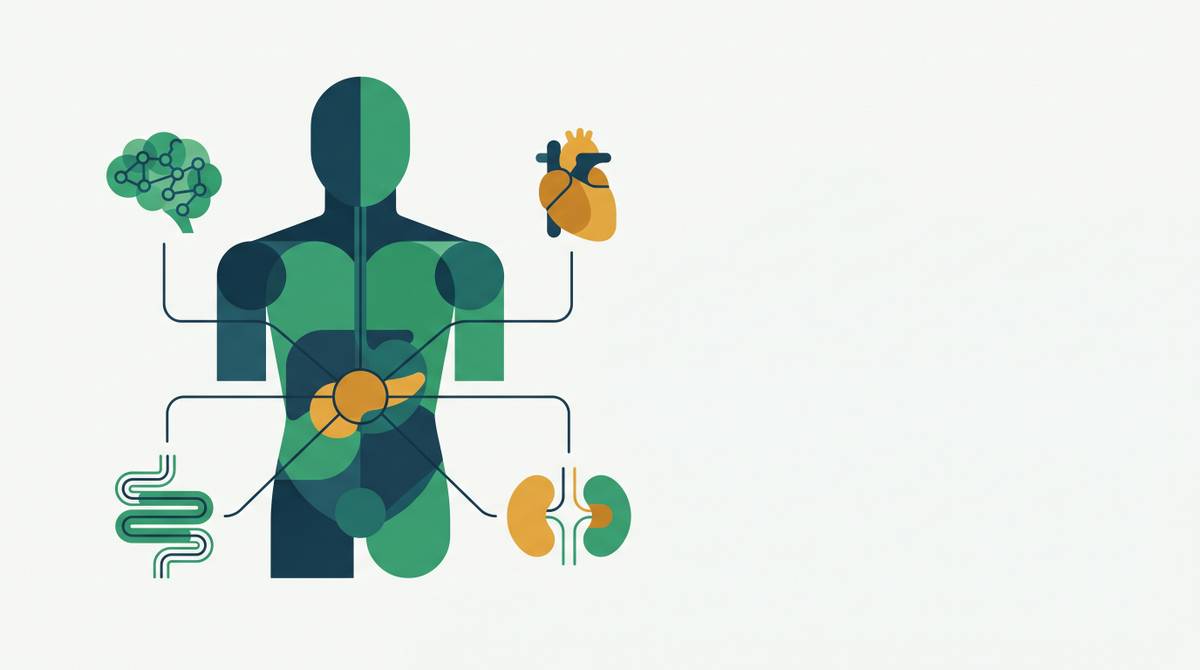
At the pancreas, GLP-1 suppresses glucagon at the upper boundary of the glucose range while GIP defends the lower boundary against hypoglycemia. Together, they stabilize glucose across the full physiological spectrum more effectively than either can alone. In adipose tissue, GIP maintains adipocyte function and adiponectin production while GLP-1 promotes lipolysis and limits ectopic accumulation; the combined effect is improved fat distribution and reduced dyslipidemia. In the brain, both hormones signal satiety through partially distinct neural circuits, and independent reinforcement of appetite suppression is plausible, even if its full magnitude at human resolution has not yet been characterized with precision.
There is also the potentiation argument. If GLP-1-mediated restoration of GIP sensitivity in type 2 diabetes patients means these signals are not simply running in parallel, then GLP-1R engagement may be actively creating conditions under which GIP's contribution becomes pharmacologically accessible. That is closer to sequential potentiation than to additive biology, with different implications for how combination therapies should be sequenced and dosed.
A qualification that cannot be dropped: much of the mechanistic evidence for synergy derives from animal models and receptor-level pharmacology. Human tissue-specific mapping at the resolution the daLUXendin probes now enable is still emerging. If brain receptor access is a genuine limiting factor in current delivery systems, how much of the dual-agonist advantage remains unrealized by subcutaneous administration? That question does not yet have a settled answer, and the clinical and commercial stakes attached to it are real.
What Understanding This Dual Mechanism Reveals About the Next Frontier of GLP-1 Therapeutics
The GLP-1 agonist market reached approximately USD 66.4 billion in 2025, according to Grand View Research, and is projected to reach USD 185.3 billion by 2033 at a compound annual growth rate of 12.4%. That scale reflects an expanding indication map that follows, fairly directly, from the receptor distribution map itself.
GLP-1R and GIPR expression in the brain opens plausible therapeutic pathways for neurological applications: addiction, neuroinflammation, cognitive decline. These are not speculative adjacencies conjured from commercial optimism. They are mechanistic extensions of the same receptor geography that explains appetite suppression, which is why the neuroscience literature has taken serious interest in GLP-1 agonism over the past several years. Peripheral dosing reaches these targets only partially. The gap between what the biology suggests is achievable and what current delivery systems actually achieve may be the defining bottleneck of the field's next phase. I suspect the industry is still underestimating how significant that gap is, partly because subcutaneous delivery has worked well enough for the indications where it was first validated that nobody had urgent reason to question the route.
Intranasal nanoparticle delivery is one serious attempt to close it. By routing peptides through olfactory and trigeminal pathways, such platforms aim to engage CNS receptor populations more directly, without relying on systemic exposure to permeate the blood-brain barrier and without the peripheral gastrointestinal burden that causes patients to discontinue treatment. The premise is not that injection is insufficient for glycemic control. It is that injection was never designed with central receptor access as its primary objective, and optimizing for that objective requires a different route.
The GIP receptor debate, agonism versus antagonism, is itself a signal about where the field stands. A scientific community still arguing about which direction to push the same receptor has not fully resolved the underlying mechanism. Higher-resolution cellular mapping, the daLUXendin work is a clear step forward here, will shape the next wave of therapeutics, as will delivery systems precise enough to engage specific receptor populations in specific tissues rather than relying on peripheral circulation to distribute the signal broadly. The biological logic of GLP-1 and GIP complementarity has been accumulating evidence for decades. Realizing its full potential now depends less on identifying new targets and more on building the delivery infrastructure to reach the ones already on the map.