GLP-1 Receptors in the Brain
GLP-1 receptors throughout the brain may protect against addiction and cognitive decline.

GLP-1 is a 30-amino acid peptide secreted by intestinal L-cells in response to food. The textbook framing treats it as an incretin: it stimulates insulin release, suppresses glucagon, and slows gastric emptying. That framing is accurate as far as it goes. But GLP-1 also functions as a neuromodulator, with a parallel signaling architecture resident in the brain itself. Its receptor, GLP-1R, is a class B G protein-coupled receptor expressed not only in the pancreas but across the central and peripheral nervous systems, cardiovascular tissue, kidneys, lungs, and gastrointestinal tract. The CNS expression pattern is what I keep returning to.
GLP-1 functions as a neuromodulator through a parallel signaling architecture in the brain itself, distinct from its incretin role in the pancreas. Its receptor, GLP-1R, is a class B G protein-coupled receptor expressed across the central and peripheral nervous systems, and endogenous GLP-1-producing neurons have their cell bodies concentrated in the caudal hindbrain, with the majority in the nucleus tractus solitarius and the remainder in the intermediate reticular nucleus. The NTS is particularly consequential because its neurons receive direct vagal sensory input from the gut, translating peripheral satiety signals into central commands that suppress hunger and regulate energy balance. Those NTS neurons project axons widely to subcortical targets, including the hypothalamus and limbic structures, which is the vagal arc that explains why GLP-1 drugs produce substantial weight loss even at doses originally calibrated for glycemic control.
The hypothalamus and the nucleus tractus solitarius (NTS) are the classical nodes for appetite regulation. GLP-1R agonists act on both to suppress hunger and maintain energy balance. The NTS is particularly consequential: its neurons receive direct vagal sensory input from the gut, translating peripheral satiety signals into central commands. The vagal arc explains why GLP-1 drugs produce substantial weight loss even at doses originally calibrated for glycemic control. Whatever the target label said, the brain was consistently in the picture.
The commercial scale of appetite-directed GLP-1 use reflects how large that realization became. The global GLP-1 receptor agonist market reached USD 66.4 billion in 2025 and is projected to reach USD 185.3 billion by 2033, with obesity therapeutics alone accounting for approximately USD 42 billion of current market size. These figures represent a fundamental repositioning of what GLP-1 drugs are understood to do.
The hypothalamus and NTS, though, are only two nodes on a far larger receptor map. Endogenous GLP-1 neurons have their cell bodies concentrated in the caudal hindbrain: the majority in the NTS itself, the remainder in the intermediate reticular nucleus. These neurons receive vagal sensory input and project axons widely to subcortical targets. It is at the boundaries of those projections, and beyond them, where the neurological story gets particularly interesting.
How Does GLP-1 Signaling in the Reward Circuit Connect to Addiction Research?
GLP-1R is expressed in the ventral tegmental area (VTA), the nucleus accumbens (NAc), and the prefrontal cortex: the three anchor nodes of the mesolimbic dopamine system that encodes reward, craving, and habit formation. GLP-1-producing neurons in the NTS project directly to the VTA and other limbic structures, physically embedding GLP-1 signaling within the dopamine reward network. When I first started working through this anatomy, the implications for addiction were not obvious to me. They become harder to ignore the longer you sit with the receptor distribution.
The mechanistic consequence follows from the structure. GLP-1R activation in this circuit modulates dopaminergic neurotransmission, synaptic plasticity, and the encoding of reward-associated cues. The receptor is not merely relaying satiety information to the limbic system; it appears to participate in the computation of salience and motivation. That distinction matters for reading the emerging addiction literature carefully.
Unhealthy alcohol use contributes to approximately 2.6 million deaths annually, and the existing pharmacological toolkit, naltrexone, acamprosate, disulfiram, produces modest effect sizes with inconsistent uptake. A 2025 randomized controlled trial published in JAMA Psychiatry (NCT05520775) reported that low-dose semaglutide reduced craving and some drinking outcomes in patients with alcohol use disorder. It was the first prospective RCT evidence of its kind. The significance lies less in the magnitude of the effect, which remains to be established in larger samples, than in the biological plausibility it places on firmer empirical footing. Separately, pharmacoepidemiological data published in Molecular Psychiatry in 2024 identified an association between semaglutide use and reduced incidence and relapse of cannabis use disorder. Early findings suggest reductions in cigarette consumption as well, though those results are inconsistent and constrained by small sample sizes.
What I am not doing here is overclaiming. Effect sizes are not yet established. Mechanisms in humans are largely inferred from preclinical dopamine work. The field needs adequately powered trials before clinical practice shifts. What the reward-circuit receptor distribution provides is a mechanistic argument for why these signals are biologically plausible, not a guarantee they are therapeutically actionable. Those are different claims, and collapsing them would be a mistake.
GLP-1 Receptors in the Hippocampus and Cortex (the Case for Cognitive and Neuroprotective Effects)
The hippocampus and frontal cortex both express GLP-1R. Both are also primary sites of early neuronal damage in Alzheimer's disease. The overlap is not causation, but it is a reasonable place to start building a hypothesis, and the hypothesis has since accumulated meaningful support.
The intracellular mechanism is worth understanding precisely, because it is not metabolic in nature. GLP-1R activation couples to Gs proteins, stimulating adenylyl cyclase, raising intracellular cyclic AMP, activating protein kinase A, and phosphorylating CREB, a transcription factor that induces expression of brain-derived neurotrophic factor (BDNF) and Bcl-2. BDNF supports neuronal survival and synaptic plasticity; Bcl-2 is anti-apoptotic. Preclinical work building on this pathway has documented reductions in neuroinflammation, attenuation of amyloid-beta accumulation, decreased tau hyperphosphorylation, and normalization of mitochondrial function. It is a cytoprotective program, and the consistency of those preclinical findings is what kept me interested even before clinical data materialized.
The epidemiological signal followed. Research published in Alzheimer's & Dementia found that GLP-1 receptor agonists were significantly associated with reduced Alzheimer's disease risk compared to DPP-4 inhibitors, with liraglutide and semaglutide each showing the association in drug-specific sensitivity analyses.
Phase 3 trial results in mild cognitive impairment and early Alzheimer's disease have not yet confirmed that observational signal, and this is where I think intellectual honesty requires some discomfort. Confounding, cohort selection, and the meaningful difference between slowing progression and reversing it are all live concerns that the epidemiological data cannot resolve. The substantia nigra, the dopamine-producing region most implicated in Parkinson's disease, also expresses GLP-1R, and early-phase Parkinson's trials have produced mixed results. The biological motivation for pursuing the question remains intact; the clinical confirmation does not.
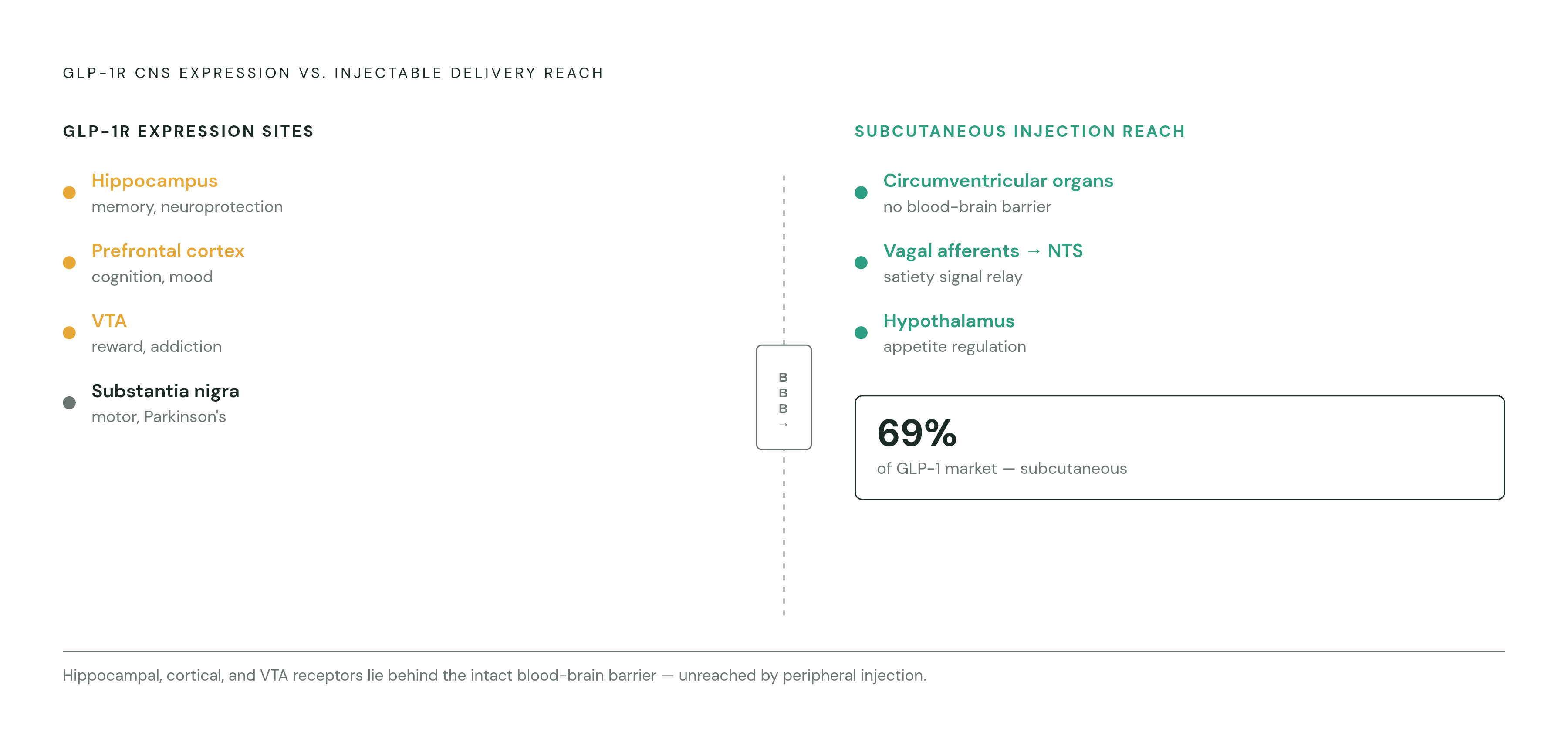
What the hippocampal, cortical, VTA, and substantia nigra data share is a structural observation that cuts across all of them. The most neurologically interesting GLP-1 receptors are not reliably reached by the delivery method currently dominating the market.
Why Systemic Injection Is a Structurally Imperfect Way to Reach Brain GLP-1 Receptors
The blood-brain barrier is not a technicality. Large peptides have limited CNS penetration via systemic circulation, and what reaches the brain from a subcutaneous injection is a fraction of the circulating dose. The primary route of CNS access for injectable GLP-1 agonists runs through circumventricular organs and vagal pathways, structures that lack the full barrier and that are contiguous with the NTS and hypothalamus. These are the appetite-regulating nodes where injectable GLP-1 drugs demonstrably work. They are not the hippocampal, cortical, and VTA receptors where the neurological hypotheses are concentrated.
There is a second structural constraint that gets less attention than it deserves. Hindbrain GLP-1-producing neurons do not themselves express GLP-1R. The neurons generating endogenous CNS GLP-1 tone are not directly accessible to systemically administered agonists. This is not a flaw in any particular molecule; it is a consequence of how the endogenous system is organized, and it constrains what injectable delivery can accomplish regardless of dose or reformulation.
Then there is the adherence data, which I find harder to set aside the more I look at it. According to an analysis by Prime Therapeutics published in 2024, 85% of patients were no longer taking GLP-1 drugs two years after starting treatment. Side effects accounted for 28.2% of all discontinuations; adverse drug reactions accounted for another 26.8%. The GI adverse events driving those numbers, nausea, vomiting, diarrhea, are a direct consequence of the systemic exposure that injectable delivery produces. Tirzepatide carries a diarrhea risk ratio of 1.81 to 2.18 versus placebo. Dropout probability is highest in the first six weeks, precisely when GI side effects are most intense and perceived benefit is lowest.
Cost adds another layer. Out-of-pocket costs for the lowest dose of semaglutide reached €2,000 in Denmark as of June 2025; in the United States, cost concerns drove 14.4% of all discontinuations. Injectable delivery currently accounts for roughly 69% of the GLP-1 market by revenue (Grand View Research, 2025). That share reflects market inertia and first-mover infrastructure, not necessarily the optimal match between delivery method and therapeutic target.
If the most therapeutically interesting GLP-1 receptors are in the brain, and systemic injection reaches them inefficiently while producing the GI side effects that push patients off therapy, then the question of what a delivery route designed for brain access might look like is worth asking directly.
The Nose-to-Brain Route as a Direct Path to the Receptor Regions That Matter Most
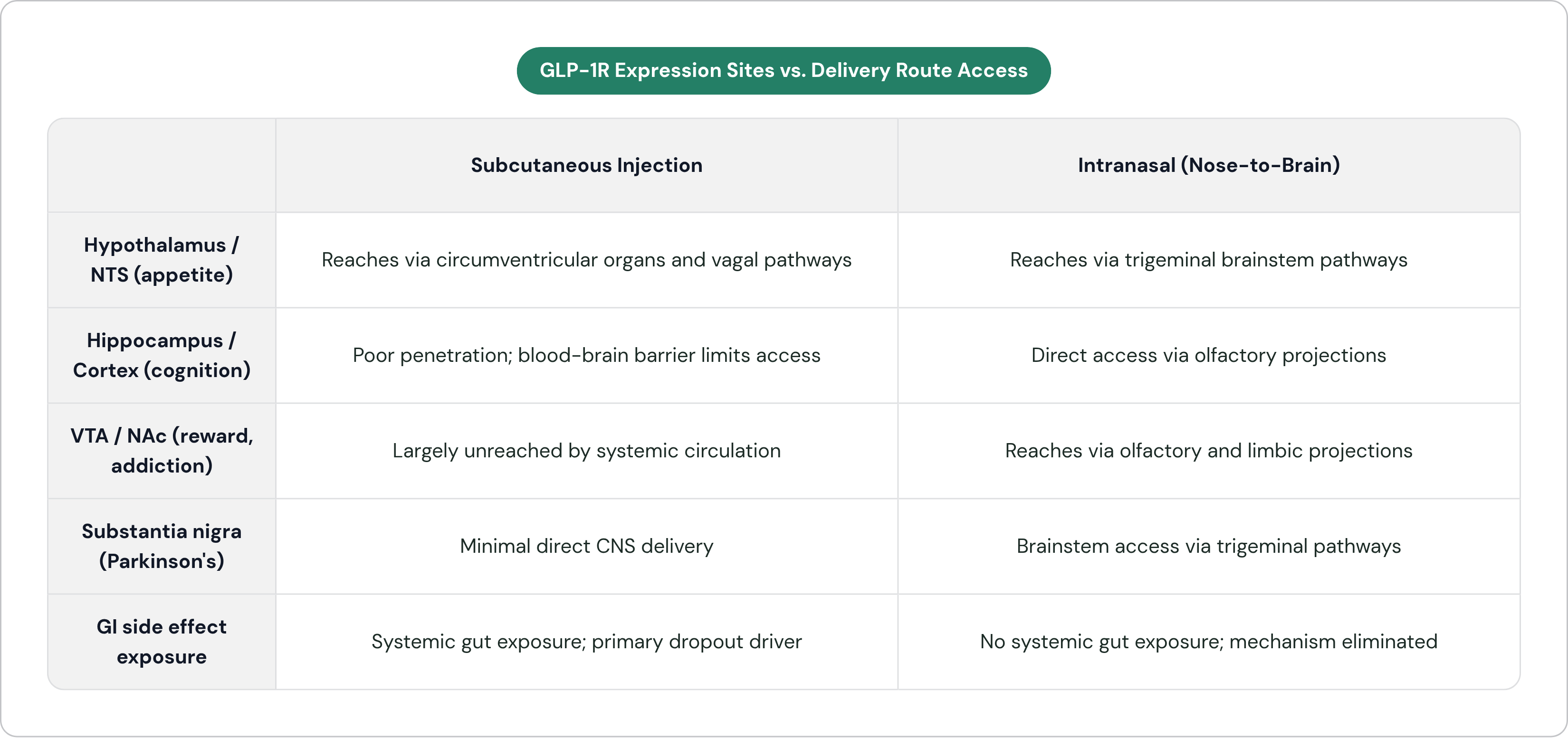
Intranasal delivery bypasses the blood-brain barrier by exploiting the olfactory and trigeminal nerve pathways. These are physical conduits from the nasal epithelium directly into the CNS, without requiring passage through systemic circulation. The anatomical advantage maps onto the receptor atlas with notable precision. Olfactory projections reach the olfactory bulb, hippocampus, and cortex; trigeminal pathways reach the brainstem and deeper structures. These are routes to the regions where GLP-1R expression is driving the cognitive and neuroprotective hypotheses, not peripheral access points.
The GI side effect profile that undermines injectable adherence is also structurally addressed by this route. Eliminating systemic gut exposure removes the mechanism producing nausea, vomiting, and early dropout, not by reducing dose but by changing the exposure pathway entirely. The 28.2% of discontinuations attributed to side effects in the Prime Therapeutics data represent a patient population that might be retained by a formulation that never directs the drug through the gut at all. I do not think that implication has received adequate attention in delivery strategy discussions.
The formulation challenge is real, and I would rather not paper over it. Naked peptides degrade rapidly in the nasal mucosa and cross mucosal barriers with limited efficiency. Effective nose-to-brain delivery of a 30-amino acid peptide requires a carrier engineered for mucosal stability, mucoadhesion, and controlled release. Scalable solutions are not trivially achieved, and the field is still working through what "engineered for this purpose" actually requires in practice. Lionbio is one platform entering this space, a nasal-spray nanoparticle peptide startup building on patented Columbia University IP to deliver GLP-1 therapeutics through the nasal epithelium directly to CNS targets, with the nausea profile of injectable GLP-1s as a central problem the route is meant to solve. The platform is oriented toward the receptor geography this article has been tracing: not generic brain access, but targeted delivery to the specific regions where GLP-1R expression makes neurological intervention biologically coherent.
The receptor map, followed from appetite regulation through reward circuitry to hippocampal neuroprotection and dopaminergic integrity, touches regions relevant to obesity, addiction, neurodegeneration, and psychiatric disease. Whether those indications become clinically actionable depends, in each case, on whether the drug reaches the receptor. That dependency is a delivery problem, one that the intranasal nanoparticle route was designed, anatomically and chemically, to address.