Molecular Structure of GLP-1 Receptor Agonists
Why DPP-4 enzyme destruction forced all GLP-1 drug designs.
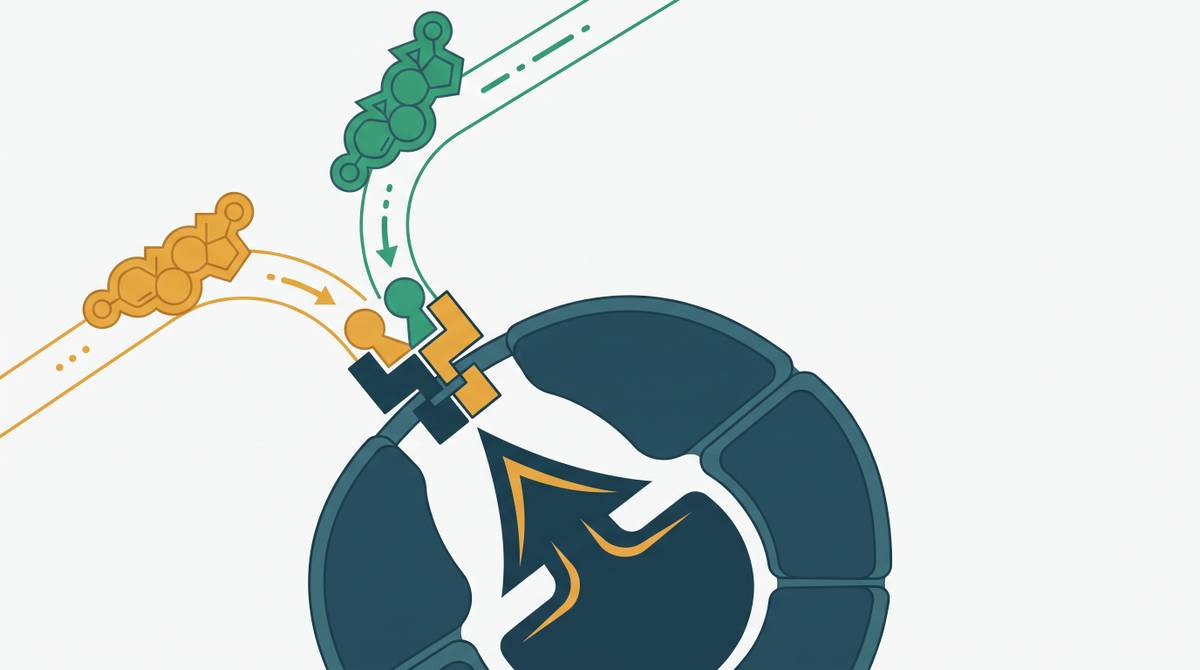
Dipeptidyl peptidase-4, DPP-4, is everywhere. It circulates in plasma and lines the endothelial surface of blood vessels throughout the body. Within minutes of GLP-1 secretion, it cleaves the peptide at its N-terminus, producing fragments designated GLP-1 (9–36 amide) and GLP-1 (9–37). Neither fragment activates the GLP-1 receptor. Neither triggers insulin release or suppresses appetite. The endogenous peptide's half-life is measured in minutes, and that is not a pharmacokinetic inconvenience. It is a molecular disqualification.
Native GLP-1 cannot be administered at higher doses to compensate for enzymatic destruction because the problem is not one of supply. DPP-4, which circulates in plasma and lines the endothelial surface of blood vessels throughout the body, cleaves GLP-1 at its N-terminus within minutes of secretion, producing fragments GLP-1 (9–36 amide) and GLP-1 (9–37) that activate neither the receptor nor any downstream signaling. The peptide is destroyed in transit before it reaches its target, so increasing the dose does nothing to change that outcome. Every structural modification defining the engineered receptor agonists used in practice is, at some level, a design answer to the biochemical problem DPP-4 posed first.
The obvious question follows: what if we simply administered more native GLP-1? Surely a higher dose could outpace the enzyme? No, and the reason cuts deeper than it first appears. DPP-4 intercepts the peptide before it can reach its target. The problem is not supply; it is that the molecule is destroyed in transit. Researchers who arrive at GLP-1 biology from a clinical rather than biochemical background tend to rediscover this point independently, convinced at first that the answer must be a dosing problem. It is not. DPP-4 renders the question structurally moot before it can even be framed that way.
This single vulnerability, a cleavage site at the peptide's N-terminus, is the origin point of every design decision the field has made since. Every modification that follows is, at some level, a structural answer to a biochemical problem DPP-4 posed first.
How the GLP-1 Receptor Binds Its Ligand and Why That Mechanism Constrains Drug Design
The GLP-1 receptor belongs to Class B of the G protein-coupled receptor superfamily. That classification carries mechanistic weight that is easy to underestimate if your background is in small-molecule pharmacology. Class B GPCRs bind large peptide ligands through a two-step mechanism that is highly sensitive to three-dimensional conformation in a way Class A receptors, which often accommodate small organic molecules, simply are not.
Binding proceeds sequentially. The C-terminal portion of GLP-1 engages the receptor's extracellular domain first, anchoring the molecule at the surface. The N-terminus then inserts into the transmembrane bundle, triggering the conformational change that activates the receptor and initiates the downstream cascade: G protein coupling, cyclic AMP production from ATP, Protein Kinase A activation. That entire signaling sequence depends on the peptide's helical geometry being intact when it arrives. An agonist presenting a disordered or incorrectly shaped N-terminus does not merely bind less well; it may fail to trigger activation at all.
Here is the tension that anyone who has worked in this space will recognize. The modifications needed to protect the N-terminus from DPP-4 cleavage must not disrupt the binding geometry the receptor requires. These are partially competing requirements. A 2025 study investigating conformational changes across GLP-1R activation and inactivation states makes clear that the receptor's conformational dynamics remain an active research frontier, still being mapped. Engineering a GLP-1 agonist means optimizing against a target whose full behavior is not yet understood. Any design team claiming complete confidence that a given structural modification preserves, rather than merely tolerates, receptor geometry is probably overreaching.
Why Can't You Just Give Higher Doses of Native GLP-1 Instead of Engineered Receptor Agonists?
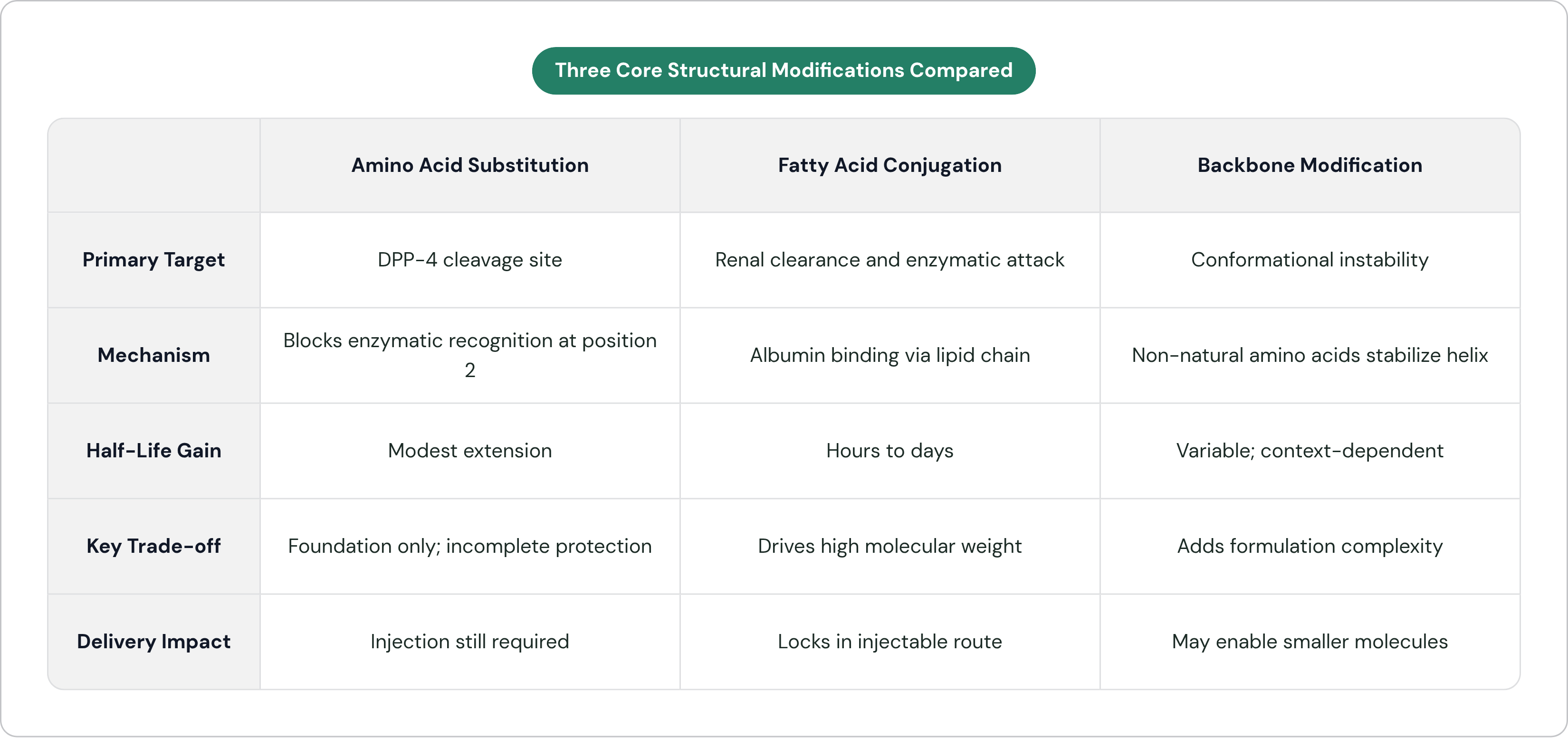
Three broad categories of modification have defined the field's engineering trajectory. Each targets a distinct vulnerability, and their interactions are where the real difficulty lives.
Amino acid substitution at the DPP-4 cleavage site is the most direct intervention: replacing or modifying the amino acid at position 2 blocks enzymatic recognition without eliminating receptor binding. Most first-generation agonists are built on this foundation.
Fatty acid conjugation and albumin binding address the half-life problem differently. Attaching a lipid chain causes the peptide to associate with circulating albumin, a large plasma protein that turns over slowly. The albumin association shields the conjugated peptide from renal clearance and enzymatic attack, extending half-life from minutes to hours or days. This strategy enabled the transition to once-weekly dosing that distinguishes later-generation agents.
Backbone modifications, substituting non-natural amino acids or introducing chemical changes that stabilize helical conformation under physiological conditions, reduce the conformational entropy that leaves unmodified peptides vulnerable. Research on short-form agonists, including work on 18-amino acid peptides such as SR18 that maintain ordered helical conformations across solvent conditions and demonstrate stable receptor interactions over extended molecular dynamics simulations, suggests that a considerably smaller molecule than current long-chain agents can satisfy the structural requirements. Smaller molecules open formulation possibilities that large, heavily modified peptides foreclose.
Each clinical generation reflects progressive refinement across these strategies. Early short-acting agents proved the concept but required frequent injection. Longer-acting formulations achieved once-weekly dosing through deeper structural stabilization. The structural trap, though, is this: the modifications that extend half-life, bulky lipid chains, increased molecular weight, complex backbone engineering, are precisely what make these molecules difficult to deliver by any route other than injection. The compliance problem patients experience was built into the chemistry from the beginning.
What Multi-Receptor Agonism Adds to the Structural Picture
The GIP receptor and the glucagon receptor are structurally related Class B GPCRs. Their peptide ligands share sequence and conformational similarities with GLP-1, and that kinship makes it feasible, if not simple, to engineer a single molecule that activates two or three receptors simultaneously by tuning the peptide sequence and conformation at specific positions.
The clinical rationale is hard to dismiss. Triple GLP-1/GIP/glucagon receptor agonism, demonstrated in clinical trials of retatrutide, produced average weight loss of 24.2% at 48 weeks, approaching bariatric surgery outcomes and the highest pharmacological weight loss reported in the literature to date.
The structural challenge scales with each additional receptor target. Each adds binding geometry requirements the molecule must satisfy simultaneously, and a peptide engineered to activate three Class B receptors navigates a considerably more complex conformational landscape than one optimized for a single target. That complexity does not stay contained at the molecular level; it propagates into manufacturing, formulation, and safety.
Drug-induced liver injury has emerged as a recurring obstacle across multiple programs, appearing in both peptide-based and small-molecule pipelines. Pfizer discontinued their small-molecule oral GLP-1 program in 2025 after liver toxicity cases emerged in clinical trials. The pattern suggests that pushing molecular complexity toward polypharmacology introduces risks not visible until late-stage trials. Structural optimization for efficacy does not automatically resolve what comes next.
The Small-Molecule Attempt to Sidestep Peptide Delivery Constraints
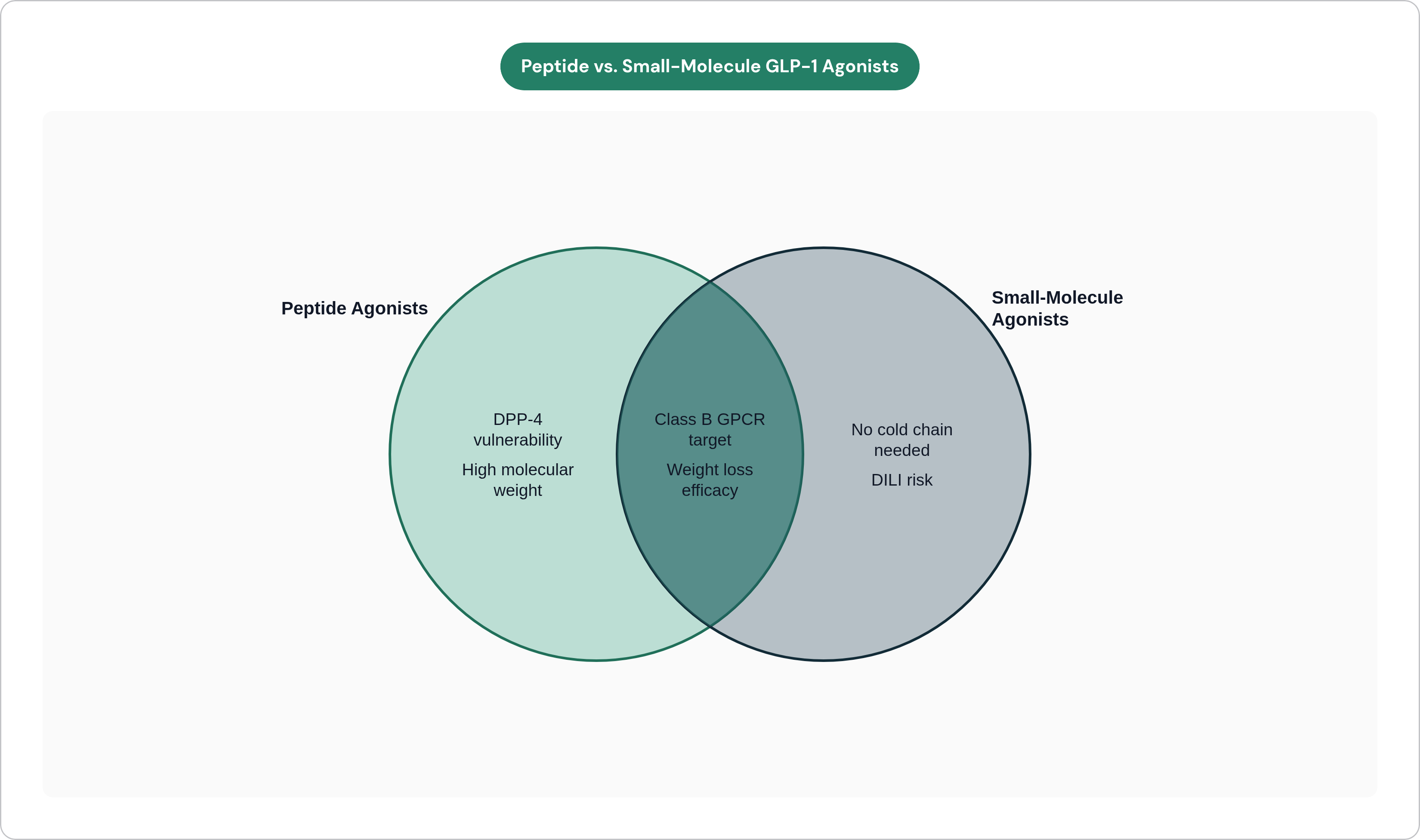
The structural logic of the small-molecule approach is coherent. If the delivery problem originates in peptide chemistry, specifically enzymatic degradation in the GI tract, poor membrane permeability, and high molecular weight, then abandoning the peptide scaffold looks like a rational engineering response. Small molecules survive oral delivery because they are not substrates for the enzymatic pathways that destroy peptides in the gut. They can be formulated as tablets. They do not require cold chain storage or injection training.
Orforglipron, a non-peptide small-molecule GLP-1 receptor agonist, completed Phase III trials in 2025 and, if approved, would represent the first oral non-peptide GLP-1 agonist to reach the market. That is a notable technical achievement, and the field should take it seriously.
The tradeoff at the receptor level deserves scrutiny, though. Small molecules bind Class B GPCRs differently from the native peptide, and less completely. Partial agonism, altered downstream signaling profiles, and divergent side-effect signatures are mechanistically plausible consequences of engaging a receptor optimized by evolution for a helical peptide ligand with a small organic molecule instead. The DPP-4 vulnerability is avoided; receptor fidelity may be reduced in ways that matter clinically. The recurring DILI signal across small-molecule programs, including Pfizer's discontinued effort, suggests that departing from the peptide scaffold introduces toxicity risks not present in the same form with peptide-based agonists.
Small molecules trade one constraint for another. Delivery becomes manageable; receptor fidelity and toxicity risk become the new problems. The native peptide conformation remains the most complete activator of the GLP-1 receptor. If the full pharmacological benefit of GLP-1 agonism is the goal, the problem to solve is peptide delivery, not peptide chemistry. The small-molecule programs looked promising a decade ago, and the formulation advantages were real. The clinical data, in certain respects, keep pointing back to the peptide.
How Structural Complexity Translates Directly into the Injection Dependency Patients Experience
Prescription volume for GLP-1 receptor agonists grew 587% in the United States between 2019 and 2024. The injectable segment held approximately 69% of the global GLP-1 market in 2025. The field's infrastructure, its clinical evidence base, its physician habits, are organized around injection as the default.
The molecular reason is not mysterious. The features that make long-acting peptide agonists clinically effective, high molecular weight, lipid conjugates, modified backbones, are the same features that prevent meaningful oral or nasal absorption without a carrier technology. The GI enzymatic environment degrades unprotected peptides before they reach systemic circulation. Nasal mucosal barriers limit peptide permeation without a delivery vehicle. Injection bypasses both efficiently, which is why the field converged on it.
The compliance consequences are significant. Discontinuation rates are steep; studies consistently show roughly a third of patients stop within twelve months. Injection burden contributes. So does nausea.
Nausea is a near-universal early side effect, typically framed as a pharmacological consequence of the molecule. That framing is incomplete. GLP-1 receptors are expressed throughout the GI tract. A peptide delivered by injection enters systemic circulation and reaches gut receptors as part of its normal distribution. A molecule that activates those receptors will produce GI effects. The route of delivery determines which receptors the peptide encounters first and at what concentration. Nausea, understood this way, is partly a delivery problem presenting as a pharmacology problem, and whether a route that bypasses systemic circulation could sidestep some portion of that gut receptor exposure is a question the field has not yet answered at scale.
Why the Nose-to-Brain Route Is a Structurally Rational Answer to Peptide Delivery
GLP-1 receptors are expressed in the central nervous system: the hypothalamus, the brainstem, regions governing appetite, reward processing, and metabolic signaling. Some of the most clinically relevant effects of GLP-1 agonism, appetite suppression and the emerging signals in addiction circuitry and neuroinflammation, are mediated centrally. This is not peripheral to the molecule's pharmacology.
Injected peptides must cross the blood-brain barrier to reach CNS targets, and large, lipid-conjugated molecules do not cross it readily. The intranasal route offers a structurally distinct pathway. The olfactory and trigeminal nerve pathways provide direct anatomical connections between the nasal epithelium and the brain, bypassing the blood-brain barrier entirely. This is established physiology.
Intranasal delivery also avoids the GI enzymatic environment that destroys peptides orally and the gut receptor exposure that produces nausea with systemic injection. For peptide molecules, it is potentially compatible with formulations that do not require heavy lipid conjugation, because the goal is direct CNS delivery rather than prolonged systemic circulation. The structural modifications that become necessary for systemic half-life extension may simply be unnecessary if the delivery route changes.
The challenge is mucosal barrier penetration. Unprotected peptides do not permeate nasal mucosa efficiently. Mucociliary clearance removes deposited material quickly. Enzymatic activity at the mucosal surface degrades peptides before absorption. These are real barriers, and the nose-to-brain route has been structurally rational for longer than it has been therapeutically viable. The receptor science arrived before the delivery technology capable of exploiting it. That gap between scientific rationale and delivery feasibility is where much of the interesting work is currently happening.
Neurological indications, including emerging research on addiction circuitry and neuroinflammation relevant to neurodegenerative disease, may require CNS concentrations that a systemic route cannot reliably achieve at tolerable doses. The delivery route is not merely logistical. It determines which biology you can actually access.
What Nanoparticle Delivery Technology Does to the Peptide's Structural Problem
The nasal mucosal barrier presents three simultaneous obstacles: size, charge, and enzymatic vulnerability. Peptides are too large to diffuse freely across mucosal tissue; they carry surface charges that interact unfavorably with mucosal components; and enzymes present at the epithelial surface degrade them before absorption can occur. Mucociliary clearance compounds all three by removing material before any of it can work.
Nanoparticle encapsulation addresses these obstacles concurrently. A properly engineered particle protects the encapsulated peptide from enzymatic attack at the mucosal surface. Particle size and surface chemistry can be tuned to interact favorably with mucosal tissue and engage the olfactory epithelium specifically. Controlled release at the target site allows the peptide to arrive with its structural integrity intact, preserving the helical conformation and receptor-binding geometry the GLP-1 receptor requires.
Consider what this means for the peptide itself. Nanoparticle delivery does not modify the cargo; it creates a protected transit environment that allows the peptide to maintain its native conformation through the delivery process, arriving at CNS tissue in a form capable of engaging the receptor correctly. The alternative, burdening the peptide molecule itself with structural modifications to survive systemic delivery, necessarily alters the molecule and, to some degree, its binding fidelity. Engineering the vehicle rather than the cargo preserves more of what makes the peptide pharmacologically effective. That design philosophy is structurally defensible, though clinical validation will be the actual test.
The platform logic extends beyond GLP-1. Any peptide or biologic requiring CNS delivery faces a structurally analogous set of obstacles at the nasal mucosa: size, enzymatic vulnerability, clearance. A nanoparticle platform designed to navigate those obstacles is applicable, in principle, to addiction peptides, neuroprotective agents, and other biologics where CNS delivery is the rate-limiting step.
Whether nose-to-brain delivery reshapes the GLP-1 market will depend on clinical outcomes. The structural rationale, built from the helical conformation required for Class B GPCR activation, the CNS distribution of GLP-1 receptors, and the persistent failure of molecular modification alone to resolve the delivery problem, points consistently toward a problem the field has not yet solved. Whether this particular approach solves it is an open question. That it is the right question seems harder to dispute.