DPP-4 Degradation of GLP-1 and Half-Life Engineering
Engineering amino acid swaps and albumin binding stretch GLP-1's survival from minutes to a week.

Dipeptidyl peptidase-4 is a serine protease with a narrowly defined substrate preference: it cleaves dipeptides from the N-terminal end of peptide chains where the second amino acid is proline or alanine. That specificity sounds limiting. GLP-1 satisfies it perfectly.
The hormone's two N-terminal residues are histidine at position 7 and alanine at position 8. The enzyme excises that dipeptide and leaves behind GLP-1(9-36), a fragment with no insulinotropic activity. GLP-1(9-36) may also function as a partial antagonist at the GLP-1 receptor, meaning the degradation product competes with whatever intact hormone remains. Degradation here isn't merely silencing; it potentially arms the molecule against itself.
The result is a plasma half-life of roughly two to three minutes.
Geography compounds the problem. DPP-4 is not primarily a circulating plasma protein. Tissue-specific knockout studies identify endothelial DPP-4, expressed on the luminal surface of blood vessels, as the dominant site of incretin degradation. More consequentially, the enzyme concentrates on intestinal cell surfaces, meaning GLP-1 faces attack almost immediately upon secretion, before it transits the gut epithelium. Only 10 to 15% of secreted GLP-1 arrives intact in systemic circulation.
One detail that tends to get buried in GLP-1-focused discussions: DPP-4 processes more than 30 known bioactive peptides, including GIP, neuropeptide Y, peptide YY, stromal cell-derived factor-1, and substance P. I keep returning to that substrate promiscuity when evaluating any strategy targeting the enzyme itself, because the off-target implications don't disappear just because GLP-1 is the molecule generating headlines.
Why Blocking DPP-4 with Gliptins Only Goes So Far
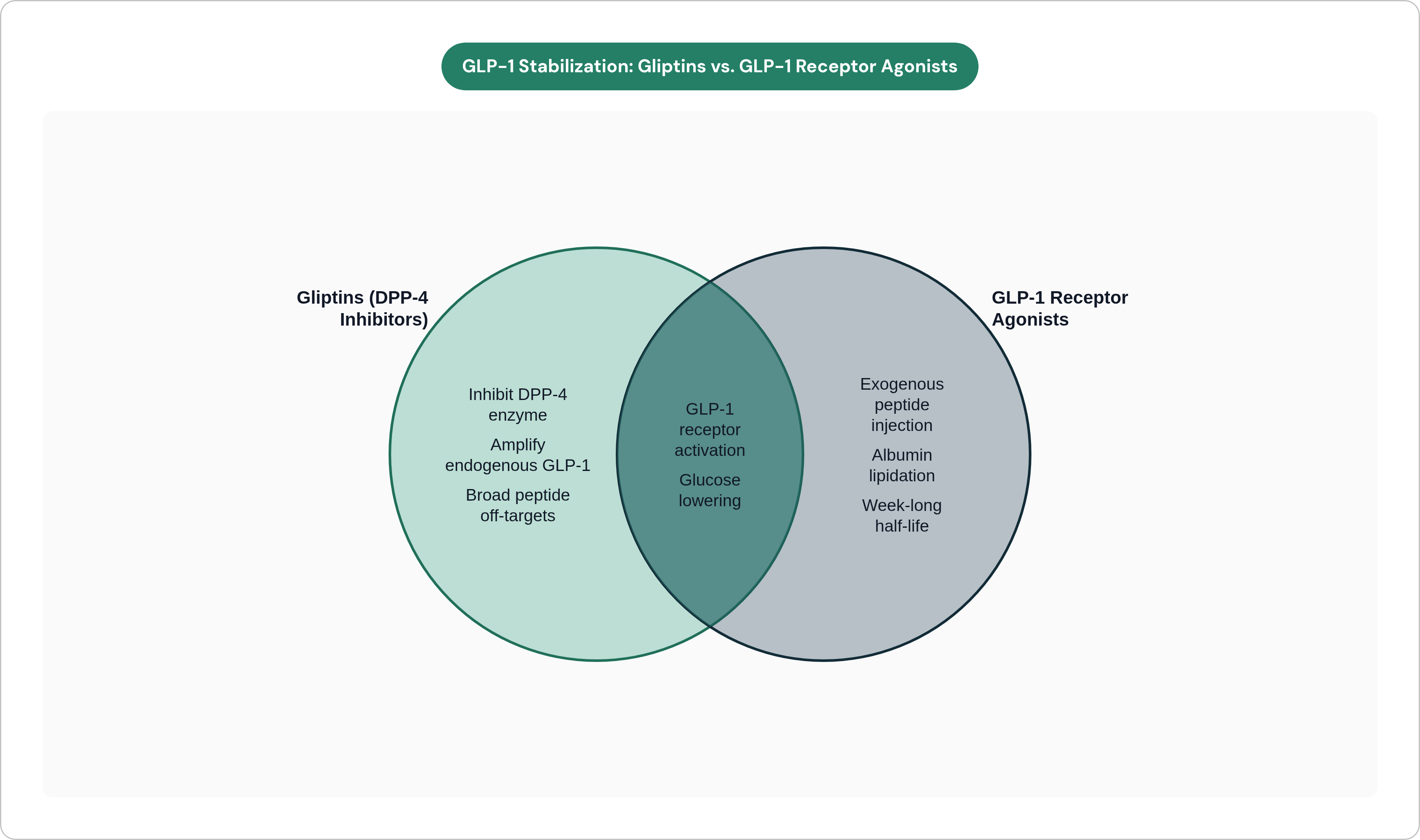
The first pharmaceutical response to DPP-4's cleavage activity was logical: inhibit the enzyme and let endogenous GLP-1 accumulate. This is the mechanism behind the gliptin class, sitagliptin and its successors, which achieved meaningful commercial success and remain in widespread clinical use.
The ceiling on their efficacy is embedded in the mechanism itself. Even with effective DPP-4 inhibition, extension of GLP-1's half-life is modest, from roughly one minute to approximately five minutes. Intact GLP-1 levels rise two to threefold. That is a real pharmacological improvement, but it bears no resemblance to the concentrations achievable by injecting an exogenous GLP-1 receptor agonist directly into the bloodstream.
Gliptins are amplifiers. Whatever GLP-1 the body secretes in response to a meal defines the upper limit of what they have to work with, and for patients whose metabolic disease requires pharmacological concentrations of GLP-1 receptor activation, that ceiling arrives quickly. There is also the promiscuity problem: systemically suppressing DPP-4 means interfering with the processing of every peptide it normally handles. A molecule acting only at the GLP-1 receptor doesn't carry that liability, which is part of why the field moved on.
The Molecular Engineering Strategies That Extended GLP-1's Half-Life from Minutes to Days
Two imperatives emerged in parallel: make the molecule resistant to DPP-4 cleavage at its N-terminal vulnerability, and slow the clearance mechanisms that remove intact peptide from circulation even when cleavage is prevented. The most successful clinical agents pursue both simultaneously.
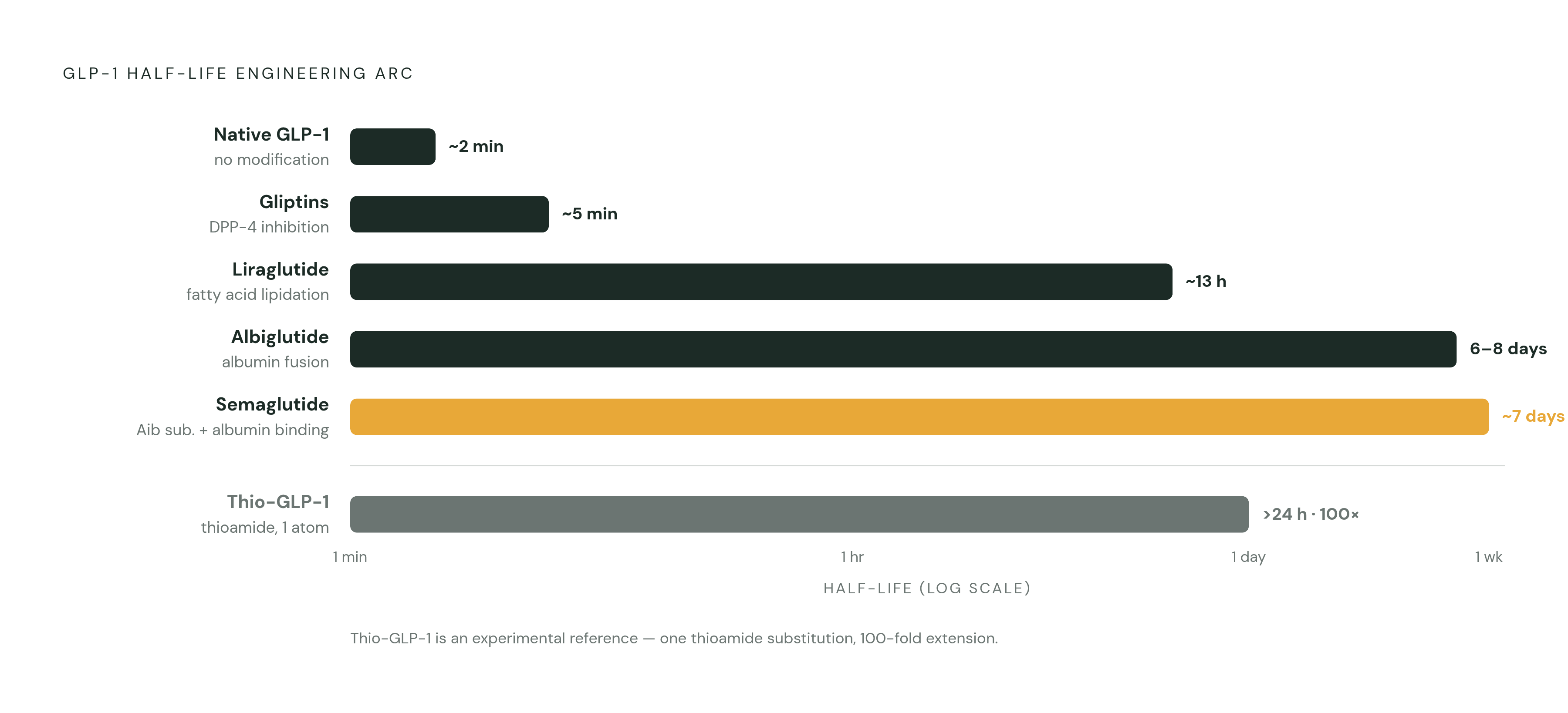
Amino acid substitution at the cleavage site. The simplest intervention is removing what DPP-4 recognizes. Semaglutide substitutes the Ala8 residue with alpha-aminoisobutyric acid (Aib). That single swap eliminates DPP-4's grip on the N-terminal dipeptide; the enzyme cannot engage a substrate it doesn't recognize in the correct conformation. Aib substitution is necessary but not sufficient. A DPP-4-resistant peptide that still gets filtered renally or degraded by other proteases ends up with a marginally longer half-life, not a transformative one.
Fatty acid lipidation and reversible albumin binding. Albumin, the most abundant protein in blood plasma, evades renal filtration by virtue of its size and FcRn-mediated recycling. Molecules that bind reversibly to albumin inherit its long effective half-life. Liraglutide and semaglutide both carry a fatty acid chain attached via a linker to the peptide backbone, binding non-covalently to albumin in circulation. Combined with DPP-4-resistant substitution, the strategy extends semaglutide's half-life to approximately one week, roughly five thousand times longer than native GLP-1 survives.
The engineering here is not merely additive, and this is where the work gets particularly interesting. Albumin binding that is too strong reduces the fraction of drug available to engage the GLP-1 receptor, because a molecule buried in an albumin-binding groove cannot simultaneously activate its target. Linker chemistry, fatty acid chain length, and attachment site all influence the binding equilibrium. The clinical molecule represents a specific, negotiated balance among competing constraints.
Albumin fusion. Albiglutide takes the albumin strategy to its structural extreme, genetically fusing two tandem GLP-1 analog sequences directly to human serum albumin as a single recombinant protein. The achieved half-life of six to eight days suits once-weekly dosing. The cost is receptor potency: the GLP-1 receptor affinity of the fusion construct is orders of magnitude weaker than that of a small, conformationally flexible analog like exenatide. This tradeoff recurs throughout half-life engineering. Stability mechanisms, whether through steric protection, conformational rigidity, or carrier binding, tend to interfere with the dynamic receptor engagement that drives pharmacological activity.
Thioamide substitution. At the experimental frontier sits an approach that illustrates how deep the medicinal chemistry toolkit actually reaches. A single-atom substitution, replacing one peptide bond oxygen with sulfur to create a thioamide linkage, produces a molecule with the same amino acid sequence as native GLP-1 but a dramatically extended half-life. Under conditions where native GLP-1's half-life runs approximately 21 minutes, the thioamide analog's half-life exceeds 24 hours, a more than 100-fold improvement from one atomic change. Thio-GLP-1 appears to act as a competitive inhibitor of DPP-4, occupying the enzyme's active site without being cleaved, while simultaneously agonizing the GLP-1 receptor. It is not yet in clinical development, but it demonstrates that the engineering design space for GLP-1 stabilization has not been exhausted by current clinical agents.
What AI-Designed GLP-1 Analogs and Stapled Peptides Add to the Engineering Frontier
Manual medicinal chemistry explores the design space around known molecular templates: start with a GLP-1 scaffold, make targeted modifications, test, iterate. The process is powerful but inherently local. It finds improvements near where it starts.
Deep learning-based protein design operates differently. A 2025 preprint describes a pipeline that generated ten thousand de novo GLP-1 receptor agonist candidates computationally, then screened sixty through stability, efficacy, and diversity filters. In vitro validation success rate among tested candidates reached 62%. Two candidates demonstrated in vivo half-lives approximately three times longer than semaglutide. The implication is not that AI replaces medicinal chemistry; the sequence space of possible GLP-1 analogs is vastly larger than what human-directed exploration has surveyed, and systematic computational mapping will surface solutions that weren't intuitable from existing scaffolds. The harder question is whether the validation pipeline can scale to match the generative capacity, and that answer isn't here yet.
Stapled peptides pursue a different structural logic. Incorporating a serum protein-binding motif into a covalent side-chain staple, a chemical bridge between two residues of the peptide backbone that locks secondary structure, produces analogs with potency comparable to established GLP-1 agonists and substantially improved pharmacokinetics. In at least one research program, these analogs were delivered via a dissolvable microstructure transdermal system, achieving sustained blood concentrations and glucose-lowering activity in animal models without injection.
What makes that combination worth noting is that stapled peptide research is beginning to treat molecular stabilization and delivery route as a single integrated design problem rather than sequential engineering challenges. The conceptual reorientation is real, even if clinical validation remains ahead.
Why Even a Week-Long Half-Life Doesn't Solve the Oral Bioavailability Problem
Stability in circulation and stability during transit to circulation are separate problems. A molecule can be exquisitely resistant to DPP-4, bound tightly to albumin, and architecturally impervious to protease cleavage, and still be destroyed before reaching the bloodstream if swallowed. The features that protect a molecule in the bloodstream offer essentially no protection in the gut.
The gastrointestinal tract presents a distinct degradation environment: proteolytic enzymes operating across multiple pH conditions, an acidic gastric lumen, and mucosal barriers with poor intrinsic permeability to peptides of any size. These obstacles are independent of whatever molecular engineering achieved plasma stability.
Oral semaglutide exists as a clinical reality, but its bioavailability relative to the subcutaneous formulation is very low. Achieving clinically comparable exposure requires roughly a 14-fold higher oral dose, co-formulation with a permeation enhancer (SNAC), and a fasted-state dosing protocol: nothing by mouth for 30 minutes before and after the dose, including water. In practice, that regimen is a real compliance burden, and the gap between how patients take a drug in a trial and how they take it over years is not trivial.
Orforglipron, approved in 2026, bypasses the peptide bioavailability problem entirely by being a small-molecule, non-peptide GLP-1 receptor agonist. As a small molecule, it crosses the gut epithelium through mechanisms unavailable to peptides, requires no absorption enhancer, and carries no fasting requirement. It is a different category of solution, not a refinement of the same one. Even so, injectables held an 83% share of the GLP-1 market in 2025, even as oral approvals arrived, which suggests formulation innovation and entrenched prescriber behavior are not easily displaced by molecular ingenuity alone.
How Half-Life Engineering Choices Shape the Patient Experience, and Where Compliance Breaks Down
A longer half-life is not, by itself, a patient benefit.
The extended plasma exposure that enables once-weekly dosing is mechanistically related to the nausea and vomiting that characterize GLP-1 receptor agonist therapy. Delayed gastric emptying and altered gut motility are not incidental side effects; they are pharmacological consequences of the same exposure levels that half-life extension enables. The once-weekly schedule that reduces injection frequency concentrates side effects at the plasma concentration peak following each dose rather than distributing them over time. The field made that tradeoff deliberately.
GI adverse events develop in 40 to 70% of patients on GLP-1 receptor agonists. For many, these effects attenuate over weeks as tolerance develops. For others, they persist long enough to end treatment.
Population-level persistence data are sobering. A study presented at the 2025 European Association for the Study of Diabetes meeting found that more than half of GLP-1 receptor agonist users had stopped treatment after one year. Blue Cross Blue Shield data indicate that most patients using these drugs for weight management did not remain on treatment long enough to achieve full therapeutic benefit, defined as a minimum of 12 weeks. The molecules are remarkable; the patient experience they create is not reliably keeping people in treatment long enough to matter.
The GLP-1 receptor agonist market was valued at tens of billions of dollars in 2025, with projections suggesting it could grow to several hundred billion dollars by 2034. If a substantial fraction of patients discontinue before achieving durable benefit, the ceiling on clinical impact is set by tolerability and behavioral persistence, not molecular pharmacology. That gap cannot be engineered away at the molecular level alone.
Why Delivery Route — Not Just Molecular Design — Is the Next Half-Life Engineering Frontier
The full engineering problem has always had three layers: survive DPP-4 cleavage, survive the route to the receptor, and arrive at the receptor without imposing a biological cost that drives patients off treatment. Injectable GLP-1 analogs solved the first layer comprehensively. They addressed the second by bypassing the GI tract entirely. The third layer remains only partially addressed, because the systemic concentrations required for peripheral metabolic efficacy are the same concentrations that generate GI adverse events.
The nasal epithelium offers a physiologically distinct alternative. Olfactory and trigeminal pathways connecting nasal mucosa to the central nervous system provide direct access to brain tissue without requiring passage through systemic circulation or the blood-brain barrier. Peptides delivered intranasally and transported via these pathways can reach hypothalamic and brainstem circuits involved in satiety and metabolic regulation at concentrations that do not necessarily reflect systemic plasma levels. The peripheral GI exposure that drives nausea would not be generated by a drug acting primarily through CNS circuits rather than gut and pancreatic receptors.
GLP-1 receptors are expressed throughout the hypothalamus, brainstem, and reward circuitry, and there is growing scientific consensus that central GLP-1 receptor activation is a primary, not secondary, mediator of the hormone's satiety and metabolic effects. Targeting those receptors directly, rather than relying on a peripheral signal that must cross the blood-brain barrier at whatever fraction survives, is scientifically coherent. The clinical translation remains to be demonstrated.
Nanoparticle encapsulation addresses the permeability constraint that has historically limited intranasal peptide delivery. Particles engineered for mucosal uptake protect the peptide payload during nasal transit, facilitate endocytic uptake at the epithelial surface, and can be designed to release payload at specific sites along the transport pathway. Lionbio's intranasal GLP-1 platform is built on this logic, grounded in more than 30 years of nanoparticle delivery intellectual property developed at Columbia University. The design premise is not to produce a better injectable molecule but to match injection-level therapeutic efficacy at the relevant receptors while reducing the peripheral exposure that generates injection-level side effects. Human trials are where that premise gets tested, and the platform hasn't reached them yet.
The same nose-to-brain route also matters for GLP-1's emerging indications in addiction, neuroinflammation, and neurodegeneration, where injectable systemic delivery provides limited CNS penetration and the therapeutic target is explicitly the brain. If intranasal delivery can be validated in metabolic disease, the neurological applications follow logically from the same mechanistic foundation.
What this trajectory actually reveals, at least to me, is that the field has consistently been better at solving the problem in front of it than anticipating the one behind the next door. Two-minute half-life: addressed. Endogenous secretion ceiling: routed around. Subcutaneous delivery: optimized. Oral delivery: partially solved, compliance-burdened. The molecular sophistication is impressive and the persistence problem is unsolved. Whether delivery route closes that gap or simply surfaces a new set of constraints is the question worth watching.