Nausea Mechanisms in Injectable GLP-1 Therapy
Nausea strikes nearly one in four GLP-1 patients through distinct brain and gut pathways.
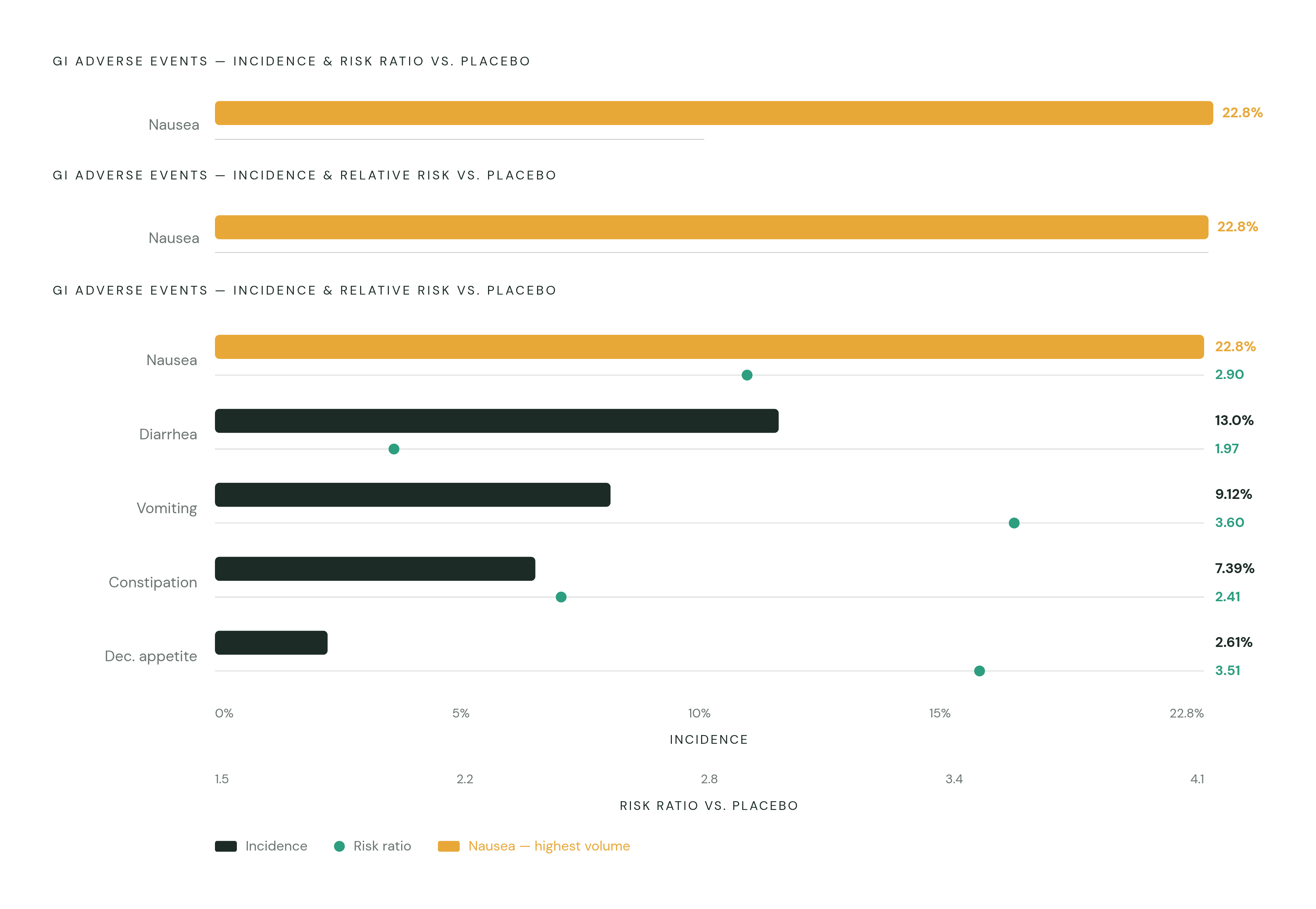
A 2025–2026 systematic review and meta-analysis of 101 randomized controlled trials covering 41,443 patients receiving one of five GLP-1RAs identified nausea as the most frequently reported adverse event, with an incidence of 22.8% and a risk ratio of 2.90 versus placebo. Vomiting occurred in roughly 9.12% of patients (RR 3.60), diarrhea in 13% (RR 1.97), constipation in 7.39% (RR 2.41), and decreased appetite in 2.61% (RR 3.51). Nausea does not merely lead the adverse-event profile; it dominates it.
The temporal pattern is frequently cited as reassurance. GI adverse events cluster in the early weeks of treatment and during dose-escalation phases, and the narrative that follows is that they are transient. For some patients, that is true. For others, nausea persists well beyond the titration window and drives discontinuation at a scale that materially affects long-term outcomes.
What the aggregate data also reveal is the degree of individual variability. A substantial proportion of patients on even high-dose regimens report no GI adverse events at all. If nausea were a simple, linear consequence of GLP-1R activation, uniform exposure should produce relatively uniform responses. It does not. That divergence points toward individual differences in receptor density, brain penetrance, vagal tone, or co-receptor expression as the operative variables, and sorting out which mechanisms are doing the shaping is where the literature gets deeply unsettled.
The Area Postrema: Why the Brain Has a Deliberate Opening to Blood-Borne Nausea Signals
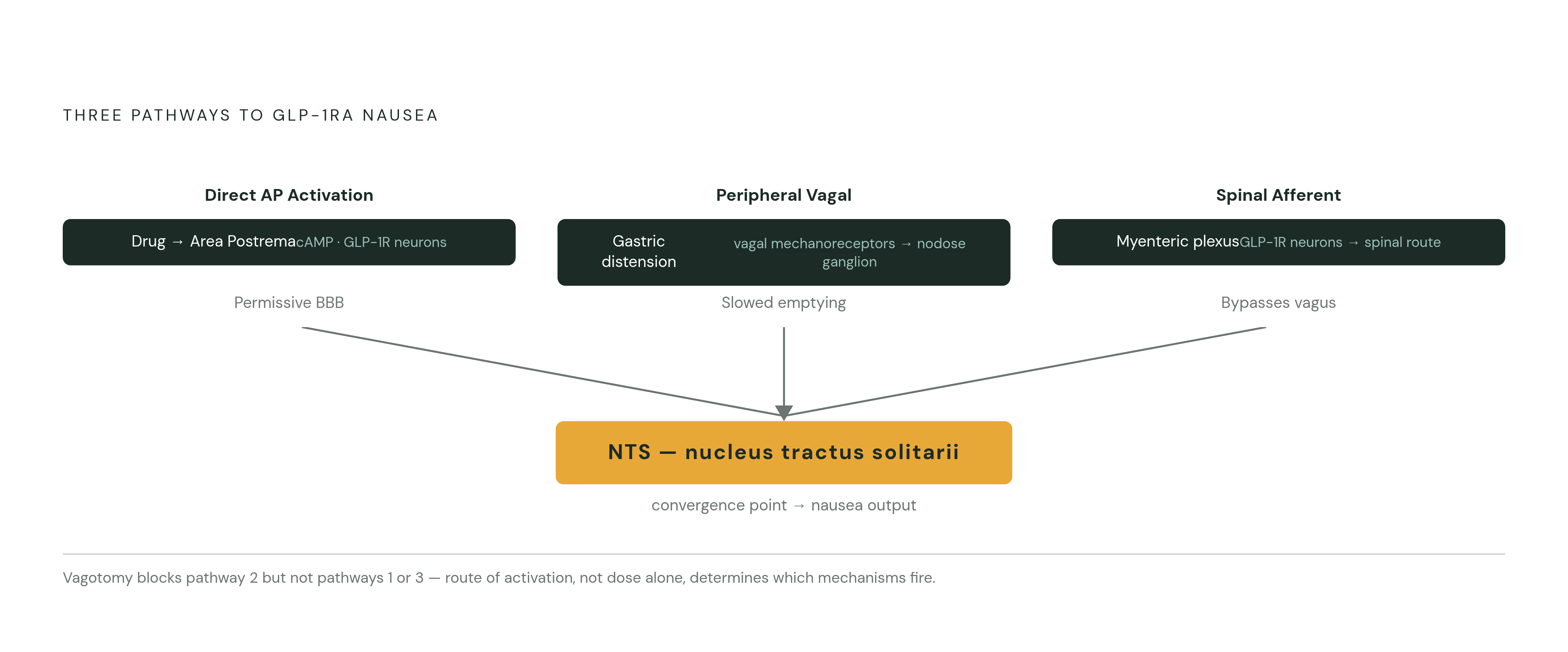
The area postrema (AP) is a circumventricular organ in the hindbrain, sitting outside the blood-brain barrier in a region where the barrier is intentionally permissive. Blood-borne molecules that cannot cross the intact BBB act directly on AP neurons. This is an evolutionary adaptation: the AP exists to detect circulating toxins and trigger protective emesis before further harm occurs. GLP-1RAs, injected subcutaneously and distributed systemically, reach this sentinel system without requiring any special CNS penetration.
The mechanistic evidence is specific. In vitro patch-clamp studies in acute brainstem preparations show that roughly half of tested AP neurons are excited by GLP-1, likely through adenylate cyclase and cAMP signaling pathways. Intraperitoneal exendin-4 induced dose-dependent retching-like behavior in animal models; direct administration into the AP replicated the effect; genetic ablation of GLP-1 receptors specifically within the AP abolished emetic behavior entirely, as reported in a 2025 study in the American Journal of Physiology. The AP GLP-1 receptor is the critical mediator of the central emetic signal.
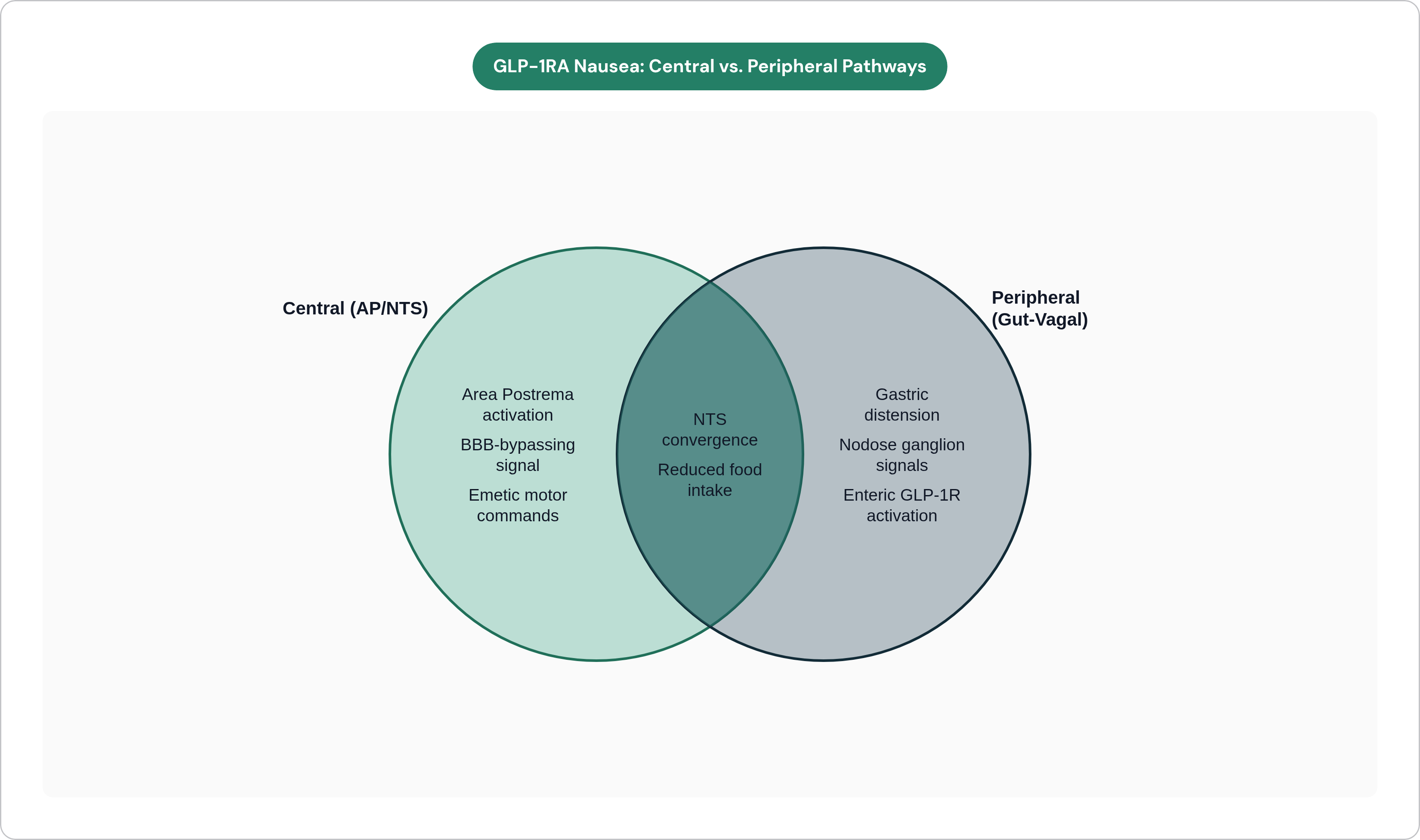
The AP sits adjacent to the nucleus tractus solitarius (NTS), and together with the dorsal motor nucleus of the vagus they form the dorsal vagal complex, the hindbrain hub governing nausea, emesis, food intake, and GI motility. All approved GLP-1 ligands reach and activate neurons in this complex, as well as neurons near other circumventricular organs including the median eminence and arcuate nucleus. Individual agents differ in their degree of CNS penetrance; exendin-4 shows the highest brain penetrance among agents studied, while acylated and conjugated variants show more restricted access. That differential penetrance likely explains some of the individual variability visible in the population data.
One constraint follows from the AP's anatomy and is worth stating plainly before moving forward: because this pathway does not require crossing the intact blood-brain barrier, it cannot be bypassed by any route that produces a meaningful systemic drug peak.
How the NTS Converts AP Signals Into the Physical Act of Nausea and Vomiting
The NTS is where multiple nausea-inducing inputs converge and are translated into motor commands. Three principal afferent streams arrive here: signals from the AP carrying blood-borne chemical information, abdominal vagal afferents routed through the nodose ganglion, and vestibular input via cranial nerve VIII. The NTS does not parse their origin; its downstream outputs are largely the same regardless of which pathway fired.
GLP-1R activation in the medial NTS subnucleus has been directly studied. Direct administration of exendin-4 to the medial NTS reduced food intake and produced pica behavior, the consumption of non-nutritive substances used as a rodent proxy for nausea, establishing that this subnucleus is itself a GLP-1R-expressing site capable of mediating nausea independent of the AP route. The NTS is more than a downstream relay.
From the NTS, outputs project to ventral brainstem motor nuclei, including the ventral respiratory group, which coordinates the mechanical events of vomiting: relaxation of upper and lower esophageal sphincters, gastric relaxation, and giant retrograde contractions of the small intestine. The pharmacological trigger is novel; the circuitry executing it is ancient.
The hub architecture of the NTS carries a specific implication. Because multiple upstream inputs converge here, selectively preventing GLP-1 from reaching the AP, rather than blocking NTS activity broadly, could reduce drug-induced nausea without disrupting the NTS's other protective functions. The intervention target is upstream of the hub.
The Peripheral Pathway: How Slowed Gastric Emptying Generates Its Own Nausea Signal, Separately from the Brain
Slowed gastric emptying is a therapeutic feature of GLP-1RAs, contributing to postprandial glucose lowering by moderating the rate at which nutrients enter the small intestine. It is also a nausea generator, through a mechanism entirely distinct from AP activation.
Acute GLP-1 administration relaxes the gastric fundus, increases gastric compliance, inhibits antral contractility, and increases pyloric tone. The cumulative effect is a dramatic reduction in gastric throughput. A stomach that cannot empty efficiently, particularly after a meal, becomes distended; that distension activates vagal mechanoreceptors in the gastric wall, which transmit afferent signals to the NTS via the nodose ganglion. This peripheral vagal arm operates even in patients whose CNS drug penetrance is low.
A 2025 review in the Journal of Clinical Investigation characterized an additional layer: GLP-1R-expressing intestinofugal neurons within the myenteric plexus can promote stomach distension and anorexia through a spinal afferent circuit, a newly described channel of gut-brain nausea communication that bypasses the vagus entirely for some of its signaling. The peripheral picture is more complex than the vagal pathway alone.
Short-acting agents tend to slow gastric emptying more acutely than long-acting formulations, which helps explain why early-dose and dose-escalation periods are disproportionately nauseating. The enteric nervous system throughout the GI tract expresses GLP-1 receptors, and direct activation by circulating drug contributes to the full GI adverse-event profile: not just nausea and vomiting, but diarrhea, constipation, and dyspepsia, as different regions of the gut respond to prolonged receptor saturation in characteristically different ways.
Why Nausea and Slowed Gastric Emptying Are Mechanistically Separable, and What That Means for Drug Design
Among the findings that have shifted how I think about this class, the mechanistic uncoupling of nausea from gastric slowing is the one that gets the least airtime outside specialist literature, and it probably deserves more.
The evidence is clean. The exendin-4-induced pica response is attenuated by CNS co-administration of the GLP-1R antagonist exendin-(9-39), but not by vagotomy. Cutting the vagus nerve does not abolish centrally mediated nausea. Conversely, GLP-1R signaling in vagal afferent neurons of the nodose ganglia is required for slowed gastric emptying; disrupting vagal signaling blocks this effect without necessarily affecting the central emetic signal. Three effects, slowing gastric emptying, inducing nausea, and reducing energy intake, are mechanistically independent of one another.
An agent or delivery approach that minimizes systemic peak concentration, the principal driver of AP activation, while maintaining local gut receptor engagement could preserve the gastroparetic benefit and satiety signaling that make these drugs effective, while reducing the central nausea drive that makes them intolerable for a significant minority of patients. The circuits are separable. Whether delivery engineering can exploit that separation is an open question.
Titration schedules cannot fully solve this. Titrating slowly reduces the magnitude of AP activation at any given moment, but the drug still reaches the AP, and at therapeutic doses required for efficacy it will activate it to some degree as the dose escalates. Route, not just dose, determines which mechanisms fire.
How GIPR Co-Agonism Reveals an Endogenous Anti-Emetic Circuit in the Hindbrain
The emergence of dual agonism targeting both GLP-1R and the glucose-dependent insulinotropic polypeptide receptor (GIPR) has provided an unexpected window into the modulability of the AP/NTS emetic circuit. I do not think the field has fully processed what it implies.
In multiple species, GIPR activation blocks emesis and attenuates illness behaviors caused by GLP-1R activation, while preserving reduced food intake, weight loss, and improved glucose tolerance. The anatomical locus of this anti-emetic effect is the AP and NTS of the caudal hindbrain, precisely the circuitry that mediates GLP-1-driven emesis. The working mechanistic hypothesis is that GIPR-expressing neurons in the caudal hindbrain form a local inhibitory network; GIPR activation engages that network to suppress emetic drive from within the same circuit. A 2025 study in Science Advances confirmed anti-emetic effects of GIPR agonism at the preclinical level, consistent with the tolerability profile observed clinically.
The clinical correlate sharpens this considerably. GLP-1R monoagonists show a significant positive correlation between steady-state plasma concentration and nausea incidence. Tirzepatide, the approved GIPR/GLP-1R dual agonist, does not: it produces less nausea per unit of circulating drug despite achieving greater weight loss. That dissociation is not attributable to dose alone.
The AP/NTS is not a one-way amplifier of emetic signals. It contains inhibitory inputs that can be engaged pharmacologically, meaning the circuit is modulatable from within. That is proof-of-concept that reducing nausea without sacrificing efficacy is biologically achievable, which changes how one ought to frame the delivery problem going forward.
Why the Route Drugs Travel to the Brain Determines Which Nausea Mechanisms Activate
Peripheral GLP-1RAs reach emesis-regulating brain regions through at least three routes: directly through the circumventricular gaps at the AP, via tanycyte-mediated uptake into the hypothalamus, and indirectly through activation of vagal afferents whose cell bodies reside in the nodose ganglia. Subcutaneous injection creates a systemic concentration peak that reaches all three access points in parallel. The AP receives a bolus signal through its permissive barrier, gastric vagal afferents are activated by slowed emptying, and enteric GLP-1Rs are bathed in sustained drug concentrations. The nausea burden from subcutaneous administration is partly a consequence of this simultaneous, multi-pathway activation rather than any single mechanism.
Molecular properties affecting CNS access correlate with nausea burden across the drug class. If penetrance can be modified through molecular engineering or delivery route, the nausea profile should follow. The circumventricular anatomy of the AP means it cannot be bypassed by any approach that preserves a high systemic peak, but routes that achieve meaningful tissue concentrations at target organs without producing that peak represent a distinct pharmacokinetic profile, not merely a reformulation.
Intranasal delivery is one framework being pursued for this reason, and Lionbio, a nasal-spray nanoparticle peptide startup, is building specifically around that routing logic. The nose-to-brain pathway allows certain molecules to transit olfactory and trigeminal routes directly into the CNS, potentially achieving concentrations in hypothalamic and hindbrain tissue that support satiety and metabolic signaling without requiring the systemic exposure level that drives AP activation. The conceptual reframe is worth taking seriously: the delivery problem is a routing problem, not purely a dosing one.
Whether that routing logic holds at therapeutic scale remains uncertain. But the mechanistic picture across all three pathways points toward something more tractable than dose reduction alone. GLP-1RA-induced nausea is the convergent output of specific, identifiable mechanisms, each with its own anatomical locus, each potentially addressable through different interventions. Treating them as distinct rather than monolithic changes the design question, from how much drug to give, to which mechanism, addressed through which intervention, yields the most favorable efficacy-to-tolerability ratio. That question is harder. It is also, I think, the more productive one.