Oral Peptide Delivery and the Intestinal Barrier Problem
Enzymes, mucus, tight junctions, and efflux pumps make oral peptide absorption nearly impossible.
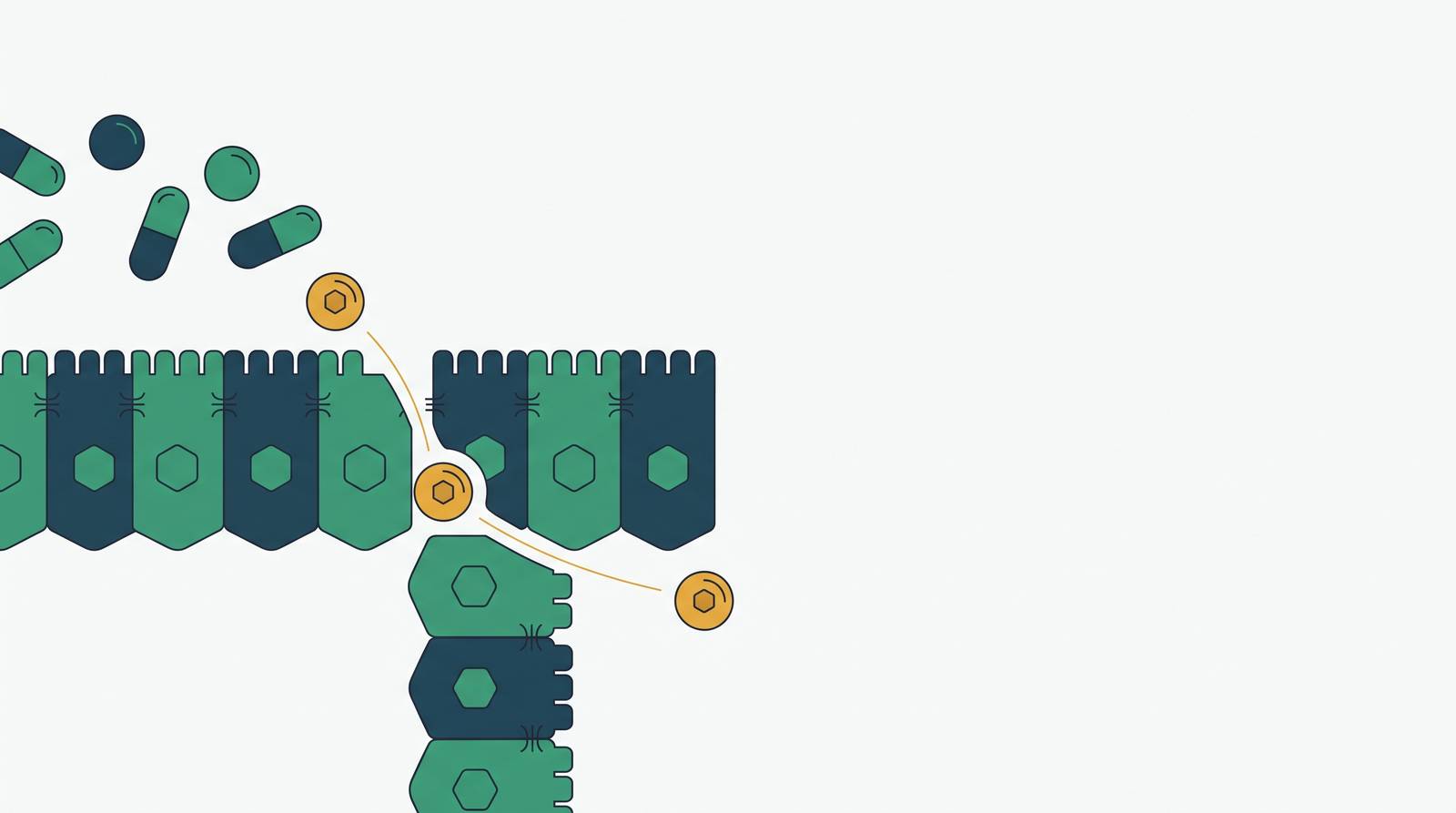
The hostile environment begins in the stomach. Gastric acid denatures protein structures and hydrolyzes peptide bonds directly, and pepsin is already working before any molecule reaches the small intestine. For many peptide sequences, significant fragmentation occurs within the gastric residence time alone.
The small intestine offers no reprieve. Pancreatic secretions deliver trypsin, chymotrypsin, and elastase into the duodenal lumen, each with distinct sequence preferences that together cover a broad swath of peptide structures. Brush-border peptidases then provide a final enzymatic sweep at the luminal surface before any molecule makes contact with the cell membrane. The architecture is sequential and redundant: what escapes pepsin encounters trypsin; what survives trypsin encounters chymotrypsin; what clears that gauntlet meets brush-border enzymes. Most therapeutic peptides arrive at the absorptive surface as fragments, the original sequence, the one engineered for receptor binding, already gone.
Structural chemistry offers partial resistance. Substituting D-amino acids at protease cleavage sites, cyclizing the backbone to restrict conformational flexibility, incorporating non-natural amino acid analogs: these strategies can meaningfully extend luminal half-life and form the basis for most modern oral peptide chemistry. But what if these modifications, while solving the enzymatic problem, introduce new ones? Each modification carries a trade-off against receptor affinity, immunogenicity, and manufacturing complexity. More importantly, they address only the enzymatic layer. The mucus layer does not care whether a peptide contains D-amino acids, and that indifference marks the beginning of a much larger problem.
The Mucus Layer as a Physical and Biochemical Trap
Intestinal mucus looks, at first glance, almost unremarkable: a hydrogel, continuously secreted, renewed, shed. Its physiological role is protection, guarding the epithelium from mechanical abrasion and pathogen invasion. For a drug molecule trying to reach the absorptive surface, that protective function is indistinguishable from obstruction.
The trapping mechanisms are multiple and simultaneous. The mucin glycoprotein mesh restricts diffusion of large or aggregated molecules on size alone. The dense negative charge of mucin sulfate and carboxylate groups electrostatically retains positively charged peptides. Hydrophobic domains within the mucin network sequester peptides that carry hydrophobic patches, a feature common in amphiphilic therapeutic sequences. Because the layer is in constant flux, any molecule that becomes entrapped is carried away before it can diffuse through.
The mucus layer also contains proteolytic enzymes, extending the degradation cascade into the zone immediately adjacent to the epithelium. Regional variation compounds this: mucus thickness and composition are not uniform across the gastrointestinal tract, and what holds in one segment does not necessarily hold in the next.
Mucoadhesive polymers and thiolated systems attempt to exploit the mucus layer rather than bypass it, anchoring drug carriers close to the epithelial surface to extend contact time. It is also worth considering, however, whether proximity actually solves the underlying problem. The drug still has to move through the mucus, not around it, and that diffusion requirement does not disappear because the carrier has better wall-contact. Proximity is not permeability.
Tight Junctions and the Paracellular Route That Is Effectively Closed to Peptides
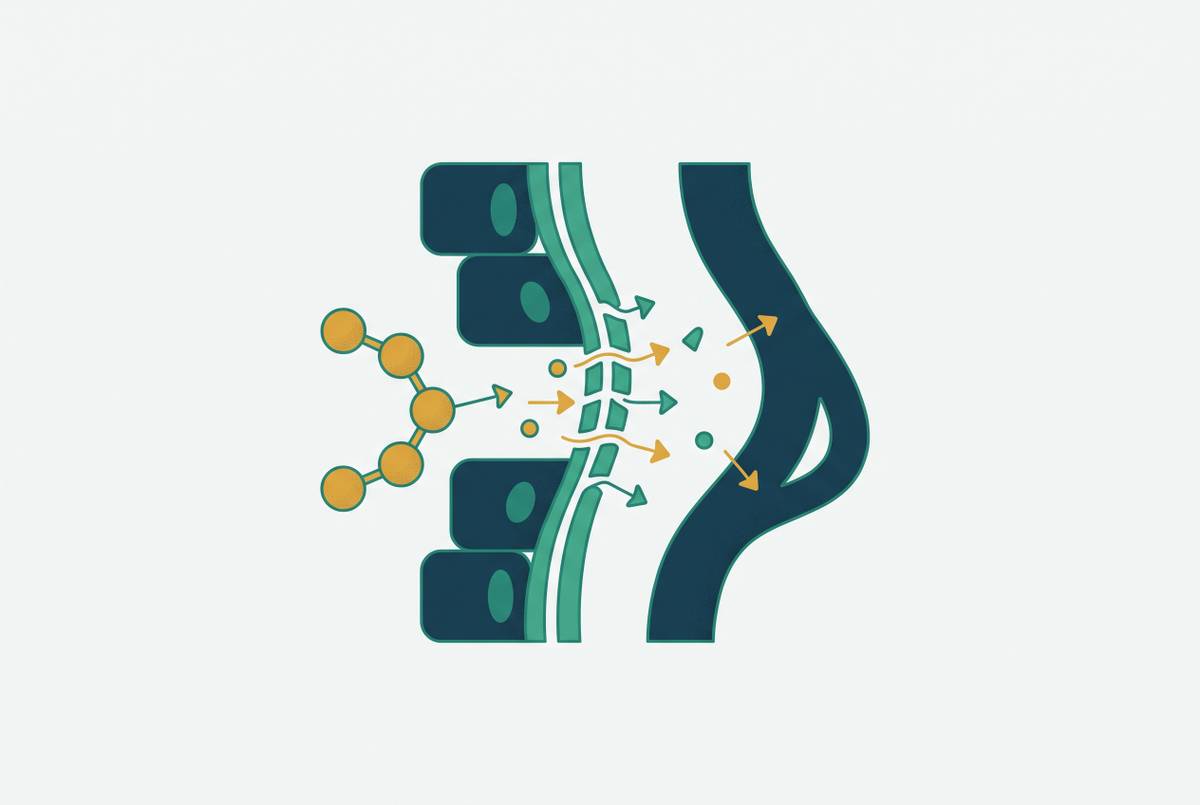
Once a molecule reaches the epithelial surface, it faces a binary routing problem. The transcellular route goes through the apical cell membrane, across the cytoplasm, and out the basolateral membrane into the interstitial space. The paracellular route goes through the aqueous space between adjacent cells, gated by protein complexes including claudins, occludins, and zonula occludens proteins.
Tight junctions evolved to regulate paracellular passage with exceptional selectivity, permitting small ions and water while excluding virtually everything else. Their effective pore size is measured in angstroms, not nanometers. Therapeutic peptides, even relatively small ones, are typically far too large to pass through. The transcellular route presents a different problem: cell membranes are lipid bilayers, passive crossing requires sufficient lipophilicity to partition into the membrane and traverse it, and peptides are generally hydrophilic and polar, excluded at the apical membrane surface. Too large for the paracellular space; wrong physicochemical profile for the transcellular route.
Permeation enhancers, including fatty acids, bile salts, and chelating agents, are designed to transiently loosen tight junctions, providing a temporary paracellular window. That raises an important question: what else passes through when the junction opens? The safety concern is not trivial. A loosened tight junction does not discriminate between a therapeutic peptide and a luminal pathogen or antigen. The intestinal epithelium exists, in part, to prevent systemic exposure to luminal contents, and intentionally compromising that function requires demonstrating that the benefit is real and the risk is bounded. If the mechanism that lets the drug through also lets pathogens through, the therapeutic window is not just a pharmacokinetic question; it is a safety question that clinical development programs have struggled to close for years.
Efflux Transporters: The Epithelial Cell's Active Rejection Mechanism
Assume, for the sake of argument, that a peptide or peptide-derived molecule manages partial transcellular entry. It now encounters something categorically different from the barriers described above: a metabolically active, ATP-driven expulsion system.
Enterocytes express ATP-binding cassette efflux transporters on their apical membranes. P-glycoprotein is the most widely studied. Its biological role is recognizing xenobiotics that have entered the cell and expelling them back into the gut lumen, an evolved defense against ingested toxins that predates the pharmaceutical era by a considerable margin. Many peptide-based drugs and their metabolites are recognized substrates.
The asymmetry is what makes this barrier particularly difficult to engineer around. Passive diffusion into the cell is driven by concentration gradient, which is finite. Active efflux is driven by ATP hydrolysis, which the cell sustains at levels that outpace the diffusion rates of most drug molecules. In practice, this creates a net-efflux situation where more molecules are expelled than accumulate. Why exactly does this matter for dose strategy? Raising the dose does not overcome it in a straightforward way, because efflux capacity scales with transporter expression, not substrate concentration; the transporter is not responding to how much drug is present, it is responding to the presence of drug at all.
P-gp inhibition is an established pharmaceutical strategy, but P-gp handles a broad range of endogenous substrates and interacts with many co-administered drugs; its pharmacokinetic interaction risk profile is well-documented and non-trivial. Efflux transporters also cannot be permanently overcome by a formulation modification applied to the drug particle. They are an active, renewable, cellular defense, operating independently of whatever is swallowed.
The Underappreciated Complexity of the Epithelial Cell Layer Itself
Early formulation research tends to conceptualize the intestinal epithelium as a monolayer of absorptive cells. Histologically, that is accurate for the dominant cell type, but it underrepresents the functional complexity that actually determines in vivo behavior, a gap that has cost the field real time, less because the models were lazy than because available in vitro systems made it genuinely difficult to do better.
Enterocytes are the primary absorptive cells and the main site of transcellular transport and efflux transporter expression. Goblet cells, interspersed throughout, continuously secrete mucus and maintain the most immediate layer of the barrier. Enteroendocrine cells secrete gut hormones, including, as a point of direct relevance, GLP-1 itself: the cellular origin of GLP-1 is the very epithelium blocking exogenous GLP-1 analogs from reaching circulation. M cells, located over lymphoid follicles known as Peyer's patches, are specialized for transcytosis of particulate matter and antigens; they carry lower efflux transporter activity and are adapted to internalize macromolecules, which explains the considerable interest in nanoparticulate delivery systems targeting them.
Each cell type carries a distinct enzyme complement, receptor profile, and transport apparatus. What a formulation accomplishes when it encounters an enterocyte may not generalize to adjacent M cells. Research published in Frontiers in Drug Delivery (2022) identified simplified cell monolayer models as a meaningful source of translational failure, noting that they frequently underrepresent the full range of epithelial cell populations and limit predictive value for in vivo outcomes.
M-cell targeting via nanoparticulate systems is an active and scientifically credible research direction, precisely because M cells offer lower efflux barriers and native macromolecule uptake capacity. The anatomical constraint warrants mention, though: M cells represent a small fraction of total epithelial surface area, and any delivery strategy built on M-cell uptake is, by design, working through a narrow absorptive window.
How the Layers Interact: Why Fixing One Barrier Rarely Solves the Problem
Each layer is, individually, a meaningful obstacle. Together, they are multiplicative, and early-stage formulation work tends to underestimate this, sometimes dramatically.
A permeation enhancer that increases paracellular permeability tenfold operates on that one layer. The molecule still encounters gastric acid and pancreatic proteases before reaching the epithelium. It still must navigate the mucus. If it gains paracellular access, it avoids the efflux transporter problem, but it has already been partially degraded by luminal enzymes. The net bioavailability gain from a single-mechanism intervention is, in most cases, far less than the improvement observed in the isolated assay.
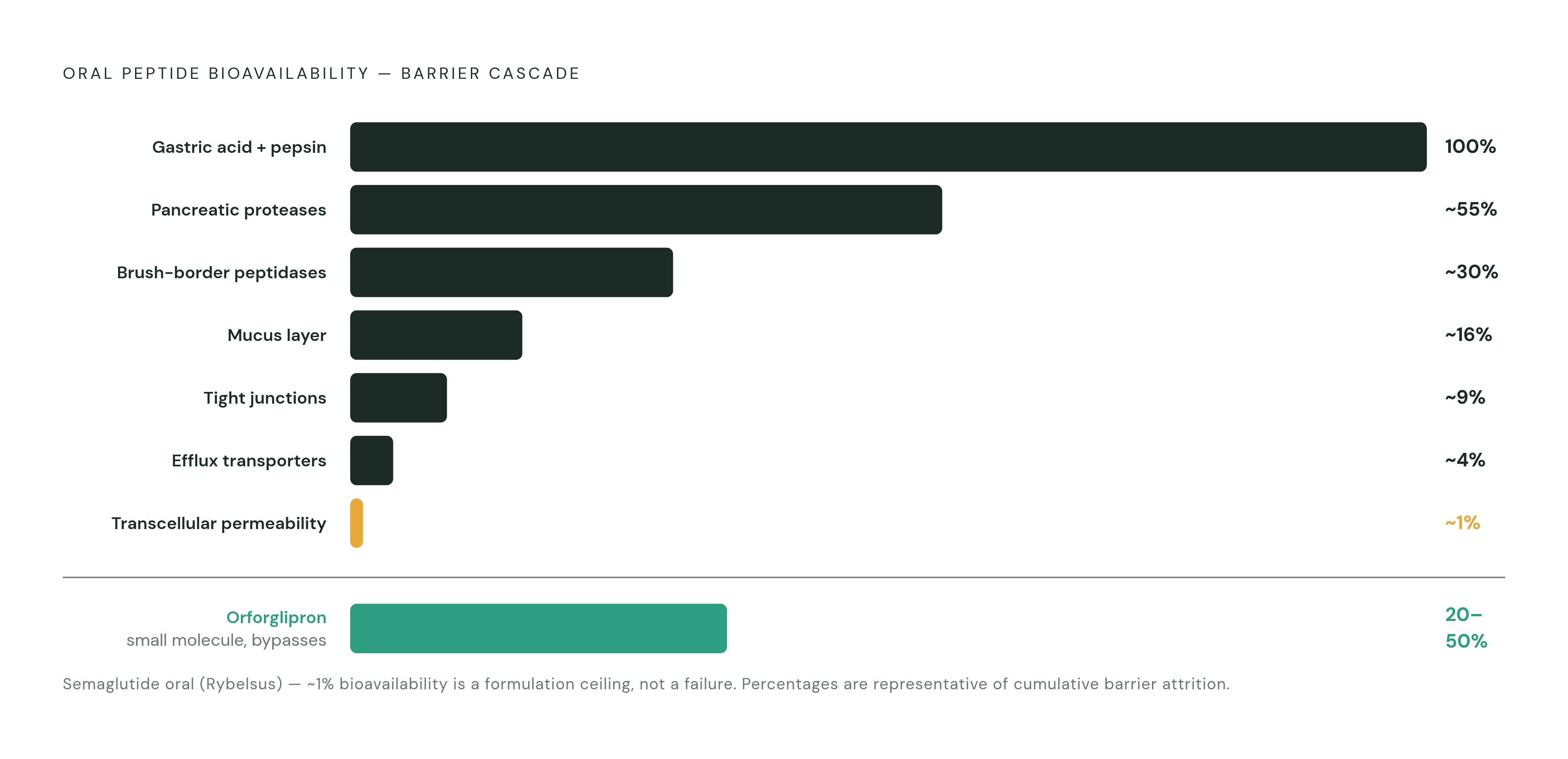
Oral semaglutide illustrates this with unusual clarity, because it is the most clinically advanced oral peptide formulation to reach large-scale use. Its enabling technology, a sodium N-[8-(2-hydroxybenzoyl)amino] caprylate co-formulation known as SNAC, works through two mechanisms: shifting absorption to the gastric mucosa, which has lower enzymatic activity than the intestinal lumen, while simultaneously providing local alkalinization to protect the peptide from pepsin. Sophisticated, well-characterized, and the product of years of development. It achieves oral bioavailability of roughly one percent. The clinical dose required for oral delivery is many times higher than the subcutaneous dose needed to achieve equivalent exposure.
One percent, after a two-mechanism solution, is a direct measurement of what a multi-barrier system extracts even from a well-engineered formulation. But how does this affect our original promise that formulation innovation can unlock oral peptide delivery? Nanoparticulate and lipid-based systems, including liposomes, solid lipid nanoparticles, and self-emulsifying delivery systems, hold real promise for multi-barrier engagement by combining protease protection, modified mucus diffusion, and cellular targeting in a single carrier. Consistent translation from preclinical to clinical performance remains the field's most demanding open problem, and the semaglutide number is a useful anchor for anyone calibrating expectations.
What the Small-Molecule Workaround Reveals About the Peptide Problem
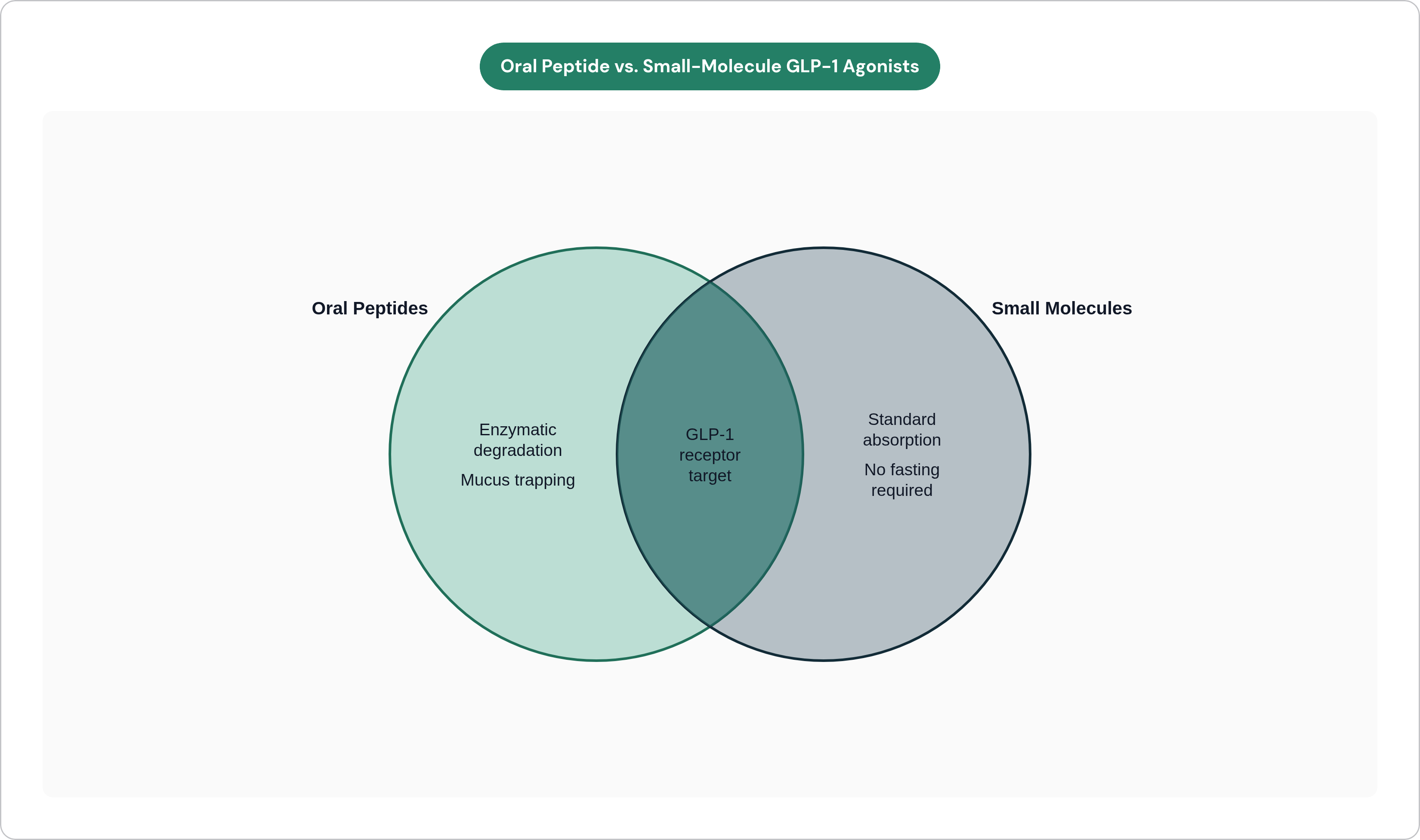
In April 2026, the FDA approved orforglipron, marketed as Foundayo, a small-molecule GLP-1 receptor agonist. It achieves estimated oral bioavailabilities in the range of twenty to fifty percent through standard pharmaceutical absorption mechanisms, without permeation enhancers, without fasting requirements, without the formulation engineering oral semaglutide requires.
The comparison is instructive in a specific way. The difference in oral bioavailability between these two GLP-1-pathway drugs is not a matter of degree; it reflects a difference in molecular architecture. One works within normal oral pharmacokinetics because its physicochemical profile is compatible with normal intestinal absorption. The other requires significant formulation effort to achieve one percent.
For any indication where a small-molecule agonist can be designed with adequate target selectivity, it will likely outperform an oral peptide formulation on pharmacokinetic grounds. That is an argument for choosing molecular design over formulation engineering wherever the choice exists, not pessimism about peptides as a class. One might argue that this makes peptide delivery research redundant — but that conclusion does not hold across the full target landscape. The question, one the field does not ask early enough, is whether the choice exists for a given target.
It frequently does not. Small molecules engage receptors through a limited set of interaction geometries. Peptides offer structural complexity, multi-point binding interfaces, and sequence tunability that small molecules cannot replicate across the full range of biological targets. Neurological targets requiring precise modulation of signaling cascades may have no viable small-molecule equivalent. Orforglipron's success identifies the cases where a molecular solution exists and removes them from the list, sharpening the question of what peptide delivery must accomplish for the cases that remain.
Why Alternative Delivery Routes Remain Scientifically Serious, Not Fallback Options
The intestinal barrier analysis does not argue against oral peptide delivery research. It argues for accurate expectations, and for concurrent investment in routes that sidestep the gut's defenses rather than attempt to negotiate them one layer at a time.
The injectable paradigm persists because it bypasses every layer described above. But injection carries its own documented costs: adherence erosion, needle fatigue, cold-chain requirements, and discontinuation rates that population-level studies have placed at roughly half of GLP-1 users within a year. The barrier problem and the injection problem are both real. The field is choosing between two approaches with distinct limitations, not between a solved approach and an unsolved one.
Pulmonary, transdermal, buccal, and intranasal routes each present different absorption profiles and different barrier sets. For therapeutics targeting the central nervous system, the intranasal route occupies a particularly interesting position. The olfactory and trigeminal pathways provide a direct anatomical connection between the nasal epithelium and the brain, enabling nose-to-brain transport that bypasses not only the intestinal barrier but also the blood-brain barrier. For neurological indications including appetite regulation at the level of the hypothalamus, addiction, and neurodegeneration, this route may be the only one capable of delivering therapeutically relevant peptide concentrations to the target tissue.
Lionbio, a biotech developing intranasal nanoparticle-based GLP-1 therapeutics, represents one approach in this space, building on nanoparticle intellectual property developed at Columbia University to deliver peptide payloads through the nasal epithelium toward central targets while aiming to reduce the nausea associated with injectable GLP-1s. Other groups are pursuing nanoparticulate and lipid-based intranasal platforms with similar logic. The common thread is circumvention rather than negotiation.
The full map of the intestinal barrier, enzymatic, physical, cellular, and active, is what makes the case for delivery innovation in peptide therapeutics legible. A molecule without a route to its target is not a therapy. The evidence on barrier complexity raises a pointed question about whether researchers and developers are evaluating the available alternatives with the rigor the problem actually demands, and the data accumulating across alternative delivery platforms are making that question increasingly difficult to sidestep.