GLP-1 Agonists and Parkinson's Disease Neuroprotection
Diabetes drugs show promise in lab but fail to slow Parkinson's in patients.

Parkinson's disease still has no cure and no drug that slows it down; every approved treatment manages symptoms while the underlying neurodegeneration keeps marching. That gap is why GLP-1 receptor agonists, a drug class most people know from diabetes and weight loss, have started pulling real attention from neurologists. It sounds like an odd pairing at first, a gut hormone showing up in conversations about the substantia nigra and dying dopamine neurons. Follow the receptor biology, though, and the connection stops looking strange at all.
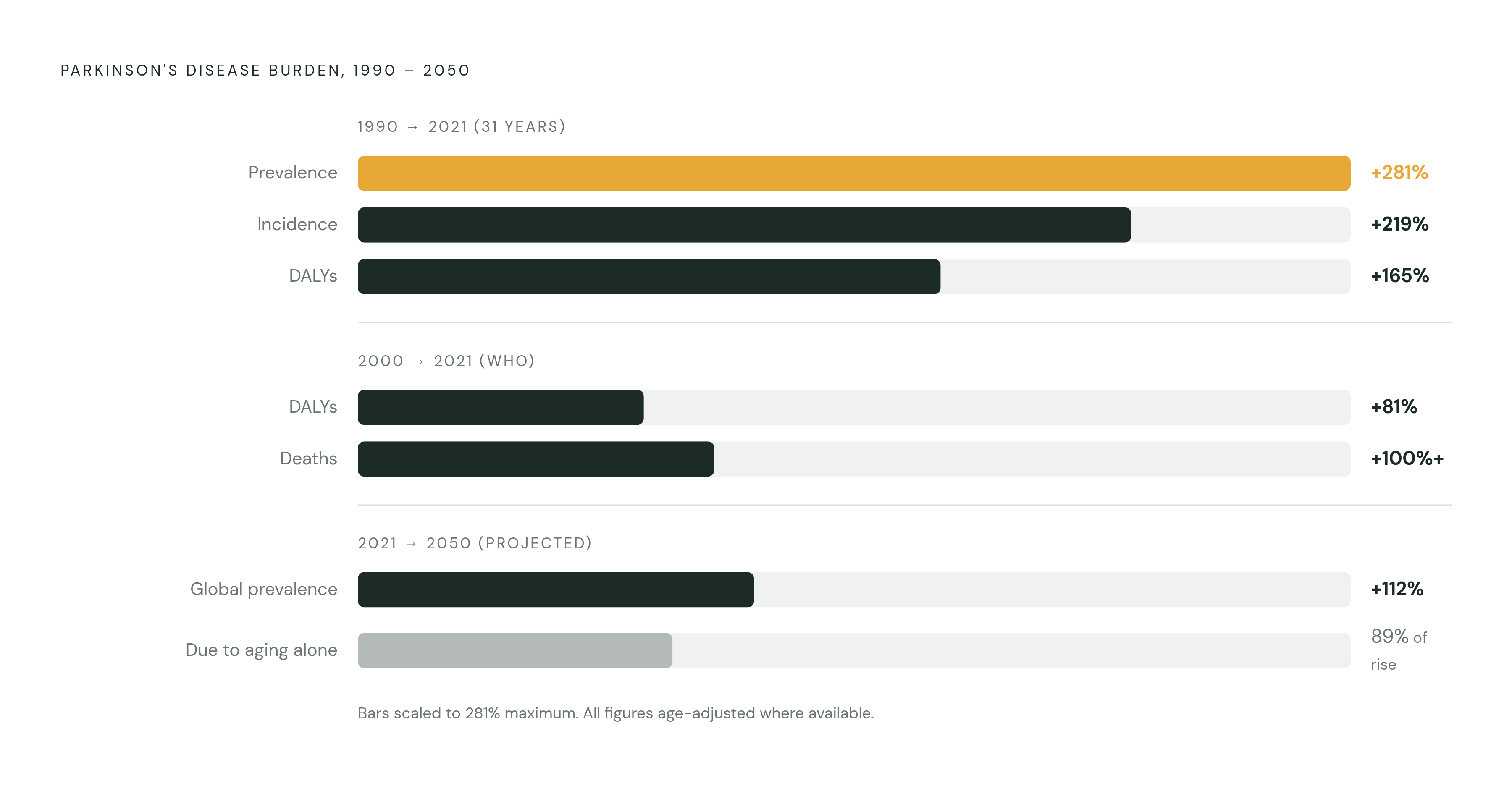
The scale of the problem is worth sitting with before we get into the science. Global Parkinson's prevalence hit 11.77 million people in 2021, and projections put it at 25.2 million by 2050, a 112% jump that's mostly, 89% of it, just population aging catching up with itself. Except aging doesn't explain all of it, since between 1990 and 2021, prevalence rose 281%, incidence rose 219%, and disability-adjusted life years climbed 165%, numbers that outpace demographic shift by a wide margin. The World Health Organization has clocked disability-adjusted life years up 81% since 2000, with deaths more than doubling in that stretch. Levodopa and everything else on the shelf treats tremor, rigidity, and slow movement, but none of it touches the dying dopamine neurons in the substantia nigra, or the alpha-synuclein clumping into Lewy bodies that actually defines this disease under a microscope. That untouched territory is where GLP-1 science has staked its claim.
How GLP-1 receptors ended up distributed across the brain
Ask most people what a GLP-1 receptor agonist does and you'll get some version of: boosts insulin, blunts appetite, keeps blood sugar level. Fair enough, as far as it goes, but it's not the whole picture, and the part that gets left out turns out to matter quite a lot for a disease like Parkinson's.
GLP-1 receptors sit on nearly every major cell type in the brain: not just neurons, but oligodendroglia, astroglia, microglia, and the endothelial cells lining blood vessels. They're not confined to the hypothalamus, where they quietly run gut-brain appetite signaling. They turn up in the ventral tegmental area, the nucleus accumbens, and the prefrontal cortex, which happens to be the exact wiring that governs dopamine-driven reward and motor control. So this isn't an anatomical accident; it's the reason a metabolic drug might do anything at all in a neurological disease.
There's a deeper logic underneath the anatomy, too. Type 2 diabetes and Parkinson's share more than a passing resemblance: both involve insulin resistance, both involve chronic neuroinflammation grinding away in the background for years. In preclinical models, GLP-1 compounds seem to quiet inflammation and oxidative stress, adjust the insulin signaling tied to whether a neuron lives or dies, and improve mitochondrial function. That last one matters more than it sounds like it should; failing mitochondria are one of the known engines behind dopamine cell death. Some models even show less neuronal injury after alpha-synuclein, the toxic protein at the center of Parkinson's pathology, gets introduced.
None of this is guesswork; it follows from where the receptors sit and which pathways they touch. Whether any of it holds up in an actual patient, over an actual disease course spanning years, remains a much harder question, and it's the one the field is still working through.
What the epidemiological signal showed before trials began
Nobody green-lit a phase 3 trial on a hunch. The push came from population data, specifically two large studies of people with type 2 diabetes, both finding lower rates of Parkinson's diagnosis among patients on GLP-1 receptor agonists compared to those on other diabetes drugs. One Danish nationwide cohort followed 33,462 patients (16,731 GLP-1RA initiators matched one-to-one against DPP-4 inhibitor initiators), all 50 or older with no prior Parkinson's diagnosis, tracked from 2007 through 2018 with outcomes read out as late as 2022.
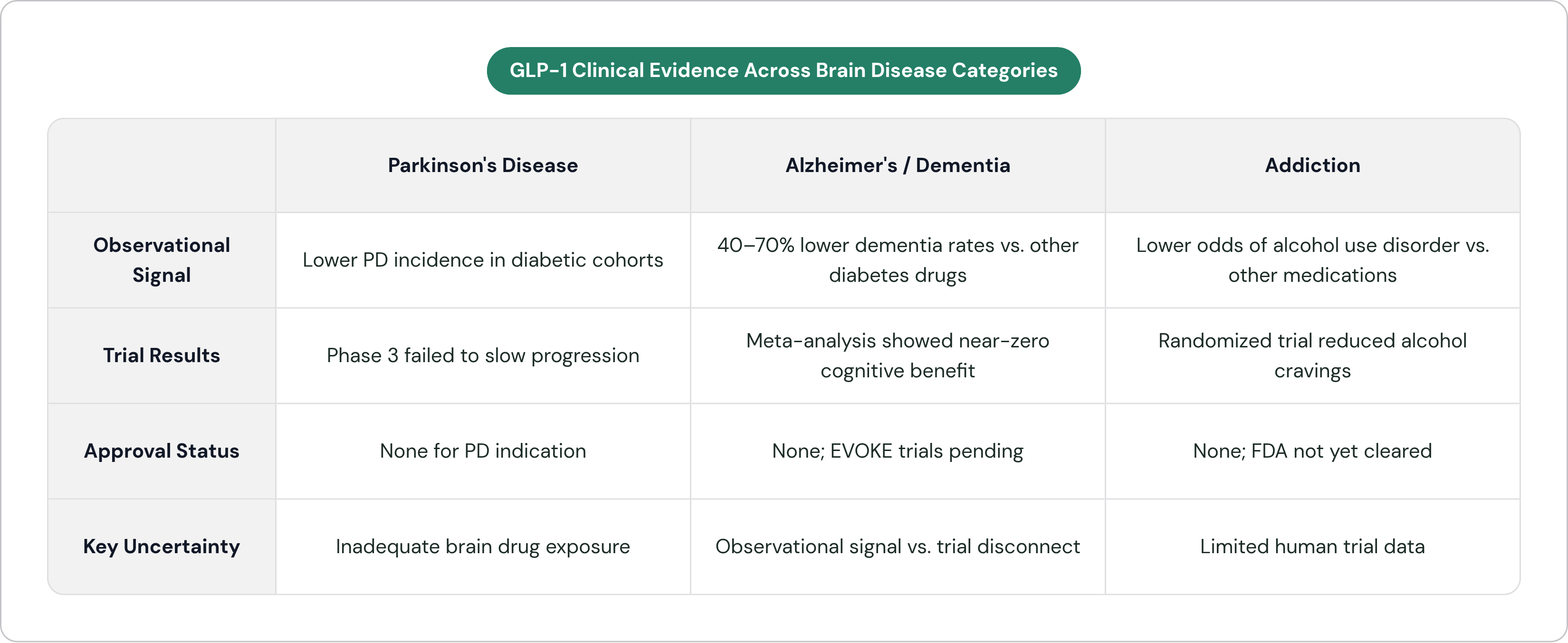
That's a real signal, strong enough to justify the cost of a randomized trial. But what kind of evidence is this, really, and what can it actually tell us? Observational data can't rule out confounding: people who get prescribed a GLP-1 drug may simply differ, in ways that have nothing to do with the drug itself, from people prescribed something else. A diabetic cohort isn't a general Parkinson's population either, and an association with lower incidence isn't proof of prevention, and closing that gap is the entire reason clinical trials exist in the first place.
What the clinical trials actually found — and where they fell short
Early results looked genuinely good. Phase 2 trials of exenatide showed sustained motor benefits across two separate studies, and liraglutide trials turned up improvement in motor disability and daily living scores. Small samples, short follow-up windows, sure, but real movement, in the right direction.
Then came the bigger, harder tests. LIXIPARK, a large double-blind, placebo-controlled trial of lixisenatide in early Parkinson's disease, published in the New England Journal of Medicine in 2024, came back neutral on its primary motor outcome. Safety held up fine, and there were secondary signals worth a second look, but this wasn't the confirmation everyone had been waiting for. Around the same time, a randomized trial of NLY01, a pegylated form of exendin-4, published in Lancet Neurology in 2024, added another data point to a picture getting messier rather than clearer.
The heaviest blow landed in 2025. A phase 3 trial of exenatide once weekly versus placebo, published in The Lancet, tested the drug specifically as a disease-modifying treatment in a large, multicenter, double-blind design, and it failed to slow disease progression. This is the most rigorous test the hypothesis has faced, and it's the biggest setback the field has absorbed so far. A 2025 meta-analysis, searching the literature through that April, pulled together the randomized trial data on GLP-1 receptor agonists in mild-to-moderate Parkinson's using the MDS-UPDRS motor score as its yardstick. What it found doesn't resolve the picture so much as confirm how mixed it actually is.
There's a sobering parallel over in Alzheimer's research worth a short detour. A separate meta-analysis of 15 randomized trials covering 1,341 participants found GLP-1 receptor agonists did not improve memory or cognition versus placebo, landing an effect size close to zero (SMD −0.01, 95% CI −0.44 to 0.41) with low-certainty evidence overall. Promising bench science, a real epidemiological signal, then a disappointing randomized trial: that sequence isn't unique to Parkinson's, and it shows up almost everywhere GLP-1 drugs run into the central nervous system.
As of mid-2025, no GLP-1 therapy has proven disease-modifying in Parkinson's. The phase 3 failure doesn't close the book on the idea, but it does sharpen the questions still sitting open: right dose, right treatment window, whether earlier intervention changes the outcome, which patients (maybe those with concurrent insulin resistance) stand to gain the most, whether combining GLP-1 drugs with other neuroprotective approaches moves the needle, and whether molecules with different receptor-binding profiles behave differently once they're actually inside brain tissue.
Why the brain may need GLP-1 delivered directly to it, not through the bloodstream
If the receptor biology is this convincing, why do the trials keep coming up empty? Part of the answer might have less to do with the molecule and more to do with how far short it falls of actually reaching its target.
The blood-brain barrier isn't a footnote here; it's a wall, and most peptides given by injection cross into the central nervous system in only small amounts. GLP-1's effects on brain tissue being mechanistically sound doesn't mean an injected dose actually shows up at the substantia nigra or nucleus accumbens in concentrations high enough to do anything. That gap, between what a drug can do on paper and what it does once it's diluted through the bloodstream, probably accounts for a good chunk of why encouraging preclinical work and a real epidemiological signal keep failing to turn into phase 3 wins.
Injection stays the default route for a reason: the injectable and parenteral segment held 69.19% of GLP-1 drug revenue in 2025. It's the well-worn path, the one regulators and manufacturers already know how to run, but familiarity isn't the same thing as what's actually right for a brain disease.
Intranasal delivery is a different route altogether. The olfactory and trigeminal nerve pathways run directly from the nasal lining into the brain, a way around the blood-brain barrier instead of through it. That anatomical shortcut can get a drug to central targets, including the substantia nigra and the broader dopamine circuitry Parkinson's destroys, in ways a bloodstream injection struggles to match. For a peptide like a GLP-1 agonist, that could mean higher concentration where it's needed and lower exposure everywhere else in the body, which matters for both effectiveness and the side-effect problem we'll get to below.
If inadequate brain exposure explains part of why these trials keep underperforming, delivery route deserves as much scrutiny as mechanism, maybe more than it's gotten so far. One approach uses nanoparticle carriers that protect the peptide from breaking down in the nasal lining long enough to cross into brain tissue intact. A peptide that degrades before it clears the nose never gets a fair shot at proving whether the underlying biology works at all. That's a bet on plumbing as much as on pharmacology.
The broader pattern: GLP-1's reach into addiction and dementia
Parkinson's isn't the only place this story keeps showing up. GLP-1 receptors run through the mesolimbic system, the nucleus accumbens and ventral tegmental area, the same reward circuitry disrupted in Parkinson's and hijacked by addictive substances. Preclinical models show GLP-1 agonists cutting drug intake, dampening dopamine release in the nucleus accumbens, and reducing relapse-like behavior across alcohol, nicotine, and opioid models. What makes it interesting is how consistent that pattern stays across such different substances.
Human data is catching up. A randomized clinical trial found that low-dose semaglutide reduced alcohol cravings and drinks per drinking day in adults with alcohol use disorder compared to placebo. A study found semaglutide use associated with substantially lower odds of developing or relapsing into alcohol use disorder, compared to other anti-obesity medications. There's even a small study suggesting a GLP-1 drug meaningfully reduced opioid cravings over several weeks. None of this has become an approved addiction indication yet; the FDA hadn't cleared any GLP-1 drug for that use as of 2025, though the field is watching closely regardless.
Dementia tells something close to the same story. Observational data has found people on GLP-1 drugs developing dementia 40 to 70% less often than people on other diabetes medications, a gap wide enough to raise eyebrows even accounting for the usual confounding baked into this kind of study. The EVOKE trials, the largest GLP-1 studies ever run in Alzheimer's disease, have been underway with results anticipated in the near term. A 2025 study dug specifically into GLP-1 receptor agonist use and dementia risk in people with type 2 diabetes.
Yet that same Alzheimer's meta-analysis from earlier, SMD −0.01 across 1,341 participants, sits right there as a reminder that a strong observational signal doesn't guarantee a randomized trial wins. The caution that applies to Parkinson's applies here too. Across addiction, dementia, and Parkinson's, the common thread is dopaminergic and reward-circuit biology, and GLP-1 receptors run straight through it. That's enough to make the brain a legitimate target for this drug class in its own right, not a side note tacked onto a metabolic drug's résumé.
Why the delivery problem gets harder when the target is the brain
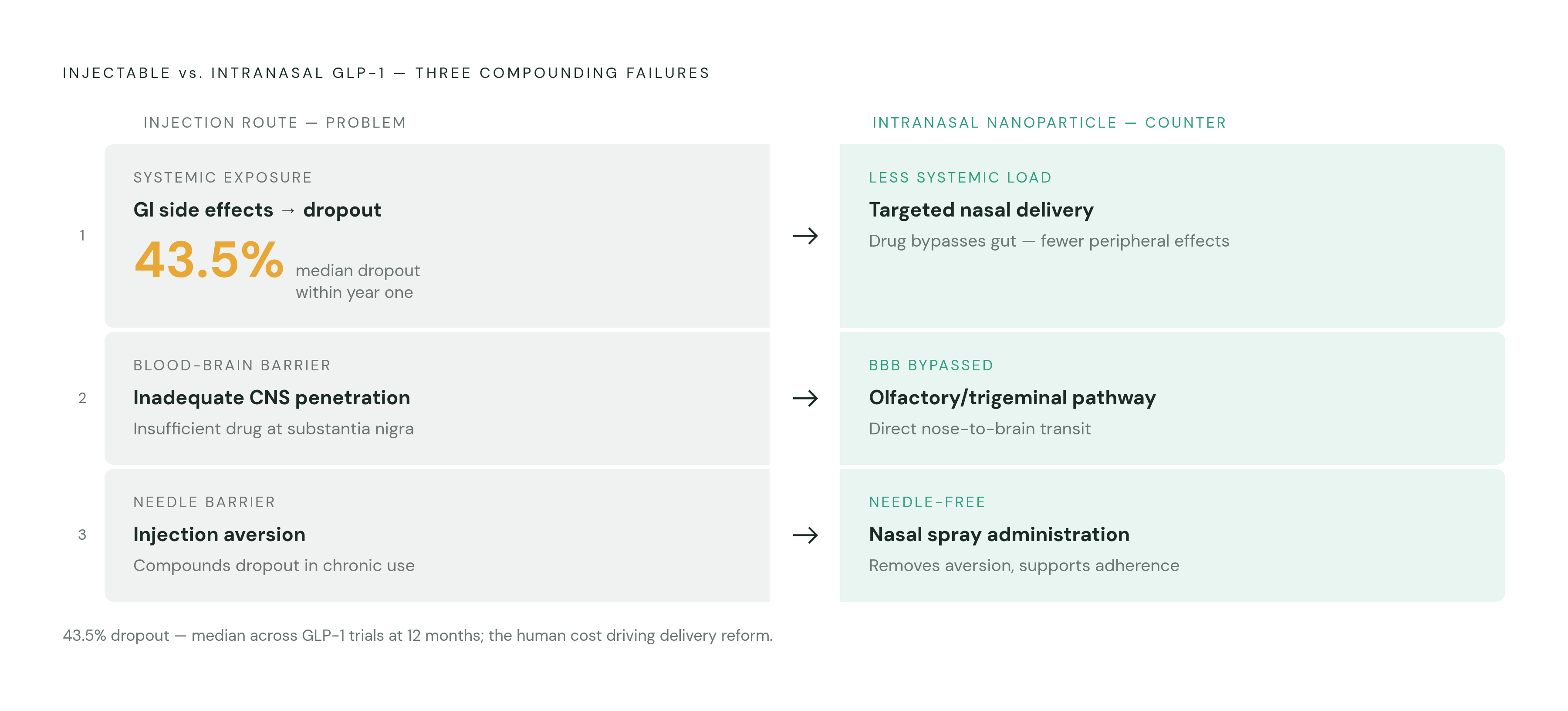
Real-world use of GLP-1 drugs comes with a tolerability problem that's well documented at this point. Nausea, vomiting, diarrhea, stomach pain: these show up constantly in treated patients, a direct result of hitting GLP-1 receptors throughout the gut and the rest of the body, well beyond whatever central mechanism anyone's actually trying to reach.
The discontinuation numbers back this up, starkly. In real-world settings, a median of 43.5% of semaglutide users stop treatment inside the first year, and real-world data suggest the majority of patients have quit within two years. The riskiest stretch sits right at the start: side effects hit hardest before any benefit has had time to show up, so the cost-benefit math a patient runs in week three looks nothing like the math they'd run in month six.
For a Parkinson's patient, that calculation shifts some. Motor decline is about as strong a reason as exists to stick with a treatment, but layering GI trouble onto a disease that already carries a heavy daily burden creates a real barrier to sticking with it, maybe a steeper one than in a population just managing blood sugar.
Line these problems up and the case for a different delivery route gets sharper. Systemic injection causes peripheral side effects, gets limited drug into the brain, and drives high dropout: three separate problems, stacked on top of each other. A nose-to-brain approach could, in principle, address all three at once. Less systemic exposure means fewer GI side effects; a direct nasal-to-brain pathway means better targeting of the regions that matter; a nasal spray takes the injection itself off the table as a reason to quit. That's the specific problem an intranasal nanoparticle platform approach is built to solve, and it's fair to ask whether the rest of the field is even trying to solve it yet.
What the GLP-1 market's current shape reveals about where the field is heading
The capital backing this science isn't small. The global GLP-1 receptor agonist market sat at $66.4 billion in 2025 and is projected to reach $185.3 billion by 2033, growing at a 12.4% compound annual rate. That's the kind of money that can fund the long, expensive neurological trials, the ones that take years and thousands of patients before a single readout comes back.
Look at where that money is actually flowing, though, and a different picture shows up. Injectable formats still hold 69.19% of revenue in 2025, even as oral and alternative delivery formats start pushing into the space. North America accounts for 75.5% of the global market, which concentrates both commercial activity and regulatory attention in a single region. And the engine underneath all of it is still metabolic: weight management, blood sugar control, and newly recognized liver indications are what's driving growth, with neurological uses sitting as an emerging layer stacked on top, not anything close to the foundation yet.
Can molecules and delivery systems built for metabolic disease just carry over into brain disease, unmodified? The trial record so far suggests not, or at least not without rethinking how the drug physically gets to the tissue it needs to reach. Most companies chasing Parkinson's, addiction, and dementia indications right now are still running the same molecules through the same injection route built for diabetes and obesity. The biology looks credible across three separate disease categories at this point. What's still missing, and what the failed trials keep pointing back to, is getting the molecule to where it actually needs to go.