GLP-1 Receptors in Nicotine and Opioid Craving Reduction
GLP-1 drugs reduce craving for nicotine and opioids by rewiring the brain's reward circuitry itself.
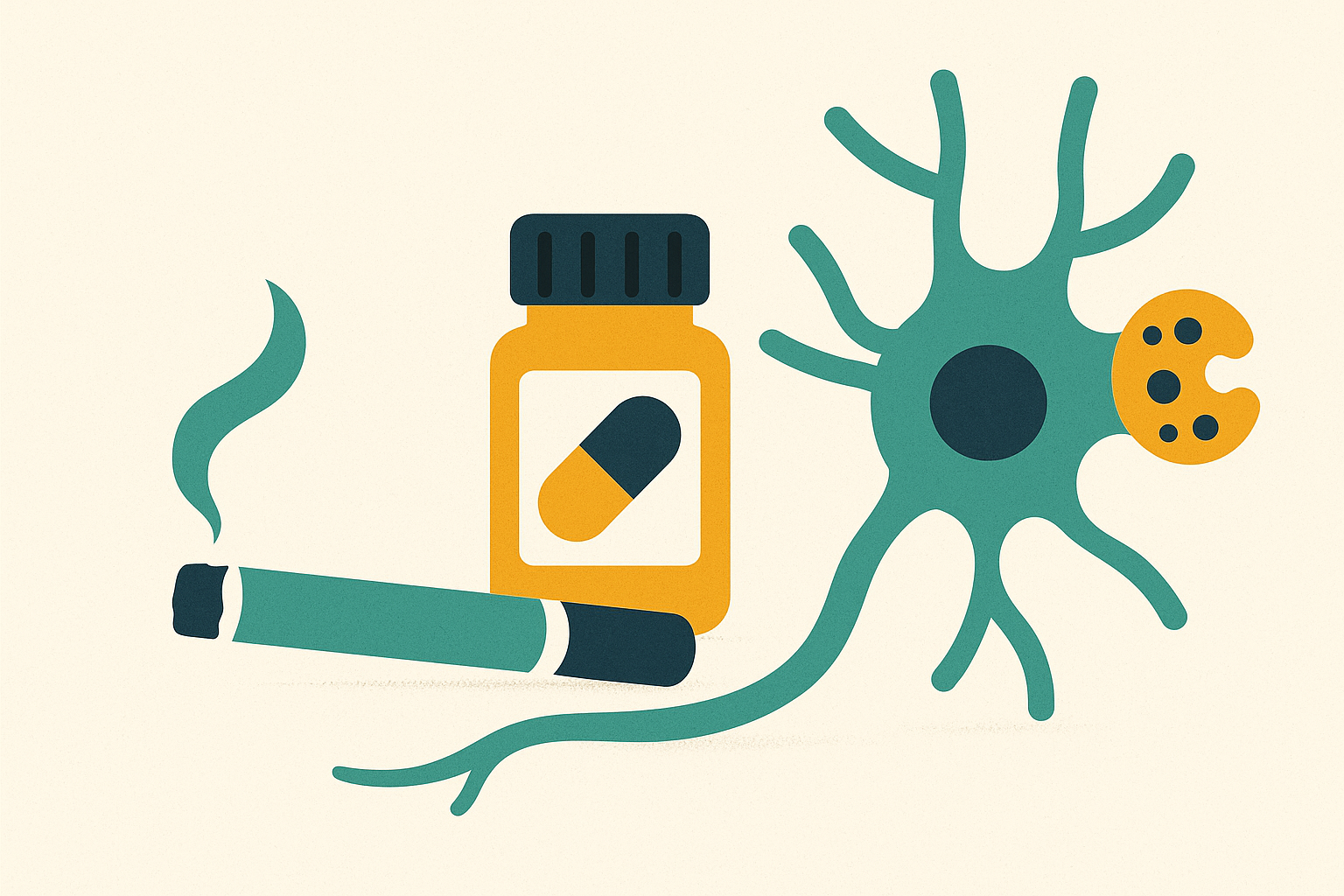
GLP-1 receptor agonists were built to manage diabetes and obesity. Along the way, researchers kept noticing something nobody had gone looking for: these drugs also seem to blunt craving for nicotine and opioids, and the reason traces back to where GLP-1 receptors actually sit. Not just in the gut, but in the ventral tegmental area, the nucleus accumbens, the prefrontal cortex, and a handful of other regions that make up the brain's reward architecture. This piece walks through that mechanism, the evidence by substance, and the delivery problem that will decide whether any of it survives contact with the clinic.
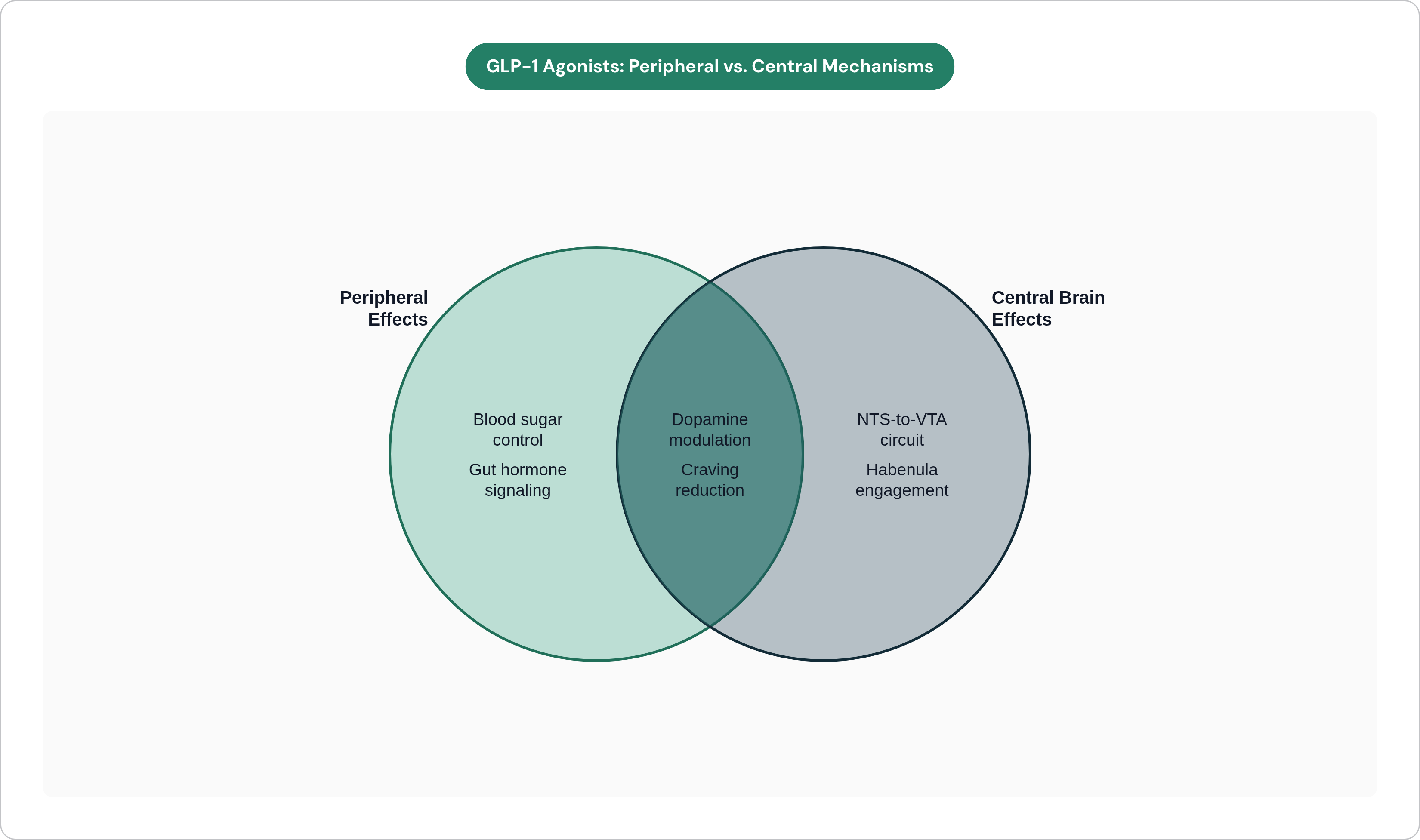
GLP-1 comes from two places. Intestinal L cells make it peripherally, where it circulates as a hormone regulating blood sugar and satiety; neurons in the nucleus tractus solitarius, a brainstem structure, make it centrally too, and those neurons project straight into reward circuitry. That dual origin matters more than it looks at first glance, because GLP-1 isn't just a gut signal that occasionally knocks on the brain's door. It's a neurotransmitter native to the circuits that govern motivation, sitting alongside dopamine, glutamate, and GABA in the VTA, the NAc, the PFC, the amygdala, and the hippocampus.
The VTA-NAc dopamine axis assigns motivational weight to a stimulus, whether that stimulus is food, a mating opportunity, or a drug, and it's also the circuit that addictive substances hijack most directly. Could activating GLP-1 receptors upstream of the dopamine signal itself, rather than downstream at some single drug's binding site, interrupt craving at a more basic level than existing addiction medications ever reach? That's the question this entire body of research is circling, and it's worth keeping in view as the mechanism gets more granular.
How GLP-1R activation actually dampens reward signaling
The core mechanism is fairly direct, at least on paper. GLP-1 receptor agonism cuts dopamine release in reward centers, which lowers the pull of drug-associated cues without touching the receptor systems those drugs actually act on. A cigarette, a dose of fentanyl, a line of cocaine, each works through its own pathway, and GLP-1R activation doesn't compete with any of them head-on. It works one level up, adjusting how much the brain cares about the cue in the first place.
That adjustment doesn't stop at dopamine. GLP-1 receptors also shift glutamatergic and GABAergic signaling in these same regions, and that three-system reach starts to explain why the effect shows up across drug categories instead of sticking to one.
There's a stress angle too. GLP-1 receptor agonists buffer stress-induced drug-seeking much the way they cut stress-driven eating, which tracks once you notice that withdrawal-driven craving and other aversive states share circuitry. Craving isn't only about chasing a high; a lot of it is about escaping a low, and GLP-1R activation appears to touch both sides of that coin.
Then there's inflammation, and this is where the mechanism gets more interesting. GLP-1 receptor agonists reduce neuroinflammation, and part of that runs through delta and kappa opioid receptor subtypes in the brain. Block or knock out central GLP-1R, and the anti-inflammatory benefit disappears entirely, which is a strong hint the brain, not the gut, is doing the work here.
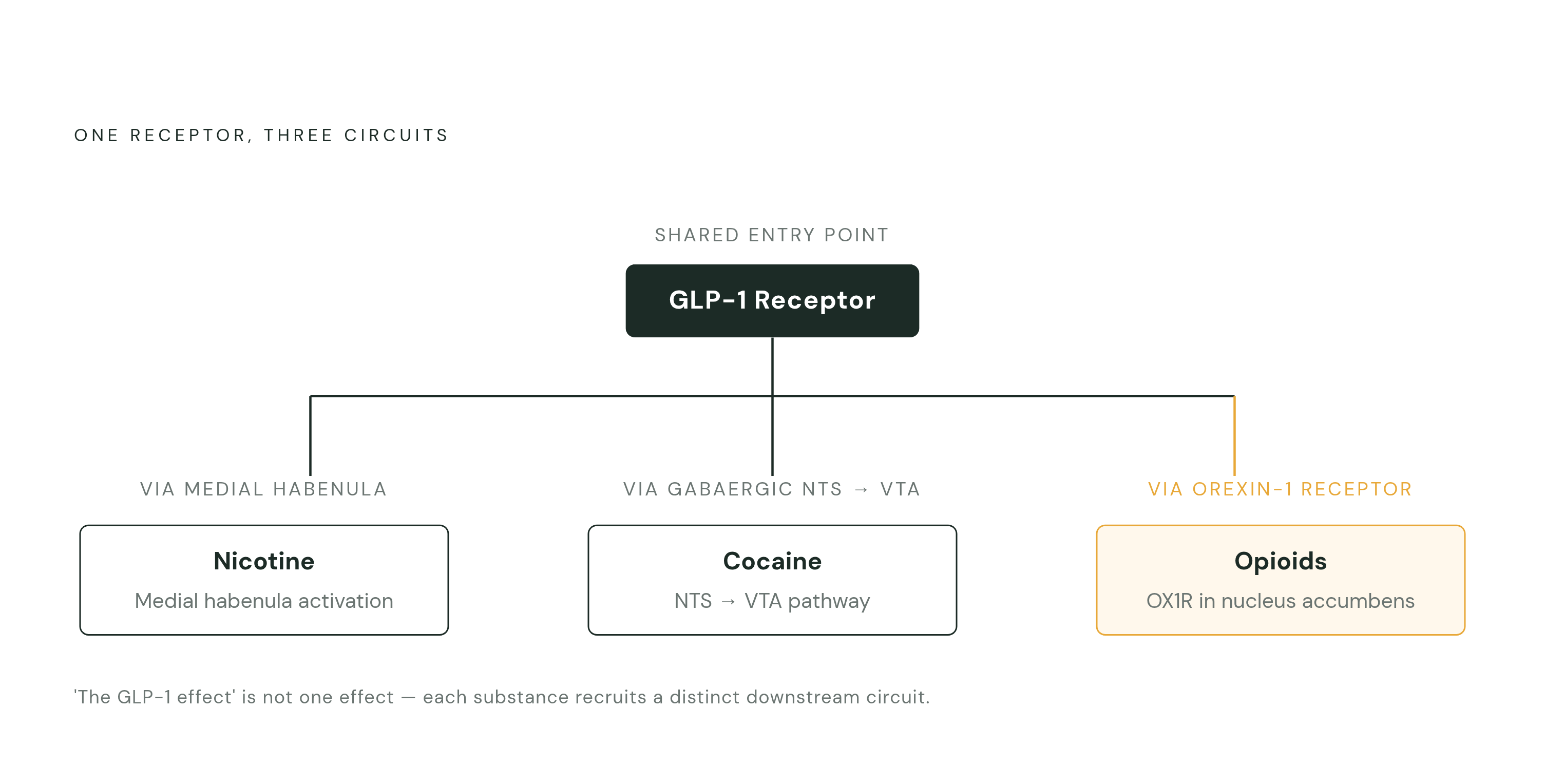
Recent research gave this mechanism its sharpest anatomical picture yet, mapping a GABAergic circuit running from the NTS to the VTA and finding GLP-1R activation increased activity in VTA-projecting NTS GABA neurons specifically during cocaine-cue presentation. Silence that circuit, and the drop in cocaine-seeking vanishes completely, one discrete pathway, activated by GLP-1R agonism, doing measurable behavioral work. That's about as tight as circuit neuroscience gets.
Yet if the effect depends on central GLP-1R engagement in one specific circuit, a drug that struggles to reach that circuit is only doing half the job. Everything downstream in this piece, the nicotine trials, the opioid signal, the delivery question, runs into that same wall eventually.
The nicotine evidence: from habenula biology to clinical trials
Nicotine runs through a different node than cocaine does. In the medial habenula, GLP-1R activation makes nicotine's effects feel aversive rather than rewarding, and animals given GLP-1R agonists cut their own nicotine intake as a result, while blocking habenular GLP-1R sends intake climbing back up. That's a tighter, more substance-specific story than most of the addiction literature offers, and it hands researchers a precise anatomical target instead of a diffuse, whole-brain effect.
Preclinical work backs this up with some consistency. GLP-1 receptor agonists reduce nicotine self-administration and nicotine-seeking in animal models, and some effects stick around after the drug clears the system, which points to something closer to circuit-level recalibration than a temporary chemical block. There's a practical bonus, too: GLP-1RAs seem to blunt the weight gain, craving, and overeating that follow smoking cessation, and weight gain is one of the more common reasons people relapse after quitting.
The clinical data adds real weight. In a randomized controlled trial, once-weekly exenatide given alongside nicotine replacement therapy for six weeks cut craving, eased withdrawal, raised abstinence rates, and blunted post-cessation weight gain compared with placebo or NRT alone. The trial enrolled people smoking at least ten cigarettes a day for at least a year, exactly the group where quitting is hardest because withdrawal and weight worries feed each other.
There's a softer signal too, and it comes from an unlikely source: social media. Roughly a quarter of nicotine-related posts from people using semaglutide or tirzepatide-class drugs mentioned quitting smoking, unprompted. That's nowhere near a clinical endpoint; it's just a signal that showed up on its own, in the wild, without anyone asking for it, and that kind of noisy real-world data either means nothing or means everything, depending on what the trials find.
An active trial, registered as NCT05530577, is testing this more rigorously now: a double-blind, parallel-arm study in dependent smokers using a validated lapse and reinstatement procedure after overnight abstinence. It's one of the first trials to apply laboratory-grade addiction endpoints, the kind normally reserved for studying relapse mechanics, to a GLP-1 receptor agonist. Dosing, duration, and whether habenula-specific engagement needs a different delivery approach than the systemic dosing used so far, all of that stays open.
The opioid evidence: promising preclinical data and an important clinical caveat
The opioid data starts in rodents, and it starts strong. GLP-1 receptor agonists, mainly exendin-4 and liraglutide, cut self-administration of heroin, fentanyl, and oxycodone across multiple studies, and they also reduce reinstatement of drug-seeking after abstinence, which is the rodent stand-in for relapse.
The circuit here isn't the habenula, and it isn't the NTS-to-VTA GABA pathway either. In opioid models, GLP-1R activation is linked to changes in orexin-1 receptor expression in the nucleus accumbens, a separate downstream target entirely. So even though the upstream receptor is the same GLP-1 receptor across nicotine, stimulant, and opioid models, the circuit it works through downstream looks substance-specific. One receptor, three different pathways, depending on what someone is addicted to, and that means "the GLP-1 effect" might not be one effect at all.
On the clinical side, a recently completed randomized controlled trial testing liraglutide in people with opioid use disorder reportedly cut craving, though full results remain unpublished as of this writing. Trial completion alone counts as a milestone in a field that has had very few opioid-specific GLP-1 studies to point to.
The population data is where things get more striking. A Washington University study from April 2026 found GLP-1 use tied to a 25% drop in the risk of developing opioid use disorder compared with non-GLP-1 diabetes medications. Among people with pre-existing substance use disorder, three years of GLP-1 use was linked to a 40% reduction in overdose and a 50% reduction in drug-related deaths, working out to roughly 12 fewer serious harm events per 1,000 users. These are population-level associations, not causal proof, but the size of them is hard to wave off.
Nora Volkow at NIDA has flagged a caveat worth taking seriously. GLP-1 receptor agonists are generally safe, but further weight loss may not suit patients already at a low BMI, a group that overlaps with some opioid use disorder patients. GI side effects, constipation especially, may hit this group harder too, since opioid use already slows gut motility on its own. Stack a GLP-1 drug's peripheral GI effects on top of that, and you've got a population at real risk of dropping out of treatment for reasons that have nothing to do with whether the drug is working on their craving.
That caveat points at a design problem, not just a safety footnote. The GI side effects come from peripheral drug exposure, and a delivery route that skipped the gut could sidestep exactly this friction in a population already prone to quitting treatment early. It's basically the thesis of the second half of this piece.
What population-scale data reveals about GLP-1s and substance use broadly
Nearly 17% of Americans aged 12 and up had a substance use disorder in 2024. Existing treatments, buprenorphine, methadone, naltrexone, acamprosate, varenicline, each target one specific receptor system, and each runs into real limits on long-term efficacy. That's the backdrop the GLP-1 signal has to be judged against: not a replacement for these tools, but a candidate working through a different, arguably more upstream slice of the brain's reward circuitry.
The idea underneath all of this is that GLP-1 agonism acts on the dopamine reward circuit itself, one level above the receptor systems any single drug targets. If that holds, it explains why the effect shows up across substance categories instead of staying locked to one drug class the way naltrexone is locked to opioids and alcohol.
The same Washington University study breaks this down by substance. GLP-1 use was tied to a 14% lower risk of any substance use disorder compared to non-GLP-1 diabetes treatment, with the effect varying by drug class: 18% for alcohol, 14% for cannabis, 20% for cocaine and nicotine, 25% for opioids. A separate 2024 study in Nature Communications found people prescribed semaglutide had a 50% to 56% lower risk of developing or relapsing into alcohol use disorder compared with other anti-obesity medications, one of the strongest single-substance signals in this whole literature.
Randomized trial data, rodent circuit work, population-level observation: put the three together and you get convergence, not proof of efficacy. That's a lower bar than a lot of readers might want, but it's still exactly the kind of evidence that justifies serious clinical work instead of a shrug.
What the population data can't answer is whether the effect scales with dose, whether it depends on central GLP-1R engagement specifically versus some peripheral metabolic pathway, and whether any of it holds up in patients who aren't obese or diabetic to start with. Those gaps aren't small. They're the questions that decide whether this becomes a real addiction therapy or stays an interesting side effect people write papers about at conferences.
Why the blood–brain barrier is both the central problem and the underappreciated variable
Here's where the mechanism runs into physical reality. A drug given by systemic injection has to survive peripheral breakdown, distribute through the bloodstream, and then get past the blood-brain barrier, and each step whittles down the dose meant for the brain before it ever arrives.
The BBB is particularly unfriendly to peptides. GLP-1 receptor agonists are large molecules, and limited BBB penetration is a well-documented barrier in the literature tracking how these drugs move from bench to bedside. It's one of the reasons the circuit-level precision Merkel and colleagues found in the NTS-to-VTA pathway might be hard to reproduce reliably with a drug delivered by injection.
The practical result is a dosing bind. The amount of drug needed for meaningful central GLP-1R engagement via injection is also the amount that saturates gut receptors along the way, and that's what drives the nausea, vomiting, and constipation tied to these medications. For a general obesity patient, that's a tolerability annoyance, but for a patient with opioid use disorder who already has slowed gut motility, per Volkow's caveat above, it's a tolerability problem stacked directly on top of a pre-existing vulnerability.
Species differences complicate things further, and this part doesn't get talked about enough. Rodent studies, including Merkel's, run in brains with different BBB architecture and different GLP-1R distribution than human brains carry, so a mechanism that looks clean in a mouse doesn't automatically hold up one-to-one in a person. That gap is one more reason delivery route might matter more to eventual success than the preclinical hit rate suggests on its own.
There's a sharper version of this problem buried in the circuit-specificity finding itself. If the NTS-to-VTA GABA pathway is the piece doing the behaviorally relevant work, incomplete central engagement doesn't just mean a weaker effect across the board. It could mean the most important node stays under-activated while less relevant regions soak up whatever drug manages to cross over. Delivery isn't a logistical afterthought bolted onto the neuroscience here; it's the thing deciding whether the neuroscience gets to show up at all.
How nose-to-brain delivery bypasses the BBB to reach reward circuits directly
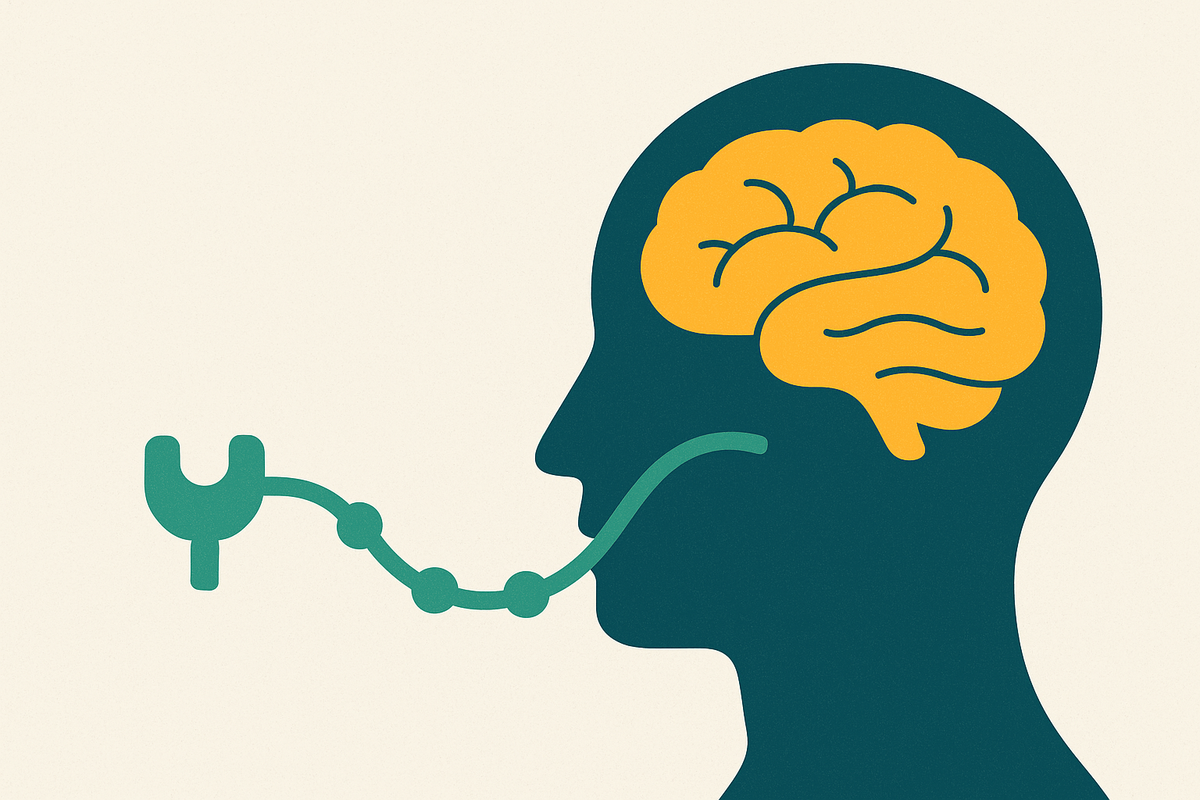
One way around the barrier is to not cross it at all. The nasal cavity offers a direct anatomical route into the brain via the olfactory and trigeminal nerves, skipping the BBB instead of trying to punch through it.
Where those pathways end up matters a great deal. The olfactory route connects to limbic structures, including the amygdala and hippocampus, while the trigeminal route reaches into the brainstem, including the NTS itself, the same nucleus that makes endogenous central GLP-1 and sits at the head of the NTS-to-VTA circuit Merkel and colleagues mapped. Intranasal delivery, by anatomy alone, aims at the exact region that both produces the brain's native GLP-1 supply and anchors the addiction-relevant circuit traced from the start of this piece.
The advantages over an injection are concrete: less peripheral exposure, a lighter GI side-effect burden, no first-pass metabolism through the liver, and potentially a lower effective dose for the same amount of central engagement. On paper, that combination addresses both problems raised above, the BBB bottleneck and the GI tolerability issue that hits opioid use disorder patients especially hard.
The nose isn't a free pass, though, and anyone who's worked on peptide delivery will tell you that. Drop a raw peptide into the nasal cavity as a plain solution, and it runs into three problems almost immediately: enzymes in the nasal mucosa break it down, poor permeability across the epithelial barrier keeps most of it from getting through, and mucociliary clearance sweeps out what's left before it has much chance to act. The anatomy is right, but left alone, the pharmacokinetics aren't enough.
What nanoparticle carriers add to intranasal peptide delivery
This is where nanoparticle engineering earns its place in the conversation. Wrapping a peptide in a nanoparticle protects it from enzymatic breakdown, and tuning the particle's size, surface charge, and surface chemistry can improve how well it crosses the epithelial barrier and travels along the olfactory and trigeminal nerves. Mucoadhesive coatings stretch out how long the particle sits in the nasal cavity before clearance sweeps it away, buying it more time to actually get where it's going.
Those aren't fixed properties baked into a molecule. They're design choices, size, charge, surface functionalization, each dialed in on purpose, which turns nanoparticle delivery into an engineering problem with adjustable knobs rather than a constraint dictated by the peptide's native chemistry.
There's a second benefit beyond just getting the peptide there intact. Encapsulation can enable controlled release at the target site, and that matters for addiction treatment specifically, since sustained receptor engagement may track closer to how endogenous GLP-1 signaling naturally behaves than a sharp spike-and-crash pharmacokinetic profile would.
The underlying logic stretches further than any single molecule, too. A nanoparticle system built to carry one GLP-1 peptide into the brain can, in principle, get adapted to carry other peptides or biologics using the same carrier design, which makes it an investment in a transferable delivery platform, not a one-off fix for one drug.
Lionbio, a Columbia University spinout building on more than three decades of patented nanoparticle delivery IP, is developing intranasal GLP-1 delivery to the brain. Its work targets the two problems this literature keeps surfacing: BBB penetration and peripheral GI side effects. If a nose-to-brain route like this holds up in trials, it would let GLP-1 peptides reach the VTA, the NAc, and the NTS circuits without routing the drug through the gut first.
The nanoparticle approach isn't novelty dressed up as innovation. It's a direct answer to a gap the neuroscience itself keeps exposing: you can't reliably switch on reward-circuit GLP-1 receptors with a drug that struggles to reach the circuit in the first place.
What rigorous clinical trials will need to establish before GLP-1 addiction therapy is standard of care
So where does the evidence actually leave things? A plausible mechanism, a consistent preclinical signal across nicotine, opioids, alcohol, and stimulants, early clinical support, and a biological reason the effect crosses substance categories instead of staying confined to one. That's a real foundation, though it isn't a finished case.
Optimal dosing for central versus peripheral targets hasn't been worked out, and whether the effect holds in patients who aren't obese or metabolically compromised is a question nobody has answered cleanly. Long-term safety data in substance use disorder populations specifically, rather than in diabetes or obesity populations, stays thin, and the substance-specific circuit differences walked through above, the habenula for nicotine, the NTS-to-VTA GABA pathway for stimulants, the orexin-NAc pathway for opioids, raise a real possibility that dosing or delivery strategy needs to be substance-specific too, rather than one design fitting every case.
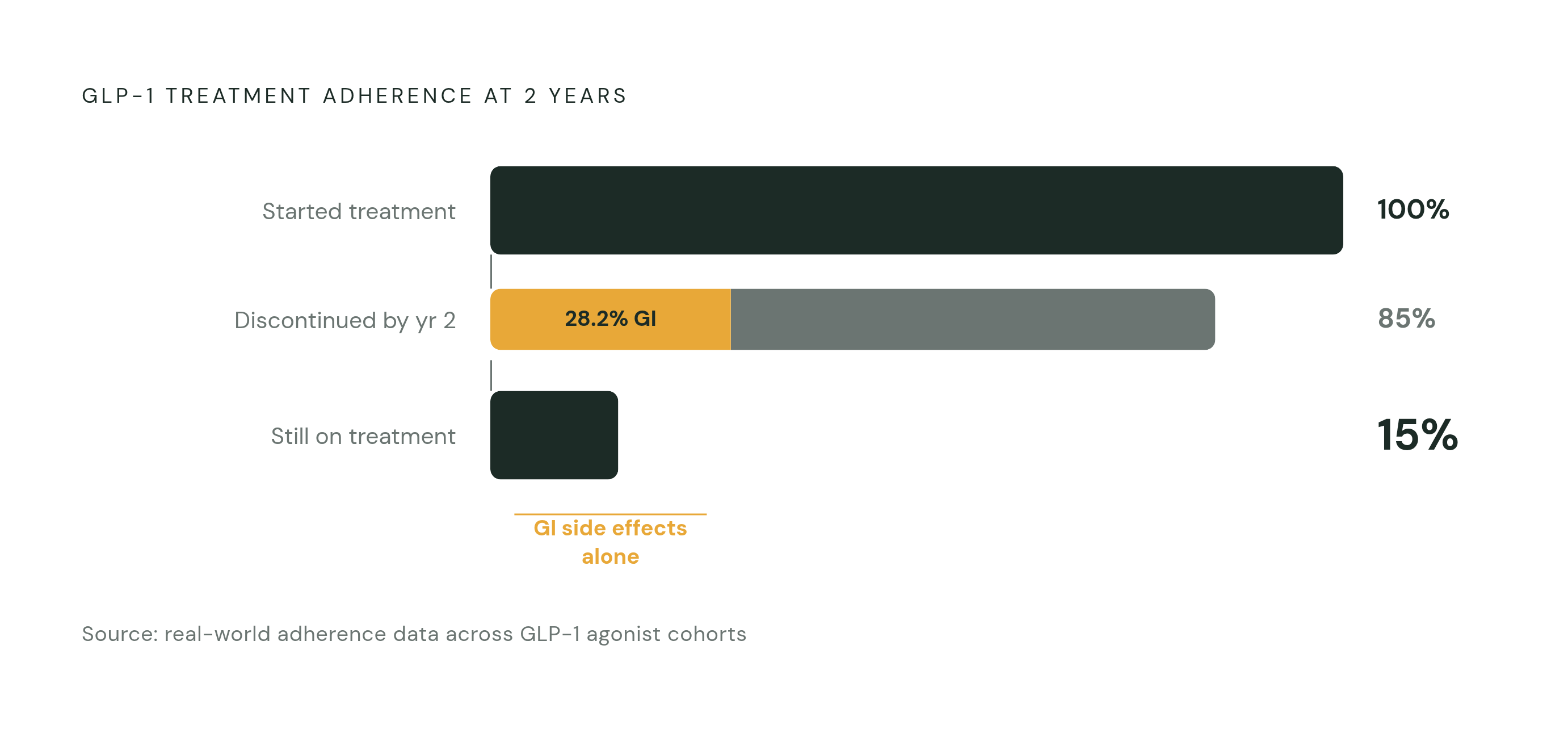
Then there's the adherence problem, and it might be the one that matters most. Roughly 85% of GLP-1 patients had stopped treatment within two years of starting, and side effects, GI issues in particular, accounted for 28.2% of those discontinuations. That number alone should temper any enthusiasm about GLP-1 agonism as an addiction therapy until the delivery problem gets solved: a mechanism that works in principle is worth nothing in practice if patients can't stay on the drug long enough for it to matter.
Whatever role nose-to-brain delivery and nanoparticle carriers end up playing, the trials that settle this question will need to weigh something harder than efficacy alone: not just whether the drug reaches the right circuits, but whether the people it's meant to help can actually stick with it long enough to find out. That's a less glamorous question than circuit mapping or population statistics, but it might be the one that decides everything else.