GLP-1 Signaling in Alzheimer's Disease Models
Diabetes drugs show unexpected promise in Alzheimer's models.

GLP-1 receptor signaling sits at the center of one of the stranger convergences happening in Alzheimer's research today. A hormone system known mainly for regulating blood sugar and appetite turns out to be wired directly into the brain regions that fail first in dementia. This piece walks through what that wiring does, mechanically and clinically, and where the tidy story starts to fray.
GLP-1 receptors turn up in the frontal cortex, the substantia nigra, and the hippocampus. That's not scatter. Those are the regions tied to memory formation, executive function, and the dopamine signaling that breaks down in neurodegenerative disease. When the receptor fires, it sets off three separate cascades inside the cell, not one. cAMP/PKA governs neuronal excitability and gene transcription. PI3K/Akt runs cell survival, glucose metabolism, and protein synthesis. MAPK handles synaptic plasticity and the cell's stress response. A receptor that does all three doesn't read like a peripheral metabolic signal that happens to leak into the brain; it sits right inside the tissue that runs cognition.
Two things get lumped together that shouldn't be: the GLP-1 your gut releases after a meal, and the exogenous GLP-1 receptor agonists used in clinic, drugs like exenatide, liraglutide, and dulaglutide. Both hit the same receptor. But they differ quite a bit in how long they circulate and how well they get into the central nervous system, and that difference matters later, when we get to why some trials worked and others flopped outright. Knockout studies make the underlying point hard to argue with: mice bred without GLP-1 receptors show worse synaptic plasticity and worse memory formation, and not subtly either. Endogenous GLP-1 signaling isn't incidental to cognition. It's built into how a healthy brain runs, meal to meal.
How GLP-1 signals reach the brain from the gut — and why the route matters for Alzheimer's research
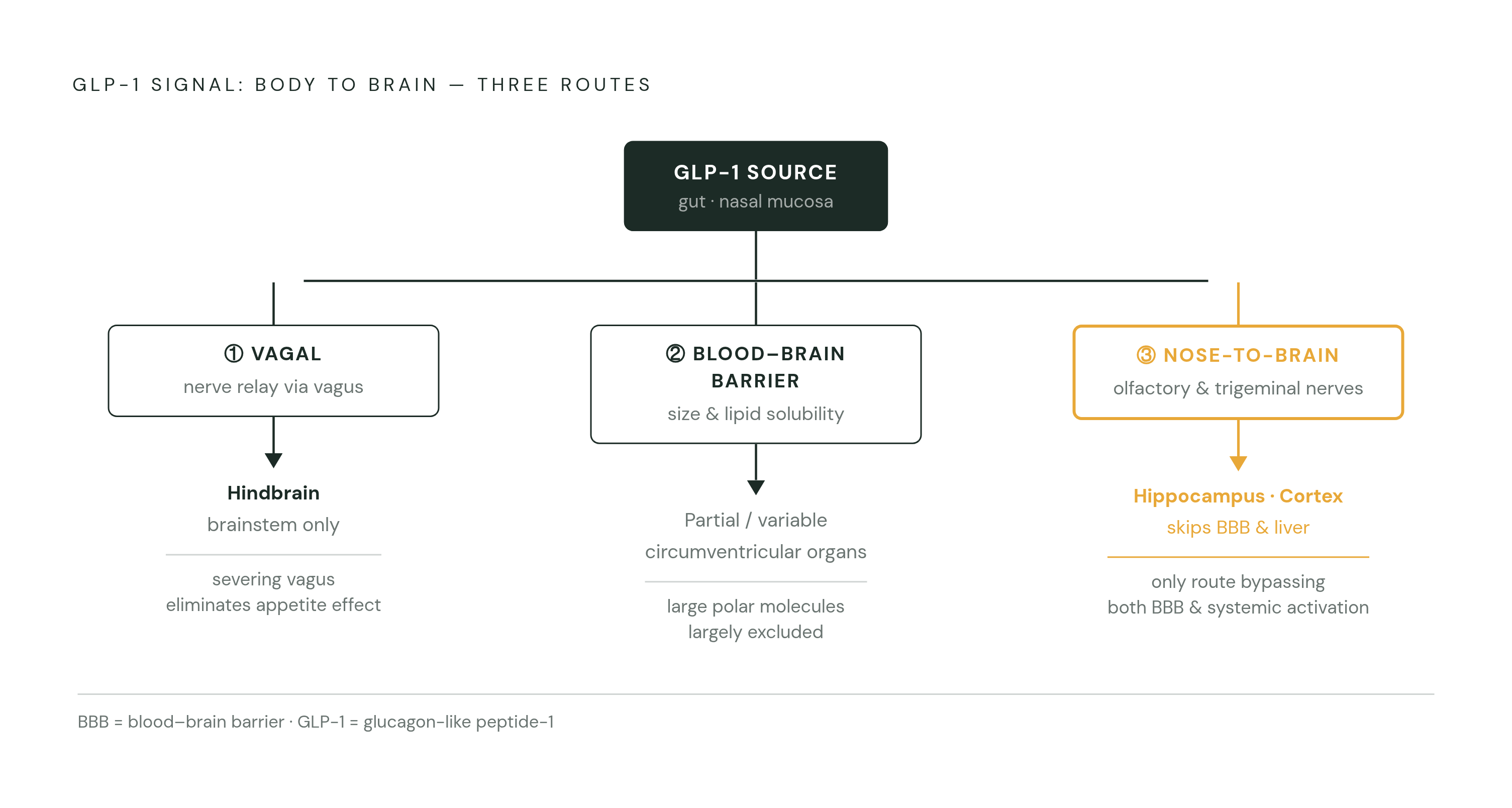
Three routes carry a GLP-1 signal from the body into the brain, and each one drops a different dose in a different place. First is the vagal pathway: gut-derived GLP-1 rides the vagus nerve up to hindbrain sites. Cutting vagal inputs in rodents kills the appetite-suppressing effect of peripheral GLP-1 completely, not partially. Sever the wire, lose the signal.
Second is the blood route. Some GLP-1 receptor agonists cross the blood-brain barrier, though how well depends on the molecule's size and how fat-soluble it is; bigger, more polar molecules struggle to squeeze through. Third is nose to brain, running along olfactory and trigeminal nerve pathways that offer a fairly direct line into the CNS. This path skips first-pass liver metabolism and skips the blood-brain barrier altogether.
None of this is a footnote to skim past. The route a drug takes decides which brain regions actually see it, at what concentration, and for Alzheimer's the regions that matter most are the hippocampus and prefrontal cortex. A peripheral injection might simply not push enough drug into those specific structures, even when blood levels look fine on paper. Lionbio is building around exactly this constraint: intranasal delivery of nanoparticle-encapsulated GLP-1 peptides, sent straight to the regions most damaged in Alzheimer's through the nose-to-brain route, while dodging the systemic receptor activation that causes nausea and GI distress in patients on standard formulations.
So when a preclinical study reports a neuroprotective effect, the first question worth asking is how the drug got into the brain in that experiment. That detail caps how much you're allowed to conclude about whether the same thing happens in a person.
Why Alzheimer's disease and metabolic dysfunction share enough biology to make GLP-1 a plausible intervention
Some researchers call Alzheimer's a form of central insulin resistance, meaning the brain's response to insulin degrades in ways that echo what happens in the pancreas and muscle tissue of someone with type 2 diabetes. Does that framing hold up against the actual mechanistic overlap? Both conditions involve insulin resistance that blocks glucose uptake into neurons, chronic inflammation driven by activated microglia and inflammatory cytokines, oxidative stress that damages mitochondria and speeds up protein misfolding, and mitochondrial dysfunction that leaves energy-hungry neurons short on ATP.
GLP-1 receptor agonism in Alzheimer's models restores PI3K/Akt signaling downstream of the insulin receptor, specifically by cutting serine phosphorylation of IRS-1, a standard marker of a dysfunctional insulin receptor. That's the mechanistic bridge the whole hypothesis leans on. GLP-1 drugs aren't just managing blood sugar from a distance; they're re-engaging a pathway neurons need in order to survive and hold onto their synapses.
One note on tolerability, since it comes back later: large health record analyses show people on GLP-1 drugs develop gastrointestinal side effects at a rate of 40 to 70%. That doesn't prove anything about the brain on its own; it's a peripheral effect tied to receptor activation in the gut. But it fits the broader mechanistic picture, and it's exactly the systemic effect a targeted delivery route is trying to dodge. The overlap between metabolic and neurodegenerative biology is what turns GLP-1 from a diabetes drug with a rumored side benefit into an actual research target for Alzheimer's, studied on its own terms.
What preclinical models show about GLP-1 signaling and amyloid burden
Across several GLP-1 receptor agonists, exenatide, liraglutide, lixisenatide, the same finding keeps showing up: treated animals carry less amyloid-beta plaque and fewer neurofibrillary tangles than controls. That consistency across different molecules tells you something on its own. The effect probably runs through the receptor mechanism itself, not some off-target quirk tied to one particular drug.
One mechanism here is worked out fairly well by now. Activated microglia ramp up an enzyme called BACE1 (beta-site amyloid precursor protein cleaving enzyme) in response to pro-inflammatory cytokines. BACE1 drives the amyloidogenic processing of APP, the step that produces the Aβ peptides that eventually form plaques. In rat models, liraglutide treatment cut BACE1 levels, and Aβ production dropped right along with it. That single enzymatic node ties together two things that used to get discussed as separate stories: neuroinflammation and amyloid production.
So the amyloid story isn't really an amyloid story at the level of mechanism. GLP-1's anti-amyloid effect doesn't look like a direct chemical grab on the Aβ peptide; it runs through inflammation suppression first. Why does the order matter? Because it implies a timing constraint. If the drug works by calming inflammation before too much amyloidogenic processing has already happened, then how early you step in probably decides how much benefit shows up later. Animal models also show normalized brain glucose metabolism alongside reduced early amyloid forms, which suggests these might be coupled effects rather than two wins that just happen to travel together.
None of this predicts efficacy in humans, though. In vitro systems and rodent transgenic models reproduce pieces of amyloid pathology, but nothing close to the full, decades-long human disease course. That gap is exactly why the trial data discussed later carries so much weight, and why it complicates the clean preclinical story.
How GLP-1 signaling affects tau pathology, neuroinflammation, and synaptic integrity — and where the evidence gets complicated
On tau, preclinical studies keep showing reduced tau hyperphosphorylation after GLP-1 receptor agonist treatment. Look closer, though, at how that effect seems to happen: the evidence points to an indirect mechanism, mediated through restored insulin signaling and lower activity of inflammatory kinases, rather than direct action on tau kinases like GSK-3β. A drug that hits its target head-on is usually easier to dose and titrate. A drug working through two or three steps of indirection is harder to predict, and its effect probably depends more on what stage of disease you catch the patient in.
Neuroinflammation is where the picture starts to click into place. GLP-1 receptor activation suppresses microglial activation and cuts pro-inflammatory cytokine release, the same pathway sitting underneath the BACE1 mechanism described above. Inflammation suppression does double duty here, cutting both the kinase activity that phosphorylates tau and the enzymatic step that produces amyloid. Neuroinflammation starts to look less like a side effect of treating either pathway, and more like the actual hub linking metabolic signaling to several arms of Alzheimer's disease at once.
Then there's synapse preservation, and this might be the outcome that matters most in the clinic. GLP-1 receptor knockout mice show worse synaptic plasticity and worse memory; GLP-1 receptor agonists in Alzheimer's models improve synaptic plasticity markers and neuronal survival. Synaptic integrity tracks with actual cognitive function in human Alzheimer's far more tightly than amyloid burden does; plenty of people carry heavy plaque loads with cognition mostly intact, while synaptic loss lines up much more reliably with symptoms. Put all three axes together and you get a drug that probably works through several mechanisms at once rather than one clean pathway. Sounds good on paper. Makes dose optimization and biomarker selection genuinely hard in practice.
What the Phase 2b liraglutide trial demonstrated — and what it left open
The ELAD Phase 2b trial enrolled 204 people with mild to moderate Alzheimer's and gave them liraglutide or placebo for 12 months. The headline finding, reported at the Alzheimer's Association International Conference in 2024, was that liraglutide appeared to slow brain volume loss, across the temporal lobe, total gray matter, and cortical volume, by nearly 50% against placebo on MRI.
That's a striking number. It's also a structural biomarker, and structural biomarkers track with neurons surviving without proving that someone's memory or daily function actually got better. Twelve months is a short window against a disease with a preclinical phase that can run for decades before symptoms even show up. A Phase 2b trial with 204 participants isn't built to catch differences in clinical outcomes like cognitive test scores anyway; it's built to find a signal worth chasing, and it found one.
That signal lines up with what the preclinical mechanisms predicted: GLP-1 signaling preserving tissue in exactly the regions that run memory and executive function. What ELAD didn't answer is whether preserved brain volume actually turns into slower cognitive decline over years, or whether the effect even holds past the 12-month mark. That open question sets up the harder problem the field ran into next. If a Phase 2b trial found a real structural signal, why did the large Phase 3 trials of another GLP-1 receptor agonist come back null on cognition?
Why the large Phase 3 AD trials produced null cognitive outcomes despite biomarker movement
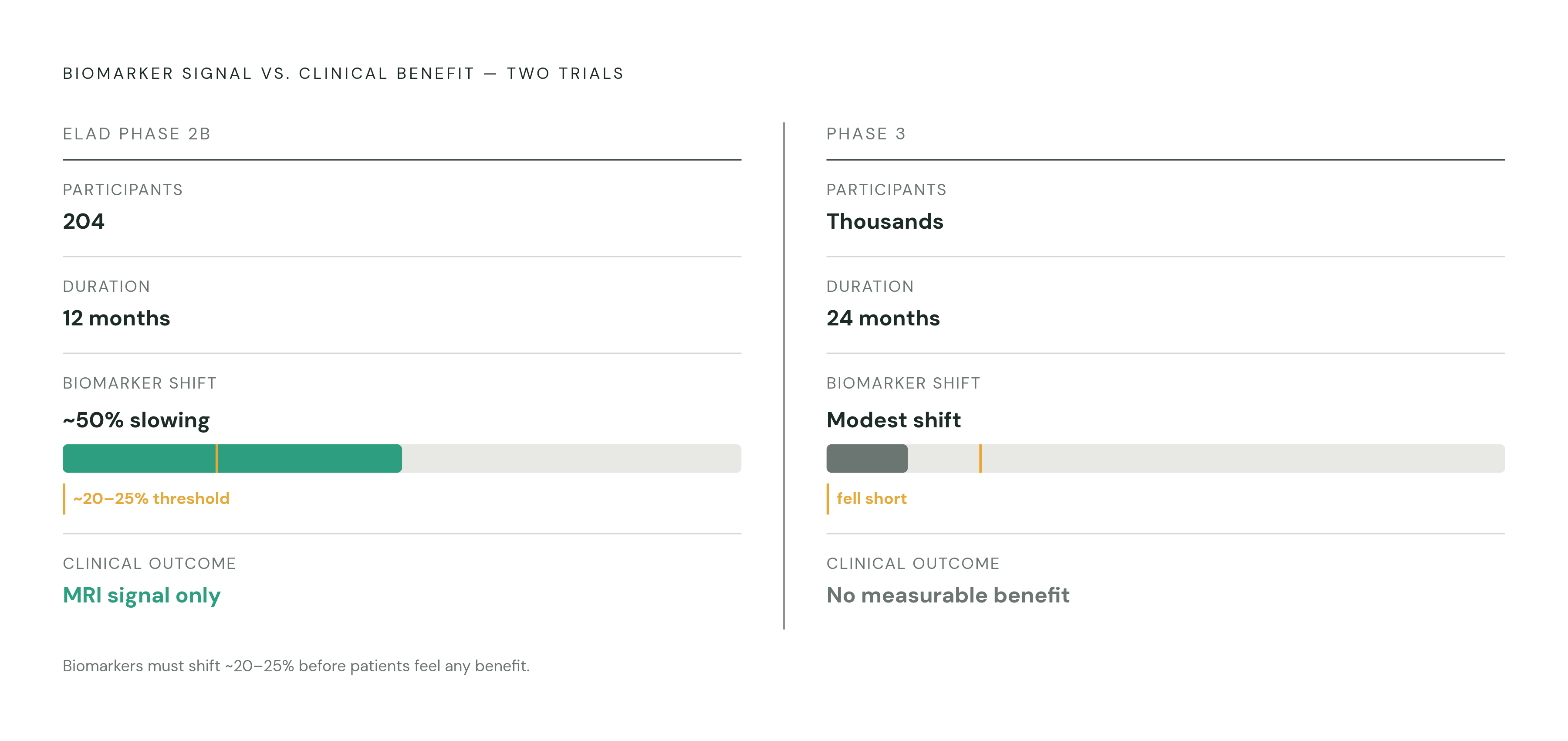
The Phase 3 program enrolled thousands of people with early Alzheimer's, either mild cognitive impairment or mild dementia, all with confirmed amyloid pathology, and ran for two years. Results presented at the Clinical Trials on Alzheimer's Disease conference in December 2025 showed no meaningful slowing of cognitive or functional decline against placebo, even though inflammatory and neurodegeneration biomarkers moved modestly in the right direction.
That gap between biomarker movement and clinical outcome is the real puzzle here, and it's worth sitting with instead of explaining away. The biology moved the way the mechanism predicted; it just didn't move far enough to register as anything a patient or caregiver would actually notice. Some researchers have proposed that key biomarkers need to shift by something like 20 to 25% before that movement crosses into measurable clinical benefit, and this trial fell short of that mark.
A few explanations deserve weighing side by side. Maybe the enrolled population had already progressed too far, with tau pathology and synaptic loss extensive enough that cooling down inflammation couldn't undo the damage. Maybe oral dosing simply doesn't push enough drug into the hippocampus and cortex to meaningfully engage GLP-1 receptors there, echoing the delivery-route problem raised earlier. Or, more plainly, GLP-1 monotherapy might not be enough to overcome the full pathological load of established disease, which tracks with what the preclinical models actually tested in the first place: early intervention, not late-stage rescue. A systematic review and meta-analysis covering 15 randomized controlled trials and 1,341 participants found GLP-1 receptor agonists did not improve memory or cognition against placebo, rated as low-certainty evidence. That null result doesn't refute the mechanism underneath it. It refutes the adequacy of one delivery method, one dosing window, and one drug used alone.
Why combination strategies — pairing GLP-1 signaling with anti-amyloid therapy — are now the leading hypothesis for clinical translation
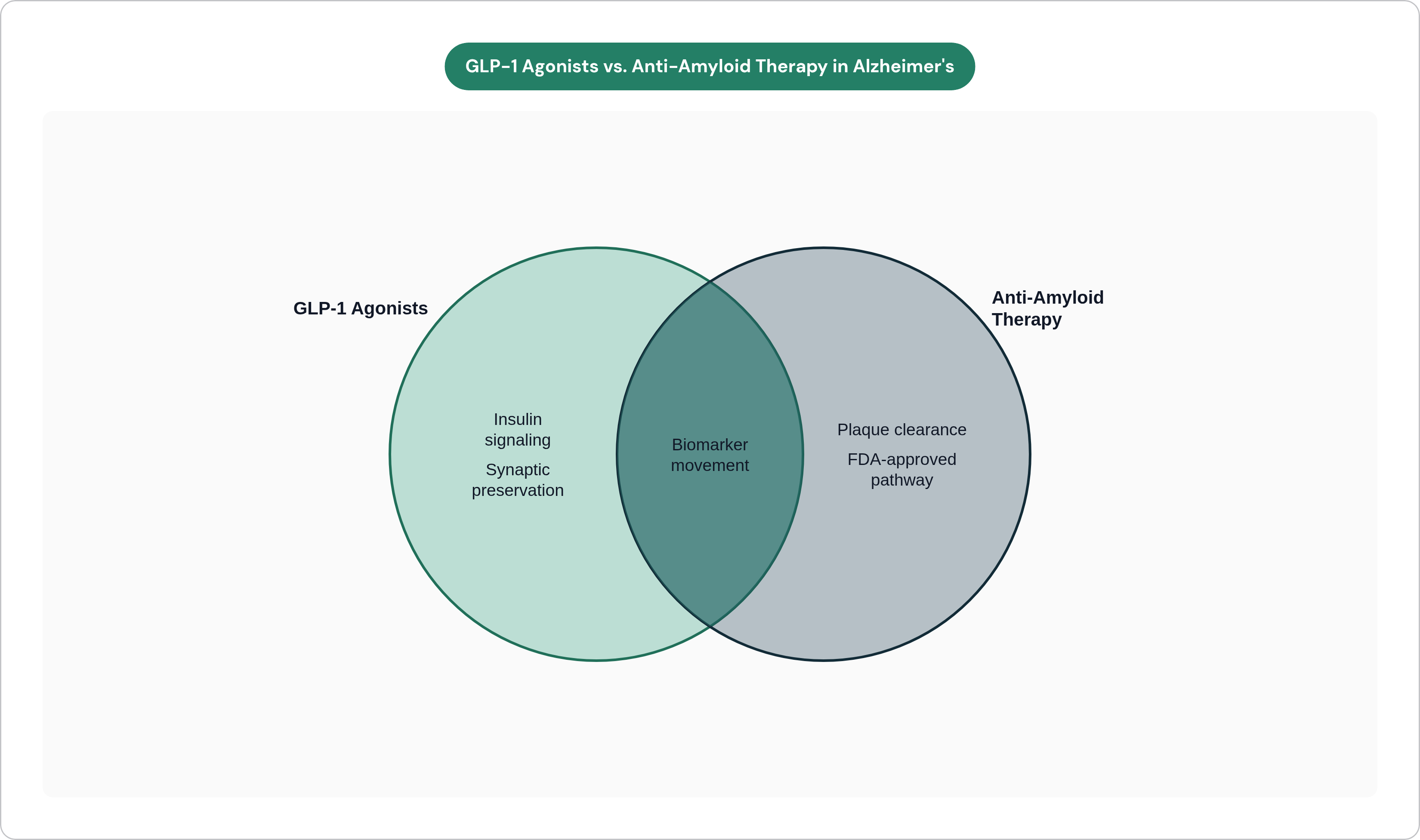
The FDA's approval of anti-amyloid antibody therapies for early Alzheimer's gave the field its first real clinical foundation for disease-modifying treatment. These drugs clear amyloid plaque, and that matters. But they leave neuroinflammation untouched, don't restore insulin signaling, and don't preserve synapses directly.
That gap lines up almost exactly with what GLP-1 signaling does. It suppresses neuroinflammation, restores central insulin signaling through the PI3K/Akt cascade, preserves synaptic integrity, and possibly cuts tau phosphorylation through the indirect kinase pathway described earlier. Neither approach alone covers the full pathology. Together, they cover more of it than either does by itself.
Go back to that 20 to 25% biomarker threshold from the Phase 3 trial. If GLP-1 alone shifts inflammatory or neurodegeneration markers by an amount that still falls short of that line, pairing it with a drug that clears amyloid might be exactly what pushes the combined effect over the threshold patients can feel. A 2025 paper out of the Chinese University of Hong Kong laid out this kind of integrative framework directly, proposing a phased clinical roadmap that pairs GLP-1 receptor agonists with anti-amyloid immunotherapy instead of testing either one in isolation.
That reframes the Phase 3 failure without overturning it. GLP-1 was never tested in what might be its best-case setup: early in the disease course, with adequate CNS drug exposure, alongside amyloid clearance rather than instead of it. What's still unsettled is sequencing. Does amyloid clearance come first, with GLP-1 layered in afterward as maintenance, or do both start together? And what biomarker panel would actually catch a synergistic effect, assuming one exists? Neither question has a clean answer yet, and that's exactly where the next round of trial design needs to put its attention.
How delivery route shapes what GLP-1 signaling can actually do in the Alzheimer's brain
Delivery route runs under nearly everything discussed above, and it earns being said outright rather than left implied. How a GLP-1 drug gets into the body decides which brain regions it can reach, at what dose, and with what side-effect burden. That fact alone may account for more of the gap between preclinical success and clinical failure than any open question about the underlying biology.
Think about what oral or injectable systemic dosing actually asks of a molecule. It has to survive the gut or make it into the bloodstream, dodge being broken down, cross the blood-brain barrier in useful amounts, and do all of that while also lighting up GLP-1 receptors throughout the gut and pancreas, which is exactly where the nausea and GI complaints come from. That's a lot to ask of one dosing strategy, and it's a plausible reason oral Phase 3 dosing might not have delivered enough drug to the hippocampus even while producing measurable effects out at the periphery.
The nose-to-brain route sidesteps a good chunk of that problem. Running along the olfactory and trigeminal nerve pathways, a drug can reach the CNS directly, skipping the blood-brain barrier and skipping the need to flood systemic circulation first. That's the logic behind intranasal, nanoparticle-based delivery approaches, aiming to get GLP-1 receptor agonists into the hippocampus and cortex directly while keeping the systemic exposure that drives GI intolerance to a minimum.
Whether that approach actually closes the gap between preclinical promise and clinical outcome is still an open question, and it should stay open until trial data says otherwise. But the throughline across every section here, from receptor distribution to the ELAD signal to the Phase 3 null result, keeps pointing at delivery as the variable most worth digging into next. The mechanism looks real. Getting the right dose to the right neurons, without setting off unwanted signaling everywhere else along the way, is the problem the field still has to solve.