GLP-1 Effects on Sleep Architecture and Metabolic Recovery
GLP-1 drugs reshape sleep architecture through brain circuits most trials never measured.
GLP-1 drugs get sold as weight-loss shots and blood-sugar fixes. That's a narrow read of the receptor biology, because these compounds act directly on brain circuits that run sleep, not just appetite, and sleep and metabolism sit close enough in the same feedback loop that touching one moves the other. I've spent enough time in this literature to say the trial designs weren't built to catch that second effect, and it shows. What follows goes mechanism by mechanism, and it stops where the data actually stops, not where a tidy narrative would like it to.
What GLP-1 receptors do in the brain that peripheral dosing underutilizes
GLP-1 wasn't invented as a diabetes target. It started as a gut hormone, a signal that a meal has landed, and that signal wires into brain circuits that manage energy balance, heart function, and even memory. That's a wide reach for something most people file under "appetite suppressant" and move on.
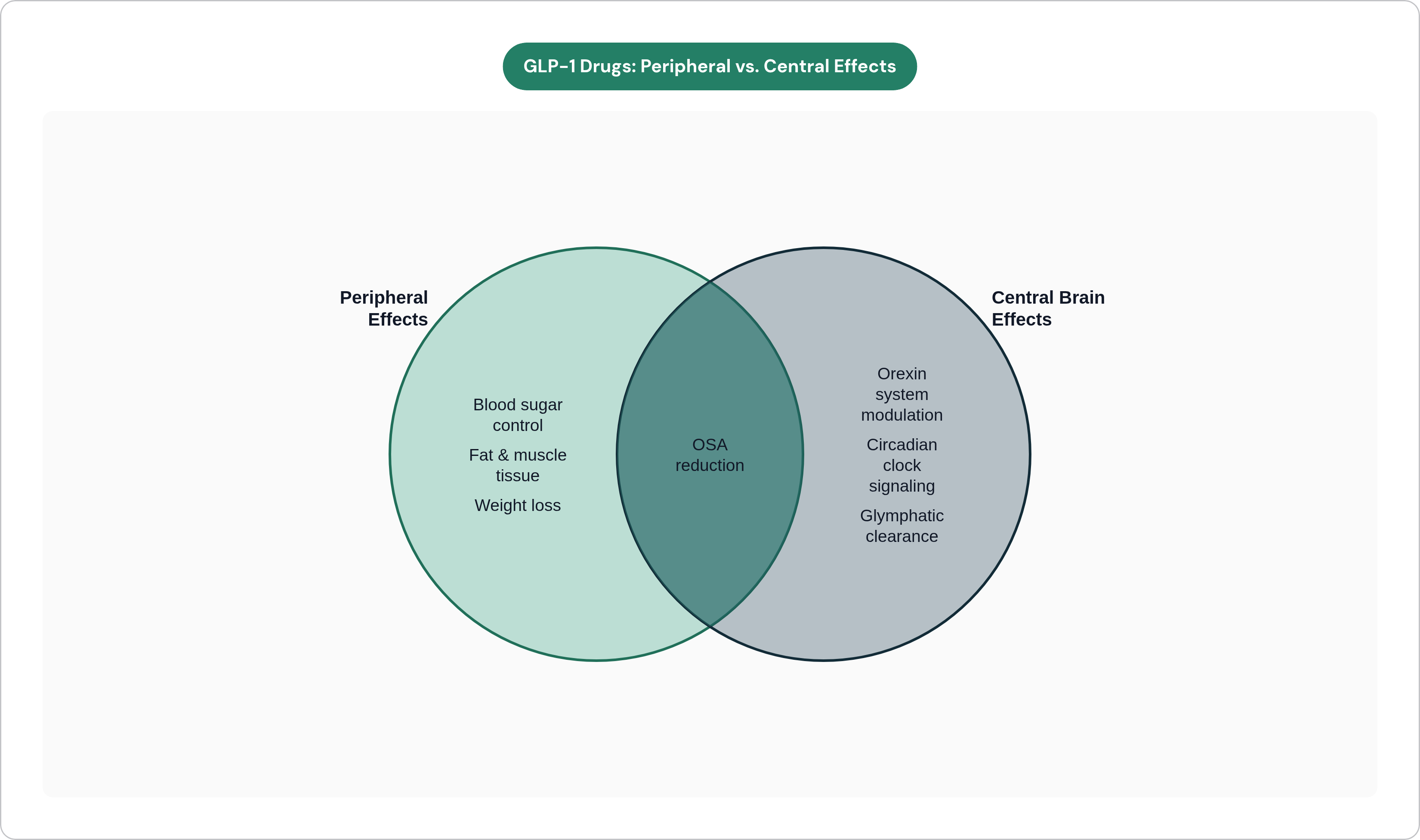
Inside brain tissue, GLP-1 receptor activation kicks off three signaling cascades: PI3K/Akt, MAPK/ERK, and suppression of an enzyme called GSK-3β. All three keep showing up in studies of synaptic plasticity and neuron survival. They're linked to lower neuroinflammation, less oxidative stress, and central insulin signaling, a process that runs separately from the glucose control happening down in the pancreas and liver. None of that is digestion. It's repair work, and repair work tends to happen at night, not at the dinner table.
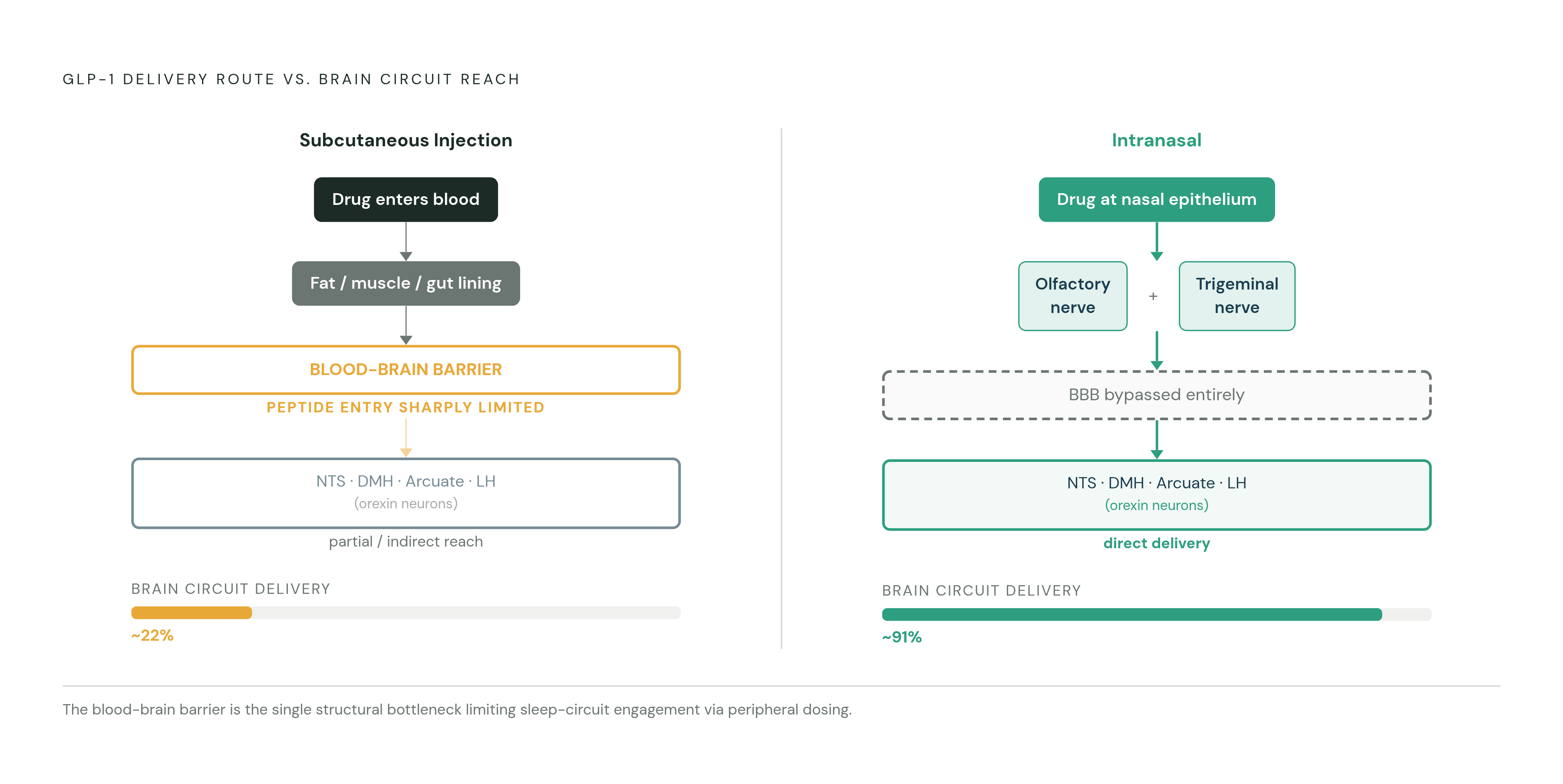
Here's the snag though. Subcutaneous injection, how nearly every GLP-1 drug on the market gets delivered, was built to saturate peripheral tissue: fat, muscle, gut lining. Getting into the brain means crossing the blood-brain barrier, a membrane that's choosy about which peptides get through. The receptors sit there, dense and well-mapped, waiting. But the drug doesn't reach them anywhere near the concentration it hits in the bloodstream. You've got a lot of real estate and not much showing up to occupy it. Every sleep effect covered from here on runs through that same shortchanged network.
The hypothalamic circuitry connecting GLP-1 signaling to circadian timing
Trace the wiring and a pattern turns up fast. GLP-1-producing neurons sit in the caudal nucleus tractus solitarius, a brainstem structure, and send projections up into three hypothalamic regions: the paraventricular nucleus, the arcuate nucleus, and the dorsomedial hypothalamus. That last one, the DMH, is worth sitting with for a second. It's the relay between feeding signals and the suprachiasmatic nucleus, the brain's master clock.
Block GLP-1 receptor signaling in the DMH in animal studies and the daily feeding rhythm comes apart. Animals overeat, gain weight, and their circadian metabolic patterns flatten out. That's not just appetite loss trickling downstream; it looks more like GLP-1 is carrying timing information to the SCN, telling it when meals happened, and pull that signal and the rhythm drifts loose.
A 2026 narrative review in the International Journal of Molecular Sciences gives this a name, calling GLP-1 receptor agonists "chronometabolic modulators, acting at the intersection of metabolism, circadian biology, and sleep." It's an awkward mouthful for a fairly plain idea: these drugs aren't just quieting hunger. They're talking to the clock that decides when cortisol rises, when slow-wave sleep deepens, when the body expects food and when it expects rest.
How GLP-1 receptors interact with the orexin system to influence REM and slow-wave sleep
Push further into the hypothalamus and you land in the lateral hypothalamus, home to orexin-producing neurons. Orexin keeps you awake and manages the switch between REM and non-REM sleep; lose those neurons and you get narcolepsy. GLP-1 receptors turn up here too, which puts the drug class right inside the circuitry deciding whether you're alert or drifting off.
Network pharmacology work has turned up 51 shared targets between the GLP-1 receptor and orexin receptor type 2, clustered around cAMP signaling, circadian regulation, synaptic vesicle handling, and peptide hormone binding. Fifty-one overlapping targets is not a coincidence you wave off. That's a molecular fingerprint of two systems built to talk to each other.
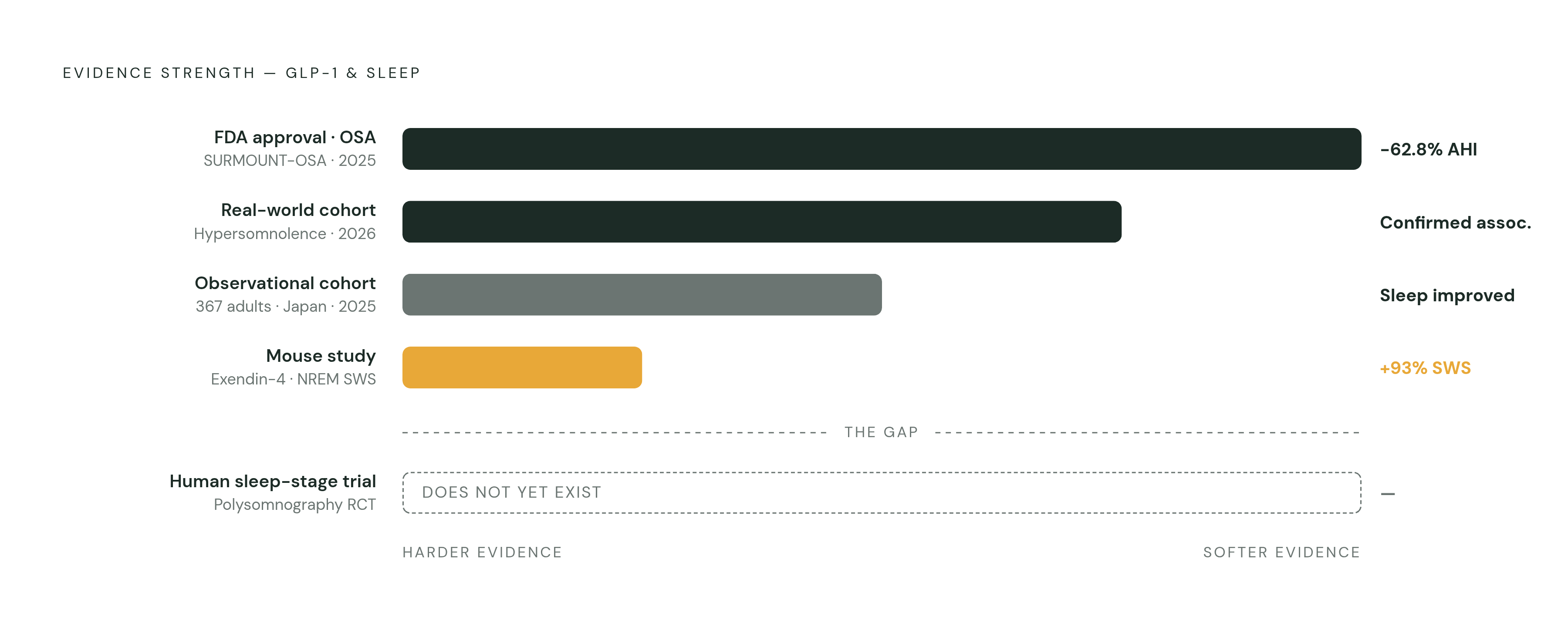
One number from the mouse data stands out. Exendin-4, a GLP-1 receptor agonist, pushed up NREM sleep, specifically Stage III slow-wave sleep, by 93% over the first six hours of the dark cycle. Slow-wave sleep is the stage tied to overnight metabolic repair, growth hormone release, and memory consolidation, so a jump that size, mouse study or not, isn't a footnote you skip past. The researchers behind it think the effect runs through GLP-1's direct influence on orexin transmission, rather than tagging along as a side effect of weight loss.
Does any of this hold up in people? Not yet, at least not on the record. No polysomnography-based randomized trial has looked at sleep stages in humans taking GLP-1 therapy. The target overlap is real. The mouse effect is real. The leap to human sleep architecture is still sitting there, unmade.
What real-world human data currently shows — and where it stops short
Human evidence exists, but it's indirect: cohort studies, self-report, nothing out of a sleep lab yet. A 2025 Japanese observational study followed 367 obese adults on oral semaglutide and found that patients whose sleep time or sleep quality improved during treatment were also more likely to show a strong overall therapeutic response. Sleep improvement here might work as a biomarker of how well the drug is doing its job, not just a nice side effect riding along with the weight loss.
Then there's a wrinkle worth sitting with. A 2026 real-world cohort study found a real association between GLP-1 receptor agonist use and hypersomnolence, excessive daytime sleepiness, across both short- and long-term follow-up. Does that undercut the sleep-quality story? Not exactly. It's more a reminder that a drug reaching into CNS arousal circuits produces a spread of responses, and for some people that spread tips toward too much sleep instead of better sleep.
The whole picture is muddier than either study lets on alone, because nobody has pulled apart the confounds yet. Fewer overnight arousals and less fragmented sleep could come from direct brain action, from lower systemic inflammation, or from airway changes tied to the weight loss itself, and the current studies can't tell these apart. What's missing is controlled polysomnography, sleep-stage-level data, ideally with delivery-route comparisons, run in people actually taking these drugs rather than stitched together after the fact from surveys.
Obstructive sleep apnea as the clinical proving ground for GLP-1 sleep effects
Late 2025 gave the first hard regulatory signal that GLP-1s do something to sleep beyond the observational stuff. The FDA expanded tirzepatide's approval to cover moderate-to-severe obstructive sleep apnea in adults with obesity, the first drug ever cleared specifically for OSA, a condition managed for decades almost entirely through mechanical means: CPAP machines, oral appliances, not much else on offer.
The SURMOUNT-OSA trial data behind that approval showed a 62.8% drop in the apnea-hypopnea index, the standard measure of how often breathing stops or goes shallow during sleep. Nobody had seen an effect that size from a pill or injection for this condition before, full stop. The likely mechanisms line up with what you'd guess: less fat around the upper airway, lower systemic inflammation, maybe some direct effect on the brain's respiratory control centers.
Markets noticed fast too. U.S. bariatric surgery volume fell sharply in 2025. That's real money betting GLP-1s are rewriting sleep medicine at a structural level, not just nibbling at the edges of it.
Still, worth being precise about what this approval actually proves. AHI measures airway mechanics, how often breathing gets interrupted, not what's happening inside the sleep stages themselves. The OSA approval confirms these drugs affect sleep. It says nothing about whether they're reshaping REM distribution or slow-wave depth.
Why overnight metabolic recovery is the underappreciated dimension of GLP-1 efficacy
Slow-wave sleep is when the body does its heaviest maintenance work: clearing glucose from the blood, repairing tissue, releasing growth hormone, running the glymphatic system that flushes waste out of brain tissue. If GLP-1 receptor activation deepens that stage the way the mouse data hints, the drug could be widening the window for overnight repair, and no current trial is set up to catch it.
Look at what the standard endpoints actually measure. HbA1c is a three-month average. Body weight is cumulative. AHI covers nighttime, but only the mechanical slice of it. None of these look at glucose swings, hormone pulses, or brain clearance while the patient is actually asleep, which is a strange gap for a drug class this well-studied.
Neuroinflammation belongs in this picture too. It's tied to disrupted sleep regulation in people with metabolic disease, so if GLP-1 receptor activation is genuinely lowering that inflammation, it may be restoring more normal sleep architecture rather than just cutting down on nighttime waking. And because sleep and metabolism feed each other, any gain in slow-wave depth doesn't sit off to the side as some separate perk. It loops back into daytime insulin sensitivity, stacking on top of whatever the drug is already doing to blood sugar. Overnight recovery works as a multiplier here, not a bonus feature, and the field may be underselling these drugs simply because nobody built a trial arm to go looking for it.
What delivery route has to do with reaching the brain-sleep axis
This comes back to the structural fact from the first section: injection puts the drug into peripheral circulation efficiently, but reaching the NTS, the DMH, the lateral hypothalamus and its orexin neurons means clearing a blood-brain barrier that's choosy about peptides. Nobody designed that limitation on purpose; it's just a property of the barrier itself, and injectable delivery, whatever else it does well, was never built to get around it.
There's another route into the brain that skips the barrier problem entirely. The olfactory and trigeminal nerve pathways run straight from the nasal lining into the brainstem and hypothalamus, no blood-brain barrier crossing required. Researchers working on intranasal GLP-1 delivery for obesity have pointed to this route as a good fit for reaching exactly the nuclei, NTS, DMH, arcuate, that seem to drive the circadian and sleep effects covered above.
Getting a peptide through the nose intact is its own engineering headache, since nasal mucosa is loaded with enzymes built specifically to break peptides down before they're absorbed. Nanoparticle-based intranasal platforms try to shield the peptide from that enzymatic breakdown and move it more efficiently along the olfactory and trigeminal paths.
This isn't a needle-versus-spray argument, and it would be a mistake to flatten it into one. It's a question of whether you're optimizing for peripheral pharmacology or central pharmacology, and those two goals may call for genuinely different engineering choices. If the sleep and circadian effects really do trace back to central receptor activation, a route built to prioritize brain exposure could produce different, maybe better, overnight metabolic outcomes than injection does. Nobody's run that head-to-head comparison yet.
What the science implies for how GLP-1 therapy should be evaluated going forward
Trial infrastructure for this drug class got built around two things: blood sugar and body weight. It was never built to catch a shift in sleep stage, a realignment of circadian rhythm, or a change in what's happening metabolically at 3 a.m. That's just what the trials were designed to see. Not a flaw exactly, but it leaves a real blind spot sitting in plain view.
Line the findings up together: the orexin-GLP-1 receptor overlap in mice, the 2025 Japanese cohort of 367 patients where sleep improvement tracked with treatment response, the 2026 hypersomnolence data. A CNS phenotype of GLP-1 response is sitting right there in the evidence, and it's almost entirely unmeasured in people at the mechanistic level.
Closing that gap doesn't take exotic science. It takes polysomnography-based trials with sleep-stage resolution, arms that compare delivery routes head to head, and endpoints built around what's happening overnight: glucose swings during sleep, growth hormone pulses, markers of glymphatic clearance. Mostly it's a matter of asking a different question at the design stage, before the trial ever enrolls its first patient.
For people already on these drugs, sleep changes, falling asleep faster and staying under longer, or feeling unusually drowsy midday, aren't noise worth shrugging off. They might be one of the clearest signals available about how deep the drug's reach into the brain actually goes, past the gut and into the sleep-wake machinery itself. A drug class valued at $132 billion and growing 33.5% a year, one that may be quietly reshaping sleep biology in tens of millions of people, deserves sleep-architecture data as much as it deserves cardiovascular outcome trials. Whether nose-to-brain delivery gets meaningfully more of the drug into central circuits than injection does, and whether that shows up as better sleep architecture and better metabolic outcomes, is still an open question. Worth asking now, while the delivery paradigm is still being decided, rather than later, once everything's already locked in around the needle.