GLP-1 Receptor Activation and Opioid Craving Reduction
Brain scans reveal why these diabetes drugs reduce opioid craving.
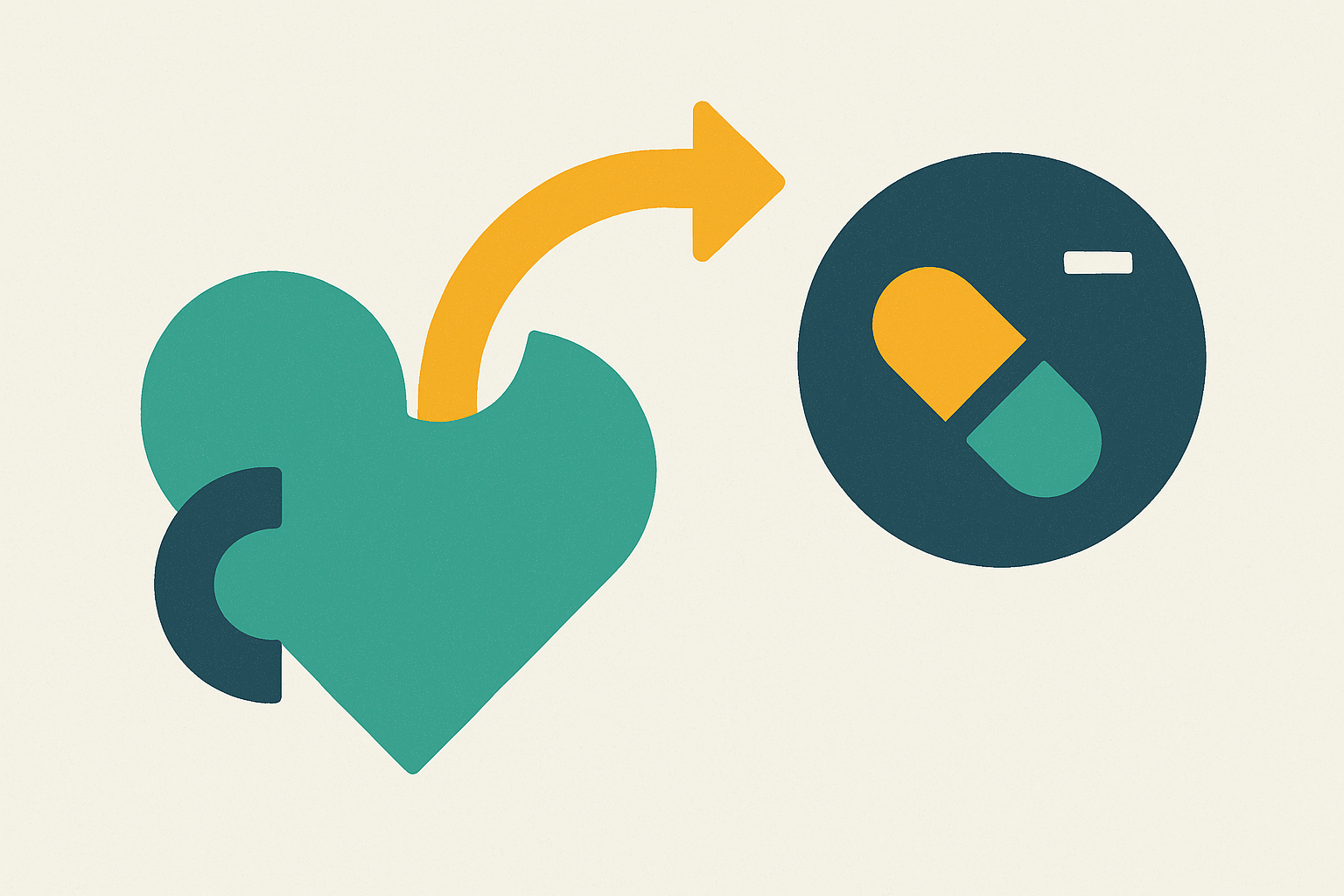
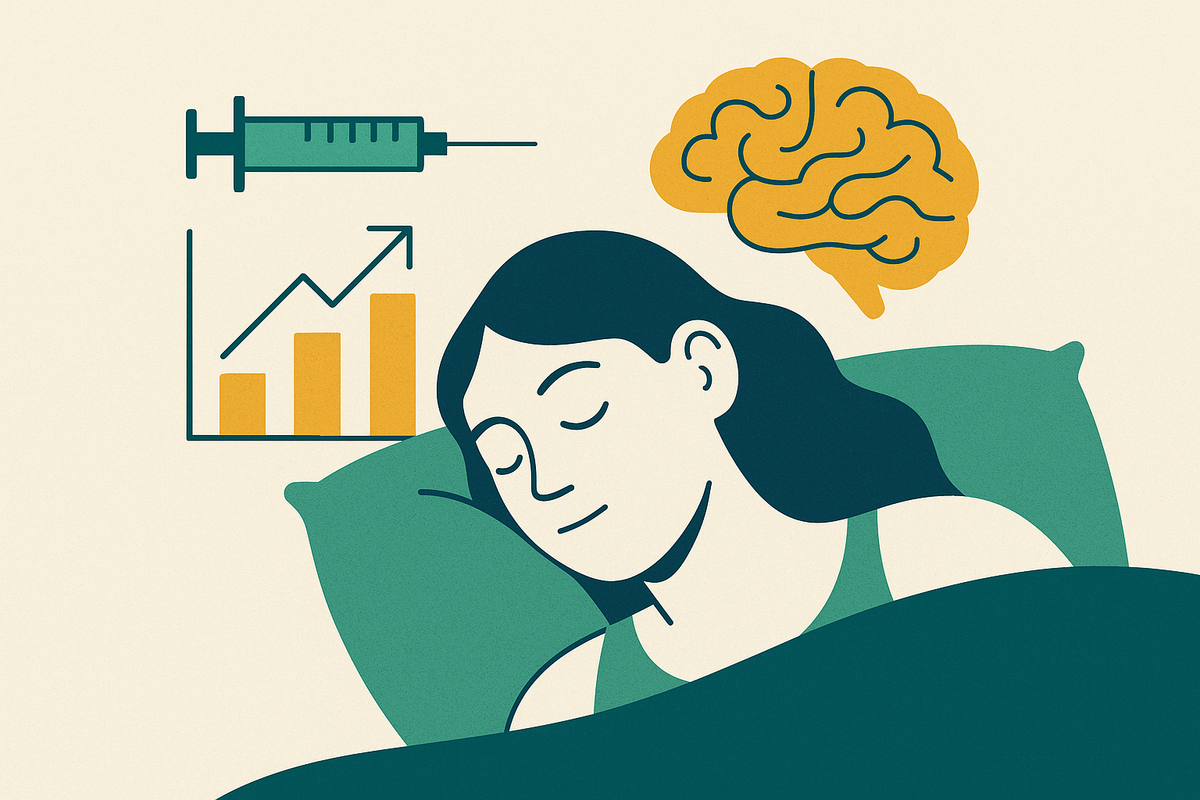
GLP-1 receptor agonists are known to most people as diabetes and weight-loss drugs. But the same receptor that governs insulin secretion and satiety also sits inside the brain's reward circuitry, and activating it appears to blunt opioid craving. This piece works through that overlap: why it exists, what the animal and human data show, and why the standard injectable route might be the wrong tool for a target that lives inside the skull instead of the gut.
GLP-1 receptor agonists do appear to reduce opioid cravings, and the reason traces to anatomy: GLP-1 receptors are densely expressed in the nucleus accumbens, ventral tegmental area, prefrontal cortex, and hippocampus, nearly every major node of the brain's reward circuitry that chronic opioid exposure rewires. Activating those receptors blunts dopamine release in response to rewarding stimuli, weakens conditioned responses to drug cues, and reduces compulsive reward-seeking behavior in both animal models and, in the one randomized controlled trial completed so far, in people with opioid use disorder. The injectable route is a structural mismatch for this target because the mechanism lives entirely inside the brain, behind a blood-brain barrier the subcutaneously injected peptide was never built to cross efficiently; forcing enough drug across requires raising systemic exposure, which drives the gastrointestinal side effects that already cause a large share of patients to discontinue treatment within the first year. For a population managing opioid use disorder, that tolerability problem is not incidental, since people in active or recovering OUD are already more likely than the general population to drop out of treatment the moment side effects appear.
GLP-1, glucagon-like peptide-1, started life as an incretin hormone. Released from the gut after eating, it tells the pancreas to release insulin, tells the liver to stop pumping out glucagon, and slows gastric emptying so you feel full longer. For roughly two decades that was the whole story, and drugs built on that mechanism moved from diabetes into cardiovascular risk reduction and liver disease. Researchers then mapped GLP-1 receptor expression more carefully and found it wasn't confined to the pancreas, gut, or liver. It's distributed through the brain, in regions that have nothing to do with digestion and everything to do with motivation, reward, and craving. Addiction researchers didn't arrive at GLP-1 chasing some abstract theory linking metabolism and addiction. They arrived because the receptor was already sitting inside the circuitry they study, which is a much more interesting way to stumble into a new field of pharmacology than most people realize.
Where GLP-1 receptors sit in the brain's reward architecture
Start with the anatomy, because it carries more of the argument than any single trial result does. GLP-1 receptors turn up densely in the nucleus accumbens, the structure most responsible for computing reward value and assigning motivational weight to a stimulus. They turn up in the ventral tegmental area, the dopamine-producing hub that feeds the accumbens and prefrontal cortex. They show up in the prefrontal cortex too, which handles executive control and the inhibitory brakes that keep craving from becoming action, and in the hippocampus, which encodes the contextual memories, a place, a smell, a specific street corner, that later trigger drug-seeking. Add the hypothalamus, which integrates hunger and hedonic drive, and the nucleus tractus solitarius, a brainstem relay feeding signals upward into everything just listed, and you've covered nearly every major node of the reward system.
This isn't a receptor that happens to sit near the reward circuitry. It's woven into it, at nearly every relay point that matters, and that's worth sitting with for a second before moving on.
Why does that matter for opioids specifically? Chronic opioid exposure doesn't just dull pain, it rewires this exact circuitry. Dopamine signaling gets distorted, natural rewards like food and social connection lose their pull, and drug-associated cues take on an outsized, almost gravitational hold over behavior. The overlap between where GLP-1 receptors sit and where opioids do their damage isn't something researchers stumbled on after the fact; it's the precondition for everything else in this piece.
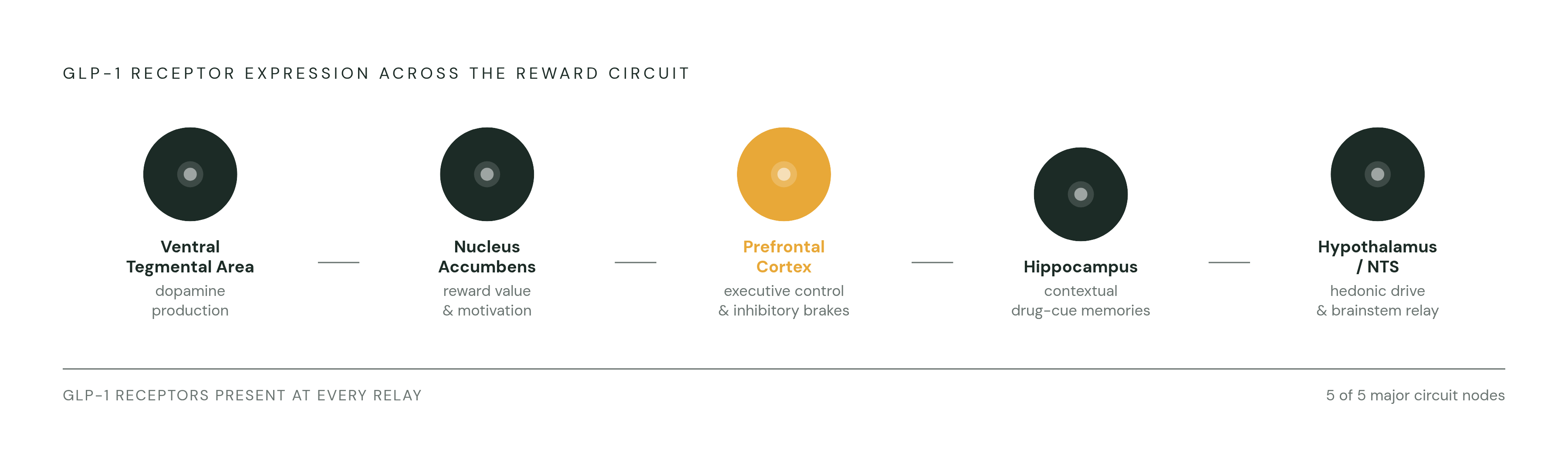
What GLP-1 receptor activation does to dopamine signaling and opioid craving
What happens when you actually activate the receptor? Three effects show up again and again across the research, and they're linked rather than separate. GLP-1 receptor activation reduces dopamine release in response to rewarding stimuli, blunting the hedonic payoff that makes drug use reinforcing in the first place. It dampens conditioned responses to drug cues, weakening the link between a trigger and the craving that follows. And it reduces compulsive reward-seeking itself: the drive to pursue the drug drops even when the drug is sitting right there in front of the animal.
The mechanism shifts across the addiction cycle, which is where it gets more clinically interesting. During intoxication, GLP-1 receptor activation seems to work mainly through the VTA-to-accumbens dopamine pathway, suppressing the reinforcement signal at its source. Different circuits carry more of the load during withdrawal, tied to neuroendocrine function and affective state rather than pure dopamine signaling. The receptor isn't doing one simple thing everywhere; it does different, phase-appropriate things depending on what the brain needs modulated at that particular moment.
In animal models this shows up as measurable behavior: reduced conditioned place preference, the standard measure of how strongly an animal seeks out an environment tied to drug reward, and reduced self-administration, meaning animals work less hard to get the drug. Research on semaglutide's effect on VTA dopamine signaling in mice, breaking the process into anticipatory and consummatory phases, adds useful detail here. The effect isn't less dopamine everywhere all the time; it's tied to specific moments in the reward sequence, anticipation versus consumption, which points toward modulation of the circuit rather than blunt suppression of it.
One more thread worth pulling, even if it complicates the tidy version of this story. DPP-4 inhibitors, which raise the body's own natural GLP-1 levels rather than introducing an external agonist, have also been linked to reduced opioid withdrawal symptoms and less anxiety-like behavior in preclinical models. That suggests the endogenous GLP-1 system, the one already running in your body without any drug on board, participates in this circuitry on its own. There's early work too on triple-agonist compounds pairing GLP-1 receptor activity with neuropeptide Y receptor targeting, hinting the effect might be amplifiable. Interesting, sure, but far from settled.
What the preclinical evidence in opioid models actually shows
The rodent literature is where this mechanism gets tested against real behavior, using heroin, fentanyl, morphine, and oxycodone as the opioids of interest, mostly exendin-4 and liraglutide as the agonists tested. Two findings recur: reduced self-administration of the opioid, and reduced reinstatement of drug-seeking after abstinence. That second measure is about as close as rodent research gets to modeling human relapse, so it carries more weight than the first.
The effect doesn't look opioid-specific, and that generalization matters more than it might first appear. A 2025 review found that GLP-1 receptor agonists reduce rewarding effects and cue- or drug-induced relapse behavior across alcohol, nicotine, cocaine, and opioids in preclinical models. If this were unique to how opioids interact with the brain, it wouldn't generalize this broadly. That it does points back to the anatomy: a reward-circuitry effect, not an opioid-receptor-specific one.
There's a study that doesn't fit, and it needs to be said plainly instead of buried in a footnote somewhere. A 2019 published study found that GLP-1 receptor agonist treatment did not reduce abuse-related effects of opioid drugs in their model. That's a real result, from a real study, and nobody has reconciled it with the studies pointing the other way. Dosing difference, maybe, or strain difference in the animals, possibly, or something about the specific opioid or behavioral assay used. Nobody's nailed it down, and pretending otherwise would misrepresent the science.
The alcohol data adds one more wrinkle worth sitting with. A randomized controlled trial of exenatide in alcohol use disorder found no overall reduction in heavy drinking across the full study population, but participants with higher BMI did show a significant reduction. More tellingly, exenatide reduced alcohol cue reactivity specifically in the ventral striatum, functionally and anatomically part of the same reward circuitry covered above. Small, specific findings like that one often carry more information than the big general ones. It tells you the drug is doing something measurable at exactly the brain location the mechanism predicts, even where the headline outcome didn't move.
So what does the preclinical record actually establish? Proof of mechanism, and a directional signal consistent enough to take seriously, but not a clinical verdict. Nobody working seriously in this space claims otherwise.
The one controlled human trial and what the ongoing clinical work is trying to answer
As of now, exactly one randomized controlled trial has tested a GLP-1 receptor agonist directly in people with opioid use disorder. It used liraglutide, registered as NCT04199728, and preliminary results presented at the AAAS Annual Conference showed patients receiving liraglutide at a rehabilitation facility reported meaningfully lower opioid craving than patients on placebo.
That's a real signal, but it came from a controlled inpatient setting, meals and environment and daily structure all managed by the facility. Does that craving reduction survive contact with the outside world, where cues aren't scheduled and cravings get triggered by an actual street corner or an actual bad afternoon instead of a structured clinical environment? A current multi-site trial is trying to close exactly that gap. Researchers at the Pennsylvania Psychiatric Institute, the University of Maryland Baltimore, and NYU at Bellevue are testing semaglutide in outpatient populations with opioid use disorder, with IRB approvals secured in late 2024 and early 2025, according to a 2025 paper in Addiction Science & Clinical Practice. That trial is built to answer the exact question the liraglutide study left open.
Observational data from residential OUD populations shows reduced craving measures among patients on GLP-1 receptor agonists too, though it can't tell you whether craving reduction translates into more days of abstinence, or whether the effect holds up over months rather than weeks. A 2025 meta-analysis of GLP-1 receptor agonists and alcohol-related outcomes leaned heavily on a large pool of real-world data alongside only a handful of actual randomized trials. That tells you something about where this field sits: a lot of interest stacked on top of a thin layer of controlled evidence.
Where does that leave things? The mechanism is credible, the preclinical evidence points consistently in one direction (with one dissent that hasn't been resolved), and the human signal from the single controlled trial is promising. The trials built to confirm or disprove the effect under real-world outpatient conditions are running now, not finished.
Why is injectable delivery the wrong route for targeting opioid craving with GLP-1 agonists?
Working mechanism is one question, and getting the drug there is another, one that turns out to matter just as much, maybe more.
Most approved GLP-1 receptor agonists are given by subcutaneous injection, a route built to reach peripheral tissue and, through general circulation, indirectly reach the brain. The blood-brain barrier stands in the way of that second part. It's an extremely selective membrane system that excludes most large molecules, so a peptide injected under the skin has to survive systemic circulation and then find a way past that barrier before it can touch a mesolimbic target at all. None of this matters for the pancreas, the gut, and peripheral satiety signaling, because the drug never needs to cross the barrier to hit those targets in the first place.
For a CNS indication, the same tradeoff looks completely different. The opioid craving mechanism described above lives entirely inside the brain, on the far side of a barrier the injected drug was never built to cross efficiently. So the dose has to go up to force enough drug across, and raising the dose raises systemic exposure everywhere else in the body.
That tradeoff shows up in the adherence numbers for injectable GLP-1 drugs generally. A large share of patients who start on them discontinue within the first year, and gastrointestinal side effects (nausea, vomiting, the symptoms driven by high peripheral drug concentration) are the most commonly cited reason for stopping. For a population managing opioid use disorder, that's not a small tolerability footnote. People in active or recovering OUD frequently carry co-occurring psychiatric conditions and cardiovascular risk factors, and they're already more likely than the general population to drop out of treatment the moment side effects show up. That's exactly the population that can least afford an interruption.
Delivery isn't a packaging detail sitting downstream of the real science. For a target that lives inside the brain, it may be the primary variable determining whether the mechanism can ever be reached at a useful concentration without also asking the patient to absorb systemic side effects they never signed up for.
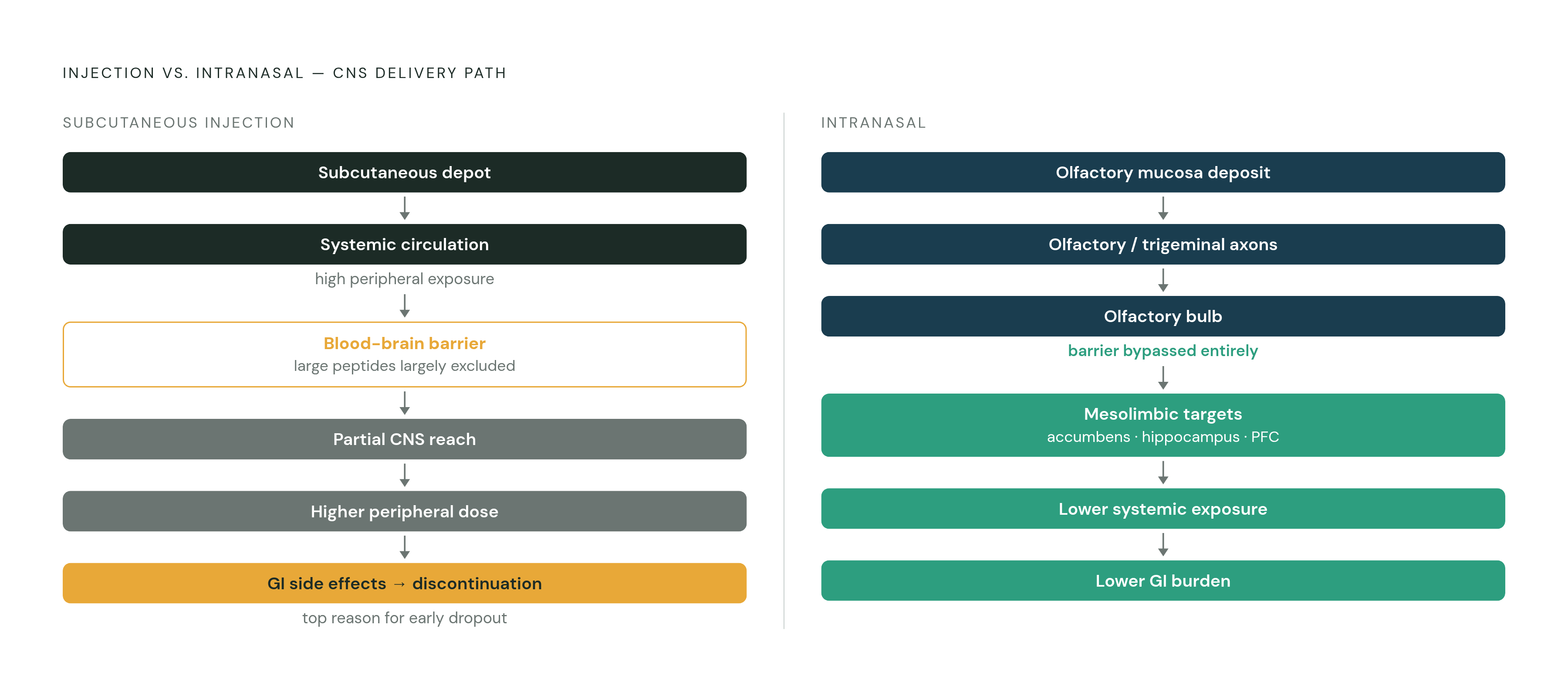
How nose-to-brain delivery bypasses the blood-brain barrier to reach reward circuitry directly
Is there a route that reaches the brain without going through general circulation at all? There is, and it's been sitting in plain anatomical view the whole time.
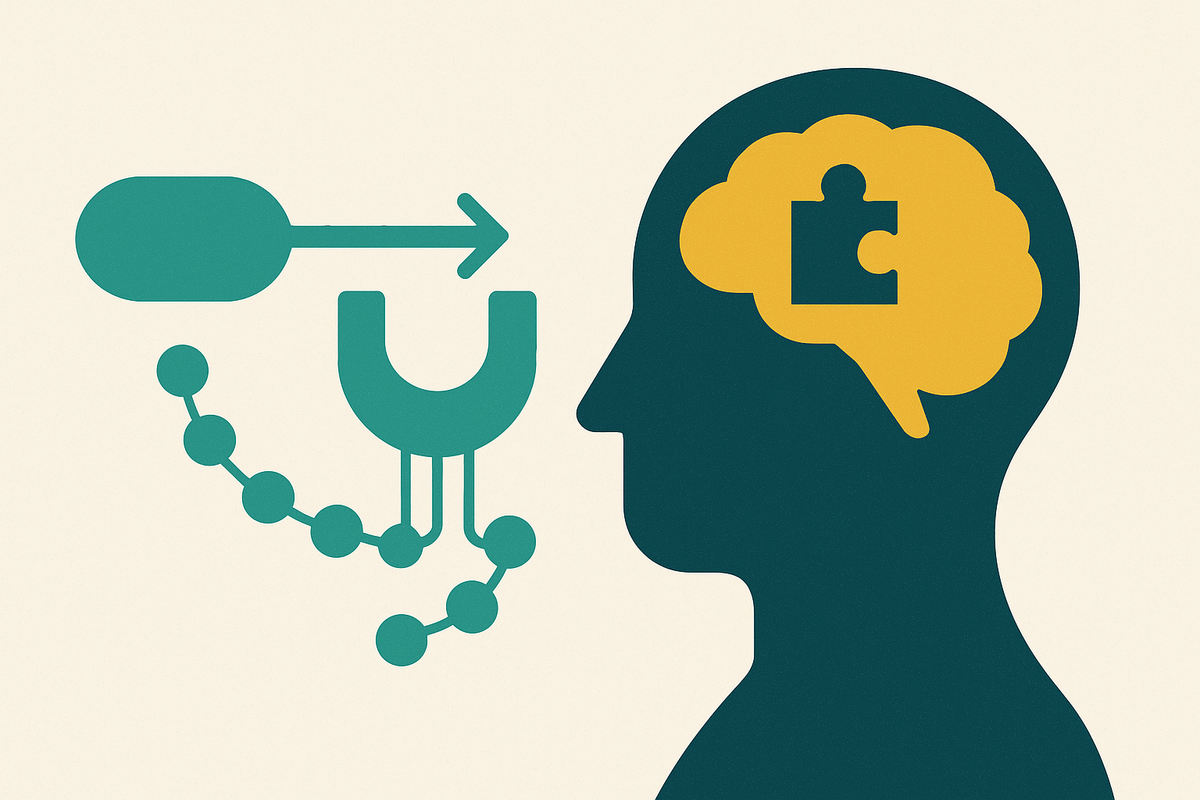
The olfactory nerve and the trigeminal nerve both run directly from the nasal cavity into the brain, physically bypassing the blood-brain barrier rather than trying to punch through it. A molecule deposited on the olfactory mucosa, the tissue at the top of the nasal cavity, can travel along the olfactory nerve's own axons into the olfactory bulb, and from there into deeper limbic structures.
Look at where that pathway lands. It terminates in or near the exact regions this piece has been circling since the first section: the nucleus accumbens, the hippocampus, the prefrontal cortex. That's not loose geographic overlap. It's close to a direct route into the reward circuitry that opioid use disrupts. A GLP-1 agonist delivered intranasally has a physically plausible path to those specific targets without first saturating the bloodstream, which changes the calculation around dose and side effects. Lower systemic exposure isn't just a comfort issue, either. A molecule that reaches its CNS target more directly can, in principle, get there at a lower total dose, which cuts the peripheral GI burden that drives people to quit their medication in the first place.
Does that solve the original problem, though? Only if the drug can actually get there in usable form, and that's where the nasal route runs into a real engineering problem. GLP-1 peptides are large and hydrophilic, and molecules built like that don't cross mucosal membranes on their own with any efficiency. Getting a therapeutic amount of peptide across the nasal mucosa and into the olfactory pathway requires something to carry it, protect it, and get it across before the body clears it away.
Why nanoparticle platforms are necessary to make intranasal GLP-1 delivery work
Peptides face three separate obstacles inside the nasal cavity, and any one of them alone is enough to sink a naive delivery attempt. Enzymes in the nasal cavity break peptides down before absorption ever gets a chance to happen. The mucosal membrane resists large hydrophilic molecules on its own, so even an intact peptide often just sits there instead of passing through. And the nose's mucociliary clearance system, its built-in defense against foreign material, sweeps things away on a timescale that can beat passive absorption outright.
Nanoparticle carriers answer all three problems at once. Encapsulating the peptide inside a nanoparticle shields it from enzymatic attack. Engineering the particle's surface, its charge, its coating, can promote adhesion to the mucosal lining and encourage uptake instead of passive sitting there. Getting particle size right lets it navigate the olfactory epithelium inside the narrow window before mucociliary clearance sweeps it out. None of this is a generic formulation tweak. Particle size, surface charge, and coating chemistry each have to be tuned specifically, because getting any one of them wrong means the carrier either never reaches the olfactory epithelium, never releases its payload, or gets cleared before it does anything useful.
The broader research landscape backs this up as more than a hypothetical fix. Work on intranasal GLP-1 delivery aimed at metabolic and cognitive targets, including a review out of Macquarie University and preclinical work from Aptar Pharma, shows the nose-to-brain route moving from concept into actual experimental testing.
Is this a narrow fix aimed at one drug and one disease? Probably not, though the field owes it to itself to stay skeptical until more of these trials read out. A validated nose-to-brain nanoparticle platform built around GLP-1 delivery is a delivery architecture, not a one-off product. An architecture like that could plausibly carry other peptide therapeutics toward CNS targets injections can't reach efficiently: addiction treatment, dementia, other neurological conditions among them.
Whether GLP-1 receptor activation modulates reward circuitry and dampens opioid craving isn't really the open question anymore. The preclinical and early clinical evidence, uneven as parts of it still are, points consistently in that direction, Bornebusch's dissent notwithstanding. What's still open is narrower and more practical: whether the field can build a delivery system precise enough to put the drug exactly where the mechanism lives, without forcing the patient's entire body to absorb a dose meant for a few cubic centimeters of brain tissue. That's an engineering problem now, as much as a pharmacological one, and engineering problems tend to get solved by people who keep showing up to the bench.