GLP-1 Receptor Agonists in Alcohol Use Disorder
Nose-to-brain delivery could unlock GLP-1's potential for alcohol addiction.
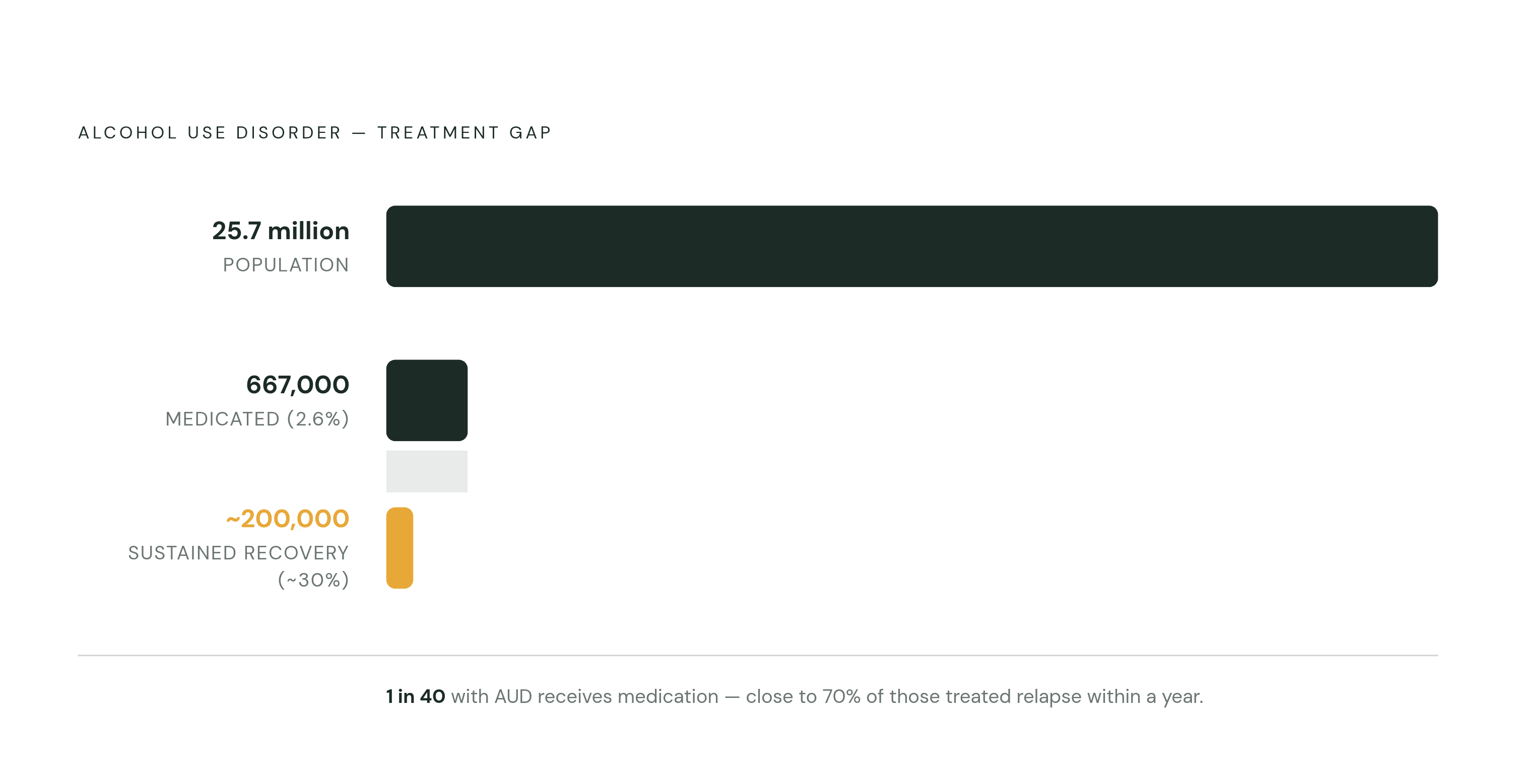
Roughly 1 in 40 Americans with alcohol use disorder gets medication for it: 2.6% of 25.7 million people, per SAMHSA's most recent count. That's the number I can't shake, and the more time I spend with GLP-1 receptor agonists, the more I think the holdup was never really the drug class, but how we're getting the drug into the body. A diabetes medication didn't wander into addiction treatment by accident. The biology of GLP-1 and the biology of the addicted brain line up in ways that are hard to ignore once you look closely, and delivery is the thing standing between that biology and an actual patient.
The 2.6% treatment rate reflects something more structural than stigma alone. Naltrexone, acamprosate, and disulfiram were never built around the brain's reward architecture; they work through peripheral blockade or aversive deterrence, leaving the mesolimbic circuitry where craving actually forms largely untouched. GLP-1 receptor agonists are different at the biological level, because GLP-1 receptors sit directly in the ventral tegmental area and nucleus accumbens, and activating them suppresses the dopamine surge alcohol normally triggers in those structures. The delivery mismatch is where the gap persists: subcutaneous injection gets GLP-1 to the brain only indirectly and incompletely, and weekly needles imposed on a population already burdened by stigma and healthcare underaccess compound the dropout problem before pharmacology gets a fair chance. A nose-to-brain route, moving drug along olfactory and trigeminal nerve pathways and bypassing the blood-brain barrier entirely, would reach the reward circuitry directly and remove the needle barrier at the same time, which is why delivery may matter more here than the molecule itself.
Start with the scale of the problem, because a receptor mechanism doesn't mean much floating in a vacuum. Close to 85% of people who needed substance use treatment last year didn't get it. The three FDA-approved AUD medications, naltrexone, acamprosate, and disulfiram, have sat mostly unchanged on pharmacy shelves for decades, and even the patients who do get treated relapse at close to 70% within a year. Stigma explains part of that, and so does a shortage of addiction-trained physicians, along with a healthcare system that still hasn't fully accepted AUD as a medical condition rather than a moral failing. Underneath all of it sits something simpler: none of those three drugs were built with the brain's reward architecture in mind. They work through blunt peripheral or aversive mechanisms, chemical deterrents and receptor blockers, not anything that touches how craving actually forms. So what happens if you design treatment around how the addicted brain actually functions?
What GLP-1 actually is and why it acts in the brain, not just the gut
GLP-1, short for glucagon-like peptide-1, is a hormone your gut releases after eating. Its textbook job is metabolic: it boosts insulin, holds back glucagon, slows stomach emptying, makes you feel full. That's the version everyone knows, mostly because it's the version that made GLP-1 drugs famous, first for diabetes, then for weight loss.
There's a second fact about GLP-1 that matters more here than anything about blood sugar. The body also makes GLP-1 in the nucleus tractus solitarius, a cluster of neurons in the brainstem, and there it acts as a neurotransmitter across several brain regions. That's not a footnote, since GLP-1 is a native signaling molecule in the central nervous system, and its job there predates its career as a gut hormone target for pharmaceutical chemists, at least by evolutionary standards if not by research history.
GLP-1 receptor agonists were built to mimic and stretch out that natural signal, first for type 2 diabetes, then obesity, and now increasingly for neurological conditions. Researchers are studying these drugs in neurodegenerative disease through metabolic, inflammatory, and neurobiological pathways at once, and that same reach across systems is what makes addiction worth studying too.
Here's the distinction the rest of this piece keeps circling back to. Injectable GLP-1 drugs hit peripheral targets hard, the pancreas, the stomach, and their effect on the brain arrives indirect and partial. A therapy that reached GLP-1 receptors in the brain more directly, say through a nose-to-brain route, would act on the actual system where addiction lives. The last two sections come back to that gap between mechanism and delivery, because it ends up mattering more than almost anything else in this story.
Why the brain's reward circuitry was always going to respond to GLP-1 signaling
Two structures anchor what's called the mesolimbic reward pathway: the ventral tegmental area and the nucleus accumbens, and both express GLP-1 receptors. That sounds like a small anatomical detail, but it's the whole precondition for everything that follows. If a receptor sits inside the reward circuitry, whatever binds to it has a plausible route into how the brain values reward, alcohol included.
Alcohol raises dopamine release in the nucleus accumbens, reinforcing drinking and, over time, turning the behavior from something chosen into something closer to compulsion, all while wearing down the executive function that would otherwise put on the brakes. GLP-1 receptor activation interrupts that sequence close to the source. In preclinical work, the GLP-1 agonist Exendin-4 suppressed the dopamine surge in the accumbens that alcohol normally triggers; when researchers microinjected Exendin-4 directly into the nucleus accumbens or ventral tegmental area, alcohol intake dropped. That second result carries real weight, because it confirms the mechanism happens centrally, in the brain, rather than as some downstream echo of what's going on in the gut or liver.
Three separate behavioral effects come out of one receptor class: reduced craving, blunted pull of drinking cues, and lower moment-to-moment reward from a drink. Human evidence backs this up too, from a randomized trial using exenatide that found reduced alcohol cue reactivity in reward-related brain regions on fMRI, alongside reduced dopamine transporter availability. The rodent mechanism is showing up in human brain scans, which is about as close to a bridge between bench and bedside as this field gets right now.
None of this is really about alcohol specifically, and that's the part I find more interesting. Food reward and substance reward run through overlapping circuitry, which is exactly why drugs built for overeating are now showing promise across alcohol, nicotine, opioid, and stimulant models at various stages of study. The mechanism tracks the reward circuit, not the substance. GLP-1 agonists also modulate the dopamine signal at the synapse itself, more upstream and more targeted than naltrexone's broader, blunter blockade of opioid receptors.
What the clinical trials show, and what they leave open
The broadest evidence comes from a 2025 meta-analysis in Lancet eClinicalMedicine, pooling 14 studies and 5,262,268 participants. It found a pooled reduction in AUDIT scores, the standard alcohol use disorder screening measure, of 7.81 points. That's a big number for a field that hasn't had a genuinely new signal in a long time.
Zoom into individual trials and the picture gets messier, the way real data usually does. Hendershot and colleagues published a phase 2 randomized trial of low-dose, once-weekly subcutaneous semaglutide against placebo in adults with AUD, in JAMA Psychiatry, in 2025. Patients on semaglutide drank less alcohol in a posttreatment laboratory self-administration test, reported significantly less weekly craving, and showed medium-to-large effect sizes on both drinks per drinking day and heavy drinking episodes. One secondary finding stands out: among participants who smoked, cigarettes per day dropped too, which fits a reward-circuit mechanism working across substances, rather than something specific to alcohol's chemistry.
Exenatide told a messier story still. Klausen and colleagues, in JCI Insight in 2022, found no overall reduction in heavy drinking days across the full sample, but among participants with a BMI above 30, the effect showed up clearly, alongside measurable drops in alcohol cue reactivity in the ventral striatum. That BMI interaction raises a question I don't think is fully answered yet: does metabolic state shape how GLP-1 acts on the central nervous system, or is it simpler than that, just a matter of how much drug reaches the brain in the first place when you're injecting peripherally?
Real-world data adds another layer. A systematic review spanning 88,190 participants, 44% of whom were on GLP-1 receptor agonists, found a mean weekly alcohol intake reduction of roughly 7.1 units among treated patients, with only a weak positive correlation between that reduction and weight loss. The alcohol effect looks like it stands on its own, rather than trailing behind weight loss the way you might expect, and a 2025 JAMA Psychiatry register study by Lähteenvuo and colleagues, drawing on large-scale observational data for semaglutide and liraglutide, backs up the RCT findings from a different angle entirely.
So what's left open? Quite a bit, honestly. Nobody knows the optimal dose for AUD specifically, and there's real reason to think dosing built around metabolic goals won't match dosing built around addiction outcomes, since those are different targets. Whether effects hold after treatment stops, or need ongoing exposure, is still unclear, and which patients benefit most, by BMI, by co-occurring metabolic disease, by craving profile, is an open question too. Underneath all of it sits the delivery question: does peripheral injection get enough drug into the CNS to make the most of this mechanism, or would more direct brain delivery do better?
Why the injection route may not be the right vehicle for a brain-targeted therapy
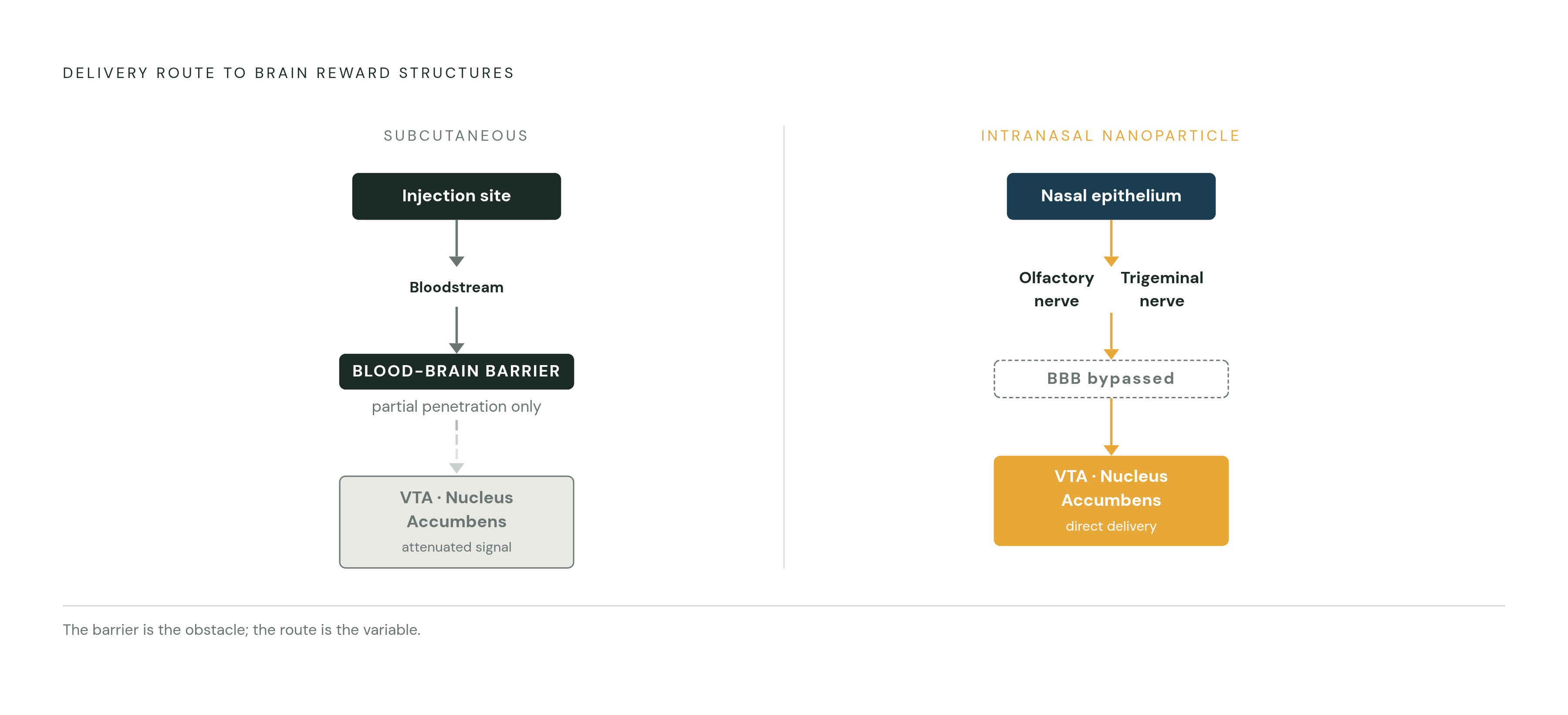
GLP-1 drugs look promising for AUD because they act on brain reward circuitry. The way we mostly deliver them, subcutaneous injection, is a peripheral route that reaches the brain indirectly and, by most measures, incompletely. That mismatch deserves more attention than it usually gets, because it's the hinge the rest of this argument turns on.
GLP-1 peptides are large molecules, and large molecules don't cross the blood-brain barrier freely. Whatever central effect shows up after a peripheral injection reflects partial, indirect exposure, rather than the drug engaging receptors in the ventral tegmental area or nucleus accumbens head-on. This brings us back to the exenatide microinjection study from the last section: injecting the drug directly into the NAc and VTA reduced alcohol intake. Read one way, that's proof of concept for targeted CNS delivery. Read the other way, it's evidence that systemic injection works around the relevant brain anatomy rather than through it.
Injection carries its own baggage too. Nausea, needle aversion, and the plain hassle of a weekly subcutaneous shot are the same compliance barriers already pushing people off injectable GLP-1 drugs in diabetes and obesity care. Now think about who's being asked to shoulder that burden here: a population already dealing with stigma around AUD, already underserved by the healthcare system, already prone to dropping out of treatment before it does any good. A needle on top of all that isn't a minor inconvenience, but a structural disadvantage baked in before a patient ever takes the first dose.
Nose-to-brain delivery is a different route entirely. It moves drug along the olfactory and trigeminal nerve pathways, bypasses the blood-brain barrier, and delivers along the neuroepithelium directly to CNS structures, including the brainstem regions where the body makes its own GLP-1 in the first place. Being needle-free removes one of the biggest barriers to a patient even starting treatment, and that matters in a disease where stigma and friction already keep most people away from medication entirely.
If GLP-1's effect in AUD is fundamentally a brain effect, then the delivery system that most directly reaches the brain is the one actually matched to the mechanism. This isn't a complicated point, but it's an easy one to lose track of once the trial data starts piling up.
What nanoparticle engineering enables that nasal spray alone cannot
Spraying a peptide up someone's nose does not, on its own, solve the delivery problem. Peptides break down fast in nasal mucosa because of local enzymes, they don't cross mucosal membranes easily, and whatever survives both obstacles tends to get cleared out before reaching anything resembling a CNS target. The intranasal route opens the door partway, and getting the drug the rest of the way takes more engineering than a spray bottle can offer.
Nanoparticle encapsulation is what closes that gap. Wrapping the peptide in a nanoparticle shell protects it from enzymatic breakdown in the nasal passage, helps push it through the mucosal barrier into the olfactory and trigeminal nerve pathways, and controls the release rate so the brain gets sustained exposure instead of a quick spike followed by nothing. This is as much a materials science and pharmacokinetics problem as it is a biology one, and decades of foundational patent work separate platforms that actually pull it off from proposals that only sound good on paper.
Lionbio's nanoparticle delivery platform, built on more than 30 years of patented intellectual property out of Columbia University, was built to solve exactly this: getting GLP-1 peptides across the nasal barrier and into the brain, with reward circuitry standing out as one of the more compelling destinations for that capability. The platform isn't locked to a single disease, either. The same nanoparticle system built to get GLP-1 into the VTA and NAc for alcohol use disorder could, in principle, address other substance addictions, neurodegenerative disease, and other CNS conditions where peripheral injection simply doesn't get enough drug to the brain. Solve the delivery problem once, at the engineering level, and the value stacks across indications instead of staying locked to one.
It's worth flagging where the broader field is heading, too. An oral semaglutide formulation won FDA approval for weight management in late 2025, a sign the industry is moving away from needles generally. Oral delivery, though, runs into its own bioavailability limits when the target is the brain rather than the gut or bloodstream, which leaves nose-to-brain delivery a genuinely open lane rather than one that's already been claimed.
Why does the 2.6% treatment rate expose the limits of injection-first drug development for AUD?
Go back to that 2.6% figure from the opening. It isn't just a grim statistic sitting there for effect. It's a direct measurement of how badly the current delivery model fits the population that needs help. Patients already navigating stigma, spotty healthcare access, and their own ambivalence about treatment are being asked to accept weekly injections and systemic nausea as the entry fee for pharmacological support. Framed that way, is the low uptake number really a surprise to anyone?
Yet the pharmacology keeps looking better, not worse. GLP-1 receptor agonists are turning up medium-to-large effect sizes in AUD trials, in a field where the three approved drugs have sat essentially frozen for decades. The mechanistic case has built up piece by piece, from converging evidence rather than coincidence: GLP-1 receptors sit directly in the reward circuitry, the body makes its own GLP-1 in the brainstem, and direct injection into the VTA and NAc reduces alcohol intake in a way that's localized to those exact structures.
What's left unresolved mostly comes down to delivery. Which patients respond best, whether the effect holds after treatment ends, how to get enough drug into the CNS without leaning on an indirect, partial route: these are delivery questions dressed up in pharmacology's language. The GLP-1 market was worth an estimated $132 billion in 2025, almost entirely on the back of diabetes and obesity. The neurological side, addiction included, remains largely untapped, and getting there depends on solving CNS delivery as much as finding a better molecule.
tens of millions of people live with alcohol use disorder in this country, and 2.6% of them are on medication for it. The brain mechanism is confirmed now, across rodent studies and human imaging both, and a delivery route, nose to brain, finally lines up with where the disease actually lives. Getting from here to meaningful treatment probably won't come from a better molecule alone, but from finally building a way to get the molecules we already have to where they need to go.