Nose-to-Brain Delivery in Neurodegenerative Disease Research
Intranasal delivery bypasses the blood-brain barrier via cranial nerves.

Neurodegenerative diseases (Alzheimer's, Parkinson's, multiple sclerosis, ALS, Huntington's) all share a basic mechanism: neurons die off progressively, and cognition, movement, or behavior degrade along with them. What separates nose-to-brain drug delivery from the last two decades of failed CNS drug programs is anatomy. Instead of asking a molecule to cross the blood-brain barrier, this route hands the drug a nerve pathway that already runs from the nose straight into the brain, sidestepping the barrier problem instead of trying to beat it.
The stakes are not abstract. Populations are aging in nearly every country with the infrastructure to track neurodegenerative disease, and the treatments on the market remain mostly symptomatic. Something eases tremor, something slows cognitive decline at the margins, but nothing yet reverses the underlying neuronal loss for most patients. The blood-brain barrier sits at the center of why that's true. Widely cited pharmacology estimates put it at blocking something like 98% of small-molecule drugs and nearly all large biologics from reaching brain tissue after oral or intravenous dosing. Oral drugs face an additional problem before they even get that far: absorption and metabolic processes reduce the amount of drug that reaches systemic circulation, let alone the brain.
Even the biologics that have cleared regulatory approval for Alzheimer's disease, drugs that do modify amyloid pathology rather than just treat symptoms, carry a real safety cost. The risk of intracerebral hemorrhage associated with some of these agents is serious enough to limit how broadly they get used. Even when a drug manages to reach the brain and do something meaningful there, the same delivery route (systemic injection, forcing the drug to cross the barrier at pharmacologic doses) can create the very complication that keeps it from wide clinical use. Nose-to-brain delivery does not solve every problem in CNS pharmacology, but it does address this one directly, by giving drugs a way around the barrier instead of through it.
How the nose-to-brain pathway bypasses the BBB anatomically
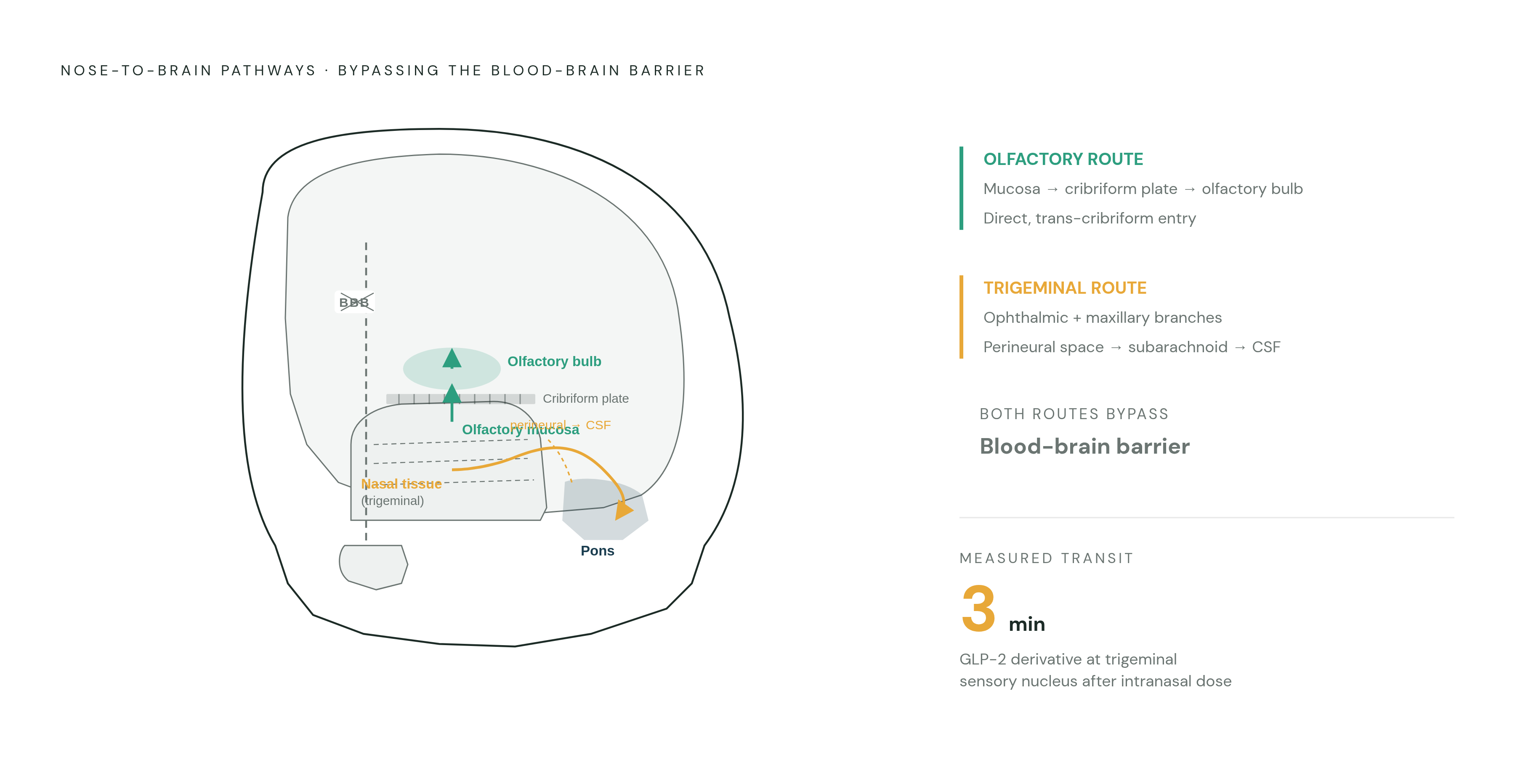
The nasal cavity is split into two regions that behave completely differently once a drug lands on them, and the difference matters enormously for anyone designing an intranasal therapeutic. It's split into two regions that behave completely differently once a drug lands on them, and the difference matters enormously for anyone designing an intranasal therapeutic.
Most of the nasal cavity is respiratory epithelium: ciliated tissue innervated by branches of the trigeminal nerve, whose main job is filtering and humidifying air rather than shuttling molecules to the brain. It absorbs some drug and is relevant to delivery, but it's not the fast lane. The fast lane is the olfactory region, a comparatively small patch of tissue sitting at the roof of the nasal cavity in the dorsal meatus. Nerve fibers called the fila olfactoria run through this tissue, bundle into the olfactory nerve, and pass through tiny perforations in the bone at the roof of the nasal cavity directly into the olfactory bulb of the brain. That's an anatomical superhighway. A molecule that gets absorbed at the olfactory mucosa is, in a structural sense, already inside the CNS compartment, with no barrier tissue left to cross.
Two nerve pathways do most of the work of getting drug molecules from that mucosa into brain tissue. The olfactory route is the direct one, and preclinical data suggest it delivers drugs more efficiently than the respiratory mucosa does, which makes sense given how short and direct the anatomical connection is. The trigeminal route takes longer to reach the same destination but arrives by a genuinely fast mechanism, once it's underway: the trigeminal nerve originates at the pons and splits into ophthalmic, maxillary, and mandibular branches, with the first two innervating nasal tissue and providing a second nerve-based conduit into the CNS. The perineural space surrounding these cranial nerves connects to the subarachnoid space and cerebrospinal fluid, giving drugs a second route into the fluid that bathes the brain.
How fast is fast? One study tracked a GLP-2 derivative reaching the trigeminal principal sensory nucleus in the pons within three minutes of intranasal dosing, a timescale consistent with active axonal transport carrying the molecule inside nerve cells rather than passive diffusion around them. Separately, insulin has been shown to reach the perineural space surrounding the trigeminal nerve through an extracellular route, confirming that both mechanisms, intracellular transport through axons and extracellular movement through the space around them, are actually operating, not just theoretically possible. A third pathway involving lymphatic connections from the nasal cavity toward the CNS is also under investigation, though it is less characterized than the two nerve routes.
Putting those pieces together makes the mechanistic case for nose-to-brain delivery pretty compelling: high permeability at the nasal epithelium, a rich blood supply feeding that tissue, and direct nerve access into the brain combine to produce a route with real CNS specificity and much lower systemic drug exposure, something neither oral dosing nor injection can offer.
Nanoparticle formulations' added value over simple drug solutions in intranasal delivery
The drug molecule still has to actually get across the olfactory epithelium for that anatomy to help. Small, lipophilic molecules diffuse through that tissue reasonably well on their own, no engineering required. Peptides, nucleic acids, and most biologics are a different story: they're too large, too water-loving, or too fragile to cross a cell membrane by passive diffusion, and they need active help.
That's the job nanoparticle carriers do. Three physical properties, particle size, shape, and surface charge, govern how well a nanocarrier gets absorbed at the epithelium and makes its way into a nerve pathway, and formulators tune all three deliberately. Lipid nanoparticles engineered with a slight negative surface charge, for instance, have shown improved transport through nasal epithelium in preclinical work. Coating a nanoparticle with chitosan, a naturally mucoadhesive material, extends how long it clings to nasal mucosa before mucociliary clearance sweeps it away, which directly increases how much drug gets absorbed rather than swallowed or cleared.
Beyond just getting a difficult molecule across the epithelium, nanocarriers do several things a simple drug solution structurally cannot. They shield the payload from enzymes in the nasal cavity that would otherwise degrade it before absorption happens. They control release, letting a single dose disperse over hours rather than dumping the full payload the moment it lands. Some platforms carry two therapeutic agents at once, or pair a therapeutic with a diagnostic imaging agent in what's called a nanotheranostic design, so a single dose does more than one job. And surface functionalization opens the door to targeting: attaching a ligand that binds preferentially to a specific neuron population, in principle, means the payload gets delivered somewhere more precise than "the brain" generally.
The range of carrier chemistries being tested is wide. Lipid-based systems (LNPs, liposomes, solid lipid nanoparticles, nanostructured lipid carriers, various nano- and microemulsions) sit alongside polymeric particles built from materials like chitosan or another biodegradable polymer, protein-based carriers, inorganic nanoparticles, and biologically derived vesicles like exosomes. Each class brings its own tradeoffs in stability, manufacturability, and immune response, which the next section gets into directly.
The major nanoparticle platforms being tested for nose-to-brain delivery in neurodegeneration
Lipid nanoparticles have the most momentum right now, partly because the mRNA vaccine work of the past several years matured LNP manufacturing to a degree few other nanocarrier classes can match. In neurodegeneration research specifically, the design logic gets more ambitious than "get the drug into the brain." One Alzheimer's-focused formulation uses lactoferrin-functionalized LNPs to co-encapsulate two different payloads at once: α-mangostin, aimed at amyloid aggregation, and an siRNA targeting an enzyme involved in generating amyloid-beta. That's a dual-mechanism attack riding in a single nanoparticle, a combination therapy that's structurally hard to pull off with a simple drug solution. Separately, LNPs loaded with CRISPR/Cas9 gene-editing machinery and delivered nose-to-brain represent an early but genuinely novel approach to neurodegeneration, one that would have been difficult to imagine as an intranasal therapy even a few years back.
Chitosan nanoparticles take a different route to the same destination. Chitosan is biocompatible and naturally mucoadhesive, so it sticks to nasal epithelium and buys the drug payload more residence time before clearance carries it away. Across a range of preclinical drug payloads, including naringenin, huperzine, galantamine, and simvastatin, chitosan-based carriers have shown improved neuroprotective effects and cognitive outcomes in animal models of neurodegeneration.
Solid lipid nanoparticles offer a somewhat simpler value proposition: non-invasive administration with fast, efficient brain targeting through the same olfactory and trigeminal nerve connections underlying the whole nose-to-brain concept. They've been studied specifically as an intranasal platform for a range of brain diseases, with less structural complexity than co-encapsulated LNP systems but a solid track record of reaching CNS targets.
Exosomes are the outlier in this group because they're vesicles that cells naturally secrete. They're vesicles that cells naturally secrete, and they cross biological barriers without triggering the immune response that a synthetic lipid or polymer particle sometimes does. Preclinical studies have used exosomes to deliver neuroprotective peptides and nucleic acids directly to brain lesion sites, an outcome attributed to their natural biocompatibility and inherent ability to slip past barrier tissue. The tradeoff is manufacturing. Producing exosomes at meaningful scale, with the batch-to-batch consistency a regulator expects from a drug product, remains an unresolved problem, and it's arguably the single biggest obstacle standing between exosome carriers and clinical use.
What the clinical and translational evidence shows so far
None of this is purely theoretical. Intranasal drug delivery already has regulatory approval and everyday clinical use for both epilepsy and migraine, which establishes something important: the nose-to-brain route is not a hypothetical shortcut dreamed up in a lab. It is a delivery mechanism that already works well enough to treat real patients for real neurological conditions.
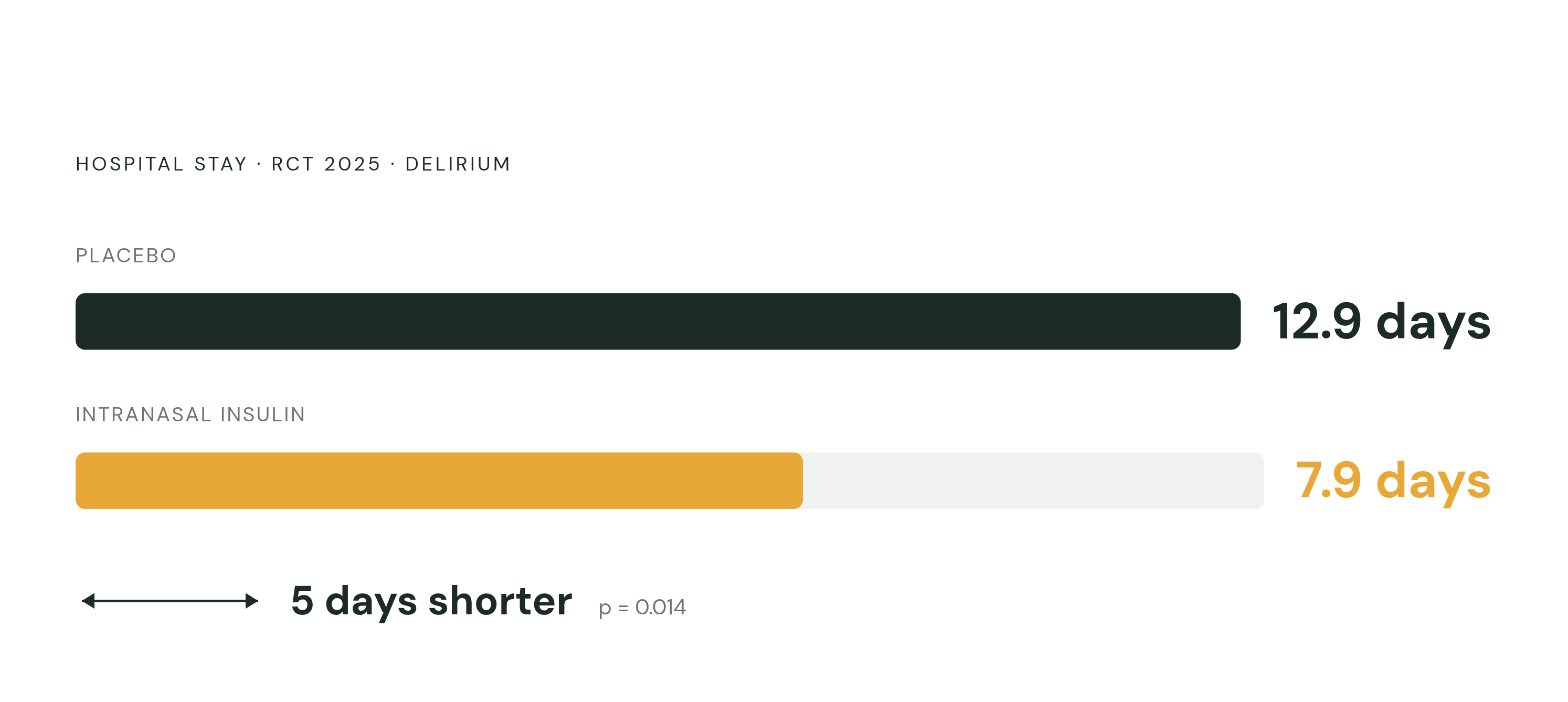
The strongest translational signal adjacent to neurodegenerative disease comes from an unexpected place: delirium. A randomized controlled trial published in 2025 tested long-acting intranasal insulin against placebo and found it significantly shortened the median duration of delirium episodes. The hospital-stay numbers make the case concretely: patients in the insulin group had a median hospital stay of 7.9 days, versus 12.9 days for placebo, a difference reported at p = 0.014, which is a result unlikely to be due to chance. Why does a metabolic hormone delivered through the nose matter for a neurodegenerative disease audience? Because delirium and neurodegenerative disease progression share neuroinflammatory and metabolic pathways, and a trial showing that intranasally delivered insulin reaches CNS targets fast enough, and in high enough concentration, to shift a hard clinical endpoint is about as strong a piece of translational proof as this field currently has.
Modeling work is closing the gap between animal data and human application from several directions at once. More physiologically realistic in vitro models are being used to test intranasal formulations before they ever reach an animal. Rodent and zebrafish models continue to generate in vivo data on delivery efficiency and targeting accuracy. On the computational side, researchers are building out computational fluid dynamics models of drug deposition in the nasal cavity, paired with physiologically based pharmacokinetic modeling, to better predict how a given formulation will behave before committing to expensive animal or human studies.
How is the field itself characterizing where things stand? A 2026 review published in Molecular Neurodegeneration and a 2025 review by Drath and colleagues in Translational Neurodegeneration both describe nose-to-brain delivery as a "fast-developing field." That's a measured phrase from peer-reviewed sources, not hype, and it's probably the most accurate one-line summary of where the science actually sits: real momentum, genuine mechanistic grounding, but not yet a mature clinical category.
The engineering and regulatory challenges that still separate preclinical promise from clinical delivery
Anatomy that makes this route appealing also makes it hard to engineer around. The olfactory region, the one nerve pathway doing the most efficient work, is a fraction of the size of the respiratory region that dominates the rest of the nasal cavity. That physical constraint puts a hard ceiling on how much drug volume can actually land where it needs to. Formulation viscosity and dosing volume matter far more here than they do for, say, an oral tablet. Layer onto that the fact that mucociliary clearance is constantly sweeping particles off the epithelial surface, and the challenge becomes obvious: without mucoadhesive engineering, most of a dose never gets the chance to be absorbed before it's cleared away.
Species differences compound the problem. Rodent nasal anatomy does not map cleanly onto human nasal anatomy, and that mismatch is a well-documented limitation of preclinical models in this space. A formulation that performs beautifully in a mouse's nasal cavity may behave quite differently once it's tested in the far larger, differently shaped human nasal passage, and that gap is part of why translational modeling work (the organoids, the CFD simulations) has become such a priority.
On the formulation side, the same nanocarrier complexity that makes co-encapsulation possible also makes regulatory review harder. A dual-payload LNP carrying both an siRNA and a small molecule, for example, needs stability data proving the two agents don't interact adversely with each other over the product's shelf life, which is a more demanding analytical burden than a single-agent drug faces. Then there's the safety profile of the carriers themselves: nanoparticle-associated toxicity, both at the nasal mucosa and potentially within CNS tissue, is a live topic in the literature. And because neurodegenerative diseases require chronic, likely lifelong treatment, patients would be dosing intranasally every day for years, a very different exposure pattern than the occasional use of a migraine or epilepsy rescue spray. Whether repeated daily dosing causes cumulative mucosal damage over that timescale is a question the field has not yet answered with long-term human data.
Regulatory infrastructure hasn't caught up to any of this yet. There is no dedicated approval pathway specifically built for nose-to-brain nanoparticle therapeutics targeting neurodegenerative disease. Developers currently have to fit their programs into general biologics pathways or drug-device combination frameworks that were not designed with this delivery route in mind, and that mismatch adds time and uncertainty to an already difficult development process.
GLP-1 receptors in the brain and their potential for neurological indications beyond metabolic disease
GLP-1 receptor agonists earned their reputation through metabolic pharmacology: they boost insulin secretion, suppress glucagon, slow gastric emptying, and increase satiety, mechanisms that have made them a major category in diabetes and weight management. GLP-1 receptors are expressed in the brain too, and that fact opens a door this piece has been building toward the whole way through. They're expressed in the brain too, and that fact opens a door this piece has been building toward the whole way through.
Subcutaneous GLP-1 drugs, however they perform metabolically, run into the exact structural problem this entire article has been describing: to affect the brain-resident receptors relevant to cognition or addictive behavior, an injected drug still has to cross the blood-brain barrier, and doing that at meaningful concentration usually means dosing higher than what's optimal for peripheral safety. That's the same tradeoff seen with the approved Alzheimer's biologics, just wearing a different molecule's clothing.
Nose-to-brain delivery reframes that problem entirely instead of trying to out-dose it. Sending a GLP-1 peptide through the olfactory or trigeminal pathway means the molecule reaches CNS receptors directly, without first saturating peripheral circulation, which in principle lets brain-resident GLP-1 receptors see therapeutic concentrations without the systemic dose climbing to levels that create side effects elsewhere in the body. Research interest in GLP-1 signaling active in the brain already spans several areas: addiction pathways, cognitive decline and dementia, and the broader obesity-brain axis governing appetite and reward.
None of that is proven at the clinical level yet for GLP-1 specifically, and it would be getting ahead of the evidence to claim otherwise. The intranasal insulin delirium trial, with its 7.9 versus 12.9 day hospital-stay difference, offers a real precedent: a peptide hormone, delivered nasally, reaching CNS targets fast enough and at sufficient concentration to move a hard clinical outcome. If that mechanism generalizes, and that's an open question, not a settled one, GLP-1 peptides delivered through the same nerve pathways could eventually extend from metabolic disease into a set of neurological indications that current subcutaneous formulations simply cannot reach as efficiently. The anatomy that makes nose-to-brain delivery interesting for Alzheimer's and Parkinson's research is the same anatomy that would carry a GLP-1 peptide past the barrier. Whether the biology on the other side cooperates is the next question the field has to answer.
Sources
- Nose-to-brain drug delivery: from bench to bedside
- Chitosan nanoparticles for brain targeted nose-to-brain drug delivery in neurodegenerative disease: a comprehensive exploration of advances, limitations and future prospects: TFO Collections: Vol 0, No null
- The Nasal–Brain Drug Delivery Route: Mechanisms and Applications to Central Nervous System Diseases - Qiu - 2025 - MedComm - Wiley Online Library
- Intranasal drug delivery to the brain for neurodegenerative diseases: Current efforts and challenges in delivery platforms and modeling - PubMed
- Navigating into the Paradigm of Nose-to-brain Delivery of Nanotherapeutics and their Repurposing as Nanotheranostics for Neurodegenerative Diseases - PubMed
- To Explore Nasal-Brain Lymphatic System for Brain-Targeted Drug Delivery and to Treat Neurodegenerative Diseases - PubMed
- Nose-to-brain drug delivery: from bench to bedside | Translational Neurodegeneration | Springer Nature Link
- Nose-to-brain drug delivery: Challenges and progress towards brain targeting in the treatment of neurological disorders - ScienceDirect