Nanoparticle Platforms Engineered for Direct Nose-to-Brain Peptide Transport
Nanoparticles engineered to protect peptides through nasal passages and into the brain.

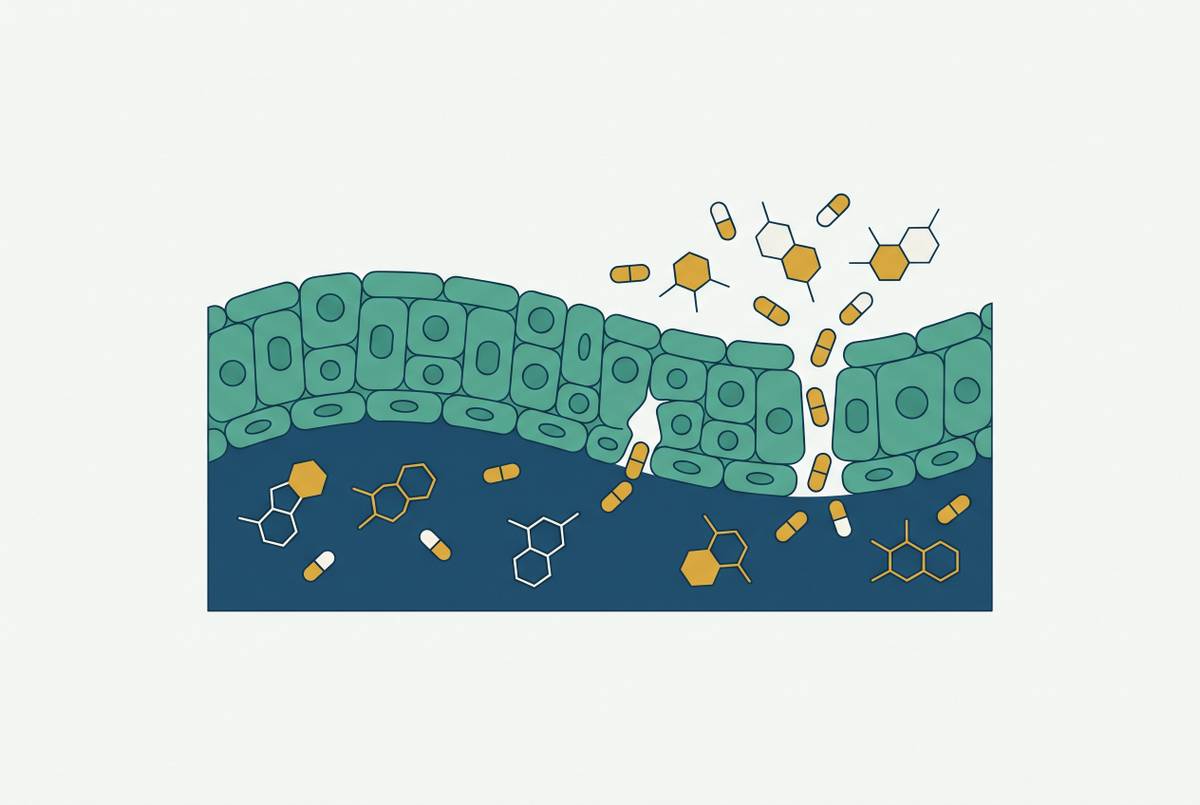
Nearly all large biopharmaceuticals never reach the brain when given by injection, and the reason has nothing to do with dose or formula. It has to do with anatomy. The blood-brain barrier is built from endothelial cells locked together by tight junctions, and that structure does not simply thin out drug concentration on its way to brain tissue: it excludes macromolecules almost categorically. Raising the dose of a subcutaneous peptide will not fix this. A bigger dose just means more drug sitting in the bloodstream, banging against a wall it cannot cross.
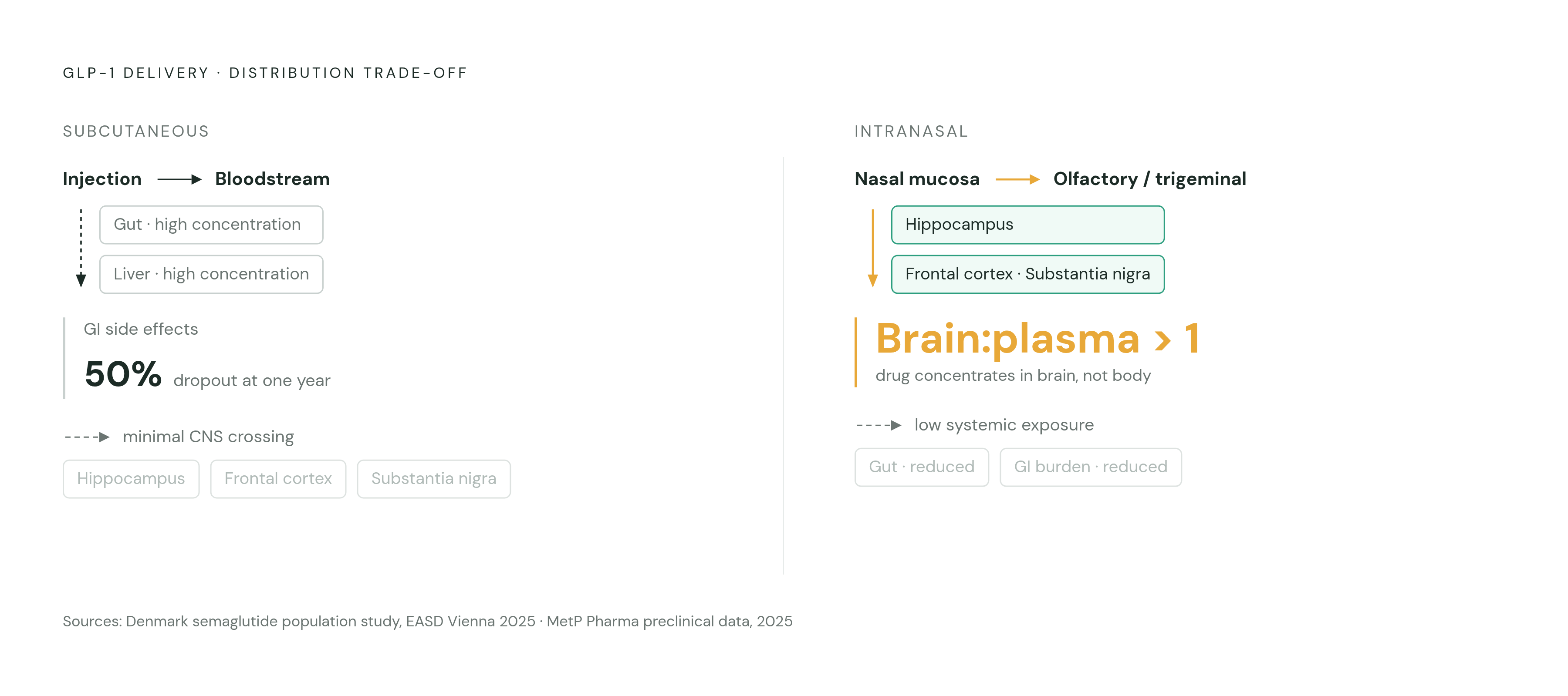
That has a second consequence, one that gets less attention than it deserves. The consequence is not only reduced efficacy at CNS targets but also elevated systemic exposure: the drug accumulates peripherally at concentrations needed to drive a modest central effect, and gastrointestinal side effects originate from that peripheral exposure. The gut, the liver, and other peripheral tissues absorb concentrations far higher than what actually matters for the therapeutic goal, and gastrointestinal side effects trace directly back to that peripheral overexposure. The drug underperforms in the brain while the body pays a tax in side effects to buy a small amount of central access. Formulation chemistry can't undo that trade, because the barrier being crossed isn't chemical, it's architectural. Which raises an obvious question: if the vasculature is closed off this tightly, is there another route into the skull that doesn't run through blood vessels at all?
The olfactory and trigeminal pathways as a direct anatomical highway to the brain
There is one, and it runs through the nose. The nasal cavity connects to the central nervous system through the olfactory and trigeminal nerves, a route that sidesteps the blood-brain barrier entirely rather than trying to sneak past it. This is not a laboratory trick or a clever workaround someone engineered. The olfactory nerve links the olfactory epithelium straight to the olfactory bulb, feeding into cortical and limbic structures, while the trigeminal nerve spreads through the nasal mucosa and reaches the brainstem and other central regions. Evolution built these pathways so the brain could sense the chemical world outside the body. Drug delivery science is simply borrowing wiring that was already there.
The pharmacokinetic data backs this up in ways that matter for anyone skeptical of the anatomy alone. Research published in Translational Neurodegeneration by Drath, Richter, and Feja in 2025 found that macromolecules given intranasally show a distribution pattern in the brain distinct from anything seen after systemic dosing, with brain exposure occurring fast. Preclinical work from MetP Pharma in 2025 gives a concrete number to hang that on: intranasal dosing in rats produced brain-to-plasma ratios consistently above 1, showing the drug concentrated preferentially in brain tissue instead of washing out into general circulation. A ratio above 1 is the signature of a route doing what it's supposed to do. It tells you the drug isn't just leaking into the brain as a side effect of being everywhere in the body; it's arriving there in excess of what systemic exposure alone would predict.
None of this proves the pathway works identically in humans, and that tension gets addressed later. For now, the anatomical case stands on its own: a nerve-based route exists, it has been measured, and it bypasses the barrier that makes subcutaneous peptide delivery so inefficient.
Why raw peptides fail in the nasal cavity
Getting past the blood-brain barrier by going through the nose sounds almost too easy. It isn't, because the nose has its own defenses, and they were not designed with therapeutic peptides in mind. Enzymes in nasal secretions cleave an unprotected peptide apart, a viscoelastic mucus layer physically traps it, and beating cilia sweep that mucus, along with anything caught in it, toward the throat within minutes. Any one of these alone would be a nuisance. All three operating at once is close to lethal for a naked peptide.
Consider the timeline. Mucociliary clearance moves mucus toward the pharynx on the order of minutes, and a peptide needs to survive long enough to diffuse across the epithelium and reach the nerve endings that lead into the olfactory or trigeminal pathways. If the enzymes don't degrade it first, the mucus traps it, and if the mucus doesn't trap it, the cilia clear it before it ever makes contact with the tissue it needs to cross. The review published in Nanoscale in January 2026 by Paraiso and colleagues puts a name to the outcome: without a carrier system built to counter these barriers, intranasal bioavailability for therapeutic molecules stays low.
The anatomical highway from the previous section has a tollbooth at the entrance that most peptides never pass. The nasal route is favorable in principle and hostile in practice, and turning it into something clinically usable is a materials science problem that requires far more than switching from a needle to a nasal spray.
Engineering nanoparticle platforms to solve nasal barriers
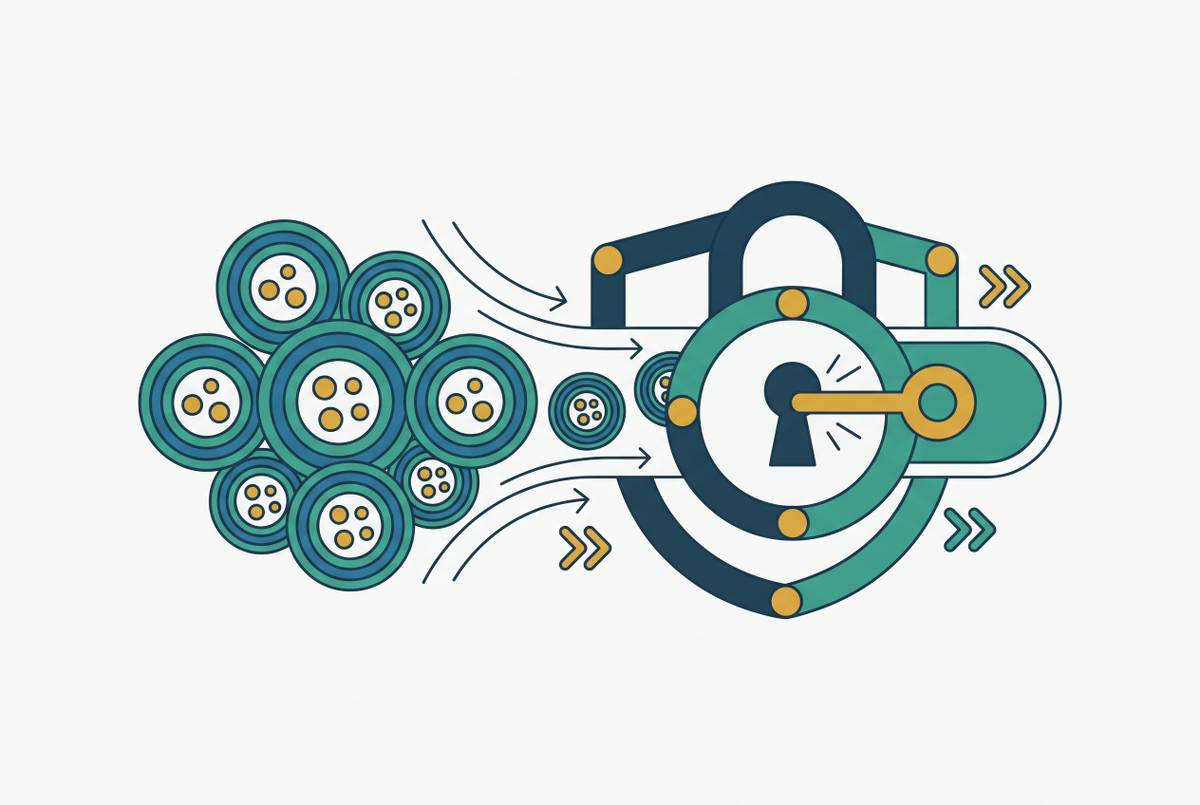
Solving that problem means addressing each barrier on its own terms, and nanoparticle platforms have become the tool for doing it. Particle size and surface charge form the baseline. Nanoscale particles can pass through the pores of the mucus mesh that would trap larger aggregates, and because the mucin network carries a negative charge, particles that are neutral or only mildly charged tend to diffuse through it more freely than heavily cationic ones, though some formulations deliberately use charge to stick to mucus rather than slip past it.
Sticking to mucus, in fact, is its own design strategy. Mucoadhesive coatings made from materials like chitosan or hyaluronic acid derivatives bind the mucus layer and resist being swept away by ciliary action, buying the peptide more time in contact with the epithelium. The Paraiso review treats mucoadhesion as its own category of nose-to-brain strategy, and the evidence it cites ties longer nasal residence to greater total drug deposition in brain tissue. A 2026 Biomaterials study puts a number on that relationship: a formulation using HA-CP extended nasal residence to roughly four hours and raised total brain accumulation of the payload. Four hours is a long stay for something that would otherwise clear in minutes.
Mucopenetration takes the opposite approach. Rather than anchoring to the mucus, coatings, PEGylation being the best known, reduce adhesion so the particle can diffuse through the mucus layer instead of getting stuck in it. Some platforms combine both ideas in sequence: an outer shell that adheres to mucus, wrapped around an inner carrier designed to slip through once the outer layer has done its job of holding the particle in place. A third approach skips both strategies and instead targets the mucus itself, using agents that temporarily loosen its viscoelastic structure so the barrier is less dense for whatever passes through it next.
Enzymatic degradation gets solved by simple physical shielding. Encapsulating a peptide inside a nanoparticle matrix means proteases in nasal secretions encounter the carrier's surface rather than the peptide backbone itself. A 2026 study described in PubMed demonstrated this directly: PLA-poloxamer P188 nanoparticles protected an amyloid-beta-blocking peptide from enzymatic breakdown, keeping its therapeutic activity intact from the nasal cavity through to brain tissue, a result significant enough to matter clinically.
Getting across the epithelium itself, rather than merely surviving the mucus, is where receptor targeting comes in. Attaching lectins or other targeting ligands to a nanoparticle surface allows the epithelium to actively pull the particle in through transcytosis rather than leaving the particle to diffuse passively and hope for the best. The 2026 Biomaterials study showed that odorranalectin conjugation improved nasal epithelium permeation through receptor-mediated mechanisms, with in vivo imaging confirming brain distribution and intracellular uptake in neurons and microglia. Yang and colleagues found something similar using a different lectin, Aleuria aurantia lectin, attached to dendritic poly-L-lysine nanoparticles, which independently supports lectin conjugation as a working strategy rather than a one-off result.
The most advanced carriers add a layer of chemical intelligence on top of all this: stimuli-responsive release. The same Biomaterials study used redox-responsive disulfide crosslinks that enable thiol-mediated anchoring to mucin glycoproteins, a mechanism that enhances mucosal transport through a specific chemical interaction rather than a generic physical one. And the field keeps expanding beyond synthetic polymers. The Paraiso review identifies protein-based nanoparticles and biomimetic nanomedicines, carriers coated in cell membranes or built from biological motifs, as distinct emerging categories aimed at dodging immune recognition and improving how precisely a particle finds its target tissue.
Taken together, these strategies read less like a single invention and more like a toolkit, where clearing mucus, resisting enzymatic breakdown, and crossing the epithelial barrier each get their own engineered answer, sometimes stacked into a single particle.
Translating nanoparticle performance to living tissue with validated models
None of these design strategies mean much until they are tested in something resembling real tissue, and the model used to test them determines how much confidence the result deserves. Think of it as a ladder, with each rung adding a barrier the previous rung couldn't capture.
Cell monolayers and air-liquid interface cultures sit at the bottom. They let researchers study epithelial permeation under tightly controlled conditions, but they say nothing about mucus dynamics or the sweeping action of cilia, because neither exists in a dish. Ex vivo models, excised nasal tissue taken from animals, climb a rung higher by adding a real mucus layer and intact epithelial architecture, but the tissue is dead, so it can't clear mucus actively and it can't reveal how the drug behaves once it enters circulation.
Nasal-mucosa-on-chip systems represent the newer rung, and they get closer to mimicking a living, dynamic environment. The 2026 Biomaterials study used a chip model alongside ex vivo Franz diffusion tests to show robust permeation, then moved to in vivo imaging to confirm the particles actually reached brain tissue. That pairing, a chip model plus live imaging, is what gives the result weight. It's evidence built in stages rather than asserted from a single experiment.
In vivo rodent studies remain the standard for proof of concept in this field, but their anatomical differences from humans complicate how far the results can be trusted, a problem taken up directly in the next section. The result that carries the most translational weight so far comes from humans, not rodents. The first PET-confirmed human proof of concept for nasal-to-brain peptide transport, using intranasal insulin at Wake Forest University School of Medicine with an Aptar Pharma precision nasal delivery system in July 2025, established that the route functions in humans, a critical translational anchor that rodent data cannot provide. Rodent data can suggest a mechanism works. Only a human study, backed by imaging that shows the drug where researchers claim it went, can confirm the route functions in the species the therapy is actually meant to treat.
The olfactory epithelium size gap between rodents and humans
That human confirmation matters because rodent anatomy and human anatomy diverge in a way that directly limits how much of the promising preclinical data can be taken at face value. In rodents, the olfactory epithelium covers a large share of the total nasal surface area. In humans, it covers a much smaller share, and that gap has direct consequences for how much of an intranasal dose can actually reach the olfactory pathway rather than sliding past it.
Maeng and Lee, writing in Frontiers in Pharmacology in 2022, documented this disparity and argued it accounts for a good share of the promising rodent results that failed to reproduce once researchers moved to human trials. A formulation tuned to perform well in a rat nose, where the olfactory epithelium dominates the nasal cavity, is not automatically tuned to perform well in a human nose, where that same tissue occupies a fraction of the space. Targeting efficiency shifts. Deposition patterns shift. Mucociliary clearance dynamics shift too, and all of these changes can erode an advantage that looked decisive in animal data.
This does not mean the nasal route is a dead end in humans, and the field's response to the gap is instructive rather than dismissive. If trigeminal pathways and other non-olfactory transport routes make a meaningful contribution to how peptides move from nose to brain in humans, then a smaller olfactory surface does not have to be the whole story. Paraiso and colleagues, along with the Wake Forest and Aptar insulin data, point in that direction, and they add that precision deposition devices, engineered to place a dose specifically in the olfactory cleft, can partially offset the area lost to human anatomy. The gap between rodent and human olfactory surface area is not going away and formulations built around rodent performance alone will keep running into it. But the engineering response, targeting the trigeminal route more deliberately and aiming devices with more precision at the tissue that remains, gives the field a real answer rather than a reason to walk away from the approach.
GLP-1 peptides and the brain: why central delivery changes what the drug can do
GLP-1 receptors sit in brain regions responsible for appetite, cognition, emotion, and motor control, including the hippocampus, the frontal cortex, and the substantia nigra. That distribution makes the brain a primary target for this drug class, benefiting directly from a dose rather than relying on spillover from peripheral circulation.
Subcutaneous delivery, though, forces GLP-1 receptor agonists to travel systemically and then cross the blood-brain barrier to reach any of those regions, and that creates exactly the trade-off described earlier in this piece: peripheral GI exposure driving nausea and dropout on one side, central exposure driving the actual therapeutic benefit on the other. Khan and colleagues, reviewing the case for intranasal GLP-1 delivery in 2024, concluded that routing the drug through the nose instead could raise brain concentrations while lowering systemic exposure, cutting gastrointestinal side effects in the process. That would address both failure modes of the subcutaneous route at once, rather than trading one for the other.
The scale of the adherence problem is stark: a large population study of semaglutide users in Denmark, presented at the European Association for the Study of Diabetes meeting in Vienna in September 2025, found that roughly half of patients stop taking these weight-loss drugs within a year, and gastrointestinal side effects, the same side effects tied to peripheral overexposure, are a primary driver of that dropout. An intranasal route designed to limit systemic exposure targets that driver directly.
The therapeutic case extends well past appetite control. Preclinical work has found that GLP-1 receptor agonists reduce alpha-synuclein aggregation, calm neuroinflammation through microglial modulation, and support the survival of dopaminergic neurons, mechanisms with obvious relevance to Parkinson's disease and dementia research. The ELAD trial, a randomized, double-blind, placebo-controlled study in patients with mild to moderate Alzheimer's disease, found that liraglutide treatment led to substantially less brain volume loss across the frontal, temporal, and parietal lobes, and in total gray matter, compared with placebo. That result is clinical evidence, not a mechanistic hypothesis, that a GLP-1 drug reaching the brain in sufficient concentration can change the physical trajectory of a neurodegenerative disease. Central delivery, in other words, does not just change how much of the drug gets where it needs to go. It changes what the drug is capable of doing once it arrives.
Sources
- Overcoming barriers: nanomedicine-based strategies for nose-to-brain delivery - Nanoscale (RSC Publishing) DOI:10.1039/D5NR02259B
- Nose-to-brain delivery of an amyloid beta blocking peptide using polylactic acid-poloxamer 188 nanocarriers - PubMed
- Nose-to-brain drug delivery: from bench to bedside - PMC
- MetP Pharma unveils brain-targeted intranasal GLP-1 delivery technology
- Intranasal delivery of glucagon-like peptide-1 to the brain for obesity treatment: opportunities and challenges: Expert Opinion on Drug Delivery: Vol 21 , No 7 - Get Access
- A rationally designed polypeptide-based hybrid platform for targeted intranasal brain drug delivery - ScienceDirect
- A Nasal Aerodynamics Perspective of Retronasal Olfaction: Rodents vs. Humans - PubMed