Companies Developing Intranasal Routes for GLP-1 and Metabolic Peptide Delivery
Nasal delivery could ease GLP-1 side effects while boosting brain concentrations.

GLP-1 receptor agonists have become the leading treatment for obesity and type 2 diabetes, but the needle that delivers them is quietly undermining the therapy's reach. Patients drop off treatment at rates that limit how much good these drugs can do at a population level, and the pattern is not evenly spread. Adherence runs worse among people taking GLP-1 RAs for weight loss than among those managing diabetes, and that matters because weight loss is the use case expected to grow fastest as indications widen. A therapy that works brilliantly in a trial but gets abandoned in the clinic has not solved the problem it set out to solve. It has only moved the problem downstream, from efficacy to persistence.
What if the injection itself is not the only thing standing between patients and better outcomes? Subcutaneous GLP-1 drugs have to cross the blood-brain barrier to reach the central targets that drive satiety and glucose regulation, and a 2024 review pointed out that nasal delivery could, in principle, reach higher brain concentrations while it lowers how much drug circulates through the rest of the body. Lower systemic exposure is the same shift that would ease the gastrointestinal side effects, nausea chief among them, that drive much of the dropout, so the dosing route and the side-effect burden are tied to the same underlying mechanism, and a formulation that solves one problem has a real shot at solving both at once.
How the nose-to-brain pathway works
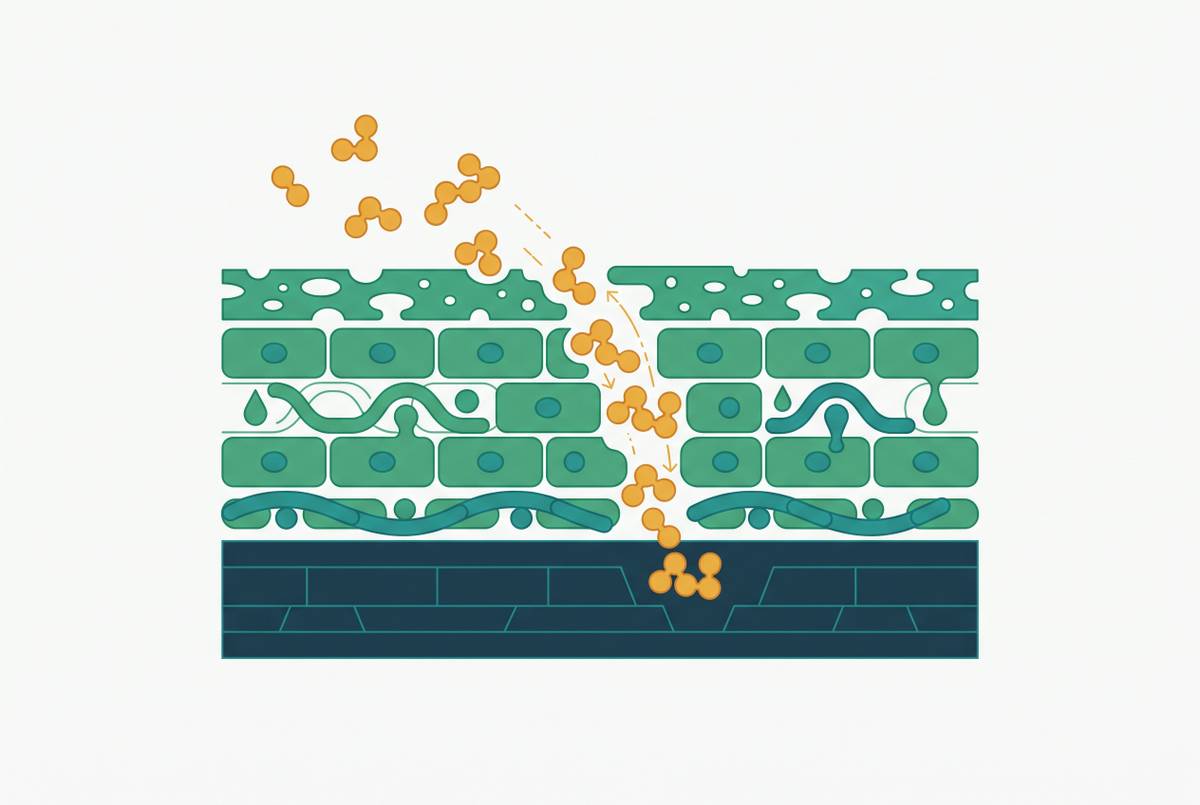
The nose offers a route into the brain that bypasses the circulatory system almost entirely, through two nerve pathways that run from the nasal cavity straight into neural tissue. The olfactory nerve connects the upper nasal cavity to the olfactory bulb through the cribriform plate, while the trigeminal nerve spreads across the broader nasal mucosa and links into the brainstem. When peptides reach these conduits, they can move into the brain without ever entering general circulation, and that is why the nasal route appeals so much for CNS-active drugs. Three transport mechanisms do the work once a molecule reaches that tissue: extracellular perineural channels, the fastest route, can land a peptide in the brain within minutes; intracellular axonal transport is far slower, taking hours; and transcellular passage through supporting cells offers a third path, relevant to different formulation designs depending on molecular size and charge.
The anatomy is elegant, and getting a peptide to use it reliably is a separate, much harder problem. So why does a pathway this direct still produce such modest results in practice? Part of the answer sits in how animal data get interpreted. The olfactory epithelium occupies a proportionally larger share of the nasal cavity in rodents, four to five times larger than in humans, so a result that looks dramatic in a rat's nose has to be read with real caution before anyone assumes it will hold at human scale.
Human evidence does exist, and it should be read for what it shows and no more. A first-in-human PET study using nitrogen-13-labeled oxytocin, led by Winterdahl and colleagues in 2025, found that intranasally administered peptides do reach human brain tissue, with uptake detectable within roughly an hour of dosing. That finding confirms the pathway is real in humans, not just in rodent models. It does not confirm that any current formulation delivers a therapeutically meaningful dose, because the brain concentrations measured were low and variable, which is what the species-translation gap would predict. The pathway works. Exploiting it well enough to matter clinically is the unsolved part, and that distinction is what separates a credible platform from a hopeful one.
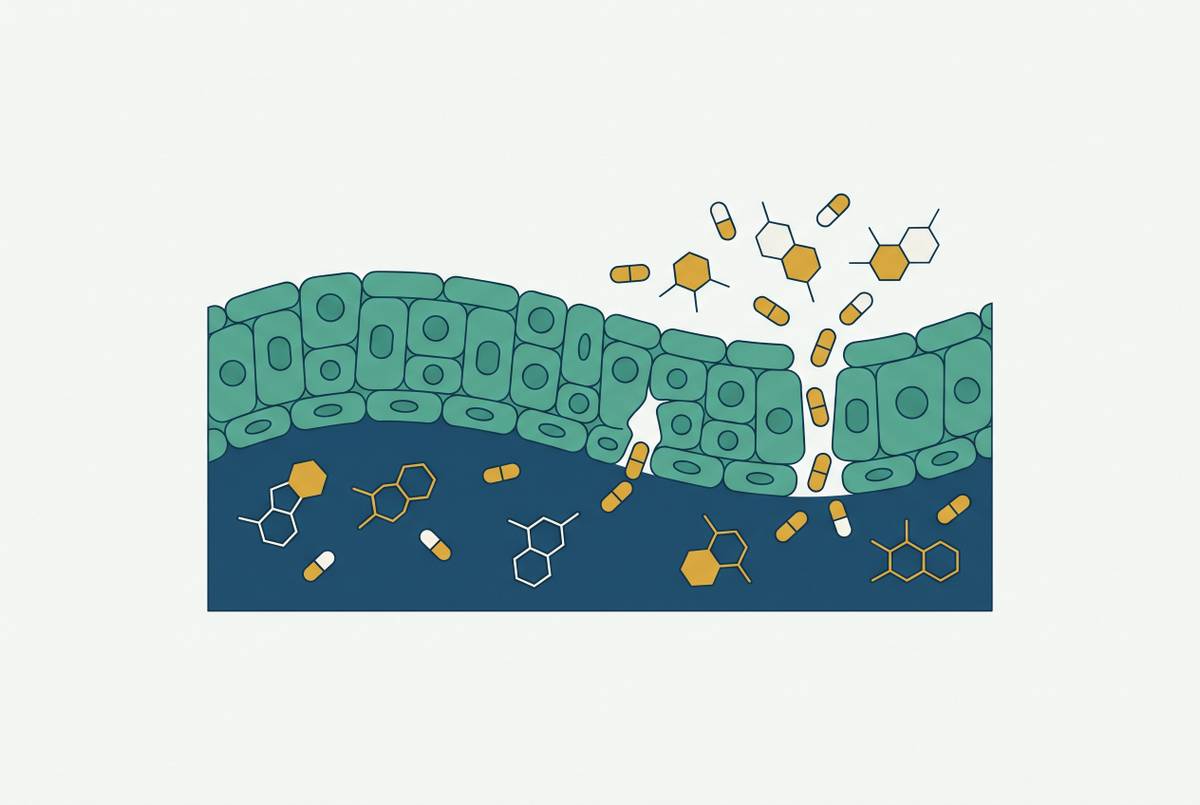
Peptides also carry their own baggage into the nasal cavity. Molecules the size of semaglutide or oxytocin are large, prone to enzymatic breakdown by the enzymes present in nasal mucosa, and hydrophilic enough that passive diffusion across the epithelium is inefficient from the start (building on the pathway established above). Put those physicochemical traits alongside mucociliary clearance (the nasal cavity's defense mechanism that sweeps foreign particles toward the throat before they can be absorbed) and a selective epithelial barrier, and the result is bioavailability low enough to undercut the entire rationale for the route unless a formulation strategy intervenes.
The three formulation strategies competing to solve nasal bioavailability
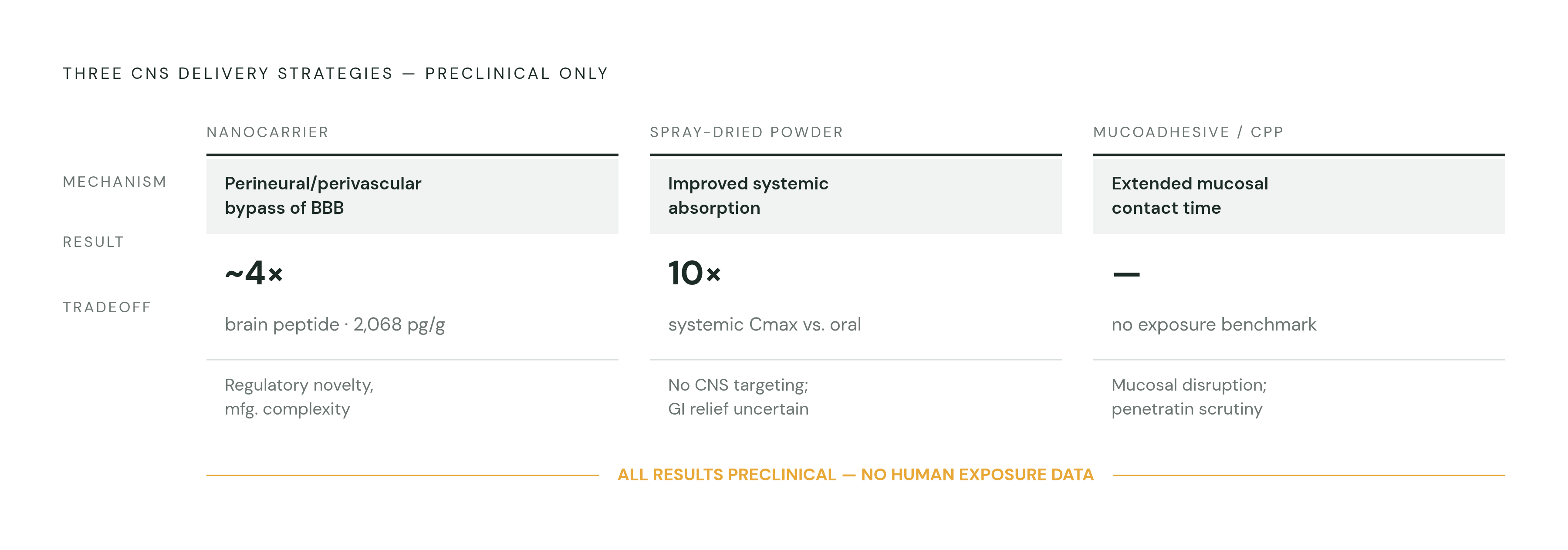
Three distinct approaches have emerged in the preclinical literature to confront that bioavailability wall, and each solves it in a genuinely different way, with its own tradeoff between how precisely it can target the brain, how much drug ends up circulating systemically, and how hard it is to manufacture.
Nanocarrier platforms attack the problem by sidestepping the blood-brain barrier. Rather than relying on passive diffusion across the epithelium, these particles travel along perineural and perivascular channels, the same anatomical shortcuts described above, carrying their payload with them. A 2025 study at King's College London demonstrated nanocarrier delivery of acyl-ghrelin, a metabolic peptide, via gold nanorod conjugates, reaching peak brain levels of roughly 2,067.6 ± 760.6 picograms per gram of brain tissue, about a fourfold increase over native expression levels in that study. The peptide was not just present in the tissue; it was active, with AMPK phosphorylation detectable at 30 to 60 minutes, evidence that the delivery mechanism preserved the molecule's biological function rather than simply depositing inert material. That result belongs to a related metabolic peptide, not to a GLP-1 receptor agonist itself, so it reads as a proof of mechanism rather than a finished answer. The tradeoff is steep on the manufacturing side: nanoparticle formulations carry real regulatory novelty, and turning a nanocarrier concept into an approvable product demands formulation science and intellectual property depth that few organizations have built.
Spray-dried and powder processing technologies take a more conservative route: they treat bioavailability as a formulation challenge rather than a brain-targeting one. Preclinical pharmacokinetic studies on both liquid and powder formulations of semaglutide have shown improved systemic absorption compared with oral delivery. That is a real gain over a pill, and it is a different kind of gain than CNS targeting. The mechanism here is better systemic absorption, not preferential delivery to the brain, so you cannot yet say the GI side-effect burden will be meaningfully smaller than with injections. A formulation can solve the convenience problem without necessarily solving the tolerability problem that drives so much of the dropout described earlier.
Mucoadhesive, thermogelling, and permeation-enhancing systems work on contact time instead of transport route. When these systems keep the active ingredient against the nasal mucosa longer and slow mucociliary clearance, more drug can cross the epithelium before it gets swept away, and some are designed to release their payload over an extended period rather than all at once. A related strategy uses cell-penetrating peptides: co-administering a GLP-1 receptor agonist with penetratin, a CPP, has been shown to sharply increase brain distribution in mice, with hippocampal insulin signaling confirmed through Akt phosphorylation. The tradeoff here hits safety and regulatory complexity, not manufacturing. Permeation enhancers raise open questions about what repeated disruption of the nasal mucosa does over months or years of use, and when a CPP pairs with the active drug, it adds another layer of regulatory scrutiny.
None of these three strategies can win on preclinical results alone. Strong rat or mouse data are a necessary step, not a sufficient one, and the formulations that eventually matter will be the ones that clear comprehensive clinical investigation designed to optimize dosing and confirm the nose-to-brain interface actually works at the doses humans receive. That caveat applies to every company discussed next, regardless of how compelling its preclinical story sounds.
The active programs: MetP Pharma, Aptar Pharma, Landmark Medicines, and the nanoparticle approach
The active intranasal GLP-1 programs differ not just in formulation strategy but in what scientific claim each has staked its credibility on, and what still has to be shown in actual human subjects.
MetP Pharma, based in Emmetten, Switzerland, has built its case around CNS-preferential targeting. In a 2025 preclinical study in rats, intranasal semaglutide delivered through the company's proprietary nasal technology produced brain-to-plasma ratios consistently above 1, a result the company's press release described as "almost impossible" to achieve through subcutaneous, oral, or conventional nasal administration. Brain exposure rose in proportion to dose and appeared rapidly after administration, which points to a platform that behaves predictably rather than erratically. The strategic logic follows directly from the opening section's mechanistic point: shifting GLP-1 exposure toward the brain and away from peripheral circulation would, if it holds in humans, address GI side effects and CNS-driven indications at the same time. The Winterdahl study raises the same open question for the field generally: these are rat data, and the species-translation gap it documents means human brain-to-plasma ratios will very likely be lower than the figures seen here. The clinical translation step has not happened yet, and MetP Pharma is now looking for partners to carry brain-targeted GLP-1 programs through further preclinical work and into clinical development.
Aptar Pharma, headquartered in Crystal Lake, has taken a different kind of position entirely, building device-integrated delivery anchored in intellectual property rather than a CNS-targeting hypothesis. In May 2026, the company published three new international patent applications covering spray-dried and powder processing technologies for nasal and pulmonary administration of GLP-1 therapies, an IP-first move that stakes out territory in biologics delivery ahead of any clinical proof-of-concept. The preclinical pharmacokinetic work behind that filing showed up to a tenfold improvement in systemic Cmax for both liquid and powder semaglutide formulations compared with a comparable oral dose. That program sits inside Aptar's wider biologics compatibility effort, which systematically tests how complex biologic molecules and their nanoparticle delivery systems interact with Aptar's nasal and pulmonary device platforms. The company frames its role in explicitly partnership-oriented terms: it positions itself as an enabler for pharmaceutical companies developing biologics, not as a drug developer pursuing its own asset, and it expects to present further data at scientific conferences and in peer-reviewed journals through 2026 and 2027. The distinction from MetP Pharma is precise: Aptar's headline metric is systemic Cmax, not brain-to-plasma ratio, a different therapeutic hypothesis that carries a different, less certain implication for whether patients see fewer GI side effects.
Landmark Medicines, based in Loughborough, UK, occupies a third position: a formulation-agnostic platform now closer to human testing than either of the above. As of September 29, 2026, the company announced plans to move its proprietary nasal drug-delivery platform toward a human volunteer study, with GLP-1 receptor agonists chosen as the first therapeutic application, and candidate molecules including semaglutide still under evaluation ahead of final selection. The planned study will start by measuring pharmacokinetics, systemic bioavailability, dose requirements, safety, and tolerability, with nose-to-brain CNS delivery reserved for separate investigation as the platform matures. That sequencing is itself a signal about how the company is managing risk: prove systemic absorption works in humans first, then ask the harder CNS-targeting question afterward. The team brings more than 20 years' experience developing complex pharmaceutical dosage forms, with broader capabilities including softgel capsules, injectable formulations, and specialist delivery technologies, and the company will attend BIO-Europe 2026 in Cologne, Germany, from November 9 to 11, to explore development, licensing, and strategic partnerships around the platform. Among the programs discussed here, Landmark sits closest to actual human subjects, so its forthcoming pharmacokinetic data stand as the nearest-term test of whether any intranasal GLP-1 platform can show meaningful bioavailability outside an animal model.
A fourth category stands apart from these named programs: nanoparticle-based nose-to-brain delivery built on deep, long-standing intellectual property foundations. What separates a platform like this from the molecule-specific programs above is scope. The nanoparticle approach is designed to carry different peptide payloads across different indications rather than optimize one molecule for one route. The King's College London gold nanorod work described earlier showed rapid peak brain levels with the delivered peptide still biologically active, and that serves as a proof of mechanism for any nanoparticle platform applied through the nasal route, not just for the specific metabolic peptide tested. The defining strength of a platform built this way is tunability: particle size, surface chemistry, and release kinetics can all be adjusted to match the pharmacokinetic demands of different peptides and different targets in the brain, instead of locking the company into one formulation built around one molecule. That breadth carries a scientific argument the single-molecule programs cannot make on their own terms. If the same underlying mechanism can carry a GLP-1 analog into the brain, it could, in principle, carry other CNS-active peptides that face the identical blood-brain barrier and peripheral-exposure problem.
Reading these four efforts side by side, no single approach has yet cleared the bar the field needs cleared: a human trial showing therapeutically meaningful brain or systemic exposure at a tolerable dose. Each has made a different bet about where the risk is worth taking on, whether that is CNS targeting ahead of commercial partnership, IP position ahead of clinical proof, or molecule-specific speed ahead of platform breadth. Which bet pays off first is an empirical question the next two or three years of data should start to answer.
Why brain targeting changes the clinical calculus beyond obesity
The case for intranasal GLP-1 delivery extends past convenience, into a claim about which diseases become treatable once CNS exposure can be controlled directly. Reaching the brain preferentially opens access to indications that depend on central GLP-1 receptor engagement in ways peripheral dosing cannot reach as effectively, including addiction and dementia. That is a meaningful expansion of what this drug class could eventually treat, and it reframes the entire intranasal effort. The injection shortage described at the outset is one motivation for this work. The prospect of treating neurological disease through a route that was, until recently, considered mainly a convenience upgrade, is another, arguably larger one. One might ask which of these two motivations is actually driving the current wave of investment, and the honest answer is probably both at once, with the neurological indications serving as the reason this technology is worth building even if the obesity delivery issue were solved some other way.
Sources
- Aptar Pharma Announces New Patent Applications and Preclinical Data Supporting Investigation of Intranasal and Pulmonary GLP-1 Delivery - BioSpace
- Nasus Pharma Ltd - Form F-1/A - FY2025
- Landmark Medicines Advances Proprietary Nasal GLP-1 Platform Towards Human Evaluation - BioSpace
- Nasus Pharma Ltd - Form 424B4 - FY2025
- Effective nose-to-brain delivery of exendin-4 via coadministration with cell-penetrating peptides for improving progressive cognitive dysfunction