GLP-1 Side Effect Profile and Treatment Discontinuation Rates
Many patients abandon GLP-1 drugs despite trial success rates.

GLP-1 receptor agonists generated roughly $132 billion in global sales in 2025, according to IQVIA data reported by Managed Healthcare Executive, making this one of the largest drug categories in modern medicine. Yet the gap between how these drugs perform in clinical trials and how patients actually stick with them in the real world is enormous, and it is barely discussed with the seriousness it deserves.
In phase 3 trials, somewhere between 82.9% and 83.6% of participants finished the study still on the drug. Outside that controlled setting, real-world discontinuation rates range from 37% all the way to 81%, depending on the population and study design. That spread is not just wide, it is a symptom. It suggests the medical community still does not have a firm grip on why patients quit, who quits fastest, or what happens to them after they do. This piece works through that puzzle in pieces: the pharmacology that makes side effects predictable rather than random, the discontinuation data across different patient groups, the cost and access barriers no side-effect management plan can solve, the weight rebound that raises the stakes of quitting, the restart cycle that reveals what patients actually want, and finally, the delivery format question that may drive all of it.
How GLP-1 drugs work and why their mechanism creates predictable tolerability problems
GLP-1 receptor agonists do several things at once: they boost insulin secretion, suppress glucagon, slow gastric emptying, and increase satiety. All of that happens through the same receptor pathway, which is worth sitting with for a moment, because it means the side effects are not a separate problem bolted onto the therapeutic effect. They are the same mechanism, expressed in a different tissue.
GLP-1 receptors show up in the pancreatic islets, in the brain, and throughout the gastrointestinal tract. Stimulate that receptor system to get metabolic benefit, and the gut gets stimulated right along with it. There is no way to activate the pancreas and the satiety centers in the brain without also touching the tissue that controls how fast food moves through the stomach and intestines.
Most drugs in this class are structurally altered to resist breakdown by an enzyme called dipeptidyl peptidase-4, which extends how long the drug stays active in the body. That is a feature for dosing convenience, since it is part of why once-weekly injections work at all. But it is also why the GI receptor activation lasts longer too, prolonging exposure to the very mechanism that causes nausea.
Delayed gastric emptying is the clearest example of this dual nature. It is the reason patients feel full faster and eat less, which is the therapeutic win. It is also the reason they feel nauseated, sometimes vomit, and why anesthesiologists have flagged aspiration risk during procedures requiring sedation, since food sitting longer in the stomach raises that risk during surgery.
Tirzepatide complicates the picture further by acting on both the GIP and GLP-1 receptor pathways at once. Two mechanisms means a somewhat different tolerability profile compared to single-pathway drugs, and the data on restart and persistence later in this piece suggests that difference is not trivial.
None of this is random toxicity. It is a pharmacologically consistent, predictable consequence of activating a receptor that exists well beyond the organ doctors are trying to treat. That consistency is exactly why GI side effects appear across the entire drug class rather than in isolated cases tied to one formulation.
Gastrointestinal side effects: how common they are, which ones drive quitting, and how they escalate with dose
Real-world studies put the rate of GI adverse events somewhere between 40% and 70% of treated patients. That is a wide range, and part of it comes down to how differently these studies are designed. But part of it is genuine variation in who tolerates the drug and who does not, which itself is a clue that patient-level factors matter as much as the drug itself.
Systematic reviews of randomized controlled trials have confirmed increased risk of nausea, vomiting, diarrhea, and constipation across the entire GLP-1 class compared to placebo. This is not a quirk of one molecule. It is baked into the mechanism described above.
GI symptoms, nausea, vomiting, and diarrhea, are consistently cited among the leading reasons patients quit. Constipation and abdominal pain occur too, but at meaningfully lower rates. What is striking is the dose-escalation trap this creates: patients on a low dose often tolerate the drug fine, but the weight loss is modest at that dose. Push toward a higher dose to chase better results, and GI burden intensifies right along with it. The Danish semaglutide data reported by AJMC points to exactly that inflection point, the moment where the dose that finally works is also the dose patients can no longer stomach.
The gap between trial data and real-world numbers deserves a closer look here too. A systematic review of randomized trials found that 6.5% of GLP-1 users discontinued specifically due to adverse events, versus 3.6% on placebo. That is a real signal, roughly double the placebo rate. But it is dwarfed by the real-world quit rates covered in the next section, which suggests trial participants are a different population altogether: more closely monitored, more motivated to stay enrolled, and probably screened in ways that filter out patients most likely to struggle.
Beyond the GI symptoms, the literature also documents additional reported adverse events beyond the gastrointestinal system, though none of these drive discontinuation at anywhere near the rate GI symptoms do. A thyroid cancer signal has been reported, with the important caveat that obesity and hyperglycemia are independent risk factors that make the relationship hard to untangle, along with reported optic neuropathy cases and pancreatitis. On pancreatitis specifically, the Jalleh 2026 review largely dispelled it as a class-wide risk based on long-term trial data, though surveillance continues.
On the longer horizon, longer-term trial data has offered some reassurance, with serious adverse events among semaglutide users comparing favorably to placebo in extended follow-up. That is a genuinely reassuring result. But long-term data is still accumulating, especially for younger patients taking these drugs for weight management rather than diabetes, a population that did not exist in large numbers when these drugs were first approved.
The discontinuation numbers across populations: how fast patients quit and who quits fastest
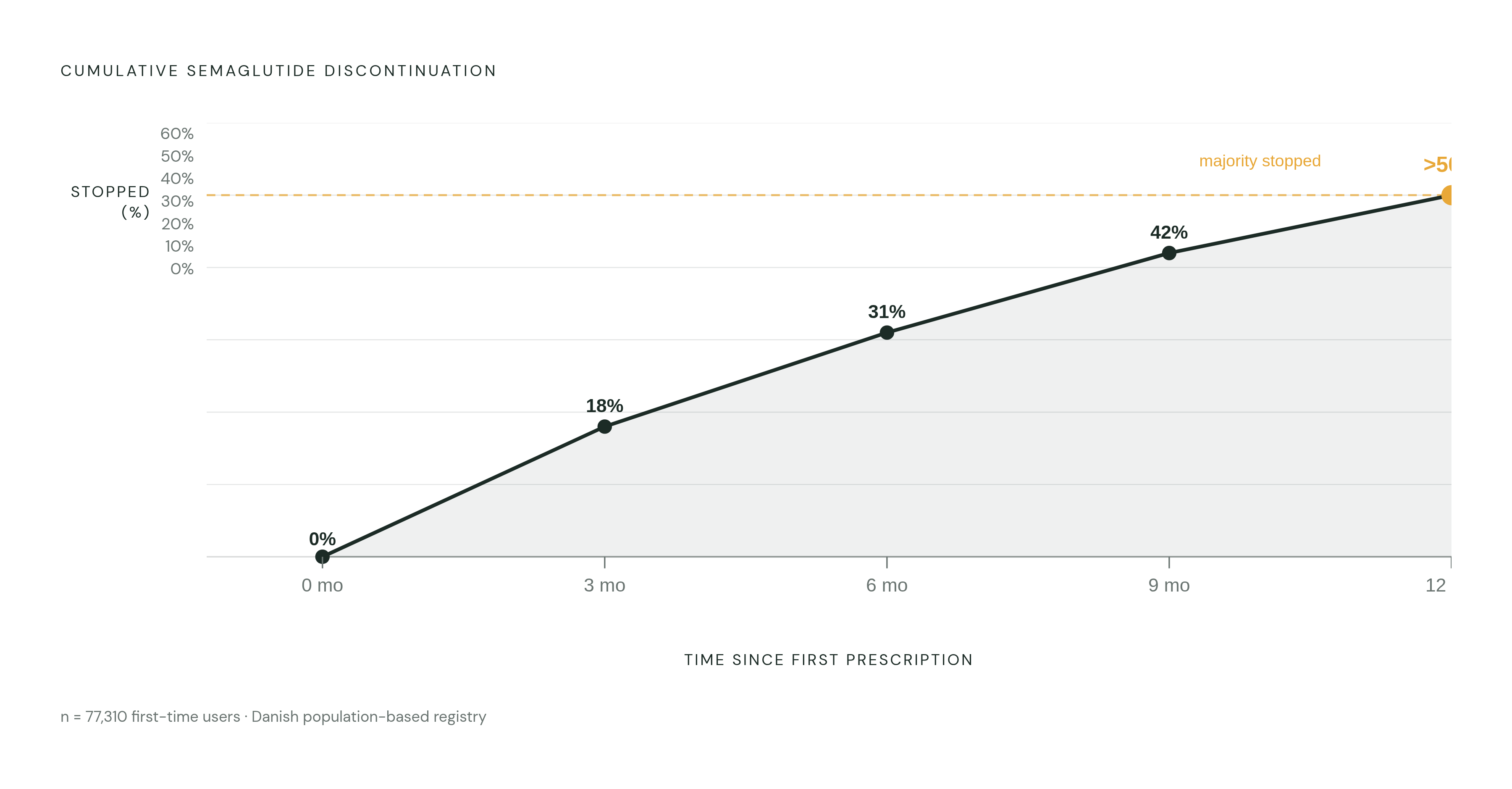
The most granular dataset here comes from a Danish population-based study of 77,310 first-time semaglutide users. The trajectory is blunt: 18% had stopped within three months, 31% within six, 42% within nine, and over half were gone by the one-year mark. That is not a slow leak. That is roughly half the starting population gone before their first anniversary on the drug.
A Prime Therapeutics study found an even starker number: 85% of patients were no longer taking a GLP-1 drug two years after starting. That figure alone should reframe how anyone thinks about long-term efficacy claims for this drug class, since efficacy data assumes continued use, and continued use is apparently the exception rather than the rule.
Diabetes diagnosis seems to change the picture. Among 73,895 new users with type 2 diabetes tracked in a PMC study, cumulative discontinuation was 23.6% at one year and 38.5% at three years, notably lower than what shows up in obesity-only populations. A Truveta/UPenn preprint by Rodriguez and colleagues in 2024, covering 125,474 patients, quantified the gap directly: one-year discontinuation ran 64.8% for patients without type 2 diabetes versus 46.5% for those with it. Why would having diabetes make someone more likely to stay on the drug? One plausible answer is that a diabetes diagnosis comes with more structured medical follow-up, insurance coverage that treats the drug as medically necessary rather than cosmetic, and a clinical urgency that weight management alone often lacks in the eyes of payers.
Who quits fastest? A study presented at the Endocrine Society's ENDO meeting in Chicago, led by Sontha and colleagues at Boston University, sketched out the demographic contours. Medicaid and Medicare patients discontinued at higher rates. Black patients discontinued at higher rates. Patients who experienced nausea or stomach-related side effects were 37% more likely to quit within a year. Younger patients were more likely to discontinue than middle-aged patients, per the Danish study reported in AJMC. And patients living in lower-income areas were more likely to discontinue than those in higher-income areas.
Research into Medicaid populations reinforces this signal specifically, with persistence and adherence to GLP-1 drugs for overweight or obesity consistently running below clinical trial benchmarks. That is not a footnote. It means compliance concentrates along income, race, and insurance lines, which turns this from a pharmacology story into a health equity story. Any fix aimed only at patients who are older, wealthier, and already carry a diabetes diagnosis is not really a fix at all, it is a patch that leaves the highest-risk populations exactly where they started.
Cost and access as discontinuation drivers that side-effect management alone cannot fix
Denmark has universal healthcare, and even there, out-of-pocket costs for the lowest dose of semaglutide ran approximately €2,000, or roughly a similar amount in dollars, as of June 2025. If cost is a barrier inside a system built to minimize exactly that kind of barrier, the picture in a country where coverage is far from guaranteed is predictably worse.
Medicare and Medicaid do not currently cover GLP-1 drugs for weight loss. The Trump administration rejected a Biden-era proposed rule that would have recognized anti-obesity medications under Medicare Part D, according to AJMC reporting. Without insurance, monthly costs for FDA-approved weight-loss formulations can reach $1,300 or more, per the same AJMC coverage. That is not a copay. That is a car payment, every month, indefinitely, for a drug that (as the next section covers) stops working the moment it stops being taken.
A study of 180-day discontinuation, published in 2026 through John Wiley & Sons and indexed on PubMed, put numbers to the hierarchy of reasons patients quit: adverse drug reactions led at 26.8%, cost concerns followed at 14.4%, and non-adherence unrelated to cost accounted for 11.2%. The same study flagged a disparity that echoes the demographic findings above: Asian, Native American, and Pacific Islander patients had more than double the odds of discontinuing compared to white patients.
Thomsen's observation from the Danish cohort cuts to the point directly: patients with more money and more resources are simply better positioned to stay on the drug. They can absorb the cost, they can tolerate the rough titration period because they have the support to get through it, and they have easier access to the incremental dose adjustments that make the drug tolerable over time. That is not a moral failing on the part of lower-income patients. It is what happens when a chronic-use drug carries a chronic-use price tag.
The injectable format adds its own layer of friction here, separate from cost but tangled up with it. It requires a prescription, cold-chain storage, ongoing clinical monitoring, and, for patients who have injection anxiety, a recurring psychological hurdle every single week. The data available cannot fully separate how much of the access problem is pure dollars versus how much is the format itself, but the two clearly interact.
One pattern does suggest that care infrastructure, not just the drug's chemistry, shapes outcomes. The ENDO meeting research found that patients were less likely to discontinue when their first prescription came from a specialist rather than a general practice setting. That is a specialist-access gap as much as anything else, and it points toward solutions that live outside the molecule entirely.
What happens to body weight after stopping, the rebound evidence
Weight loss from GLP-1 drugs does not hold once the drug stops. That single biological fact is what turns a compliance problem into something closer to a clinical emergency, because every discontinuation carries a consequence that goes beyond simply losing progress.
The Rodriguez et al. Truveta/UPenn preprint captured this pattern in the reinitiation data: weight regain after stopping was significantly associated with patients restarting the drug. Patients stop, the weight comes back, and then they come back to the drug. That cycle, on its own, is evidence of the rebound. Nobody needs a separate biomarker to prove it, the behavior pattern proves it.
MariTide, a monthly antibody-peptide conjugate from Amgen currently in Phase 3 trials, is a notable exception. MariTide, a monthly antibody-peptide conjugate from Amgen currently in Phase 3 trials, has reportedly shown weight loss that persists even after dosing stops. That is an anomaly, and researchers are watching it closely for exactly that reason: it contradicts the rebound pattern seen elsewhere in the class and suggests that mechanism of action, not just dose or duration, might determine whether weight loss is durable or temporary.
For the injectable GLP-1 drugs on the market today, though, the clinical reality is closer to managing a chronic condition than treating an acute one. There is no natural stopping point the way there is with a course of antibiotics. The drug has to keep working to keep the benefit.
That reality recasts the Prime Therapeutics figure from earlier in a different light. If 85% of patients have stopped by two years, most of them are not holding onto whatever weight they lost. They are somewhere in a loop: lose weight, drop off the drug, regain it, and possibly restart later.
Sontha, from the ENDO 2026 study, said stopping early may mean missed chances to prevent heart attacks, kidney disease progression, and other complications. Weight is the number everyone watches, but it is not the only outcome riding on continued use. The broader clinical benefits documented in long-term trials also depend on staying on the drug, not just starting it.
None of this means quitting is catastrophic in every case, and the goal here is not to alarm anyone into permanent use regardless of circumstance. But the cost of quitting a GLP-1 drug does appear higher than it is for many other commonly prescribed medications, and that asymmetry is exactly why fixing compliance carries more urgency than it might for a typical chronic-disease drug.
The restart pattern: what cyclic use reveals about unmet patient needs
If the rebound data raises the stakes of quitting, the restart data tells you something else: quitting is often not permanent, and a large share of patients try again.
The ENDO 2026 study, using Komodo Health claims data across more than 60,000 Americans with type 2 diabetes, found that 41.5% of patients who stopped restarted within a year, and 58% restarted within two years. Among the 73,895 type 2 diabetes patients in the PMC study cited earlier, cumulative reinitiation among those who discontinued reached 41.1% at one year and 57.4% at three years. The Rodriguez preprint found a similar split by diagnosis: 51% of type 2 diabetes patients who discontinued restarted within a year, compared to 34.7% of those without diabetes. And per Medscape reporting on the adherence data, nearly one in four patients who discontinued semaglutide restarted within just three months.
What does that pattern actually tell you? These are not patients who tried the drug, decided it was not for them, and walked away for good. These look far more like patients who ran out of money for a month, hit a side effect they could not manage at a particular dose, lost insurance coverage, or hit some other structural wall, and then came back the moment circumstances allowed.
That cycle is not free of cost, even when it looks encouraging on the surface. Every restart means re-titration from a lower dose, which means going through the GI adjustment period again. It means gaps in whatever cardiovascular or glycemic protection continuous use would have provided. And it means the cost exposure returns too, on a drug that was already too expensive to stay on the first time.
There is a genuinely encouraging trend in this data, though, once you account for the factor driving it. One-year persistence for semaglutide improved from 33.2% in 2021 to 58.6% in the first half of 2024, according to a PMC persistence study. Tirzepatide showed one-year persistence between 64.0% and 64.8% across 2023 and the first half of 2024. Newer drugs, prescribed in a more mature clinical environment with better titration support and more experienced prescribers, appear to hold patients longer.
Tirzepatide initiators also showed greater adherence and longer persistence than semaglutide initiators among patients with prior GLP-1 experience over a 12-month window, per a PMC comparative adherence study. At ENDO 2026, patients on tirzepatide were 41% less likely to discontinue than those on older drugs like liraglutide. If two drugs targeting overlapping mechanisms produce meaningfully different persistence rates, drug design itself, not just patient willpower or circumstance, is shaping how long people stay on treatment. That observation is exactly what opens the door to the final piece of this puzzle.
Why delivery format is not a secondary concern but a primary driver of the compliance problem
The injectable route currently holds 69.1% of the GLP-1 market by route of administration, according to Grand View Research. The dominant delivery format in this category is also the one that carries the heaviest day-to-day burden.
Injection burden is not simply a psychological hurdle, though for many patients it is that too. Weekly subcutaneous injections require cold storage in a refrigerator, correct injection technique that has to be learned and repeated correctly, consistent access to needles and supplies through a pharmacy supply chain that does not always run smoothly, and a willingness to keep up a needle-based routine indefinitely, not for a few weeks, but for as long as the clinical benefit is supposed to last.
Stack that against everything covered in the sections above: the GI side effects that intensify with dose, the cost that runs over a thousand dollars a month without insurance, the specialist-access gap that shapes how well a patient is supported through titration, and the biological reality that stopping means losing the benefit and likely needing to restart from scratch later. Delivery format is not sitting off to the side of that picture. It is woven through nearly every stage of it, from the anxiety of the first injection to the logistics of keeping a supply cold while traveling to the sheer repetition required to sustain a habit for years without an endpoint in sight.
The persistence gap between tirzepatide and older drugs like liraglutide suggests formulation and dosing schedule already move the needle on how long patients stay engaged. If a once-weekly injection outperforms an older, more frequent dosing schedule on persistence, what would a formulation that removed the injection requirement entirely do to these numbers? The data reviewed across this piece cannot answer that directly, since it describes the drugs currently on the market rather than hypothetical future formulations. But the pattern connecting dosing frequency, specialist support, and persistence is consistent enough to suggest that delivery format deserves to be treated as a primary design variable in this drug class, not an afterthought layered on top of a chemistry problem that has already been solved.
Sources
- The science of safety: adverse effects of GLP-1 receptor agonists as glucose-lowering and obesity medications
- More than half of those who stop GLP-1s restart within a year
- GLP-1 RA Adherence Shows Drop-Off After 1 Year | AJMC
- Discontinuation and Reinitiation of GLP-1 Receptor Agonists Among US Adults with Overweight or Obesity
- GLP-1 Side Effects Only One Factor Driving Patient Discontinuation Rates
- ncbi.nlm.nih.gov
- Characterisation of real-world patients who discontinued a glucagon-like peptide-1 agonist - PubMed
- medscape.com