Gastroparesis Risk With GLP-1 Agonist Use
Distinguishing normal side effects from a serious diagnosis requires testing, not guesswork.
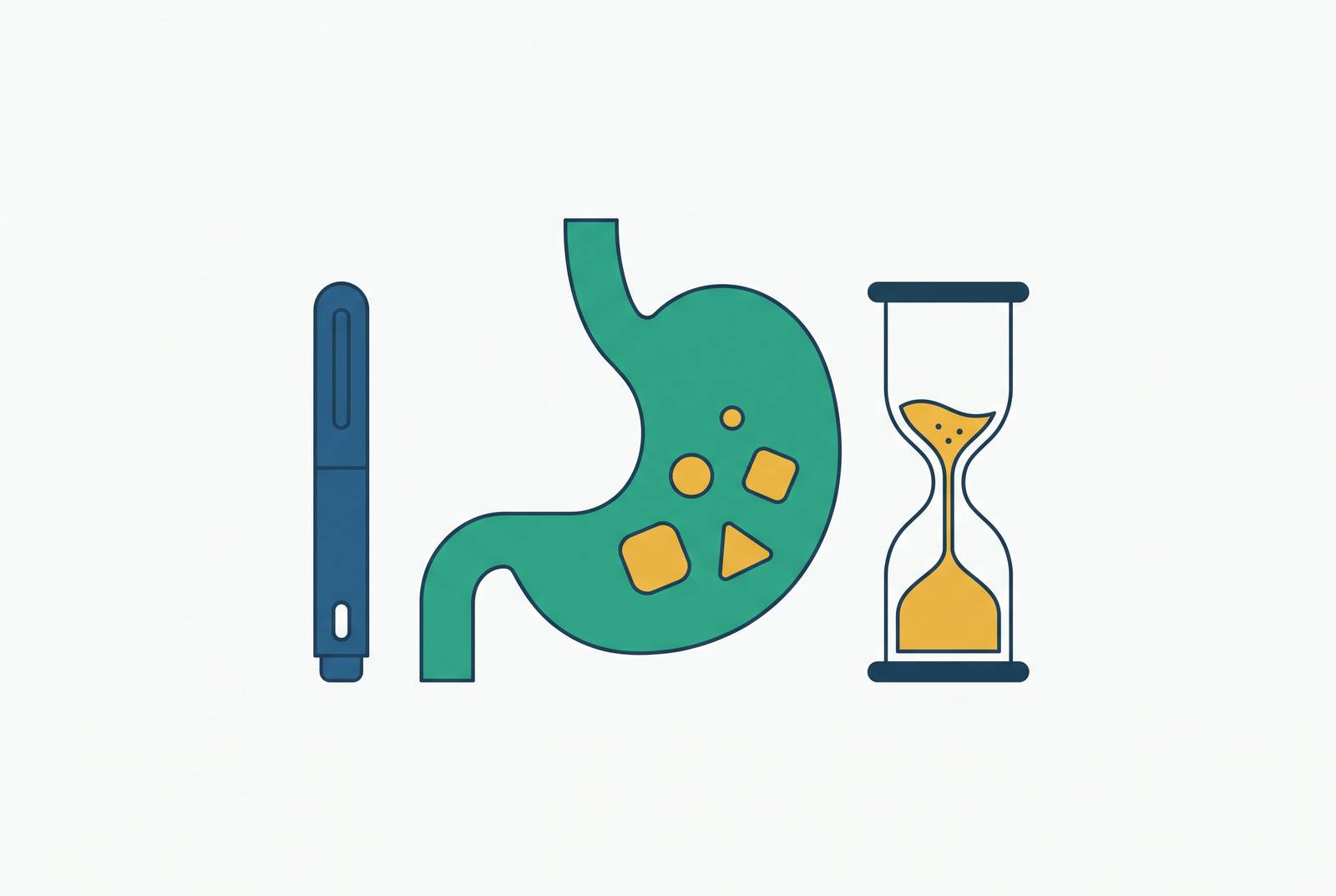
GLP-1 receptor agonists slow the stomach down. That's the mechanism working as intended, not a malfunction, so the real question for anyone prescribing or taking these drugs is where that expected symptom turns into a diagnosable complication. The two get confused constantly, in clinics and online alike, and getting the line wrong is the single biggest error in how this topic gets discussed.
Delayed gastric emptying and gastroparesis are not the same thing. One is a pharmacological effect built into the drug's action. The other is a pathological diagnosis with objective criteria attached to it, and confusing the two leads patients to panic over normal side effects while occasionally missing the cases that actually need a workup.
On the expected end, patients feel full faster, eat less, and get mild nausea, especially after a dose bump. It tends to track the dose: worse at each step up, then settling as the body adjusts. Some of that settling comes from tachyphylaxis, the gradual dulling of a drug's effect with continued exposure. None of that is a red flag. It's the drug doing its job.
The gastroparesis end differs in kind, not just in degree. A real diagnosis calls for gastric emptying scintigraphy, the gold-standard test that tracks how long a radiolabeled meal sits in the stomach before it clears. The symptoms that should push a clinician toward that test look different from ordinary dose-escalation nausea: vomiting of undigested food that won't stop, severe nausea that persists even after weeks on a stable dose, abdominal pain bad enough to interfere with daily function, early satiety severe enough to block adequate nutrition, and measurable nutrient deficiency. The pharmacological slowing appears in nearly every user of the drug class. Confirmed gastroparesis-level delayed emptying occurs in fewer than 2% of them, and that gap between "almost everyone" and "under 2%" is the whole story of this section.
Two details complicate the tachyphylaxis story, and they matter. GLP-1 drugs have long half-lives, so the receptor stays occupied for extended stretches, which limits how much tolerance can build in the meantime. Receptor activation also slows gastric emptying at low, physiological concentrations, so there's no dose floor below which the effect simply switches off. Patients whose gastric emptying was already sluggish before starting treatment tend to show less additional slowing on the drug, which sounds like good news until you notice what it actually means: they started closer to the symptomatic threshold to begin with.
Scintigraphy rarely gets ordered in everyday practice. That means a real share of the "gastroparesis" recorded in observational health records reflects symptom-based clinical judgment, not confirmed delayed emptying on a test. A chart of relative risk built on top of a shaky diagnostic floor is still standing on that floor, and that gap produces nearly every statistic in the rest of this piece.
What the hazard ratios show, and what they do not
A JAMA study by Sodhi and colleagues, drawing on a US health claims database spanning 2006 to 2020, found a hazard ratio of 3.67 (95% CI 1.15 to 11.90) for gastroparesis among GLP-1 users compared with users of bupropion-naltrexone. A separate study found a smaller but still significant hazard ratio of 1.591. On the procedural side, a retrospective cohort from Baylor Scott & White covering 218 adults on GLP-1 receptor agonists undergoing upper endoscopy found retained gastric contents in 20.6% of cases, well above the 2% to 4% baseline in patients not on these drugs, and consistent with the 6.8% to 30.5% range reported across other large single-center studies. Research has put the pulmonary aspiration hazard ratio at 1.33 for GLP-1 users.
Stacked next to each other, these numbers look alarming. So what do they actually prove, and where do they run out of runway?
Start with the comparator. Bupropion-naltrexone is an active weight-loss drug, not a neutral, risk-free baseline, so a hazard ratio of 3.67 against it doesn't mean GLP-1 drugs multiply gastroparesis risk by 3.67 relative to a baseline of taking nothing. Then there's the gap between relative and absolute risk: the absolute rate of gastroparesis among semaglutide users runs around 6.5 cases per 1,000 person-years. That's a low number on its own, even though the relative hazard looks dramatic on a forest plot. And claims-based diagnoses rarely come paired with a scintigraphy scan, so an unknown fraction of these "cases" are symptomatic patients who were never actually tested.
A Cleveland Clinic study led by Garg and colleagues, using the TriNetX database covering roughly 88 million patients and presented at Digestive Disease Week, found that the risk of a new gastroparesis diagnosis among type 2 diabetes patients on GLP-1 receptor agonists, versus matched controls, kept climbing at 6, 9, 12, 18, and 24 months out. That detail matters. The risk doesn't confine itself to the early dose-escalation window; it appears to build over time rather than front-load and fade. A systematic review published in PLoS One in August 2026 by Olubodun and colleagues concluded that GLP-1 receptor agonists "may induce or worsen" gastroparesis in both diabetic and non-diabetic patients. That hedge is an honest reflection of the same diagnostic gap running through the whole evidence base. It's an honest reflection of the same diagnostic gap running through the whole evidence base.
The tirzepatide signal divergence
A 2025 pharmacovigilance analysis of adverse event databases turned up something that breaks the pattern: zero gastroparesis reports linked to tirzepatide, while semaglutide and liraglutide both showed a detectable signal. That result cuts against the easy assumption that every drug in this class carries the same gastrointestinal risk, and it deserves to be taken seriously rather than waved off.
The leading explanation points to tirzepatide's dual mechanism. Unlike single-target GLP-1 agonists, tirzepatide also activates the GIP receptor, and GIP stimulation appears to partially counteract the gastric-slowing effect that GLP-1 receptor activation produces on its own. GIP and GLP-1 pathways influence gut motility through separate, only partly overlapping circuits, so a molecule pulling on both levers at once could plausibly land softer on gastric emptying than a pure GLP-1 agonist does. That's a biologically coherent story, and it's the one to bet on if you had to bet.
But how much weight should that inference actually carry? Tirzepatide has been on the market for less time than older GLP-1 drugs and has a smaller cumulative user base feeding into adverse event systems. Zero reported signal could reflect a genuine pharmacological advantage, or it could just as easily reflect fewer prescriptions and fewer years of exposure generating fewer reports. The Cleveland Clinic database study folded tirzepatide into its broader GLP-1 cohort rather than isolating it, so whatever agent-level difference exists may have been averaged away rather than measured.
Treating a zero-report count in a voluntary adverse-event system as proof of safety is a misread of what that data can tell you, full stop. A pharmacovigilance database counts reports, not incidence, and a newer drug with fewer prescriptions will always look cleaner on paper than an older one with a decade more exposure behind it. The dual-mechanism hypothesis is a real biological argument and probably the right one. It still needs a head-to-head trial, isolating tirzepatide from the pooled GLP-1 cohort, before anyone calls it an established low-risk option rather than a promising lead.
Patients With Elevated Baseline Risk Before the First Dose
Some patients start treatment already standing closer to the edge than others, and the drug doesn't create that risk from scratch so much as add to what's already there. Diabetes mellitus is itself an independent, well-established risk factor for gastroparesis, and GLP-1 receptor agonists get prescribed disproportionately to people who already have diabetes, so the two risks stack rather than sit side by side. Anyone with a pre-existing GI motility disorder, or a documented history of slow baseline gastric emptying, starts closer to a symptomatic threshold than someone with ordinary motility going in. A history of nausea, vomiting, early satiety, or chronic bloating should trigger a GI evaluation before the first injection, not after symptoms show up and someone has to reconstruct the timeline months later.
Dosing itself is a modifiable risk factor, and the Olubodun review calls this out directly: rapid dose escalation is a key precipitating factor across reported cases, and so is inappropriate re-initiation after a treatment gap. Symptom onset in the cases reviewed ranged from hours to several months after starting, clustering most heavily around dose increases and restarts. This isn't a risk confined to week one that fades afterward; it resurfaces every time the dose moves or the schedule breaks.
The Cleveland Clinic work offers a basis for pre-prescribing risk stratification, grounded in the patient-level variables that matter most rather than a bureaucratic scoring system. The Cleveland Clinic data also found that type 2 diabetes patients on GLP-1 drugs tended to run higher BMI and worse glucose control than comparators not on the drug, and both of those are established risk factors for GI complications in their own right.
Slow, careful dose escalation gets framed most often as a tolerability trick, something to make the nausea easier to sit through. It is that. But calling it only a comfort measure undersells what it's actually doing: it's a genuine risk-reduction strategy, grounded in the same mechanism that produces the complication in the first place, and clinics that treat titration schedules as a courtesy rather than a safeguard are skipping the one lever they actually control.
The Endoscopy and Anesthesia Problem: Delayed Emptying as a Procedural Hazard
The Baylor Scott & White data, published by Le, Prasad, and Shah in the Proceedings of Baylor University Medical Center, gives the clearest look yet at what delayed gastric emptying means once a patient is on a procedure table. Among 218 adults on GLP-1 receptor agonists undergoing upper endoscopy between June 2013 and June 2023, retained gastric contents appeared in 20.6% of cases. Nine procedures had to stop early. One patient aspirated. One needed intubation mid-procedure.
Set that 20.6% against the 2% to 4% baseline rate in patients not on these drugs, and the gap stops looking like statistical noise. It's a fivefold-plus jump, and it changes how an endoscopy unit has to plan the case, not just how it talks about risk afterward. Other large single-center studies report retained-content rates between 6.8% and 30.5% among GLP-1 patients, close enough to Baylor's number to suggest a real, reproducible pattern rather than one hospital's unusual patient mix. The pulmonary aspiration hazard ratio of 1.33 cited earlier connects to this directly: retained stomach contents under sedation is the mechanism, and aspiration is the downstream event that follows from it.
Guidance on how to handle this has already reversed once and remains unsettled. The American Society of Anesthesiologists issued 2023 guidance recommending a hold on GLP-1 drugs for one week before procedures for weekly dosing, one day for daily dosing. A 2024 guideline update walked that back toward a risk-stratified approach, recommending that most patients simply continue their GLP-1 agonist through elective procedures rather than holding it across the board. A full reversal within about a year is not what settled clinical consensus looks like. It's what a field still building its evidence base looks like, and the guidance keeps moving as more procedural data comes in.
The decision gets harder at the point of care because patients don't always mention GLP-1 use during intake, and holding the drug carries its own metabolic cost for diabetic patients who depend on it for glucose control. Medication reconciliation ahead of GI procedures needs to ask about GLP-1 use explicitly, every single time, as a standard part of intake rather than a line buried in a general medication list. That isn't standard everywhere yet, and the Baylor numbers make a strong case for why it should be the default rather than the exception.
Recognizing true GLP-1-induced gastroparesis: presentation patterns and the reversibility finding
What separates an actual case from ordinary dose-escalation nausea? The Olubodun review lays out a pattern built from nausea, vomiting, abdominal pain, bloating, early satiety, and oral intolerance, ranging from acute flares to a chronic, grinding course. Timing carries real diagnostic weight: onset ranged from hours to several months after starting, clustering most often around a dose increase or a restart after a gap. Severe, persistent symptoms right after a dose step-up tell a different story than mild nausea that's stayed flat since week one.
The most important finding in that review is also the most reassuring one. In every case reported, stopping the GLP-1 drug led to symptom resolution. That's case-series evidence, not a controlled trial, so it doesn't carry the same weight as a randomized comparison. But the pattern holds consistently enough to suggest that GLP-1-induced gastroparesis, when it genuinely occurs, behaves as a reversible drug effect rather than lasting damage to gut motility.
Reversible doesn't mean harmless while it's happening, though. The same body of evidence also includes procedures stopped mid-exam, an aspiration event, an intubation performed during a routine scope. The distance between "this clears up once the drug stops" and "this needed emergency airway management" can be short, and it can close fast. That's why the procedural risks in the section above deserve treatment as urgent, not incidental.
Confirming a case in real practice stays genuinely hard. Scintigraphy is the gold standard, but it isn't part of routine workup for every patient who reports GI symptoms on a GLP-1 drug, so most real-world diagnoses get made on symptoms alone. Milder cases usually get managed with dose reduction first, rather than an immediate jump to stopping the drug, paired with closer monitoring through the next escalation step. Garg's group at Cleveland Clinic recommends a joint endocrinology and gastroenterology approach for higher-risk patients, ideally starting before the first dose rather than scrambling after symptoms appear.
What the evidence base still cannot answer
Stepping back from the individual numbers reveals a pattern in the research itself: nearly everything cited above is observational, retrospective, or built from case series. No prospective trial has been designed and powered around gastroparesis as its primary endpoint. That's a structural gap in the evidence, not a footnote, because observational data can show a clear association while leaving causation and true incidence genuinely unresolved.
Diagnostic inconsistency makes the gap worse. Some studies rely on scintigraphy-confirmed cases, others on symptom-based diagnosis pulled straight from claims data, and stacking hazard ratios from studies that define "gastroparesis" differently is a bit like comparing race times run on different tracks at different distances. The long-term trajectory of risk stays an open question too. Does tachyphylaxis meaningfully lower risk as the years pass, the way it seems to blunt nausea, or do patients who started with pre-existing vulnerability just keep accumulating risk the longer they stay on the drug? The Cleveland Clinic finding that risk kept climbing out to 24 months leans toward the second answer, but one dataset, however large, doesn't settle a question this consequential on its own.
The tirzepatide divergence raises a question about how the drug itself gets built, not just how it gets prescribed. If a dual-receptor mechanism genuinely softens the gastric-slowing effect, that points to something concrete: future dual- and triple-agonist molecules could be engineered with GI tolerability as an explicit design target from the start, built in rather than patched after approval as a side effect to manage. That's speculative today, resting on a biological argument rather than a trial result. Rigorous, agent-by-agent pharmacovigilance and head-to-head trial data can answer this question over the next several years.
The therapeutic upside of this drug class, appetite regulation, glucose control, weight loss, runs through the same gastric pathway that produces its most serious complications. That overlap is not a flaw to design around later. Getting the risk profile right, drug by drug and receptor by receptor, is not separate from the science of these drugs. It is the science.
Sources
- Impact of GLP-1 receptor agonists on gastric residuals in patients receiving gastrointestinal endoscopic procedures - PMC
- Increased Risk of Gastroparesis Associated with GLP-1RA Use in Patients with T2DM
- Gastroparesis induced by glucagon-like peptide-1 receptor agonists: A systematic review of clinical features, diagnosis, management, and outcomes - PubMed
- GLP-1 Agonists and the Risk of Pulmonary Aspiration during Elective Upper Endoscopy: A Systematic Review and Meta-analysis - PMC
- Gastroparesis induced by glucagon-like peptide-1 receptor agonists: A systematic review of clinical features, diagnosis, management, and outcomes - PMC
- journals.lww.com
- jci.org