Needle Aversion and Injection Anxiety in Chronic Disease Management
Needle fear keeps a meaningful share of patients from taking life-sustaining injections they need.

Needle fear is not a fringe anxiety confined to a handful of nervous patients. It is a mainstream clinical variable that decides whether people take medicine they need. A PLOS ONE study broke prevalence down by condition: cancer patients report needle fear at rates between 17% and 52%, chronic kidney disease patients between 25% and 47%, diabetes patients somewhere between 0.2% and 80%.
That diabetes range deserves its own explanation, because a spread that wide says more about how researchers measured the problem than about diabetes itself. A study using a strict DSM-level phobia diagnosis finds almost no one qualifies, while asking patients instead whether anxiety about needles changes how they take their injections gets a "yes" from most. Neither study is wrong; they're measuring different thresholds of the same experience, and the stricter measure tends to be the one that gets cited in clinical settings. The honest read is that needle fear is undercounted, and that undercounting lets clinicians keep treating it as rare when the real answer depends entirely on how you ask the question.
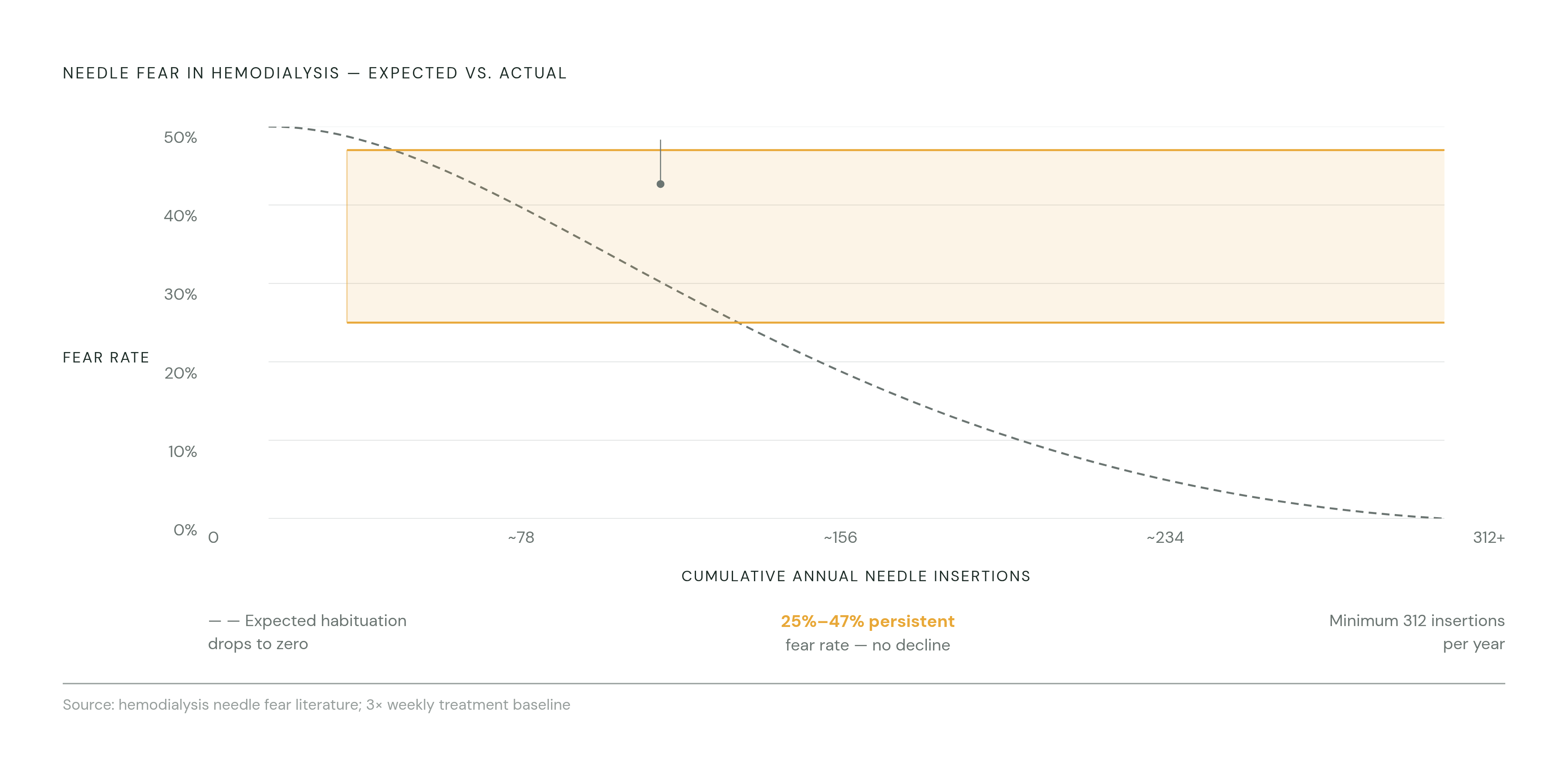
Dialysis is the population worth sitting with, because it breaks a natural assumption: that repeated exposure wears fear down over time. Hemodialysis patients need a minimum of 312 needle insertions a year (roughly six a week) for as long as they stay on treatment. Despite that, patients in chronic kidney disease cohorts still report needle fear at rates of 25% to 47%. Habituation isn't something the body reliably delivers on its own; exposure can sit alongside fear indefinitely, and that runs counter to what most clinicians assume when they tell a patient it gets easier with time. The dialysis numbers are the cleanest proof available that, for a significant share of patients, it doesn't.
Cancer patients show a different pattern, layered with memory rather than raw repetition. A procedure that hurt or went badly leaves a residue, and dread builds before the needle is even in the room. The fear response here is partly a learned association with the treatment itself, distinct from the puncture alone.
Put those threads together and one pattern holds across every disease category studied: a meaningful minority of patients, and in some populations a clear majority, carry needle-related fear into treatment, and time on therapy does not reliably fix it. That is the premise the rest of this piece works from. Clinicians who assume fear fades with exposure are working from a model the dialysis data flatly does not support, and that's worth saying plainly rather than softening.
What fearful patients actually do (avoidance behaviors and their clinical cost)
Fear on a survey is a data point. Fear that changes behavior is a clinical problem, and the same PLOS ONE survey tracked both. Among participants who reported needle phobia, 52.2% said they had avoided blood draws, 49.0% had avoided blood donation, 33.1% had avoided vaccination. Those are skipped medical care, itemized.
The two most cited triggers were general anxiety, at 96.1%, and pain, at 95.5%. This fear tracks real sensory memory and real anticipatory stress, built from lived experience rather than free-floating unease.
Avoidance scales with the stakes. Skipping a blood draw costs less than skipping a life-sustaining medication, but the same psychology drives both decisions; only the size of the loss changes. Insulin shows what happens once the stakes get serious: in a study of 225 patients, 47% delayed starting insulin, and among those who delayed, 35% pointed specifically to needle phobia or fear of pain as the reason. Delaying insulin in type 2 diabetes means months, sometimes years, of poor blood sugar control while an effective drug sits unused in the fridge.
The same PLOS ONE review links this pattern of fear-driven nonadherence to worse outcomes and higher mortality in type 2 diabetes and hypertension. Hold onto that frame for the rest of this piece: when a patient stops an effective therapy over needle fear, the failure sits with the delivery mechanism more than the patient's discipline, and that distinction is the one this piece keeps circling back to.
Why injection frequency is as important as injection existence in determining who stays on therapy
Treating "injectable" as one monolithic category is where a lot of adherence thinking goes wrong; not every injection carries equal psychological weight. Frequency matters, device design matters, and route matters; all three decide how much fear actually gets between a patient and the next dose.
A 2026 systematic review of injectable cardiovascular therapies, covering studies published between January 2005 and March 2025, found injection-related discomfort, needle anxiety, and side effects were consistent barriers to staying on treatment. It also found that drugs dosed less often (PCSK9 inhibitors given every two to four weeks, once-weekly GLP-1 receptor agonists) generally saw higher persistence than drugs requiring daily injections. Frequency alone does real adherence work, separate from anything about the needle itself.
Device format matters too, and here the industry's own preferences are telling. In a study comparing healthcare provider and patient views, 58% of providers preferred subcutaneous injection over intramuscular, and both fear and needle visibility were rated bigger concerns under intramuscular delivery. Both providers and patients expected higher adherence with subcutaneous autoinjector devices specifically, and that expectation is the tell: autoinjectors exist partly to manage anxiety by keeping the needle out of view during the shot. The injection still happens. The fear just gets a shorter window to take hold.
That window matters because of when it opens. The PLOS ONE review found needle fear runs highest in the early weeks and months of a new therapy, which happens to be exactly when a clinical team has the most contact with a patient and the best chance to catch trouble before it turns into a dropped prescription. The riskiest stretch for losing a patient and the stretch where intervention is most possible are the same stretch. Most programs still treat that overlap as an afterthought instead of the hinge point it actually is.
The GLP-1 market as the clearest current case study in injection-driven dropout
GLP-1 receptor agonists offer the sharpest current picture of injection-driven dropout at scale, largely because the category grew fast enough that its adherence gaps now show up in national claims data. Injectable formulations held 69.1% of GLP-1 revenue in 2025, carrying the bulk of a market serving an enormous population.
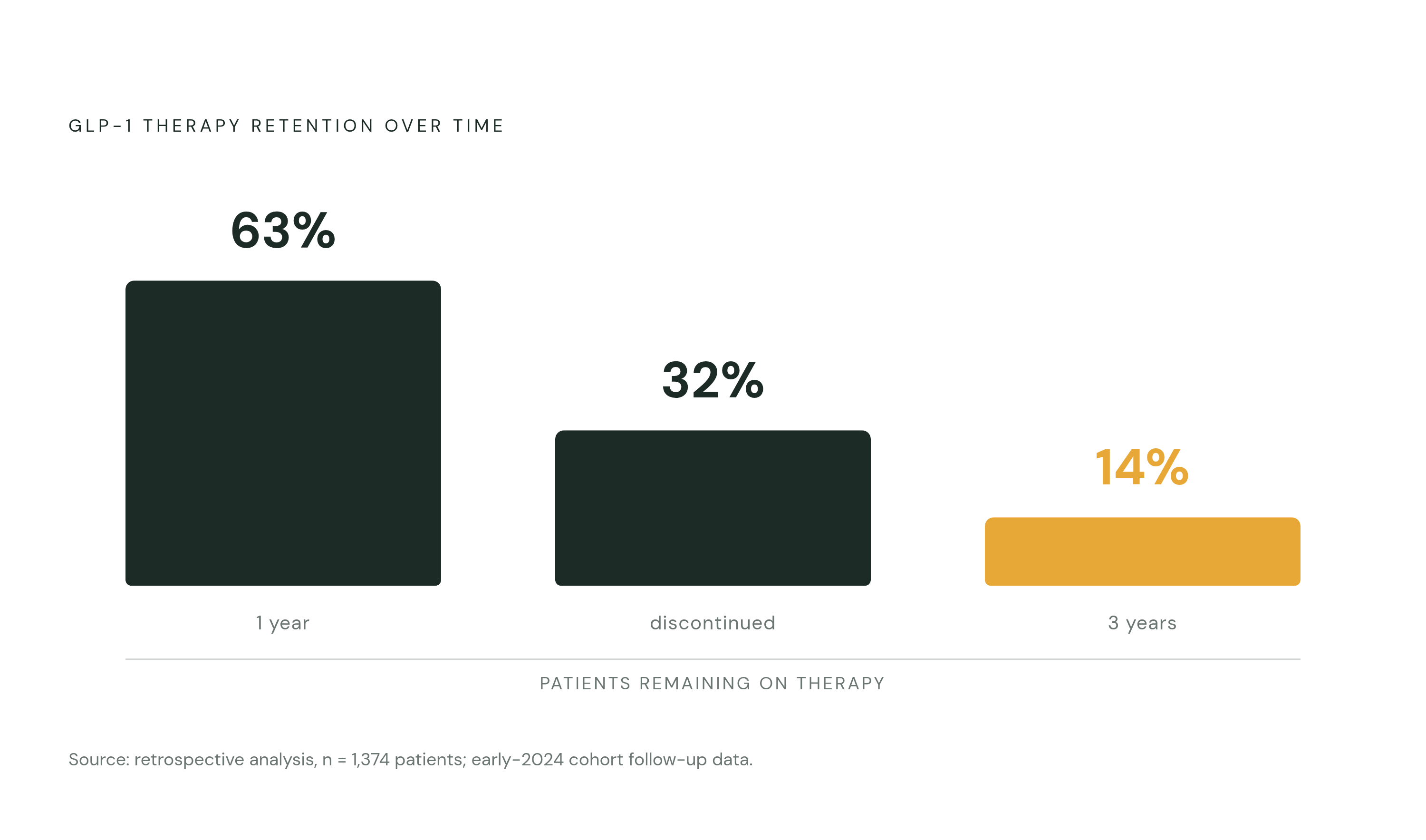
Set against that scale, the persistence numbers should reset expectations about what this market actually delivers to patients. Among patients who started GLP-1 therapy in early 2024, 63% were still on the drug a year later, according to a HealthVerity pharmacy claims analysis. Only 14% of patients remain on therapy after three years, so that improvement does not hold.
A retrospective analysis of 1,374 patients found 31.7% discontinued GLP-1 therapy altogether. Among documented reasons, 26.8% cited an adverse drug reaction, 14.4% cited cost, 11.2% cited nonadherence broadly. Needle fear doesn't show up as its own clean line item, and that absence is itself informative: gastrointestinal side effects and injection burden arrive tangled together in a patient's actual experience, so no claims database can cleanly separate "I stopped because of the nausea" from "I stopped because I dreaded the shot." The two are distinct in theory and inseparable in practice.
The number that matters most here is 14%. A drug category commanding tens of billions in annual revenue is currently keeping fewer than one in seven patients on therapy past year three. That gap between commercial trajectory and patient retention is the real story, and it's one the industry has been slower to reckon with than its own growth numbers. Whatever gets said about GLP-1 as a durable chronic-disease solution, the three-year retention number tells a messier story than the sales figures do.
Why the oral pivot does not simply dissolve the adherence problem
The logic behind oral GLP-1 formulations is simple enough: remove the needle, remove needle fear as a reason people quit. Oral semaglutide formulations have been advancing toward broader availability for weight loss indications. On its face, the pivot toward pills looks like the obvious fix.
But the data complicates the story it's supposed to simplify, and this is the part that gets glossed over in most coverage of the oral pivot: gastrointestinal side effects don't improve with oral delivery, they get worse. In the OASIS-4 trial, gastrointestinal disorders affected a substantial majority of patients on oral semaglutide, a higher GI burden than what shows up with the injectable version. Research comparing oral and subcutaneous semaglutide has found higher rates of discontinuation due to side effects with the oral form. The trade isn't free: patients gain convenience and give up some efficacy and tolerability along with the needle.
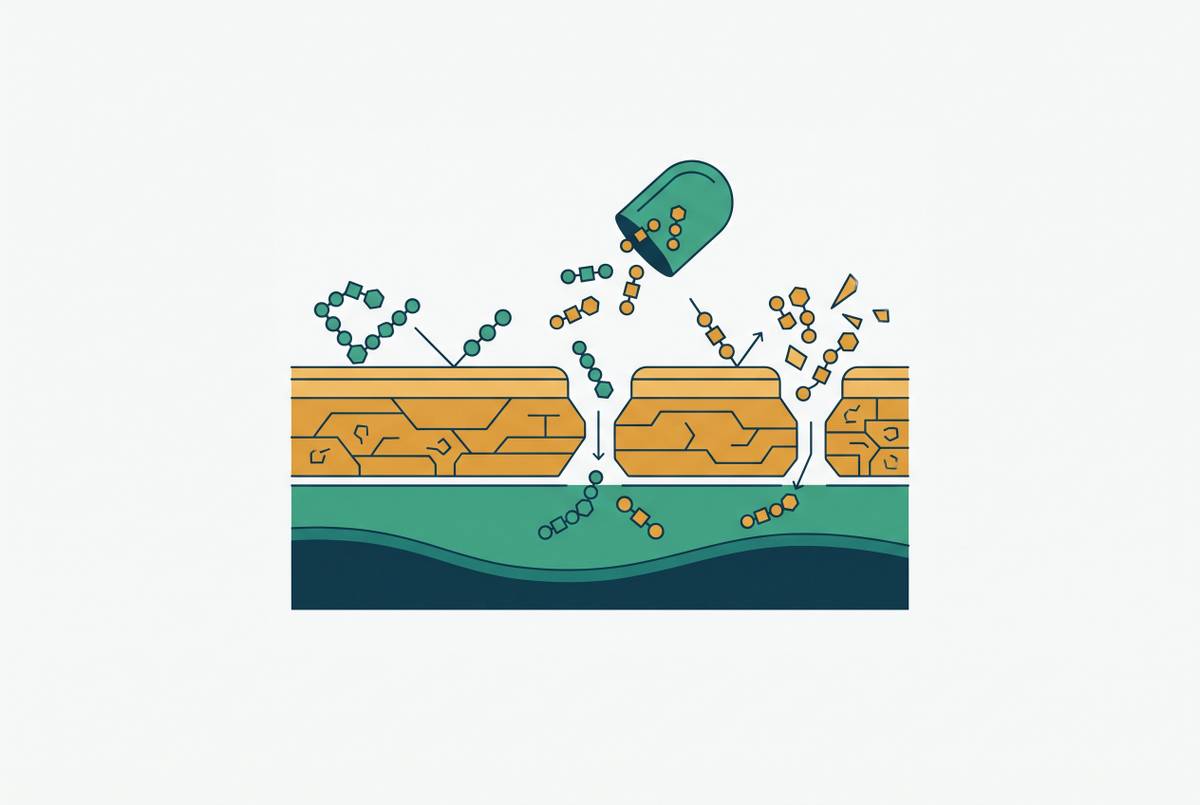
The mechanism behind that trade is worth spelling out plainly. Oral peptide drugs need a chemical escort to survive the stomach without being broken down before they can act. Oral semaglutide relies on an absorption-enhancing compound to shield the peptide long enough to get absorbed. That workaround solves the survival problem and creates a new tolerability problem in the same motion.
So the oral pivot relocates the adherence problem more than it dissolves it. The needle stops being the obstacle, and the gut becomes the new one. Getting a fragile peptide molecule to its target without causing harm along the way is still unsolved; it has just moved to a different organ. Calling that a solution rather than a swap is the mistake worth naming plainly.
What the neurobiology of needle fear explains about why willpower and patient education alone are insufficient interventions
Needle phobia involves a physiological fear response that goes beyond ordinary unease, which is part of why telling an anxious patient to just relax misreads what's actually happening in their body.
The two dominant triggers from the survey data, general anxiety at 96.1% and pain at 95.5%, map onto two separate brain systems that happen to interact. Anticipatory fear and pain memory are distinct experiences that interact, and an intervention that addresses only one of them is only half an intervention. Most patient education programs are built to address exactly one of these systems (information, reassurance, explanation) while leaving the other untouched entirely.
The dialysis numbers are worth revisiting here. Patients getting 312 or more needle insertions a year still report fear at rates of 25% to 47%. That number should trend toward zero over years of treatment if exposure alone reliably retrained the fear response. Instead it holds steady. Repetition alone does little of the work therapy would need to do, and assuming otherwise is probably the single biggest misread in how clinics currently handle this problem.
Timing compounds it. Fear peaks early in treatment, exactly when clinical teams have the most contact with a patient and the best shot at intervening before avoidance becomes habit. Behavioral techniques exist and have real evidence behind them, including various forms of distraction and structured exposure approaches. Every one of them, though, needs trained staff, dedicated clinical time, and a patient willing to sit through the discomfort of practicing exposure. None of that scales to millions of chronic disease patients self-injecting alone at home, with no clinician in the room and no one checking whether the dose actually got taken.
That's the ceiling on behavioral approaches. They manage the fear response at the margins, but the stimulus causing it stays exactly where it was. As long as the injection remains the delivery method, the fear has something concrete to attach to, and no amount of coaching removes the object of the fear itself.
How delivery route innovation reframes the needle fear problem as an engineering question
Everything above points toward one conclusion, and it's worth stating plainly rather than hedging around it: needle fear is common, biologically stubborn, and neither faster dosing schedules nor oral reformulation solves it. Dosing frequency helps at the margins, and oral delivery trades the needle for a gut side effect problem that the OASIS-4 numbers suggest is arguably worse. What's left is the delivery route itself. The real opening sits in removing the stimulus entirely, ahead of any effort spent on better patient education or friendlier devices.
Intranasal delivery deserves a close look here, because it is among the non-injectable routes researchers have proposed as a way to sidestep the absorption and tolerability obstacles that limit oral delivery.
That mechanical convenience matters for GLP-1 specifically, too. GLP-1 receptors are present not only in the intestine but in the brain itself, in the nucleus tractus solitarius and the olfactory bulb. A drug reaching the brain through the same olfactory pathway where the body already makes some of its own GLP-1 fits the existing biology instead of working around it. The nose-to-brain route also skips first-pass metabolism entirely, meaning it can reach meaningful brain concentrations at lower doses than a systemic injection needs; that's an efficiency argument that bears directly on tolerability.
The core engineering challenge hasn't disappeared, though, and it's the same one oral delivery runs into: how does a fragile peptide survive the trip to its target without being broken down first? Intranasal delivery just relocates where that problem gets solved, from the gut to the nasal mucosa. Nanoparticle encapsulation is one approach being explored to handle it at that stage, protecting the peptide, extending its contact time with the nasal mucosa, and helping it cross the olfactory epithelium intact. Lionbio, a nasal-spray nanoparticle peptide startup, is working on exactly this problem for GLP-1 delivery.
None of this erases the fact this piece opened with. A meaningful share of adults, by conservative estimate somewhere between one in five and one in three, carry real needle fear into every injection prescribed to them, across every chronic disease category examined here. That is a design constraint the injectable paradigm was never built to accommodate, and faster dosing schedules and friendlier autoinjectors have only chipped at its edges. A delivery route that removes the needle changes what there is to be afraid of, rather than asking the patient to somehow become less afraid. That difference is the whole argument this piece has been building toward.