Transdermal Peptide Delivery Technologies in Development
Scientists are engineering patches and energy pulses to deliver peptides through skin.
The stratum corneum exists to keep things out, and therapeutic peptides sit on the wrong side of that rule. There's a hard ceiling on what can cross skin passively, somewhere around 500 Daltons, and peptides blow past it by a wide margin. That single fact explains why an entire field of engineering has grown up around finding workarounds instead of giving up and reaching for a needle.
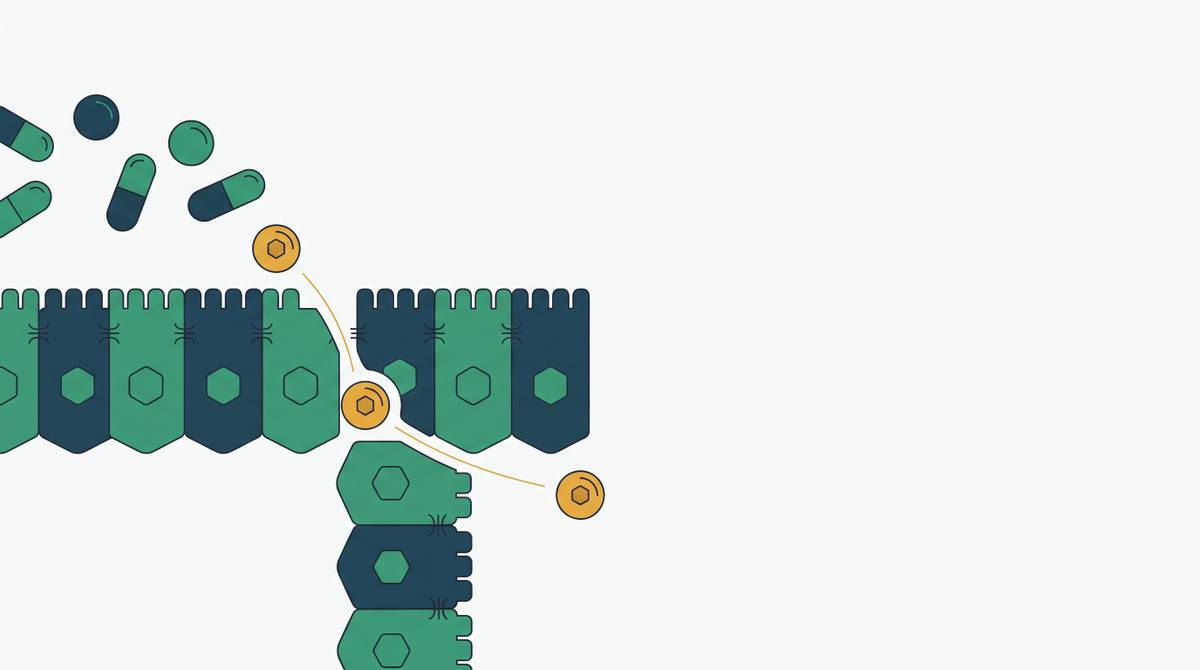
The rule itself comes down to basic chemistry. Small, fat-soluble molecules can slip between skin's outer cells and dissolve into the lipid matrix holding the barrier together. Above roughly 500 Daltons, passive diffusion stops working in any real way, and peptides fail this test twice over: they're large, and they're water-loving, so the same lipid matrix that lets a small fat-soluble drug through actively pushes peptides away instead. A GLP-1 peptide typically weighs many thousands of Daltons, several times past the point where passive skin absorption stands any chance, and swallowing doesn't fix the problem either, since the GI tract's enzymes tear the peptide apart before enough of it reaches the bloodstream to matter. Injections were never really chosen so much as left standing after skin and gut both said no. So the engineering question worth sitting with is this: can outside energy, or clever carrier chemistry, force open a door that biology built to stay shut?
How microneedles physically bypass the barrier without breaching it deeply
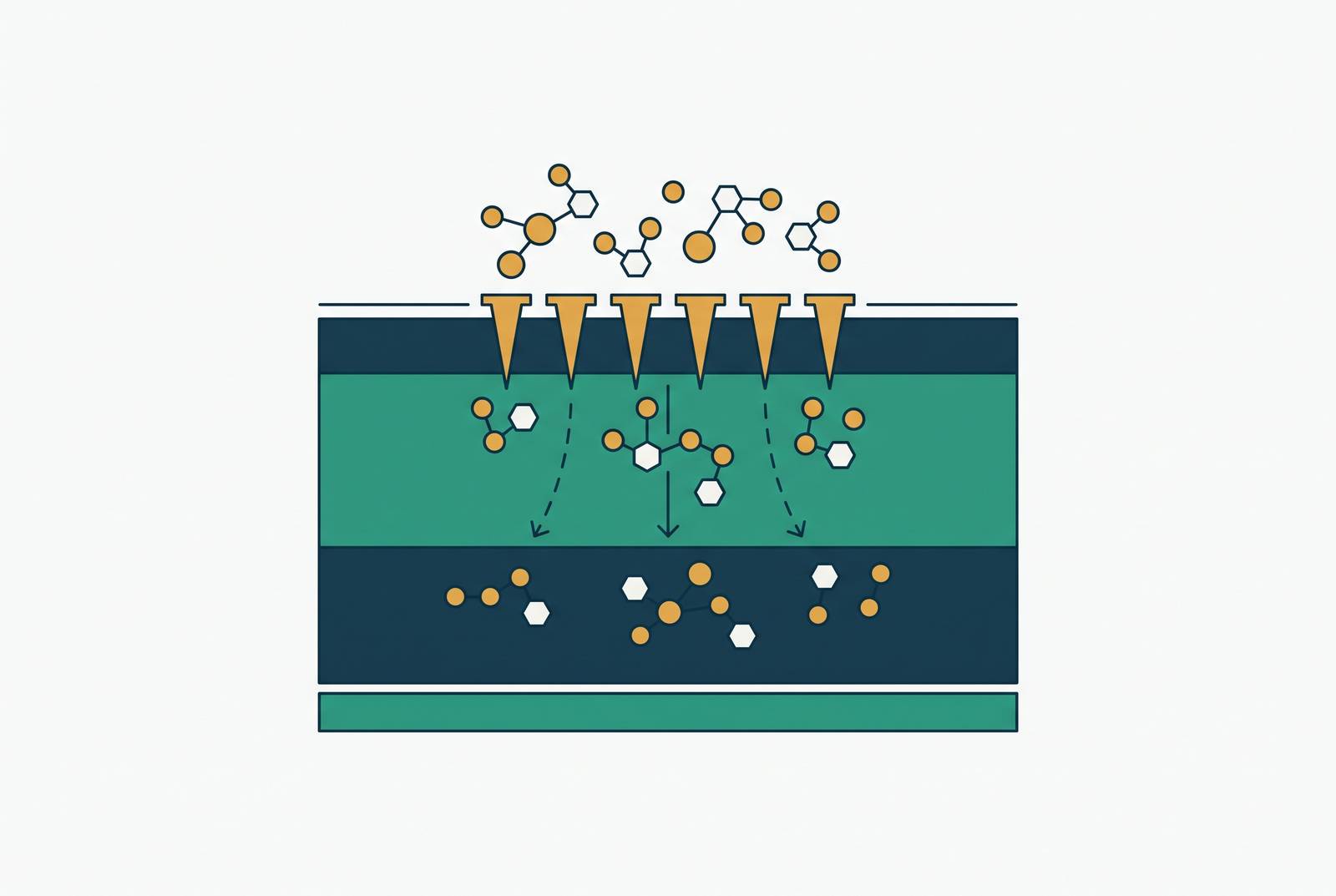
Microneedles solve the size problem by ignoring it. An array of micron-scale needles punches temporary microchannels straight through the stratum corneum into the dermis below: deep enough to reach tissue that can absorb a drug, shallow enough to miss nerve endings and skip real bleeding.
There are four main formats, and each handles loading and release differently. Solid microneedles get coated with drug and dissolve their payload on contact, while hollow ones work like tiny reservoirs, pushing formulation through a channel. Dissolvable polymer needles carry the drug inside a matrix that breaks down in the skin's own fluid, leaving nothing sharp behind, which matters a lot if the goal is a patch someone applies at home with nobody watching. Hydrogel-forming needles swell on contact with skin fluid and build a diffusion path without dissolving outright.
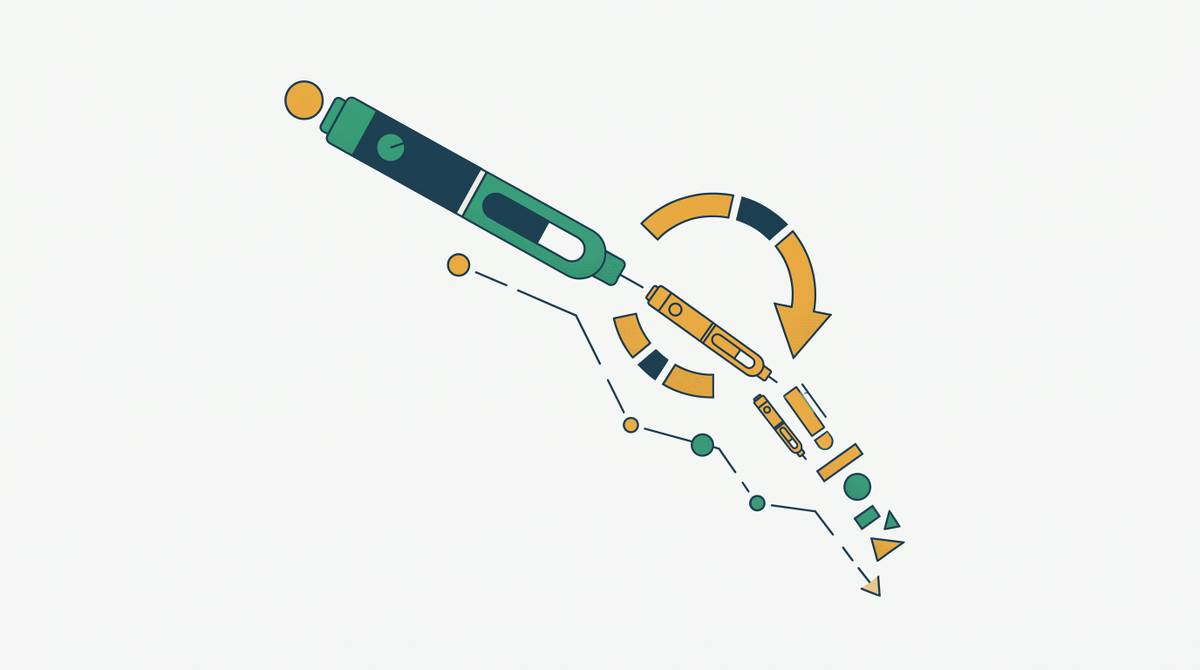
A preclinical design published by Singh and colleagues in Advanced Therapeutics in May 2024 pushed this further with a programmable core-shell patch, roughly 2 centimeters square, that released semaglutide in four separate pulses spaced a week apart, sustaining drug effect across a full month. It was the first patch built to simulate a weekly injection schedule instead of dumping drug all at once. That target matters because earlier microneedle work struggled badly with bioavailability; some prior semaglutide patches only reached about a third of the exposure a subcutaneous injection delivers.
The current benchmark belongs to Daewoong Therapeutics' CLOPAM platform, and nothing else in the field comes close. A Phase 1 study involving roughly 70 participants, reported in August 2025, hit markedly high relative bioavailability compared to subcutaneous injection, a genuine step-change from earlier patch attempts. It also held therapeutic plasma levels for seven days, supporting once-weekly dosing on par with injectable schedules. The needles are made from polyvinyl alcohol, dissolve after application, and the patch sits at room temperature with no cold chain required. In February 2026, an exclusive global licensing deal was signed, cementing CLOPAM as the furthest-advanced transdermal GLP-1 program with actual human data behind it. Anodyne Nanotech's HeroPatch enters clinical trials in 2026 as a second program worth watching, though it trails Daewoong by a wide margin in clinical stage.
What's left unresolved shouldn't get waved away, and it's the part that separates a promising Phase 1 readout from a product on a shelf. Manufacturing uniform microneedle arrays at commercial scale is a genuinely hard problem: a patch that works in a lab batch of a few hundred units doesn't automatically work at a run of millions, because needle height, coating uniformity, and dissolution rate all drift once a process scales past a bench. Patient technique varies once self-application replaces a nurse's steady hand, and long-term data on how skin tolerates getting punctured at the same spots, week after week, for years, still doesn't exist. Treating CLOPAM's numbers as a finish line means skipping the part of the process that actually decides whether this reaches patients, and that's the mistake worth naming plainly here.
How sonophoresis and electroporation use energy to temporarily rewire the skin's chemistry
Where microneedles create a physical shortcut, sonophoresis and electroporation disturb the skin's chemistry just long enough to let a drug through, then let the barrier heal on its own. Both are temporary, both are reversible, and both lean on outside energy rather than a needle or a molecular disguise.
Sonophoresis uses ultrasound. Cavitational ultrasound generates tiny bubbles inside skin tissue, and when those bubbles collapse, they carve micropores into the stratum corneum. Low-frequency ultrasound goes deeper and disrupts the skin's lipid packing more than high-frequency waves do, which makes it the more useful register for moving large molecules. Insulin delivery research offers a useful stand-in here, since insulin shares the large, water-loving profile that makes peptides hard to move through skin in the first place. The catch is that sonophoresis needs a transducer pressed against the skin, a harder sell for daily self-use than a patch someone slaps on and forgets about. Some research pairs ultrasound with nanocarriers directly: the sound pretreats the skin, opening channels, and nanoparticles carry the actual cargo through them. That combination is getting attention precisely because it splits the labor between two mechanisms instead of asking one to do everything.
Electroporation works the same angle from a different direction. Short bursts of high-voltage electrical pulses disrupt the lipid bilayer of the stratum corneum, opening watery pores that last from milliseconds to a few seconds, long enough for a water-loving macromolecule, exactly the kind of cargo the lipid matrix normally shuns, to get through. At low pulse intensities the effect reverses cleanly, with barrier integrity back within minutes to hours. One real edge over passive approaches is control: dialing pulse parameters up or down changes how deep and how long the skin stays permeable, a kind of dial diffusion-based methods simply don't have. The practical limit matches sonophoresis's: it needs a pulse generator, which points toward clinical or supervised settings rather than a device sitting in someone's bathroom cabinet.
Neither method has produced an approved peptide product yet, and that's worth stating plainly instead of hedging around it. Both remain research tools and early-stage clinical technologies rather than commercial platforms. Treating either one as a standalone delivery answer misreads what the data show. The more likely long-term role for each is as a helper, prepping the skin for a nanocarrier or formulation to do the real delivery work, not as the delivery mechanism itself.
What nanocarriers and cell-penetrating peptides contribute that energy methods cannot
Energy-based methods force the barrier open, while nanocarriers disguise the cargo so the barrier never flags it as something to keep out. A water-loving peptide wrapped in a lipid shell that matches the chemical makeup of the stratum corneum can move through in ways the naked peptide never could, and that's the whole point of the strategy.
Transfersomes, ethosomes, and niosomes are the names attached to this idea in practice: bendy vesicles that squeeze through the narrow gaps between skin cells under osmotic or hydration gradients, basically flexing their way through spaces too small for a rigid particle. Surface tweaking adds a layer of precision that energy methods can't match, since a targeting molecule or a permeation enhancer can get attached at the molecular level, tuned to a specific cargo rather than applied blanket-style across the whole treated area. Release speed becomes adjustable too, just by changing the nanoparticle's makeup and how fast it breaks down. None of this is speculative engineering; lipid nanoparticle manufacturing was proven out at enormous scale during the mRNA vaccine rollout, which gives this particular path more credibility than most of the alternatives here.
Cell-penetrating peptides take a more biological route, hijacking pathways cells already use to bring things across their own membranes. These are short sequences, usually cationic or amphipathic, acting as a kind of ferry. One studied specifically for transdermal use, MTD 1067, showed conjugated cargoes reaching the dermis at 4.4-, 18.8-, and 32.9-times higher concentrations than unconjugated controls, based on confocal microscopy published in Nature Scientific Reports in 2022. The tiered numbers matter more than they look at first glance: the benefit grew as cargo size grew, which is exactly the relationship that matters for a field trying to move large peptide molecules rather than small drugs. MTD 1067 also showed low toxicity to cells, a real advantage over older chemical permeation enhancers that tend to damage skin structure while opening it up.
A newer thread worth watching involves self-assembling peptides that build their own delivery structure. Researchers at Inha University, publishing in Biomacromolecules in January 2024, showed peptide nanostructures that assemble into tunable shapes, fibers, ribbons, spheres, with each geometry affecting how deep the structure goes and how it releases its cargo. It's a strange kind of elegance: the carrier and the drug get designed from the same molecular family, instead of bolting a delivery vehicle onto a payload that has nothing chemically to do with it. None of these nanocarrier and CPP strategies rule out the energy-based methods from the last section. Most advanced programs actually combine them, using electroporation or sonophoresis to open the door and a nanoparticle to walk through it.
Where transdermal peptide delivery actually stands in 2026 and what the data reveal about its limits
As of 2026, no transdermal peptide therapeutic has FDA approval, and no transdermal GLP-1 candidate has reached Phase 3. That's worth sitting with before getting excited about any single data point, including CLOPAM's, because Phase 1 success and market approval are separated by a lot more than time passing.
The clearest documented problem is variability in absorption, and this is where a lot of the field's optimism runs into trouble. A 2025 study by Martinez and colleagues in Clinical Pharmacokinetics measured semaglutide absorption from experimental patches and found a coefficient of variation roughly three times higher than subcutaneous injection. In plain terms: the same patch, worn by different people, or by the same person on different days, produces far less predictable blood levels than a needle would. That unpredictability feeds straight into less consistent glucose control and less consistent weight loss, because the drug's effect depends on how much of it actually reaches circulation. Skin temperature, hydration, and blood flow at the application site all push transdermal absorption around in ways a subcutaneous shot mostly avoids.
Daewoong's 80%-plus relative bioavailability figure from Phase 1 is genuinely the most encouraging human data point in the field right now, and it deserves to be treated that way. Yet Phase 1 studies answer questions about bioavailability and safety, not efficacy across a large and biologically varied population, and that gap isn't a small technicality. Manufacturing uniform microneedle arrays at commercial volume, proving long-term patch adhesion, and confirming that cold-chain independence holds up outside a controlled trial all have to happen before a regulatory filing is even plausible. Even with strong Phase 1 results in hand today, FDA approval realistically needs several more years of trial work, which puts a genuinely commercial transdermal GLP-1 product somewhere in the late 2020s at the earliest, and more likely the 2030s. Immunogenicity questions and the plain difficulty of manufacturing peptide cargoes at scale show up across the 2025 review literature no matter which delivery vehicle gets chosen, a reminder that some of the field's open problems live in the drug itself, not just in how it gets there.
None of that erases the real progress made so far. The honest read is that the engineering is moving fast, while the gap between a promising patch and an approved therapeutic is still measured in years and trial phases, not in press releases. Anyone reading CLOPAM's Phase 1 numbers as proof the problem is solved is reading past the part of the story that actually decides the outcome.
Why the adherence crisis makes delivery innovation commercially necessary, not merely scientifically interesting
The GLP-1 receptor agonist market was valued at $66.4 billion in 2025 and is projected to reach $185.3 billion by 2033, growing at roughly a 12.4% compound annual rate. At that scale, delivery innovation stops being a side detail and becomes a lever on how much of the market gets captured, and by whom.
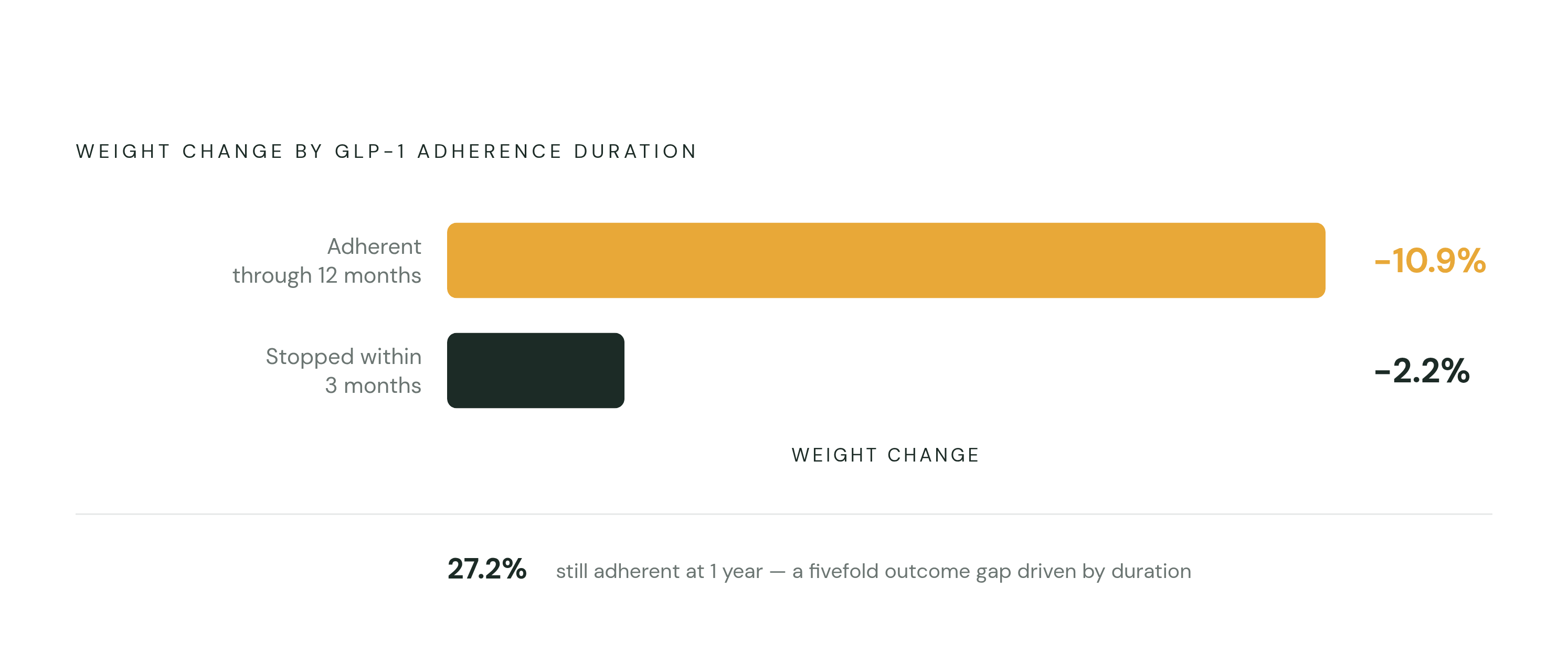
The adherence numbers explain why, and they're worse than most people assume. Real-world persistence at one year runs between 32% and 50% across studies, while adherence, measured as the share of days a patient actually stays covered by the drug, averages somewhere around 51% to 54%, and one cohort found only 27.2% of patients adherent through their first year of therapy. A Danish population study tracking 77,310 early users found more than half had stopped treatment within twelve months. These aren't rounding errors. They describe most patients falling off therapy before it can do what it's supposed to do, and that single fact should reframe how the whole delivery conversation gets read.
The consequence shows up directly in outcomes. An analysis of 95,334 patients found that those who stayed on therapy for 12 months saw a weight change of -10.9%, while those who stopped within three months saw only -2.2%, a fivefold gap owed mostly to whether someone kept taking the drug, not to any underlying biological difference between them. Documented reasons for stopping include gastrointestinal side effects like nausea and vomiting, plain aversion to needles, cost, and injection site reactions. Every one of those is, at least partly, a delivery-format problem rather than a molecule problem, and that's exactly where the case for microneedles and patches gets its teeth. Annual gross costs above $12,000 per patient add pressure from the payer side too, and a patch or nasal spray that removes cold-chain logistics and sharps disposal could meaningfully cut the total cost of running someone through a year of therapy.
Which raises the real question sitting underneath all the engineering described so far: does a multibillion-dollar category ultimately get won on peak efficacy, or on whoever keeps patients on the drug long enough for that efficacy to matter? The data above point toward the second answer, and most companies in this space still talk as though the first one is what matters. A molecule that produces a 10.9% weight change in trials is worth nothing to a patient who quits by month three; delivery format sits right at that intersection, and that's exactly why it stopped being a side project a while back.
How transdermal compares to the other non-injection routes being developed in parallel
Oral GLP-1 delivery is, right now, the closest of the non-injection routes to full commercial reality, and it's worth naming that plainly rather than treating every route as equally far along. The FDA approved the first oral GLP-1 for weight management in late 2025, and a second oral GLP-1 agonist got approval for weight management in April 2026, together establishing oral dosing as a proven category rather than a fringe idea. The limitation is baked into the chemistry: getting a peptide through the GI tract without it being destroyed takes high doses and chemical modification, and even then, systemic absorption stays lower and shakier than an injection gives. The drug still has to travel through the bloodstream to reach the brain; it doesn't get there directly, and that indirect route is where oral delivery quietly gives back some of what it gained by skipping the needle.
Transdermal delivery's advantage is that it skips GI breakdown entirely, and a patch lends itself naturally to controlled, sustained release over a week, matching how these drugs already get dosed by injection. Its limits, covered above, are bioavailability variability and a regulatory path still years from finishing. Betting on transdermal as the near-term winner would be a mistake; oral has years of head start and a live approval already on the books. But writing transdermal off entirely would be its own kind of error, given where CLOPAM's numbers already sit.
Intranasal, or nose-to-brain, delivery sits in a different lane altogether, and it deserves closer attention than its development stage suggests, even though it trails both other routes. The olfactory epithelium offers a direct anatomical route from the nasal cavity into the brain, skipping the GI tract and the blood-brain barrier in one move. That's a fundamentally different engineering problem than either skin or gut delivery: the challenge isn't a thick chemical barrier or digestive enzymes, but the limited absorptive surface of the olfactory epithelium itself, a narrow passage that happens to lead somewhere the other two routes can't reach directly. Nanoparticle carriers fit this route especially well, since they can shield a peptide from the nose's mucociliary clearance while getting built to cross the olfactory epithelium into brain tissue. That distinction matters beyond convenience. GLP-1 receptors sit in the brain itself, and central delivery could engage mechanisms, appetite regulation, reward circuitry, that peripheral delivery only reaches indirectly and partially.
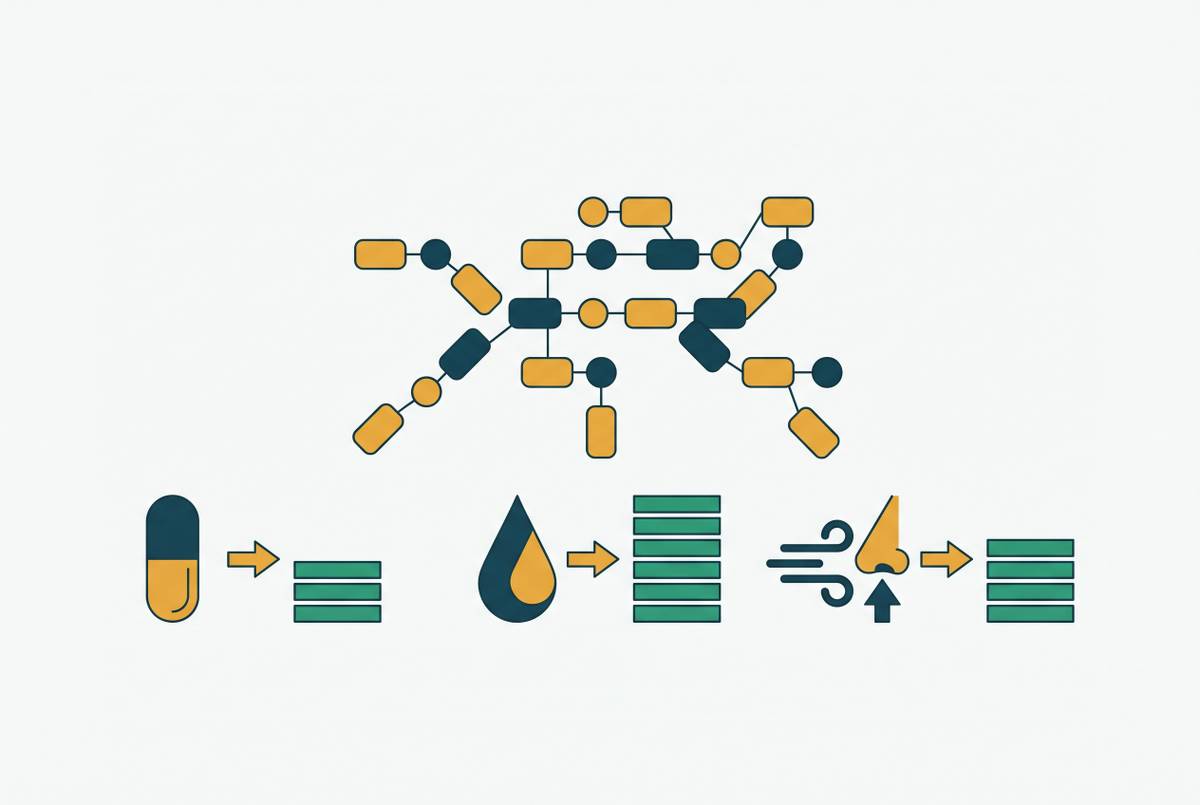
Laid out side by side: oral sits furthest along commercially but still can't reach the brain directly and carries real bioavailability limits. Transdermal offers an injection-free path to sustained, weekly-style dosing but stays years from approval and still wrestles with the variability problem covered earlier. Intranasal offers the most direct route to the brain of any non-injection option, at the cost of working through a smaller absorptive surface that current nanocarrier engineering is only starting to exploit fully. Lionbio, a nasal-spray nanoparticle peptide startup, is among the biotechs working specifically on that problem for GLP-1 delivery. None of the three has solved the problem outright, and the field would do better to say so instead of picking a favorite prematurely. If a single winner has to get named this early, intranasal deserves more credit than its Phase 1-and-earlier status suggests, precisely because it targets the brain directly instead of working around the bloodstream to get there eventually. That's a bet on mechanism, not a settled outcome. Each of the three routes is chasing a different piece of the same puzzle, and betting the whole field on one of them right now would be premature.