Peptide Bioavailability Benchmarks Across Delivery Routes
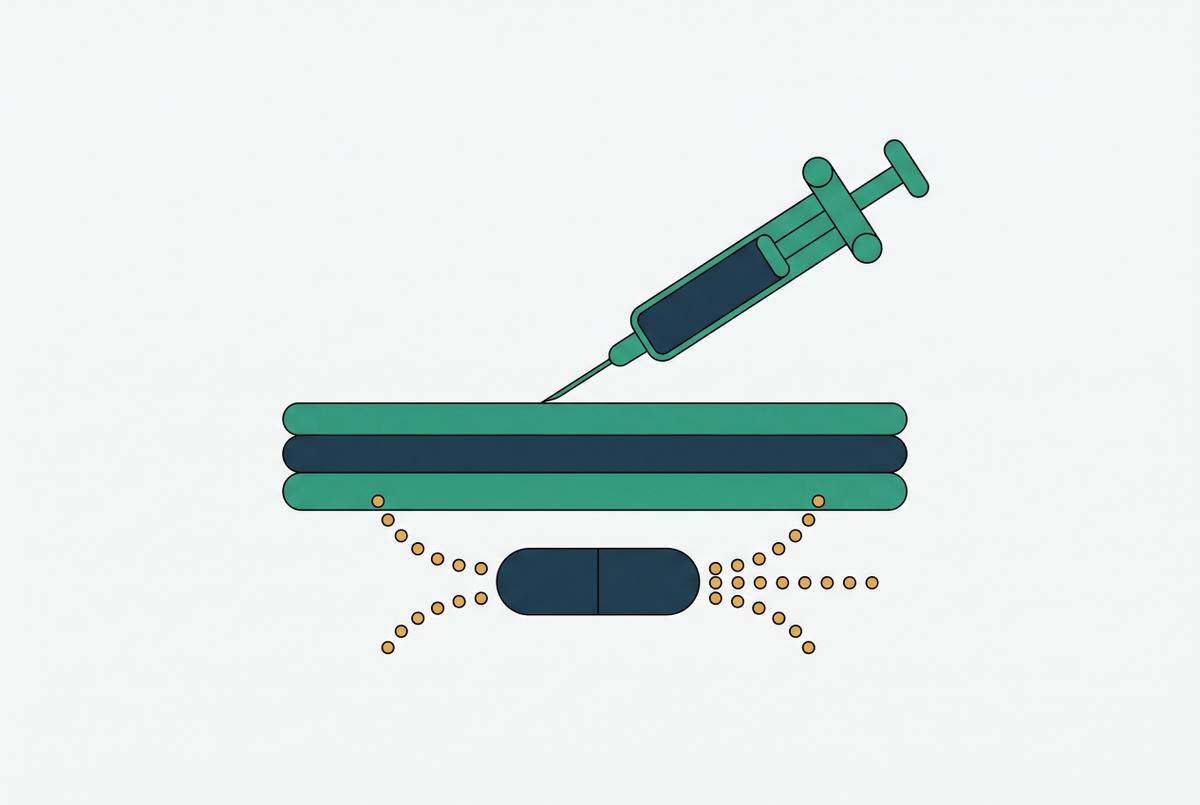
Injectable routes bypass the gut's defenses, but patients quit anyway from needle burden.
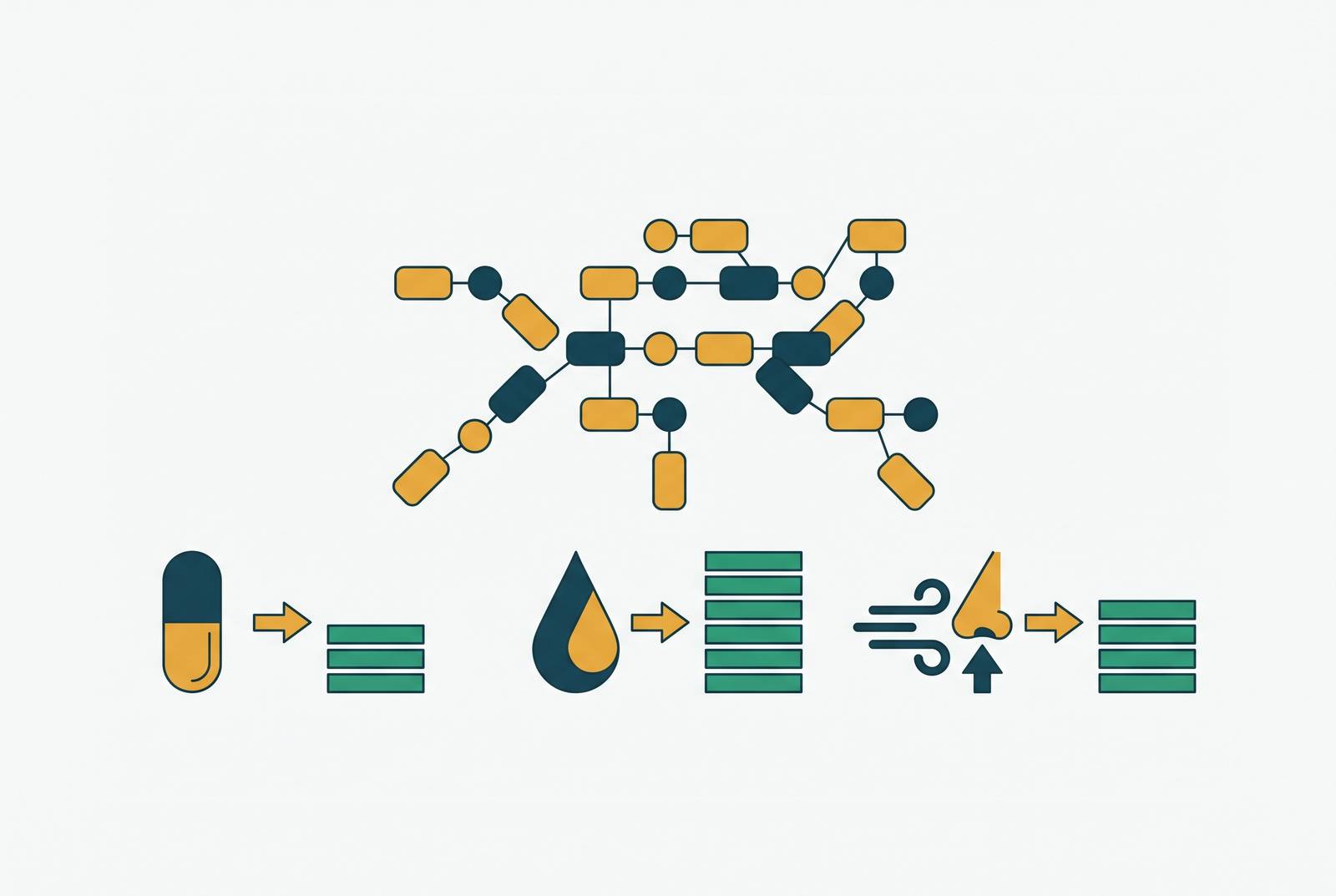
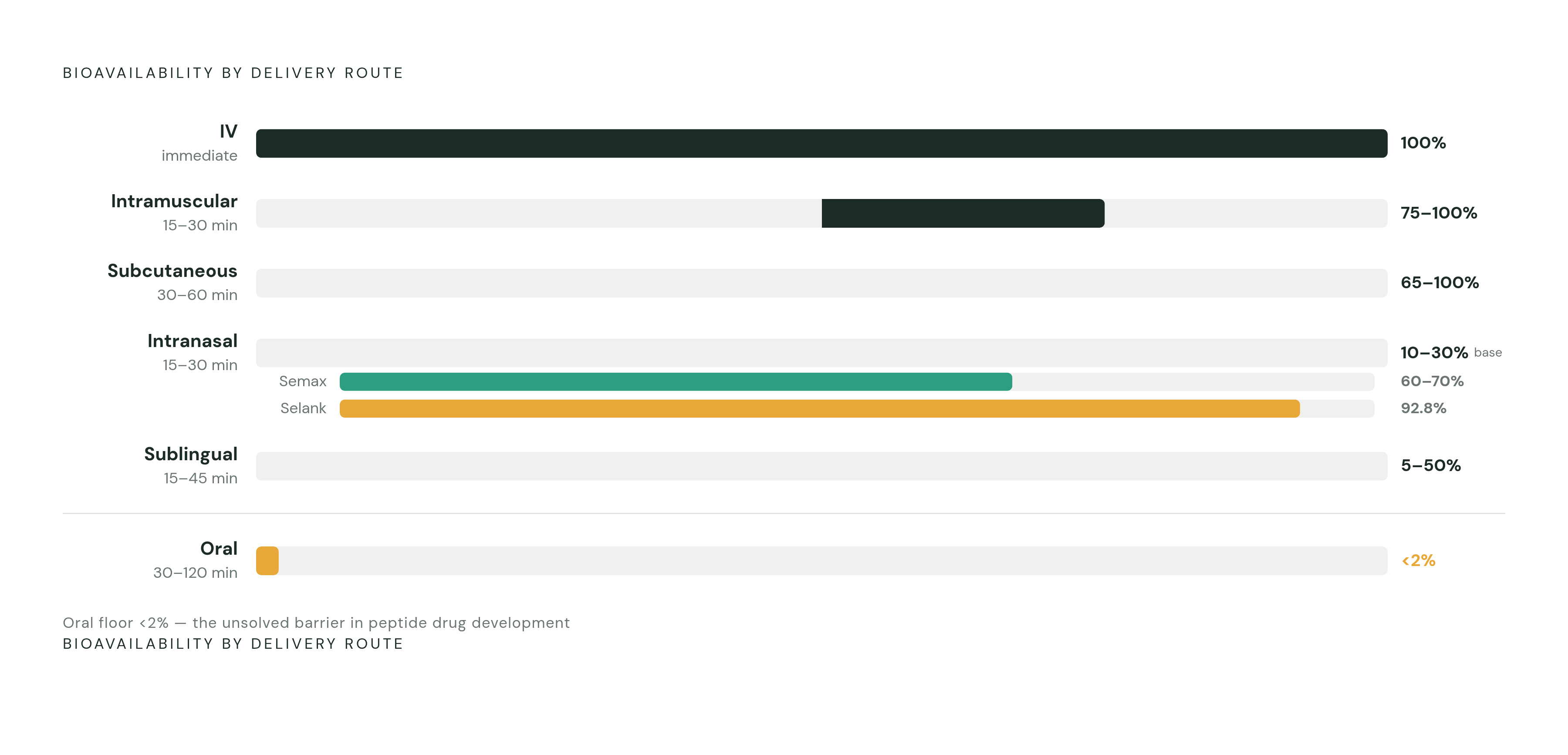
IV delivery sets the ceiling at 100%, by definition, since the drug lands straight in the bloodstream with nothing left to survive. Intramuscular injection runs 75 to 100%, with onset in 15 to 30 minutes. Subcutaneous injection sits in similar territory: 65 to 100%, onset 30 to 60 minutes. Intranasal delivery drops to 10 to 30%, onset 15 to 30 minutes, and that range carries an asterisk large enough to earn its own section further down. Sublingual delivery spans a wide 5 to 50%, onset 15 to 45 minutes, a spread so broad it says almost as much about the chemistry of the individual peptide as it does about the route itself. Oral delivery, the route patients actually want, sits below 2%, onset 30 to 120 minutes: the floor that defines peptide drug development's hardest unsolved engineering problem.
Ranking these routes by bioavailability percentage alone is a mistake, and it's the mistake most discussions of peptide delivery make. These are population-level ranges, not fixed constants; a given peptide's size, charge, and stability can push it toward either edge of its route's range, sometimes drastically. A route that delivers less peptide into the bloodstream can still be the right choice, particularly when the actual target isn't systemic circulation at all but a specific organ. That point becomes impossible to ignore once the discussion turns to the brain, later in this piece.
So what's actually driving these numbers? Each one is the downstream consequence of a specific set of biological barriers: some total, some partial, some avoidable with the right formulation. The sections that follow trace those mechanisms, starting with the two extremes and then moving into the most operationally interesting middle ground: the nose.
Why injectable routes achieve near-complete bioavailability, and what they cost the patient
Injection works because it skips the fight entirely. Subcutaneous and intramuscular delivery place the peptide into tissue that's well supplied with blood vessels but largely free of the enzymatic hostility that defines the gut. No stomach acid, no luminal proteases, no epithelial wall to cross. The peptide diffuses into nearby capillaries or lymphatic vessels and enters circulation more or less intact.
Subcutaneous injection typically delivers 80 to 100% bioavailability for most peptides. What's lost comes from local enzymatic degradation right at the injection depot, plus a portion of the dose diverted into lymphatic drainage before it reaches systemic blood. There's no first-pass metabolism to contend with, so the dose-to-exposure relationship stays predictable. That's why regulators still treat injectable delivery as the reference standard for peptide pharmacokinetics: what gets injected is close to what the patient actually gets.
Consistency at the molecular level doesn't mean the experience at the patient level is painless, though. Weekly self-injection, cold-chain storage, needle anxiety, injection-site reactions: these compound over months into a measurable driver of dropout, a pattern examined in full toward the end of this piece.
State the tradeoff plainly: injectable routes solve the bioavailability problem about as completely as it can be solved, and they still lose patients. The drug itself usually isn't the issue; the delivery mechanism asks too much of the person taking it, week after week, for years. Treating the injection format as a solved, permanent feature of GLP-1 therapy misreads where the pressure in this field is actually building. That unsolved half is precisely what's pushing formulation science toward every other row in the table above.
Why oral bioavailability for peptides collapses below 2%: the GI gauntlet in detail
Swallow a peptide and it enters what's fairly called a gauntlet: a stack of overlapping barriers, each capable of destroying the dose on its own. Stomach acid goes first, denaturing the peptide's structure before any enzyme even gets involved. Then come the proteases: pepsin in the stomach, trypsin and chymotrypsin in the small intestine, the same machinery the body uses to break down dietary protein. An orally dosed peptide gets no special treatment here. As far as the digestive system is concerned, it's lunch.
Whatever survives that chemical assault still has to cross the intestinal wall, and that's its own obstacle. The GI epithelium is sealed by tight junctions, with a mucus layer on top, both specifically built to keep large, water-loving molecules out of the bloodstream. Anything that squeezes through then passes through the liver before reaching general circulation, where first-pass hepatic metabolism strips out another share of the dose.
Stack acid denaturation, enzymatic cleavage, epithelial exclusion, and hepatic clearance on top of each other, and the sub-2% bioavailability figure for oral peptides stops looking like a formulation failure. It reflects several independent, redundant defense systems, each evolved specifically to stop the body from absorbing intact foreign proteins, working precisely as designed. That has a real cost: below 2% bioavailability means an oral dose has to be enormously larger than an equivalent injectable dose to hit the same plasma concentration, and that drives up manufacturing cost, raises tolerability risk, and multiplies formulation complexity all at once.
Getting a peptide past the gauntlet means deliberately building in nanoparticle carriers, permeation enhancers, or protease inhibitors: additions to the formulation rather than changes to the peptide itself. Oral bioavailability turns largely on these formulation choices, and development programs that spend years reworking the molecule instead of the capsule around it risk solving the wrong layer of the problem. That same logic resurfaces a few sections from now, applied against a nasal barrier that turns out to be far less punishing.
Where intranasal delivery actually lands on the bioavailability map, and why molecular weight is the governing variable
The 10 to 30% headline range for intranasal bioavailability hides a lot of variation, and molecular weight is the main reason why. Peptides under roughly 1,000 daltons tend to move through nasal mucosa reasonably well, diffusing passively through tight junctions and across cells. Above that threshold, without specialized formulation, bioavailability typically falls below 10 to 20%, because the pore size of the nasal epithelium and the mucus layer sitting on top of it start acting as a genuine filter rather than a minor speed bump.
The approved drug list backs this up. Only a handful of peptides carry FDA approval as nasal sprays: desmopressin, calcitonin-salmon, nafarelin, buserelin. Each one made it through because its size, charge, or lipophilicity happened to line up favorably with what the nasal barrier allows. Calcitonin-salmon shows what happens when the fit isn't ideal but the dosing compensates for it. Its nasal bioavailability runs around 3% relative to injection, so the approved nasal dose is set at 200 IU against an injectable dose of 100 IU, a straightforward 2x adjustment that makes the route clinically viable without touching the molecule itself.
Contrast that with bremelanotide, tested intranasally in Phase 2 and then abandoned for a subcutaneous injectable formulation, which the FDA approved in 2019. The problem there wasn't just a low bioavailability number; it was inconsistency, dose-to-dose variability that made the nasal version unreliable in a way injection wasn't. That distinction matters: a low but predictable bioavailability is workable, as calcitonin-salmon shows, while an unpredictable one, at any percentage, is much harder to build a program around. Formulation teams chasing the percentage instead of the variance risk solving the wrong problem.
On the other end of the spectrum sit a couple of genuine outliers. Semax, at roughly 813 daltons, reaches 60 to 70% nasal bioavailability, helped by its size but also by the fact that it was designed from the outset for nasal administration; it's been approved in Russia as a nasal spray since 2011. Selank goes further still, reported at 92.8% intranasal bioavailability. These numbers matter less as records to admire than as proof of concept. They show what's achievable when a molecule is sized and shaped for the route it's meant to travel through, rather than forced into a route it was never built for.
One more constraint sits underneath all of this. Whatever gets deposited in the nasal cavity gets cleared by mucociliary action within roughly 15 to 20 minutes, a hard ceiling on the absorption window for any unprotected peptide, regardless of how favorable its molecular weight happens to be. Put it together and nasal bioavailability looks less like a fixed property of a given peptide and more like a function of three variables working in concert: molecular weight, formulation, and where exactly in the nasal cavity the dose lands. Move any one of those, and the same molecule can shift a long way along the range.
The anatomical shortcut that makes intranasal delivery qualitatively different from every other non-injectable route
Every route discussed so far shares a downstream problem that has nothing to do with getting into the bloodstream. Once a peptide is in systemic circulation, the blood-brain barrier still stands between it and the brain, excluding most peptides regardless of how they got into the blood in the first place. High plasma concentration doesn't guarantee central nervous system access; it's a second barrier stacked on top of the first, and injection does nothing to help with it.
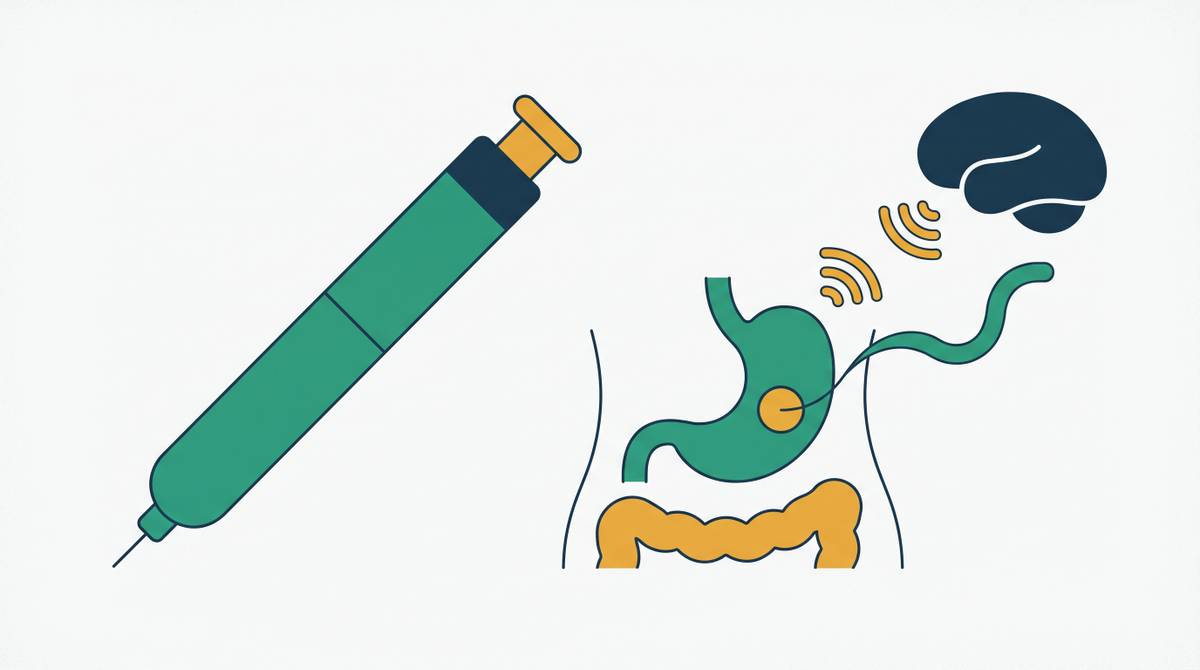
The nasal cavity offers a direct anatomical line to the brain that the other routes lack. The olfactory epithelium, tucked high in the nasal cavity, connects to the brain through olfactory nerves and a smaller set of trigeminal pathways. That connection reaches cerebrospinal fluid and brain parenchyma without the peptide ever needing to enter systemic circulation. A molecule deposited on that specific patch of tissue can reach brain tissue directly, sidestepping the blood-brain barrier as though it weren't there.
That produces a genuinely counterintuitive result, and it's the strongest claim in this piece: for a brain-targeting peptide, subcutaneous injection, despite its far higher systemic bioavailability, can deliver less active drug to brain tissue per dose than a nasal spray does. The relevant number for CNS applications isn't plasma bioavailability at all; it's brain bioavailability, a separate and largely independent measurement. Oxytocin makes the point cleanly. Its systemic nasal bioavailability is low, in the 2 to 5% range, and yet there's a substantial clinical and research literature documenting CNS effects from intranasal oxytocin. It reaches the brain largely through nerve pathways rather than by circulating through blood at meaningful concentration, which is precisely why the plasma number undersells what the dose is doing.
How much of this translates from animal studies to humans? Not as cleanly as researchers would like, and some caution is warranted here. In rodents, olfactory epithelium covers roughly 40 to 50% of the total nasal surface area; in humans, it's less than 10%. That gap explains a good deal of why encouraging nose-to-brain results in mice or rats don't automatically hold up in people, and it's exactly why formulation work that targets the olfactory region specifically, rather than the nasal cavity in general, matters so much for this pathway to work in practice.
Even with that translational gap, the direction of travel is toward real evidence rather than promise. In 2025, researchers led by Hatakawa demonstrated nose-to-brain delivery of JAL-TA9, a nine-residue peptide, at concentrations sufficient to show amyloid-beta cleavage activity, a concrete data point grounding what had largely been theoretical. The broader research effort around nose-to-brain peptide delivery now stretches across neurodegenerative disease, acute neurological conditions, brain tumors, and psychiatric disorders, a fairly wide net for a delivery mechanism that, on paper, looks like a minor variation on nasal spray.
How nanoparticle formulation redraws the intranasal bioavailability map
An unprotected peptide dropped into the nasal cavity faces three problems working against it at once: mucociliary clearance sweeping it out within 15 to 20 minutes, enzymatic degradation in the mucosal secretions themselves, and a permeation barrier limiting how much crosses the epithelium at all. Each one takes a bite out of whatever fraction was headed toward systemic circulation or the olfactory pathway, and they operate simultaneously, not one after another.
Nanoparticle encapsulation is the engineering response to all three at once. Wrapping the peptide protects it from enzymatic attack while it sits in the nasal cavity. Mucoadhesive properties extend how long the formulation stays in place, pushing back against the clearance clock. Tuning particle size and surface chemistry can bias deposition toward the olfactory region specifically, rather than the respiratory epithelium that dominates the rest of the nasal cavity. The release mechanism itself can also be built to hold the peptide inside its shell until after it crosses the epithelial barrier, rather than releasing it too early and losing it to degradation before it ever gets the chance.
Cell-penetrating peptides add another layer on top of that. Combined with nanoparticle carriers such as liposomes, CPPs help drive penetration through both the nasal mucosa and the blood-brain barrier at the same time, an unusual double benefit for a single additive. Akita and colleagues, in 2021, showed that CPPs boosted nose-to-brain delivery of GLP-2 enough to produce antidepressant-like effects at doses that had failed entirely when given intravenously. That's a formulation change that decided whether the drug worked at all, well beyond a marginal improvement in an absorption percentage.
None of this engineering is peptide-specific, and that's worth sitting with. The nanoparticle platform logic applies across different peptide payloads, which is exactly why intellectual property built around the delivery mechanism tends to carry value well beyond whatever single molecule it was first developed for. Put the numbers side by side and the picture sharpens considerably. The 10 to 30% unformulated range reads better as a floor than a ceiling, and most bioavailability tables get quoted as though it were the latter, understating what's achievable by a factor of two or three. Semax already demonstrates 60 to 70%, Selank 92.8%, both achieved through molecular design and formulation rather than any change to the underlying route. The real ceiling for intranasal delivery sits well above where the raw benchmark table suggests, and that gap between floor and ceiling is the entire argument for investing in formulation work at all.
What GLP-1 delivery looks like through this mechanistic lens
GLP-1 receptor agonists sit at the center of a tension that runs through everything above: injectable routes deliver the bioavailability that makes these drugs work, but the day-to-day experience of injecting is exactly what erodes long-term use. Injectable formulations hold a dominant share of the GLP-1 market for a reason grounded in the bioavailability advantage covered earlier, a market position rather than an inevitable endpoint for how these molecules must be delivered.
The adherence numbers are why that dominance is under real pressure. One-year persistence among high-potency GLP-1 weight-loss drugs improved from 33.2% in 2021 to 60.9% in the first half of 2024, genuine progress by any measure. But it still means roughly four in ten patients had stopped treatment within a single year, and persistence keeps falling the further out you look, with only a small share remaining on therapy after three years. A Danish population-based study presented at EASD in 2025 found that more than half of GLP-1 users had discontinued treatment, a figure that lines up with the broader persistence data.
Why do patients quit? Side effects lead the list, and gastrointestinal effects in particular stand out as the single biggest driver of discontinuation, roughly half of users reporting nausea at some point in treatment. That underscores something the earlier sections already implied: the injectable route's bioavailability advantage doesn't count for much if the patient stops taking the drug.
Here's where the mechanisms traced through this piece stop being academic and start bearing on a specific, commercially urgent question. Nothing about GLP-1 peptides makes them uniquely resistant to nasal delivery. The same molecular weight thresholds, mucociliary clearance windows, and nanoparticle protection strategies that lifted Semax and Selank into the 60 to 90%-plus range apply in principle to other peptide classes too. Whether any given GLP-1 molecule clears that bar depends on its size, its stability, and how well a formulation can shepherd it past the nasal epithelium: the exact set of variables this piece has spent its length unpacking. Betting against nasal GLP-1 delivery on the strength of the raw 10 to 30% benchmark alone repeats the mistake this piece opened by warning against: mistaking a population range for a hard limit. The benchmark numbers work best as a map of which barriers a molecule has to clear, and increasingly, of which barriers formulation science already knows how to clear for it.