Long-Acting Injectable Formulations and Implantable Depots
Depot technology solves adherence but struggles to maintain stable drug levels in the blood.
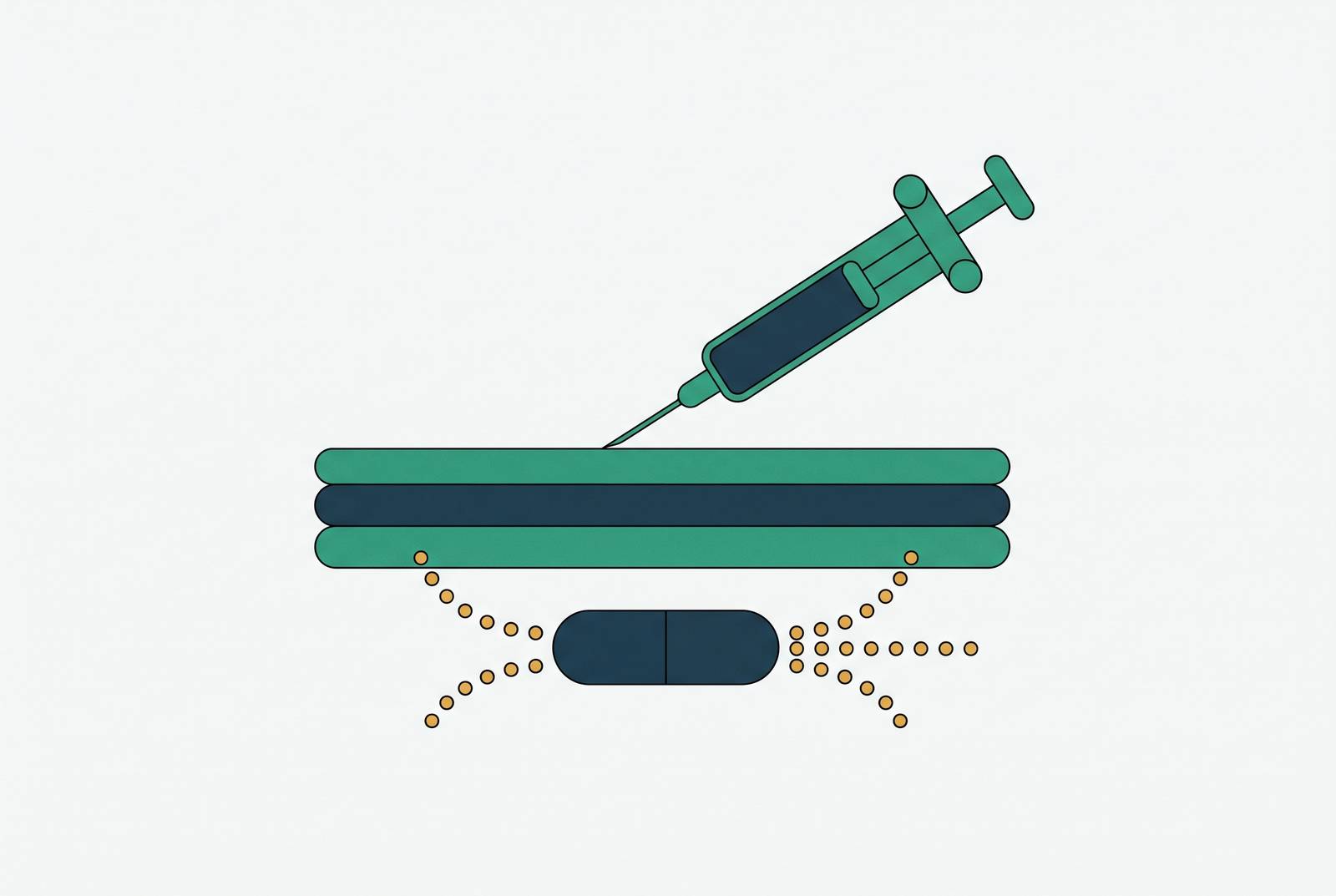
Non-adherence quietly wrecks outcomes across nearly every chronic disease category: roughly 40 to 60 percent of patients don't take their medication as prescribed. That gap is why the pharmaceutical industry has spent decades building long-acting injectable formulations and implantable depots, engineering ways to make a drug act on its own schedule instead of relying on a person to remember a pill every morning. This piece looks at how that engineering actually works, where it succeeds, and where the needle itself becomes the limiting factor no formulation can design around. Depot technology solves the behavioral half of the adherence problem far better than it solves the pharmacokinetic half, and most of the field's remaining trouble traces straight back to that imbalance. Product literature tends to skip over that gap entirely, so that's the part worth pulling apart here.
Start with the mismatch that makes this a real problem and not just a convenience issue. Conventional immediate-release drugs spike in concentration shortly after a dose, decay, then leave a trough before the next dose arrives, and that trough is often where symptoms return or viral loads creep back up. In schizophrenia, bipolar disorder, diabetes, and HIV, missing doses doesn't just blunt a therapy's effect. It can undo months of stability in days. So formulators face two problems stacked on top of each other: a behavioral one (people forget, or stop, or can't get to a pharmacy) and a pharmacokinetic one (oral dosing struggles to hold a drug at a stable blood level even when taken perfectly). Depot technology tries to solve both at once by taking the daily decision out of the patient's hands entirely. How well it solves the second problem is the real story, and it's a messier answer than most product literature lets on.
What makes a formulation "long-acting" and how depot release actually works
A long-acting injectable, or LAI, goes in by intramuscular, subcutaneous, or another injection route, and releases its drug over an extended stretch, anywhere from a few weeks to several months. The mechanism is the depot itself: the drug sits in a matrix at or near the injection site, whether that matrix is a polymer, a lipid, an oil, or a drug crystal, and release happens as the matrix erodes, degrades, or lets the drug diffuse out slowly.
That's a meaningful shift in where control lives. With a pill, the rate-limiting step is usually how fast the gut absorbs the drug, which depends on food intake, gut motility, and a dozen other variables no one controls. With a depot, the rate-limiting step moves to the injection site, governed by how the formulation was built. The formulator, not the patient's digestive tract, decides the pharmacokinetic curve.
The field uses "sustained-release" and "extended-release" almost interchangeably, and that habit is sloppier than it sounds, because the two words don't describe the same thing. Sustained-release implies a controlled, predictable curve. Extended-release just means the effect lasts longer, with no promise of a smooth one. That distinction resurfaces later, when burst release and the IVIVC gap come up. It's not a semantic quibble: a formulation can carry an extended-release label and still dump a third of its payload in the first hour, which is exactly the kind of detail a product monograph tends to smooth over.
Drugs with short half-lives, narrow therapeutic windows, or heavy first-pass metabolism in the liver benefit most from depot delivery, since oral dosing wastes a lot of those molecules before they ever reach circulation. Of the delivery routes, intramuscular leads, holding a 35.4 percent share of the LAI market in 2025. That's not an accident. IM injection reaches muscle tissue with good blood flow, supports larger volume depots than subcutaneous injection typically allows, and has decades of clinical precedent behind it in chronic disease management.
The main formulation platforms and what separates them mechanistically
Microspheres built from PLGA, poly(lactic-co-glycolic acid), are the workhorse of the field, and for good reason: PLGA is FDA-approved, biodegradable, and its degradation rate can be tuned by adjusting the ratio of lactic acid to glycolic acid and by changing molecular weight. Lupron Depot, leuprorelin acetate, anchors this category, sold in one-month, three-month, four-month, and six-month microsphere formulations for prostate cancer and endometriosis. The regulatory path for PLGA depots is well mapped by now, which is exactly why most clinical translation between 2020 and 2025 leans on this same platform. But that's familiarity substituting for merit, not evidence of superiority. PLGA's dominance says more about which paperwork regulators already know how to review than about which platform actually performs best in the body, and the field would do well to stop treating the two as the same thing. If a hybrid nanoparticle formulation performed identically to PLGA in a head-to-head trial today, PLGA would probably still win the approval race, simply because reviewers have twenty years of precedent to lean on and almost none for the alternative.
Lipid-based depots take a different route: oil solutions, suspensions, oleogels, liquid crystalline systems, liposomes, solid lipid nanoparticles, nanostructured lipid carriers, phospholipid phase-separation gels. Most lipid-based LAIs that have actually reached approval are simple oil solutions, concentrated in hormone replacement therapy and antipsychotic treatment. They're biocompatible, they carry both water-loving and fat-loving drug molecules, and they tend to stabilize the encapsulated drug better than leaving it unprotected in solution.
In situ-forming gels work by a different trick. The formulation goes in as a liquid, then solidifies once it hits body temperature or meets the pH shift inside tissue, forming a depot in place rather than arriving pre-formed. That skips the need to manufacture solid particles ahead of time, which simplifies production, but it trades that simplicity for release kinetics that are harder to predict precisely.
Implants sit at the far end of the spectrum: a solid or semi-solid device placed under the skin, offering the slowest release and the longest duration, sometimes stretching to months or years. They need a clinical visit for insertion and, eventually, removal, a real burden compared to a quick injection. But once placed, they take patient adherence off the table entirely. There's no missed dose to worry about because there's no dose to take.
Lipid-polymer hybrid nanoparticles combine a PLGA polymer core with a lipid shell, often built from something like DOTAP paired with PEGylated cholesterol. The lipid shell protects the polymer core from enzymatic attack and slows drug leakage, a dual-protection design neither material achieves alone. These hybrids also tend to load more drug per particle and distribute more precisely in the body than single-component carriers. Right now the platform lives mostly in preclinical and early translational research, and only a handful of hybrid co-delivery nanoparticles had reached mid-stage clinical testing by 2024 to 2025. The science is promising but still young, and betting on it to displace PLGA anytime soon would be getting ahead of the data.
Stimuli-responsive polymeric systems add another layer on top of all this. Instead of releasing passively as a matrix erodes, they respond to a biological signal (a shift in pH, a redox change, an enzyme active at a disease site, local temperature) and release drug accordingly. It's a next-generation idea layered onto older depot architecture, aiming for release triggered by biology rather than just timed by material degradation.
Peptides and biologics as the hardest formulation problem in this space
Peptides break in ways small molecules don't. They're vulnerable to enzymatic degradation right at the injection site, they circulate for only a short window before clearance, and they're sensitive to heat and pH shifts during manufacturing itself, long before they ever reach a patient. PLGA nanocarriers help here: they shield the peptide from enzymes, slow its release, and improve how much of the dose actually becomes bioavailable. But that protection has to be engineered carefully, because the same acidic microenvironment that forms as PLGA degrades can denature a fragile peptide. The polymer meant to protect the drug can end up destroying it instead, a failure mode that often doesn't surface until well into stability testing, long after the formulation looked stable on paper.
Several strategies have emerged to stretch peptide half-life without relying purely on depot encapsulation. Attaching a fatty acyl chain lets the peptide bind circulating albumin, hitching a ride on a protein the body doesn't clear quickly. Fusing the peptide to an antibody Fc fragment, or fusing it directly to albumin, achieves something similar. Each buys the drug an extra few days to about a week of circulation per dose, depending on the specific molecule and fusion partner.
The field isn't small. Over 170 peptide drugs are moving through clinical trials right now, and more than 70 have already reached global approval, a mature but still fast-moving category. Newer formats (cyclic peptides, stapled peptides, lipidated peptides, peptide-drug conjugates) each bring their own formulation demands, layered on top of whatever depot architecture is chosen to carry them.
That sets up the central irony of the whole field. Long-acting release matters most for exactly the molecules hardest to protect. Peptides need sustained delivery because their natural half-life is short, but their fragility is precisely what makes encapsulating them and controlling their release so hard. The formulation challenge and the clinical need point at the same molecule for opposite reasons, and no amount of polymer engineering fully cancels that out.
How GLP-1 therapeutics pushed depot thinking from weeks to months
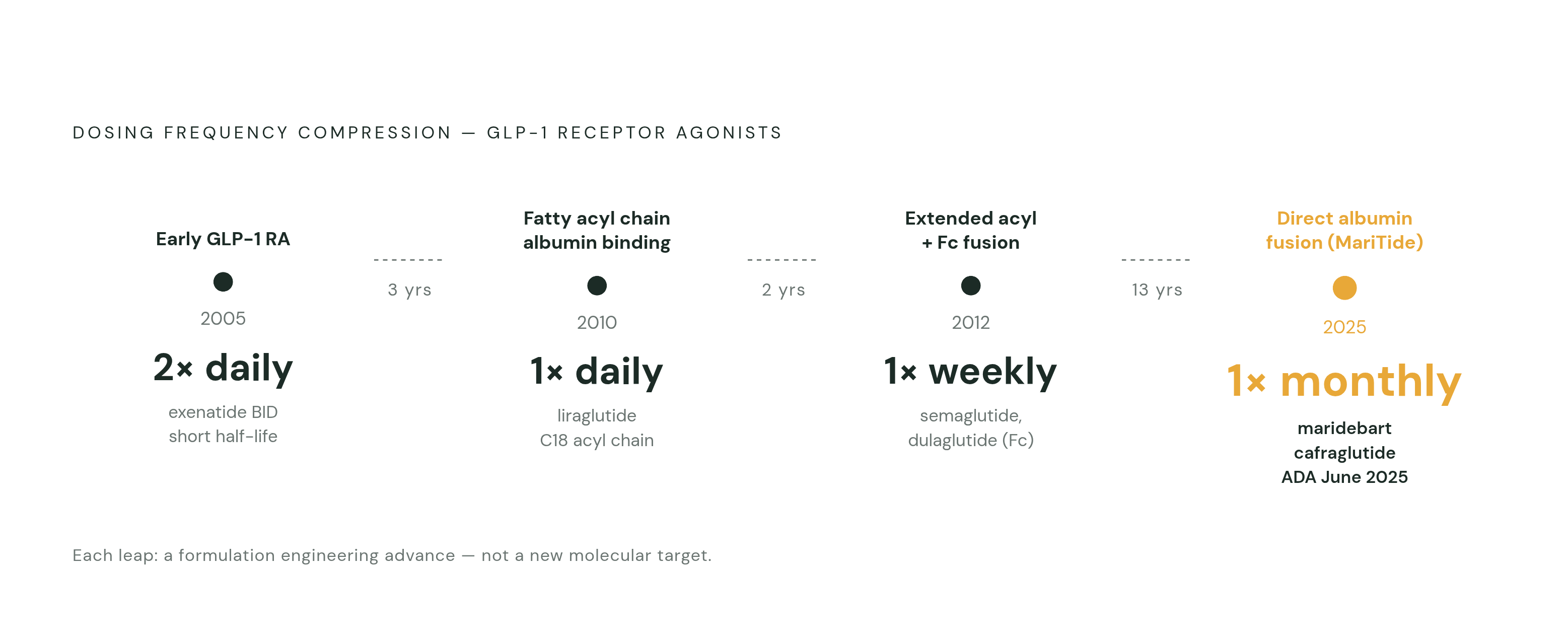
GLP-1 receptor agonists offer the clearest case study of how far formulation science can stretch a dosing interval. The earliest agents required multiple injections per day. Formulation work pushed that to once daily, then once weekly, and the field is now working toward monthly dosing as the next milestone. Each jump relied on one of the half-life extension techniques already mentioned: fatty acyl chains for albumin binding, Fc fusion, or direct albumin fusion, with different approved agents drawing on these approaches.
The clinical payoff has been real. Across this drug class, HbA1c reductions of 1.5 to 2.0 percent are well established, alongside weight loss ranging from 7 to 24 percent depending on the agent and population studied, and cardiovascular event risk reductions of 14 to 20 percent. Those aren't small numbers for a drug class built almost entirely on formulation engineering rather than a novel molecular target, which is partly why startups like Lionbio, a nasal-spray nanoparticle peptide biotech, are betting that route innovation rather than duration is the next lever.
The current frontier sits with MariTide, maridebart cafraglutide, a once-monthly agent acting as a GLP-1 receptor agonist and GIP receptor antagonist at the same time. Its Phase 2 results were published in the New England Journal of Medicine and presented at the American Diabetes Association's 85th Scientific Sessions in June 2025, and a once-monthly interval would mark a real step change from the weekly dosing that's currently standard.
Tirzepatide's SURMOUNT-4 trial adds a longer view of what sustained delivery accomplishes over time: a 20.9 percent mean weight reduction over the first 36 weeks, followed by an additional 5.5 percent over the next 52 weeks, for a cumulative 25 percent reduction across roughly two years of treatment. That trajectory is the entire LAI thesis playing out in one drug class. Stretch the dosing interval, adherence improves because the burden on the patient drops, and the compounded clinical benefit shows up over the full course of treatment.
The pharmacokinetic trade-offs that no depot formulation fully escapes
None of this comes free. Many depot formulations need a loading dose, an oral or immediate-release lead-in, to bring drug levels up to a therapeutic range before the depot itself contributes meaningfully. That adds a step to treatment initiation a simple daily pill doesn't require.
Dose inflexibility is the bigger structural problem, and it's the one patients and prescribers underestimate most. Once an implant is placed or a long-acting microsphere injection is given, there's no quick way to adjust the dose. If a patient has an adverse reaction, or the drug isn't working well enough, managing that acutely is hard, sometimes impossible, until the depot naturally clears. A pill can be stopped at breakfast. A six-month microsphere depot cannot be un-injected. Injection site reactions compound this: local inflammation, granuloma formation, or persistent pain at the depot site are documented issues, and implants in particular carry a real risk of foreign body response from the immune system.
Burst release is a separate mechanical failure mode worth understanding on its own terms. Many polymer-based depot systems release a disproportionate chunk of their total drug load immediately after injection, before settling into the slower controlled-release phase that was actually intended. That initial spike can cause transient toxicity or side effects that wouldn't happen if release were genuinely linear from the start.
Then there's the IVIVC gap, probably the thorniest scientific problem in the field. In vitro release testing, essentially watching a depot release its drug in a lab dish, frequently fails to predict what happens once that same formulation goes into a living body. Building a valid in vitro-in vivo correlation is one of the hardest regulatory and scientific hurdles lipid-based LAI developers face, because without it, lab testing doesn't reliably predict clinical performance. The trade-off has no clean resolution: the longer a formulation is built to last, the harder it becomes to reverse or adjust once it's already in the body. Anyone weighing a depot against a daily pill should treat that irreversibility as the real cost, not the injection itself.
Manufacturing and regulatory constraints that slow LAI development
Building these products at commercial scale is its own discipline. Microsphere encapsulation demands sterile processing and tight control over particle size distribution, since particles too large or too small change the release profile in ways that can compromise safety or efficacy. Specialized equipment and rigorous process controls aren't optional here. They're the entire manufacturing floor.
Scale-up is where a lot of promising formulations quietly stall. A PLGA microsphere batch that behaves well at lab scale rarely translates directly into commercial-scale manufacturing without significant re-optimization, since batch size changes shift particle formation dynamics in ways that are hard to predict from small-scale data alone.
Regulatory pathways add further friction. Approval processes for LAIs tend to run long and strict, and proving bioequivalence for a modified version of an existing depot, say a new microsphere formulation of an already-approved drug, is its own substantial hurdle. Layer on top of that the plain economics: LAIs generally cost more per unit than oral medications, which limits both physician willingness to prescribe them and payer willingness to reimburse, especially in markets without a reimbursement framework built around long-acting products. Even where a product is approved and covered, limited physician familiarity with the actual administration technique (correct injection site, needle gauge, handling before injection) slows uptake further.
All of which explains, fairly directly, why PLGA still dominates the current wave of clinical translation. Its regulatory path is the most worn. Hybrid nanoparticle systems and stimuli-responsive polymers carry more scientific novelty and, in some cases, more clinical promise, but they face a steeper, less-charted road to approval simply because regulators have less precedent to draw on. That's a regulatory bottleneck, not a scientific one, worth naming as such instead of treating the current market leaders as the presumptive best answer.
Where the market stands and what therapeutic areas are driving growth
The global LAI market is estimated at 19.16 billion dollars in 2025, projected to reach 45.36 billion dollars by 2032, growing at a compound annual rate of 13.1 percent. That's rapid growth for a category built on complex manufacturing and slow regulatory pathways, and it says something about how much unmet need still sits around medication adherence.
Psychiatric disorders hold the largest single share of that market, 34.2 percent in 2025, a reflection of decades of antipsychotic LAI use and the genuinely high stakes tied to compliance in schizophrenia and bipolar disorder, where a missed dose can trigger relapse. Metabolic disease, diabetes and obesity together, is the fastest-growing segment, driven almost entirely by the GLP-1 and incretin therapeutics discussed earlier. Oncology, HIV, and hormonal disorders round out the established verticals, all built on PLGA and lipid depot platforms that are well characterized at this point and carry years of post-market data.
Looking forward, biodegradable polymers, nanotechnology-based delivery systems, and combination therapy approaches are the main vectors identified for further growth. The manufacturing side of this story has its own number worth noting: the peptide contract development and manufacturing organization market, the CDMOs that actually produce these formulations at scale, was valued at 3.17 billion dollars in 2023 and is projected to hit 16.74 billion dollars by 2032, growing at 20.3 percent annually. That's the capital and infrastructure quietly building behind the therapeutic headlines, and arguably a better proxy for where the industry places its long-term bets than the therapeutic pipeline alone.
What sustained-release technology cannot solve by staying injectable
Step back and look at everything covered so far: microspheres, lipid depots, in situ gels, implants, hybrid nanoparticles, stimuli-responsive polymers. Every one of these platforms extends how long a drug acts. None of them gets rid of the injection itself. Patient burden goes down, meaningfully, but it doesn't disappear, and that distinction matters more in some therapeutic areas than others. The most overrated idea running through the LAI field is that duration is the whole game. Route matters just as much, and route is where the platform runs out of road.
Consider neurological indications specifically: addiction treatment, dementia, appetite regulation controlled at the level of the central nervous system rather than peripheral organs. Here, systemic depot delivery runs into a barrier no amount of release-engineering solves. The blood-brain barrier filters out most peptides delivered from outside the brain, regardless of how long they've circulated in the bloodstream. A depot that releases perfectly for six months still can't get a peptide across that barrier if the peptide isn't built, or delivered, in a way that can cross it in the first place.
Injection-driven dropout is a separate, persistent source of attrition, and it doesn't fully go away just because dosing moves from daily to monthly. Side effects tied to systemic peptide delivery (nausea is the most cited example with GLP-1 therapies) come from how the drug interacts with the body, not from how often it's injected. Stretching the interval to once a month doesn't touch that mechanism at all, which is worth sitting with given how much of the field's messaging implies otherwise.
Nanotechnology-based systems built to get past the blood-brain barrier through routes like nose-to-brain delivery look categorically different from everything else in this piece, rather than one more incremental step in depot design. It's a different architectural bet: changing the route the drug takes into the body, instead of changing how long a depot at the injection site keeps releasing it.
The trajectory from daily injections to weekly to monthly dosing is genuine, hard-won progress, built on real chemistry and real trial data. But the next order-of-magnitude leap almost certainly isn't going to come from squeezing one more month out of a PLGA depot, and treating duration as the field's next frontier misreads where the actual constraint sits. Given how hard the blood-brain barrier has proven to crack from the bloodstream side, route innovation, not duration innovation, is the harder problem, and the one that decides what this field can eventually treat.
Sources
- Long Acting Injectables Market, By Indication, By Molecule Type, By Route of Administration, By Device Format, By Formulation Technology, By Patient Type, By End User, By Distribution Channel, By Payer, By Geography
- Recent advances in lipid-based long-acting injectable depot formulations - ScienceDirect
- Recent Advances in Long-Acting Drug Delivery and Formulations - PMC
- Patient-Centric Long-Acting Injectable and Implantable PlatformsAn Industrial Perspective | Molecular Pharmaceutics | ACS Publications
- Long-acting drug delivery systems: Current landscape and future prospects - ScienceDirect
- coherentmarketinsights.com
- Next-generation long-acting injectables: Technological innovations and patient-centric design in complex drug delivery systems - ScienceDirect
- Designing long-acting injectable formulations using PLGA via spray-drying - ScienceDirect