Patient Adherence Measurement Methods in Chronic Peptide Therapy
Researchers use incompatible tools to measure whether patients take their peptide medications.

Adherence, as the World Health Organization frames it, is the extent to which a patient's behavior matches what was agreed on with a prescriber. That's a collaborative standard, not a compliance checklist, and by that standard, chronic disease treatment is failing badly. A 2025 state-of-the-art review by Dunbar-Jacob and Zhao (published in Nurs Rep) puts non-adherence as high as 50% across chronic conditions, linking non-adherence to serious downstream consequences including medication-related hospitalizations in the US. Peptide therapy, and GLP-1 treatment specifically, sits in the middle of this problem with a twist: the tools used to measure adherence were built for pill bottles, not injection pens. That mismatch doesn't just blur the picture, it produces a confident, specific, wrong story about why patients quit, and the field keeps building policy on top of that wrong story.
The four main measurement families and what each is actually capturing
Adherence measurement splits along two axes. One is subjective versus objective: did a patient self-report their behavior, or did some external system record it. The other is direct versus indirect: did the method observe the drug itself (in blood, urine, or the gut), or infer use from a proxy like a pill count or a pharmacy refill. Four method families dominate, and each trades accuracy for convenience in a different place. None of them should be trusted alone. That's not a hedge, it's the actual finding: the field's most-used tool is also its least reliable one, and that ordering should worry anyone reading adherence statistics at face value.
Self-report questionnaires are, by a wide margin, the most common tool in the literature. The 2025 Dunbar-Jacob and Zhao review found 72% of studies relied on some form of self-report, and the Morisky Medication Adherence Scale (MMAS-8) is the single most used instrument, showing up in 25.6% of chronic kidney disease studies per a 2026 systematic review in BMC Nephrology. The appeal is obvious: questionnaires are cheap, fast, and need no hardware. The cost is precision. Patients over-report their own adherence, whether from faulty recall or a plain wish to please whoever's asking, and that bias tracks with who the patient is rather than what they actually did. Sociodemographic variables predict what a patient will say about their adherence, but not what an objective monitor finds. Studies relying only on self-report are, structurally, built to flag the wrong patients as non-adherent, and that's worth stating plainly rather than softening: the most popular method in the field is also the one most likely to mislead.
Pharmacy claims data, mainly Proportion of Days Covered (PDC) and Medication Possession Ratio (MPR), is the second most common approach, showing up in 22% of studies in the same 2025 review. PDC calculates the share of days in a defined window a patient had access to their medication, and convention, set by the Pharmacy Quality Alliance and used by CMS, treats a PDC of 80% or higher as "adherent." MPR draws on the same claims data but applies different denominator logic, and here's the part that trips people up: PDC and MPR can produce different adherence figures for the same patient population, even though they draw on the same underlying pharmacy claims. Multiple PDC algorithm variants exist specifically to handle gaps in real-world data, each treating therapy gaps differently. Persistence, a related but distinct concept, is conventionally defined as no gap longer than 56 to 60 days between fills. The blind spot is structural, not incidental. Claims data confirms a drug was dispensed and paid for. It says nothing about whether the patient ever opened the box.
Electronic monitoring devices, pill bottles with sensor caps and similar hardware, show up in only 2.5% of studies in the 2025 review, despite being, per a 2024 review by Gackowski and colleagues in Med Sci Monit, among the fastest-evolving methods available. These devices record when packaging is opened, which gets closer to actual use than a refill record does. Adoption stays low anyway, probably because the hardware and data infrastructure cost more than a questionnaire or a claims pull ever will.
Biologic assays (direct detection of a drug or its metabolite in blood or urine) and ingestible biosensors sit at the far end of the spectrum. Assays appear in a small minority of studies in the 2025 review, mostly because they're expensive and logistically heavy. Biosensors resist overestimation better than any other method and come closest to confirming true administration, but they're also the priciest option on the table right now. Video-observed therapy and machine-learning-based tools are newer entrants still finding their footing, with researchers exploring whether ML-derived patient-reported outcome measures can model several adherence behaviors at once instead of treating each as a separate signal.
None of these four families, alone, captures the full arc of adherence: initiation, implementation, persistence. Multimodal strategies that combine two or more methods in the same study get recommended across the literature constantly and remain rare in actual practice. That gap between recommendation and habit is the thread running through everything that follows. The field keeps recommending a fix it doesn't apply, and it's worth asking why: probably because the fix costs more, in both money and coordination, than anyone wants to admit upfront.
How concordance between methods breaks down, and what that reveals
Self-report overestimates adherence relative to electronic monitoring. That finding holds up across multiple chronic disease reviews, consistently enough that researchers treat it less as a live debate and more as a baseline assumption to design around. Self-report and pharmacy refill data don't line up well either, particularly in outpatient settings, because recall bias, the time burden of accurate reporting, and social desirability all distort the self-report side in ways the administrative record simply doesn't share.
PDC and MPR deserve a second look here, because their disagreement is easy to wave off as a technicality. It isn't one. Both metrics draw on the exact same pharmacy claims, yet they produce different adherence figures for the same patient population, which means choosing between them is a substantive analytic decision, not a rounding difference. Layer the PDC variants on top of that, PDC1, PDC2, PDC3, each treating therapy gaps differently, and the same patient's data can generate meaningfully different "adherence" conclusions depending purely on which algorithm a study happened to pick.
What makes this hard to fix is quieter than the disagreement itself: multimodal measurement strategies remain rare in actual practice despite being recommended across the literature. So the disagreement between methods rarely gets surfaced at all. Most published research reports one number, from one method, and moves on. Method choice ends up functioning almost like a silent variable in the results, quietly deciding which patients look adherent and which don't, without anyone flagging that a choice was made in the first place. For a therapy class where dropout is frequent and driven by several overlapping causes at once, that's not a footnote. It shapes which interventions get funded and which patients get targeted, invisibly, and it means a fair amount of published GLP-1 adherence literature is measuring its methodology as much as its patients.
Why GLP-1 persistence data looks the way it does, and what the claims record misses
GLP-1 adherence research leans almost entirely on integrated pharmacy and medical claims analysis, with PDC of 80% or higher as the bar. The numbers that come out of that approach are stark. A Prime Therapeutics and Magellan Rx analysis of commercially insured, non-diabetic members found 47.1% persistence at one year in a semaglutide-specific cohort, but only 32.3% overall one-year persistence across the full sample. A separate real-world study found 85% of patients had stopped their GLP-1 medication within two years of starting.
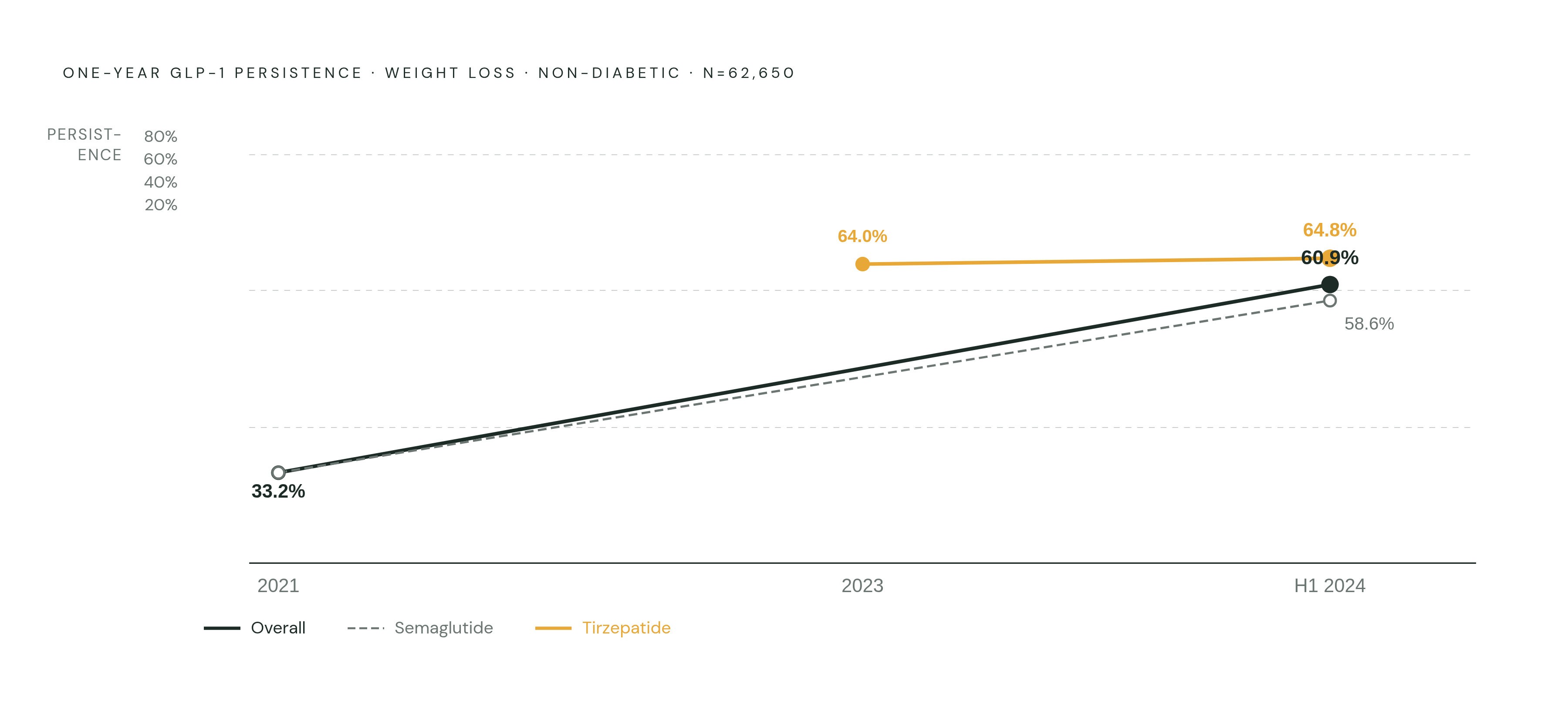
A genuinely encouraging trend sits underneath those grim topline numbers, though, and it's worth sitting with before assuming the whole picture is bleak. One-year persistence among a weight-loss-indicated, non-diabetic, commercially insured cohort (62,650 patients, average age 45.7, 75.5% female) climbed from 33.2% in 2021 to 60.9% in the first half of 2024. Broken out by product, semaglutide's one-year persistence moved from 33.2% (2021) to 58.6% (first half of 2024), while tirzepatide held a higher baseline throughout: 64.0% in 2023, 64.8% in the first half of 2024. Daily-injection products fared worst by a wide margin: liraglutide brands in the Prime/MRx analysis showed two-year persistence of just 7.4% and 7.0%, a gap large enough that dosing frequency alone looks like it's doing real work here.
But what does PDC actually see in any of this? A filled prescription, and nothing past that point. It can't tell whether the patient administered the dose correctly, skipped it, or never opened the pen at all. Dose-titration holds, a clinically directed pause built into GLP-1 escalation protocols to manage side effects, look identical in a 60-day gap rule to a patient simply walking away from treatment. Nausea, cost, a supply shortage, a deliberate clinician-guided break: all of it produces the exact same signature in the claims record, a gap, with no label attached explaining why. The semaglutide and tirzepatide shortages running roughly 2022 through 2025 created involuntary gaps that PDC algorithms likely classified as non-persistence, even for patients who wanted to keep taking the drug and simply couldn't get it. PDC cannot tell a supply chain problem from a patient giving up, and nothing currently forces it to try. That's the core failure of the entire measurement approach, and it means treating PDC as ground truth, the way most published research does, is a mistake dressed up as rigor.
Clinical trials for GLP-1 obesity indications often report adherence above 85%, a figure that looks almost unrelated to the claims-based real-world numbers above. The gap isn't mysterious once you look at trial mechanics. Trial populations get closer monitoring, more support, and screening that filters out some of the patients most likely to struggle in the first place. Real-world commercially insured populations face financial and psychological pressures no trial protocol replicates. Shortage resolution, better titration protocols, and lifestyle support programs are all plausible drivers of the 2021-to-2024 persistence climb, but PDC data, on its own, can't tell them apart. That inability is the whole argument for the rest of this piece.
The dropout drivers that standard measurement methods are least equipped to detect
Gastrointestinal side effects are the headline reason patients quit GLP-1 therapy, and the scale is significant: real-world studies put GI adverse events somewhere between 40% and 70% of treated patients. A cross-sectional survey of GLP-1 receptor agonist discontinuation in routine practice found patients themselves cited nausea (64.4%) and vomiting (45.4%) as their leading reasons for stopping, while physicians pointed to inadequate glycemic control (45.6%) and nausea or vomiting (43.8%). A systematic review of randomized controlled trials found sharply elevated nausea risk against placebo: relative risk of 2.95 for semaglutide, 2.90 for tirzepatide, 4.77 for orforglipron.
Why do the standard tools miss almost all of this? Self-report instruments like the MMAS-8 ask whether a patient took their medication. They don't ask why a patient cut a dose in half, skipped a week, or stopped altogether, so they capture the fact of non-adherence without ever touching the physiology driving it. PDC registers a gap in coverage but has no mechanism for recording cause: a two-week hold prompted by nausea reads identically to a patient who simply disengaged. Electronic monitoring can log that a device was opened, but it has no way of knowing whether the patient vomited minutes later or quietly self-administered a reduced dose out of caution.
Sex differences compound this, and this is where the measurement gap stops being abstract. A Truveta analysis presented at ISPOR 2025 found women experience nausea and vomiting at 2.5 times the rate of men on GLP-1 therapy. Most adherence questionnaires aren't stratified by sex, though, and PDC-based population studies can bury this disparity entirely unless researchers deliberately cut the data by subgroup. That's a design choice, not an oversight born of missing data: the data to stratify by sex generally exists. Whether the analysis asks for it is a separate question, and usually the answer is no.
Dose titration adds a structural wrinkle that's easy to overlook. Gradual escalation is a required part of GLP-1 protocols specifically to blunt GI symptoms, so a period of intentional sub-therapeutic dosing gets built into the treatment plan from day one. PDC, though, counts every covered day identically: a patient in the first week of a starter dose contributes the same adherence credit as a patient on full maintenance dose. Self-report tools don't distinguish between the two either. "Took my medication" means the same thing on a questionnaire whether it refers to a starter dose or a therapeutic one, and electronic monitoring has no way to record which pen setting or cartridge strength a patient actually used.
Cost sits in an entirely separate lane from side effects, but it lands in the exact same blank space in the data. Per the Truveta ISPOR 2025 analysis, 12.8% of patients discontinued specifically due to affordability. Financial dropout and side-effect dropout both show up as the same gap in a refill record, indistinguishable from each other no matter how carefully someone reads the claims data afterward.
Injection burden is probably the hardest driver to see in any current dataset. Self-injection fatigue and needle aversion build gradually over months, and no validated questionnaire currently tracks that trajectory specifically for GLP-1 therapy. The claims data offers one indirect clue: daily-injection products showed markedly lower two-year persistence than weekly-injection products in the Prime/MRx analysis, suggesting dosing frequency matters to patients in a concrete, physical way. But claims data can only register that a patient switched products or dropped out entirely. It has no way to capture the accumulated fatigue of the needle itself, which is plausibly the thing driving that switch in the first place.
What a multimodal measurement strategy would actually look like for peptide therapy trials and clinics
The 2025 state-of-the-art review's own recommendation is straightforward: standardize definitions and thresholds, report consistently, combine measurement methods instead of leaning on one. Right now that combination is the exception in published research, not the norm, and closing that gap is less a technology problem than a willingness problem. So what would it actually take? Start with the fix that costs the least and does the most, because the field doesn't need a moonshot here, it needs people to stop settling for the cheapest single number.
Pair PDC with a structured reason-for-gap capture. Claims data flags the event (a coverage gap opened), and a follow-up mechanism, whether that's phone outreach or an EHR-linked questionnaire, assigns a cause: GI symptoms, cost, supply shortage, or an intentional clinician-directed pause. Neither piece alone tells the full story. Together, they turn a blind gap into an actionable one, and that's the single highest-leverage fix available given tools that already exist today. No new hardware required, just the willingness to ask why.
Questionnaire instruments need to match the therapy's actual failure points, and right now they mostly don't. The MMAS-8 was built around chronic pill regimens, and it shows: it doesn't ask about injection-site experience, nausea-driven dose-skipping, or behavior during titration. Peptide therapy needs either a condition-specific instrument or an adjunct symptom-burden scale layered on top of the generic adherence questionnaire, something built to catch the GI and injection-burden dimensions that MMAS-8-style tools were never designed to see.
Electronic monitoring is catching up on the hardware side. Smart auto-injector pens that log date, time, and delivered dose are already in development, and they close a real gap: the space between "possessed the drug" (what PDC measures) and "administered the drug" (what actually matters clinically). These devices could, in principle, flag dose-reduction events in real time, something the claims record has no way to see at all.
Machine-learning-based patient-reported outcome measures represent a newer frontier. Per the 2024 Gackowski review, ML tools can model interactions between several patient behaviors at once rather than treating each measurement in isolation, potentially spotting nausea-linked dose-skipping patterns before they surface as a full gap in the pharmacy refill record. That's a meaningfully earlier warning signal than anything PDC offers on its own.
Sex-stratified analysis belongs in the baseline design of any adherence study, not on a list of optional cuts to run if time allows. Given the 2.5-fold difference in nausea and vomiting rates between women and men, any adherence instrument or PDC subgroup analysis that skips stratification by sex will misread where dropout actually concentrates. This isn't a nuance to fold in later. It should be the default, and any study still treating it as optional is producing a weaker result than the underlying data would allow.
Titration-phase adherence and maintenance-phase adherence need to be measured as two separate windows, not folded into one continuous PDC calculation. Treating them as a single metric all but guarantees that the escalation protocol's built-in, clinically intentional sub-dosing period gets mistaken for patient disengagement, when it was never supposed to look like therapeutic dosing in the first place. Get that distinction wrong, and every number built on top of it inherits the same error.
Sources
- Innovative Approaches to Enhance and Measure Medication Adherence in Chronic Disease Management: A Review
- Medication Adherence Measurement in Chronic Diseases: A State-of-the-Art Review of the Literature
- primetherapeutics.com
- Medication adherence tools and measures in chronic kidney disease: a systematic review | BMC Nephrology | Springer Nature Link
- pmc.ncbi.nlm.nih.gov
- experts.umn.edu
- Innovative Approaches to Enhance and Measure Medication Adherence in Chronic Disease Management: A Review
- pmc.ncbi.nlm.nih.gov