Mucosal Absorption Barriers for Peptide Biologics
Enzymatic barriers and tight junctions make nasal delivery far harder than injection for peptides.
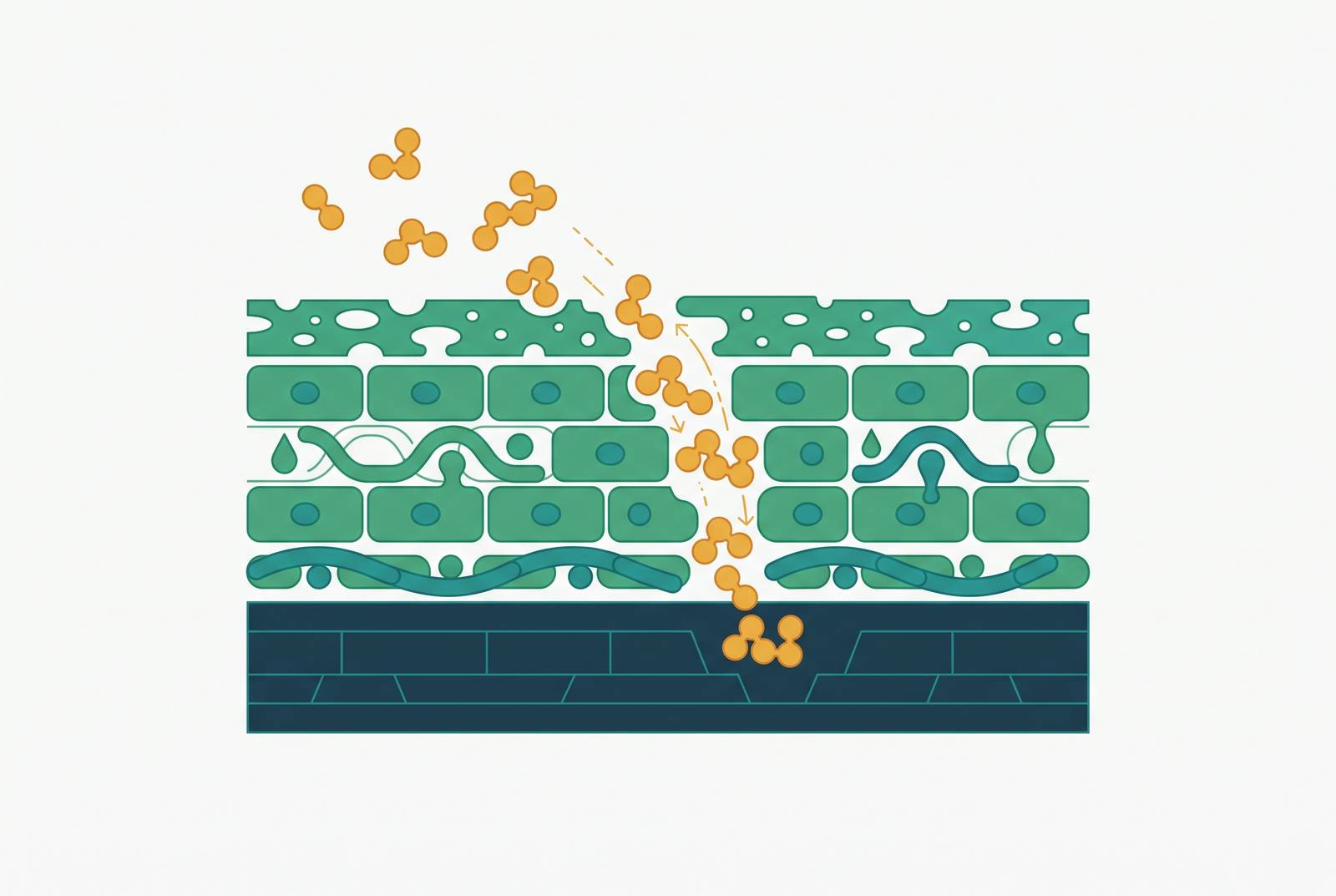
Peptide biologics and the nasal mucosa are built in opposition to one another. The molecules are large, hydrophilic, and sensitive to enzymatic attack. The mucosal surface they must cross evolved for the opposite purpose: to keep exactly this kind of molecule out. One of the major challenges in applying protein and peptide biologics to clinical medicine is the lack of rational and efficient methods to circumvent the epithelial and endothelial cell barriers that separate large molecules from their target tissues, and the nasal cavity is a particularly unforgiving place to attempt it. The mucosa is an active exclusion system, not a passive film that a molecule either does or does not slip through, and a peptide landing on it triggers several rejection mechanisms at once, not one.
That multiplicity matters more than any single obstacle. Intranasal formulations have to contend with restricted dose volume, limited surface area, and a set of absorption barriers built into the mucosa itself, all while working inside a time window that mucociliary clearance sets and closes on its own schedule regardless of what has or has not been absorbed yet. No single fix addresses all of these at once.
Nasal delivery falls short most starkly when compared to the route peptide biologics already rely on. Subcutaneous injection delivers most peptides into systemic circulation with high efficiency because it skips the mucosal gauntlet. Intranasal bioavailability, by contrast, swings widely from one peptide to the next, and often lands far below what injection achieves, depending on the specific molecule's size, charge, and the formulation built around it. Understanding why that gap exists, and why it is not closed by any one clever trick, requires working through the barriers one at a time, starting with the variable that determines which of them will matter most for a given peptide: molecular weight.
Molecular weight and the hard ceiling on passive nasal absorption
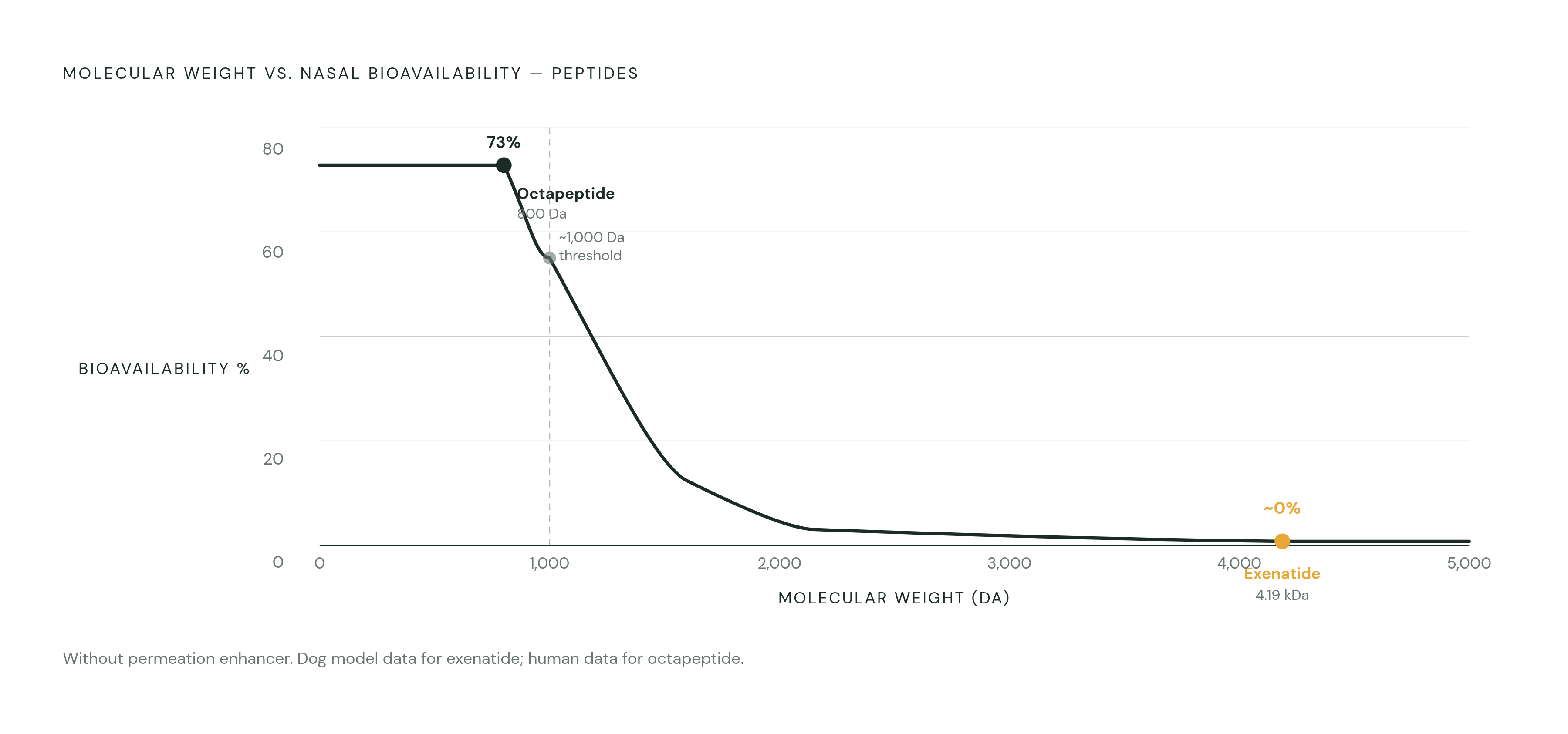
Size sets the terms before anything else does. Research on nasal peptide absorption has found that above roughly 1,000 Da, molecular size becomes the single strongest predictor of how much of a dose will cross the mucosa, outweighing other molecular properties in determining the outcome. It is close to a hard ceiling, and the published bioavailability data make the shape of that ceiling vivid.
An 800 Da octapeptide, small enough to sit just under the threshold where size starts to dominate, achieves roughly 73% nasal bioavailability with no permeation enhancer. The slope between those three points is a cliff, and most therapeutic peptides of clinical interest sit well past its edge.
The cliff exists because of timing, not merely permeability in the abstract. Larger peptides diffuse across the epithelial surface more slowly, and the nasal mucosa does not wait for them. Enzymatic degradation and mucociliary clearance both operate on their own fixed clocks, regardless of how large or fragile the molecule sitting on the mucosa happens to be. A peptide has to cross before those clocks run out, and slower diffusion simply means losing that race more often.
The GLP-1 therapeutic class illustrates the stakes concretely. Exenatide, a GLP-1 receptor agonist built from 39 amino acids at approximately 4.19 kDa (4186.6 Da), reached only minimal nasal bioavailability in dogs when given without an enhancer, a result that places the entire GLP-1 class in the near-impermeable range by default, purely as a function of size. The ceiling, in other words, is not absolute. But clearing it required actively working against the barriers that stop a peptide this size, not simply adjusting the formulation at the margins.
Size is not the only variable in play. A peptide at 4 kDa does not have that luxury, and understanding why requires looking at each barrier in turn, starting with the one that begins working the moment a peptide lands on the mucosal surface.
Barrier one: how proteolytic enzymes in the nasal mucosa degrade peptides before they reach the epithelium
The nasal mucosa does more than block molecules mechanically. It is enzymatically active, and the mucus layer coating the epithelium contains proteolytic enzymes whose job, in effect, is to cleave peptide bonds on contact. A peptide biologic sitting in that mucus is not waiting to be absorbed so much as it is being actively disassembled, and that process starts well before the molecule ever reaches a tight junction or gets caught in the sweep of ciliary motion. Enzymatic degradation is independent of the other two barriers in a strict sense: it does not require the peptide to attempt paracellular transit, and it does not depend on how long clearance takes to remove the dose. It begins in the extracellular mucus layer, acting on the molecule before the question of crossing the epithelium even arises.
The GLP-1 class again offers a concrete illustration. A molecule that falls apart quickly in solution needs to cross the mucosa fast or not cross.
Addressing this barrier gives formulation scientists a narrow set of choices. A carrier or excipient has to shield the peptide from enzymatic contact through encapsulation, inhibit the relevant proteases directly, or deliver the peptide fast enough that degradation stays incomplete by the time absorption happens. Nanoparticle-based delivery systems have become the most studied response, because a well-designed particle can protect the peptide from enzymatic attack, improve mucoadhesion to extend how long the formulation stays in contact with the mucosa, and allow controlled release, all through a single engineered construct. That triple function will matter again later, because enzymatic degradation is only the first of three barriers operating at once, and a solution to this one alone does not guarantee that a peptide which survives intact will have anywhere to go.
Barrier two: why tight junctions between epithelial cells block the paracellular route for peptides
Even a peptide that survives the mucus layer intact runs into a second obstacle immediately: the space between epithelial cells. Tight junctions are protein complexes that seal that paracellular space, and they evolved specifically to prevent macromolecules and pathogens from slipping through it. Peptide biologics fall squarely into the category these junctions were built to exclude, which closes off what would otherwise be the most intuitive route into the body: simply passing between cells rather than through them.
With the paracellular path sealed, the only viable option left is transcellular: going through the epithelial cell itself. The relevant mechanism is transcytosis, a process in which the cell internalizes a molecule on one surface, traffics it across the cytoplasm inside an endosome, and releases it on the opposite side. For large solutes crossing mucosal epithelium, transcytosis is the established route, and that makes it the molecular gateway that much of the engineering effort around nasal peptide delivery is trying to exploit.
Transcytosis is not available for free, however. Each of those steps is a separate bottleneck, and a formulation that fails at any one of them fails the whole barrier.
The glycosphingolipid conjugation work offers the clearest published demonstration of what exploiting this pathway correctly can achieve. Peptide cargoes fused to glycosphingolipids carrying ceramide domains with C6:0 or smaller fatty acids crossed epithelial barriers with 20 to 100 times greater efficiency, both in vitro and in vivo, than the unconjugated peptide alone. That gain comes not from brute-force permeabilization but from the ceramide domain hijacking the cell's own endogenous lipid-sorting machinery, essentially routing the peptide cargo through a trafficking pathway the cell already runs for its own purposes. That is a fundamentally different strategy from forcing a molecule through by sheer concentration or pressure, and it points to transcytosis, engineered correctly, as a route with real headroom.
An obvious objection follows from the existence of permeation enhancers: if tight junctions are the obstacle, why not just open them transiently and let the peptide through directly? Nanocarrier size and surface chemistry can be tuned to improve mucosal penetration through receptor-mediated endocytosis or through transient junction-opening, but controlled transcytosis remains the preferred engineering target for a reason: it achieves transport without indiscriminately dismantling the barrier for everything else riding along with the formulation.
Barrier three: how mucociliary clearance races against absorption and usually wins
Surviving enzymatic attack and finding a transcytosis route still does not guarantee a peptide reaches circulation, because the nasal mucosa is in constant motion rather than a static surface. Mucociliary clearance is a normal physiological defense against inhaled pathogens and particles, and the ciliated epithelium sweeps mucus, and anything suspended in it, toward the nasopharynx continuously. That sweeping happens on a fixed timescale that has nothing to do with whether the material riding along is a therapeutic peptide or an inhaled dust particle. The mucosa does not know the difference, and it does not slow down to accommodate one.
Where a dose lands changes how much time it gets. Deposition near the nasal vestibule, toward the front of the cavity where ciliary density runs lower, produces slower clearance and longer contact time than deposition further back, where cilia are denser and clearance moves faster. That difference in deposition site is part of why desmopressin delivered as a spray has performed better than desmopressin delivered as drops in some studies, a formulation detail that looks small until the underlying clearance mechanics are understood.
Mucoadhesive agents respond to this barrier directly, by anchoring the formulation to the mucosal surface rather than letting it float freely in the mucus layer where cilia can sweep it away. Thermoresponsive hydrogels represent a more recent extension of the same logic: a formulation that is low-viscosity and easy to spray at room temperature, then transitions to a higher-viscosity, mucoadhesive gel once it reaches body temperature, addressing clearance directly at the level of the formulation itself rather than relying on surface chemistry alone.
Mucociliary clearance interacts with the other two barriers more directly than either interacts with it. Compress that time budget, and a peptide gets fewer opportunities to be degraded, but it also gets fewer opportunities to be absorbed, since the two competing processes, destruction and crossing, are both racing against the same shrinking clock. That shared dependence on a single time constraint is what links all three barriers together, and it is the reason none of them can be treated as a separate problem to solve in isolation.
Defeating the three barriers simultaneously, not sequentially
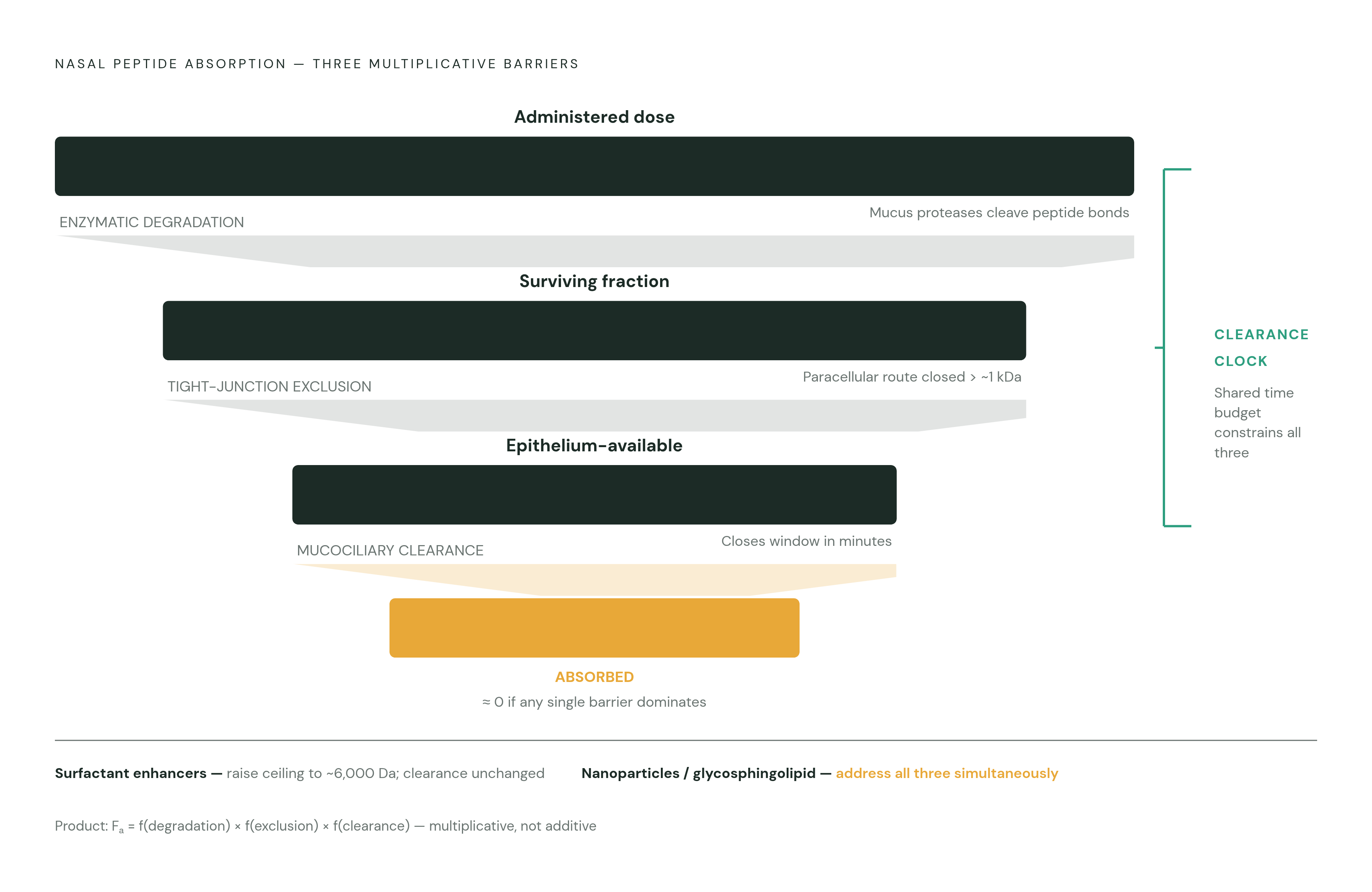
The three barriers do not simply add up. They multiply against each other, because each one determines how much material is left over for the next one to act on. A formulation that solves enzymatic degradation but leaves clearance unaddressed still fails, since the peptide it protects gets swept away before it ever reaches a transcytosis pathway. A formulation that extends residence time through mucoadhesion but does nothing to enable transcellular transport also fails, because the peptide simply sits on the mucosal surface longer before eventually being degraded or cleared anyway. Solving any one barrier in isolation does not accumulate toward a solution if the timescales and mechanisms involved are not engineered together from the start.
The relationship is kinetic rather than conceptual. Mucociliary clearance sets a fixed time budget for everything else to happen within. Enzymatic degradation consumes a share of the intact drug inside that time budget, continuously, from the moment of deposition. Tight-junction exclusion then blocks transcellular transit of whatever fraction of the dose survives both of the first two processes. If any single one of these three terms dominates the outcome, overall absorption approaches zero regardless of how well the other two are handled. That is the mathematical shape of the problem, and it is why a single-barrier fix, however elegant, tends to produce disappointing bioavailability numbers in practice.
Simple permeation enhancers illustrate the limits of a partial solution well. Surfactants and medium-chain fatty acids can extend the effective molecular weight ceiling for passive absorption, allowing molecules up to roughly 6,000 Da to achieve meaningful absorption where they would otherwise be nearly impermeable. That is a real gain, but it falls well short of the molecular weight of many peptide biologics of clinical interest, and it does nothing at all to address clearance, which keeps running on its own schedule regardless of how permeable the epithelium has become.
Nanoparticle carriers represent a more complete answer because a single, well-designed particle can be built to address all three barriers at once rather than trading one for another. Nanoparticulate systems have proven particularly useful for biopharmaceuticals with inherently low epithelial permeability precisely because their size and surface properties can be engineered to improve mucosal penetration through receptor-mediated endocytosis, addressing both transcytosis and clearance with the same physical object.
The glycosphingolipid conjugation work offers a different but complementary proof of the same underlying principle. By solving transcytosis at the molecular level, rather than through a particle carrier, it achieves mucosal bioavailability for GLP-1 that approaches what injection delivers directly, and it does so in a construct that inherently shields the cargo during transit, addressing enzymatic exposure as a byproduct of solving transcytosis rather than as a separate engineering task. That outcome reinforces the central point rather than contradicting it: the molecular route and the particle route arrive at similar results because both, in their own way, treat the three barriers as a single interconnected design problem rather than three separate items on a checklist.
A reasonable objection remains. The degrees of freedom available to formulation science, encapsulation, surface chemistry, particle size, mucoadhesive coating, and molecular conjugation, are not infinite, but they are enough to construct an answer tuned to all three barriers at once, provided the design starts from that premise rather than arriving at it one fix at a time.
Sources
- Intranasal Peptide Delivery: 5 Key Bioavailability Factors
- Mucosal absorption of therapeutic peptides by harnessing the endogenous sorting of glycosphingolipids
- Exploring intranasal delivery of peptide and protein nanoparticles by a thermoresponsive hydrogel - ScienceDirect
- Therapeutic peptides and proteins: Status and developments in drug delivery - ScienceDirect
- Nose-to-brain drug delivery: from bench to bedside - PMC