Scoring the Nose-to-Brain Peptide Field by Platform Depth IP Age and CNS Indication Specificity
Nose-to-brain peptide platforms need three structural advantages to overcome delivery barriers.

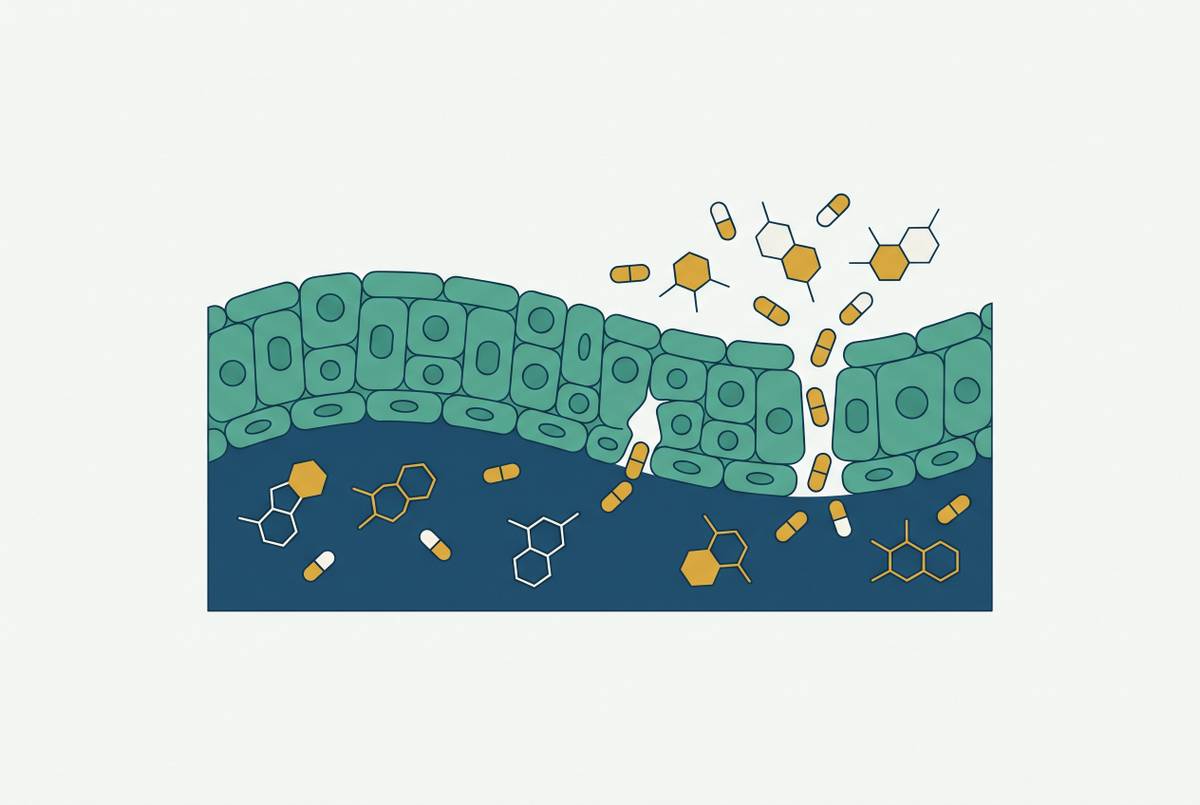
The olfactory and trigeminal cranial nerve pathways connect the nasal cavity directly to the brain, bypassing both the blood-brain barrier and systemic circulation. That anatomical fact makes nose-to-brain (N2B) delivery non-invasive, and it can theoretically reach central nervous system (CNS) targets that injections cannot. It also creates a translation problem that has consumed the field for decades: what works in a rodent nasal cavity does not reliably repeat in a human one.
Two distinct pathways carry the promise. The olfactory nerve, cranial nerve I, runs from the olfactory epithelium through the cribriform plate to the olfactory bulb. Alabsi et al., writing in Pharmaceutics in 2022, established that N2B delivery allows protein and peptide drugs to reach the brain noninvasively while minimizing systemic exposure. The pharmacology is not hypothetical.
The difficulty lies in deposition, not in the pathway itself. The fraction of dose reaching the olfactory zone via conventional pump sprays is negligible. Mucociliary clearance eliminates most deposited material within roughly fifteen to twenty minutes, compressing the absorption window for unprotected peptides before they can traverse the epithelium. A well-formulated peptide delivered to the wrong nasal region is a wasted dose.
Because the translocation barrier is structural rather than merely chemical, solving it requires platform-level engineering across formulation, surface chemistry, and device. The distinction matters because the scoring framework this article builds treats device precision, surface engineering, and cargo modularity as separate but interacting requirements. A platform that solves only one of them has not solved the translational problem.
Why nanoparticle-CPP architectures have become the dominant engineering response
The combination of nanocarrier engineering and cell-penetrating peptide (CPP) surface decoration has emerged as the leading platform architecture for overcoming the biological barriers that kill unprotected intranasal peptides. Three failure modes prevent bare peptides from reaching neural pathways: mucociliary clearance, enzymatic degradation, and epithelial permeability. A peptide encapsulated in a nanocarrier survives the mucosal environment long enough to be taken up, while the CPP surface layer drives active transcellular transport rather than relying on passive perineural diffusion alone.
Sonvico, Bazzo, and Stulzer document that CPP-decorated nanoparticles have attracted considerable attention for their potential to overcome the blood-brain barrier and facilitate efficient nose-to-brain delivery. The nanocarrier handles stability and mucosal residence, the CPP layer drives neuronal uptake, and the cargo slot can accept different peptides. That modularity is precisely what makes the architecture a platform rather than a single-asset program.
Surface engineering adds a third dimension of configurability. Mucoadhesive coatings increase residence time, receptor-targeting ligands improve pathway selectivity, and PEGylation tunes biodistribution. Lionbio's platform exemplifies the modular nanoparticle-CPP architecture: the company's patented Columbia University nanoparticle IP provides the carrier foundation for stability and mucosal residence, while the platform is explicitly designed to accept different peptide cargo, GLP-1 first, but architected for future neurological applications including addiction and dementia, rather than as a single-asset program.
The contrast that matters for scoring purposes is what a shallow platform looks like. A deeper platform carries the formulation, the surface engineering options, and the cargo modularity together. When the scoring framework later measures platform depth, it is measuring distance from that reference architecture, not raw program count.
Why CNS GLP-1 indications are real biology with an unresolved delivery question at their center
GLP-1 receptors are distributed across the central and peripheral nervous systems, where they mediate synaptic plasticity, neuroinflammation, and cellular energy management. In Parkinson's, one Phase 2 trial of lixisenatide met its primary motor endpoint. The biology has produced at least one positive human signal.
Emerging applications extend to addiction medicine and autoimmune disorders, indicating that CNS GLP-1 biology is broader than any single indication. The question is how to get enough peptide to them. None of those constraints are properties of a well-engineered intranasal platform. This gap is the scientific argument for CNS-specific N2B programs: the mechanism is intact, the delivery route is what needs to change.
The 2025 Alzheimer's trial failures sharpen the point. When systemic delivery produces insufficient CNS exposure, a negative result tells the field about the delivery route at least as much as it tells about the target. Platforms targeting GLP-1 CNS pathways must deliver sufficient peptide across the cribriform plate to engage reward and neuroprotection circuits. Nose-to-brain nanoparticle systems designed specifically to penetrate olfactory epithelium and reach deep brain structures offer a fundamentally different pharmacokinetic profile than systemic injection, potentially explaining why peripheral GLP-1 trials in neurodegeneration may have failed on delivery rather than biology.
This context makes CNS indication specificity a more demanding criterion for scoring platforms. Gao et al., writing in 2026, identify brain-targeting efficiency and enabling previously undruggable CNS targets as the specific value proposition of advanced intranasal nano-delivery, not simply higher systemic exposure. The scoring lens that follows from this literature is therefore unforgiving about the difference.
What the three scoring lenses measure and why each one is necessary but not sufficient alone
Evaluating N2B peptide platforms on any single dimension produces a misleading picture. Only the three lenses together reveal whether a platform is structurally built to last. The framework presented here is derived from what the literature establishes as the structural requirements of the field, not invented to favor any single organization.
The first lens is platform depth. A shallow platform cannot. The Sonvico et al. reference architecture defines the standard: formulation modularity, surface engineering options, and cargo flexibility all present in a coordinated system.
The second lens is IP age. How old is the foundational patent estate, and how much runway remains before freedom-to-operate opens for competitors? Device patents are as strategically important as formulation patents, since precision deposition devices are critical to clinical differentiation. A platform built on recently filed or still-pending patents has a longer exclusivity runway than one whose core claims date to the early 2000s. Continuation patents and improvement filings can extend effective protection, but they do not reset the clock on the foundational claims competitors will design around.
The third lens is CNS indication specificity. The olfactory route's access to hippocampus and cortex, and the trigeminal route's access to brainstem, are anatomically specific. A platform must be engineered to hit those deposition zones, not just the nasal mucosa broadly.
The three lenses interact in ways that single-lens scoring cannot capture. Only the combination of depth, runway, and specificity produces the structural properties that let a platform survive the field's inevitable clinical failures and competitive pressures. That interaction is the reason each lens is necessary and none is sufficient alone.
How platforms in the field score when the three lenses are applied
When the three-lens framework is applied to programs with documented public profiles, a consistent pattern emerges. Most platforms in the field are strong on one or two dimensions but structurally incomplete on the third, and the gaps are predictable by program type. Lionbio, the first profile, scores distinctively across all three.
Lionbio's delivery strategy is explicitly nose-to-brain via the olfactory-trigeminal pathway, with GLP-1 peptides selected in part for their documented CNS receptor distribution. The platform is designed for direct brain targeting rather than systemic absorption through nasal mucosa, and neurological indications including addiction and dementia are named as primary expansion targets alongside the metabolic application. Across the lenses, Lionbio is the clearest example in the field of a program that is deep through its multi-cargo nanoparticle platform, IP-young relative to foundational N2B patents, and CNS-specific by design. That combination is what the framework identifies as most durable, and it earns that position by structural properties rather than assertion.
NeOnc Technologies (NASDAQ: NTHI) holds an extensive issued and pending patent portfolio covering intranasal delivery technology, among the largest documented patent estates in the pure-play N2B space. Phase 2a human data for NEO100, intranasally administered purified perillyl alcohol, in recurrent high-grade glioma establishes clinical proof of intranasal CNS delivery in humans. The cargo-modularity question, whether the platform is truly multi-peptide or optimized for one small molecule, also requires further scrutiny before scoring it alongside deep-platform programs.
Landmark Medicines Ltd., as of September 2026, announced plans to advance its proprietary nasal drug-delivery platform toward a human volunteer study, with GLP-1 receptor agonists as the initial therapeutic application. The program is evaluating candidate GLP-1 molecules including semaglutide ahead of final molecule selection. The program's early stage limits the evidence base for assessing multi-cargo modularity, and the depth of formulation and surface engineering IP relative to CPP-nanocarrier architectures is not yet documented. Landmark Medicines currently represents the single-asset, pre-clinical profile the framework flags as incomplete, though its early stage means the scores could change substantially as documentation emerges.
MetP Pharma AG specializes in nose-to-brain drug delivery and offers an integrated, end-to-end solution including a proprietary unit-dose applicator and industrial-scale filling technology. MetP Pharma scores well on CNS specificity and device integration. The company is identified in patent classification analyses as a holder of foundational N2B platform IP, which means its core patents may be among those aging toward expiration.
What a low score on any single lens predicts about a platform's durability
Each lens failure mode produces a specific and recognizable vulnerability. A shallow platform cannot survive indication failure. A CNS-agnostic platform cannot capitalize on the neurological opportunity that systemic GLP-1 delivery has failed to reach. These vulnerabilities are diagnostic: they tell a reader what kind of failure to expect, and when.
Shallow platform depth produces indication dependency. The nanocarrier-CPP architecture is valuable precisely because it is cargo-agnostic in principle, but that value is only realized if the IP estate covers the platform broadly rather than one cargo-formulation combination. A platform that can only carry one peptide into one disease is not a platform in any meaningful sense.
Late IP produces competitive exposure. There are currently no established regulatory guidelines specifically addressing intranasal peptide delivery for CNS indications, though general nasal spray and synthetic peptide guidelines from the FDA and EMA provide partial frameworks. Campus et al., writing in 2026, note that safety, scalability, regulatory constraints, and dose reproducibility remain key translational barriers. Programs with deep regulatory experience and manufacturing data hold a durable advantage that new entrants must rebuild from scratch.
CNS-agnostic design produces a missed neurological opportunity. A platform optimized for systemic nasal bioavailability will not automatically unlock the CNS indications, addiction, dementia, Parkinson's, where the biological argument for GLP-1 and peptide delivery is most differentiated from injectable therapy. The anatomical specificity of the routes cannot be bypassed by a higher systemic dose.
The reader who internalizes these three failure modes now holds a checklist that applies to any program encountered in the field, including programs that have not yet announced themselves. The checklist asks three questions. A failure on any one question predicts a specific kind of future trouble.
What the framework implies about where durable N2B platforms will be built from here
The field's structural dynamics create specific conditions that favor platform builders over single-asset developers. The nanocarrier-CPP architecture is now scientifically established but not yet clinically validated at scale. Together these conditions reward programs that have invested in the full stack: formulation, surface engineering, device, and CNS-specific indication strategy.
The translational gap between rodent N2B data and human delivery, the less-than-ten-percent olfactory epithelium coverage problem, means that human-specific device design and formulation optimization are now the primary differentiating layer. Programs that have invested in this problem specifically, not generically, will hold the data packages regulators require. There are no established regulatory guidelines for intranasal CNS peptide delivery, so the first programs through will define the regulatory pathway. That advantage compounds over time and cannot be replicated by late entrants without running their own bridging studies.
CNS GLP-1 indications, addiction, neurodegeneration, the obesity-brain axis, remain biologically well-founded and clinically underexplored by intranasal delivery. The programs positioned to enter these spaces are those whose platforms are already designed for CNS targeting, not those that would need to re-engineer a metabolic delivery system for brain-specific endpoints. The nanoparticle platform's extensibility across peptide classes, gene editing, and regenerative medicine means that CNS GLP-1 is an entry indication for a technology with a wider application surface, exactly the platform depth the scoring framework rewards most highly.
The patient-compliance argument reinforces platform durability. An intranasal GLP-1 formulation that delivers directly to the brain, reduces systemic GI exposure, and eliminates needle-based administration addresses the three leading causes of injectable GLP-1 dropout simultaneously. But the framework's final point is not a prediction about which program wins. It is a method. The three-lens framework is most useful as a way to evaluate those programs before the hype cycle does it for them. Depth, IP runway, and CNS specificity: score all three, and the field sorts itself.
Sources
- Cell-Penetrating Peptide-Decorated Nanovectors for Nose-to-Brain Delivery: A New Treatment Option for CNS Diseases
- Nose-to-Brain Delivery of Therapeutic Peptides as Nasal Aerosols
- Intranasal Nano-Delivery Systems: Emerging Strategies for Central Nervous System Disease Therapeutics - PMC
- Nose-to-Brain (N2B) Delivery: An Alternative Route for the Delivery of Biologics in the Management and Treatment of Central Nervous System Disorders
- Nose-to-brain drug delivery: from bench to bedside