Nasal Epithelium Barriers to CNS Drug Delivery
The nasal route to the brain works differently than animal studies suggest.
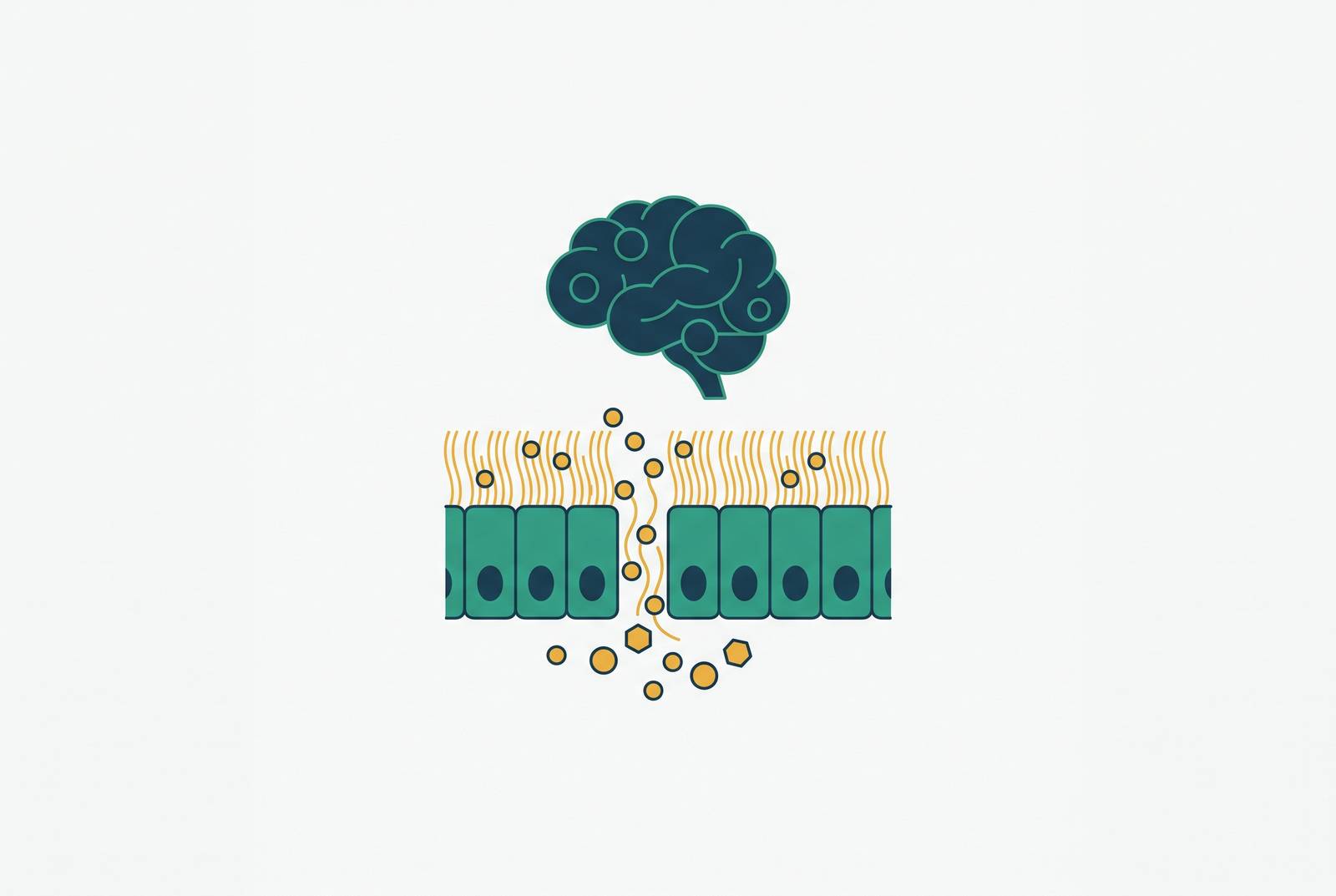
The blood-brain barrier stops most drugs cold. That is why a therapeutic that works beautifully in a petri dish so often does nothing for a neurological condition once it enters the bloodstream. That single fact, more than any other, explains the growing interest in nose-to-brain delivery: the nasal cavity offers a route into the central nervous system that bypasses that barrier. This piece maps the layered set of obstacles, anatomical, mucociliary, and enzymatic, that stand between a nasal spray and a therapeutic effect in the brain, and asks what a formulation actually has to do to get through all of them at once.
Intrathecal injection and mechanical BBB disruption both work, in the narrow sense that they get a drug into the brain. But they are invasive procedures with real complication risk, not something a patient administers at home twice a day. Intranasal delivery, by contrast, is self-administered, skips first-pass liver metabolism entirely, and in principle can act fast because of one anatomical quirk that gets less attention than it deserves: the olfactory neuroepithelium is the only piece of the central nervous system that sits in direct contact with the outside world. Everything else about the CNS is sealed. This one tissue is not.
Two epithelial regions, two different pathways to the brain
The nasal cavity is not one uniform surface, and treating it as such is where a lot of naive formulation thinking goes wrong. Two epithelial regions do fundamentally different jobs, and a drug's fate depends heavily on which one it actually contacts.
The olfactory epithelium sits high in the nasal cavity, lined by olfactory sensory neurons and Bowman's glands, and its neurons send axons straight through the cribriform plate into the olfactory bulb. That is the direct wire to the forebrain, no detour through the bloodstream required. It sounds like the obvious answer to the whole delivery problem, until you look at the numbers. In humans, olfactory epithelium covers only 3 to 5% of total nasal surface area. In rodents, the same tissue covers roughly 50%. That is not a rounding difference; it is close to a tenfold gap, and it means most of what a human sprays into their nose never touches the tissue that offers the direct route. The olfactory region in a person spans about 5 cm², inside a nasal cavity with a total volume around 6 cm³, and the olfactory epithelium can accommodate only 25 to 200 microliters of volume. Do the geometry, and it becomes clear that most of a nasal dose lands on respiratory epithelium, not olfactory tissue.
Respiratory epithelium covers the bulk of the nasal cavity and mainly feeds drug into systemic circulation, the same slow, indirect route as an oral tablet. But it carries its own path to the brain, through trigeminal nerve innervation. That pathway reaches the brainstem and hindbrain rather than the forebrain, a meaningfully different destination than the olfactory route. The perineural space around the trigeminal nerves connects into the subarachnoid space and cerebrospinal fluid, providing a direct anatomical link to the brain. It is just architecturally distinct, and a formulation aimed at forebrain targets like the hippocampus is not the same formulation you'd want for a brainstem target. In both pathways, once a drug reaches olfactory or trigeminal neurons, it gets pulled inside through nonspecific uptake or receptor-mediated endocytosis. The mechanism of entry is shared; the destination is not.
The mucus layer and mucociliary clearance as the first line of defense a drug encounters
Before a drug reaches either epithelium, it has to survive the mucus. That layer is a continuously secreted gel built specifically to trap inhaled particles and clear them, which is precisely what makes it a problem for a drug trying to sit still long enough to absorb. It is a continuously secreted gel built specifically to trap inhaled particles and clear them, which is precisely what makes it a problem for a drug trying to sit still long enough to absorb.
Cilia on the epithelial surface beat in coordinated waves, sweeping mucus, and anything trapped in it, back toward the pharynx to be swallowed or coughed out. This is mucociliary clearance, and it happens on a clock that has nothing to do with pharmacology. A drug molecule gets a narrow window of residence time in the nasal cavity before it is physically relocated to the gut, at which point it has effectively been redirected away from the nasal absorption route entirely.
For peptides and biologics, the mucus adds a second insult on top of the physical sweep. Peptide drugs also face enzymatic degradation in the nasal environment, a chemical threat that runs alongside the mechanical one. So a peptide sitting in that layer faces two clocks running simultaneously, one mechanical and one chemical, and losing either race means the drug never reaches the epithelial surface intact. Large molecules suffer this worst. If a macromolecule can't cross the epithelial cells fast enough, mucociliary clearance can remove it before absorption has a chance to occur; size, in effect, works against a drug at multiple stages.
Epithelial permeability, molecular weight, and drug crossing of the tissue
Assume a drug survives the mucus. It still has to get across the epithelial cell layer itself, and there are exactly two ways in.
The transcellular route sends a drug straight through the cell membrane, which favors small, lipophilic molecules that can dissolve into the lipid bilayer and pass through it. The paracellular route goes between cells, through tight junctions, and is open to hydrophilic and larger molecules in principle. In practice, tight junctions are built to be restrictive, that's their entire biological purpose, so anything relying on the paracellular path faces low absorption efficiency almost by design.
Molecular weight draws a fairly hard line here. Bioavailability drops sharply once a molecule climbs above roughly 1 kDa, and most therapeutic peptides, GLP-1 analogues very much included, sit well past that threshold. What crosses after the epithelium reaches the lamina propria, where it either enters systemic blood and lymphatic circulation, or, if it went through olfactory neurons, continues along the direct intracellular path to the brain. The tension in this whole field is obvious when you step back: the molecules that cross the nasal epithelium most easily, small and lipophilic, are rarely the molecules with the most interesting CNS therapeutic profiles. The compounds researchers most want to deliver this way are, structurally, close to the worst possible candidates for the transport routes available. That's the central formulation paradox the entire field is organized around solving. It is the central formulation paradox the entire field is organized around solving.
The translational gap that makes rodent data an unreliable guide for human nasal delivery
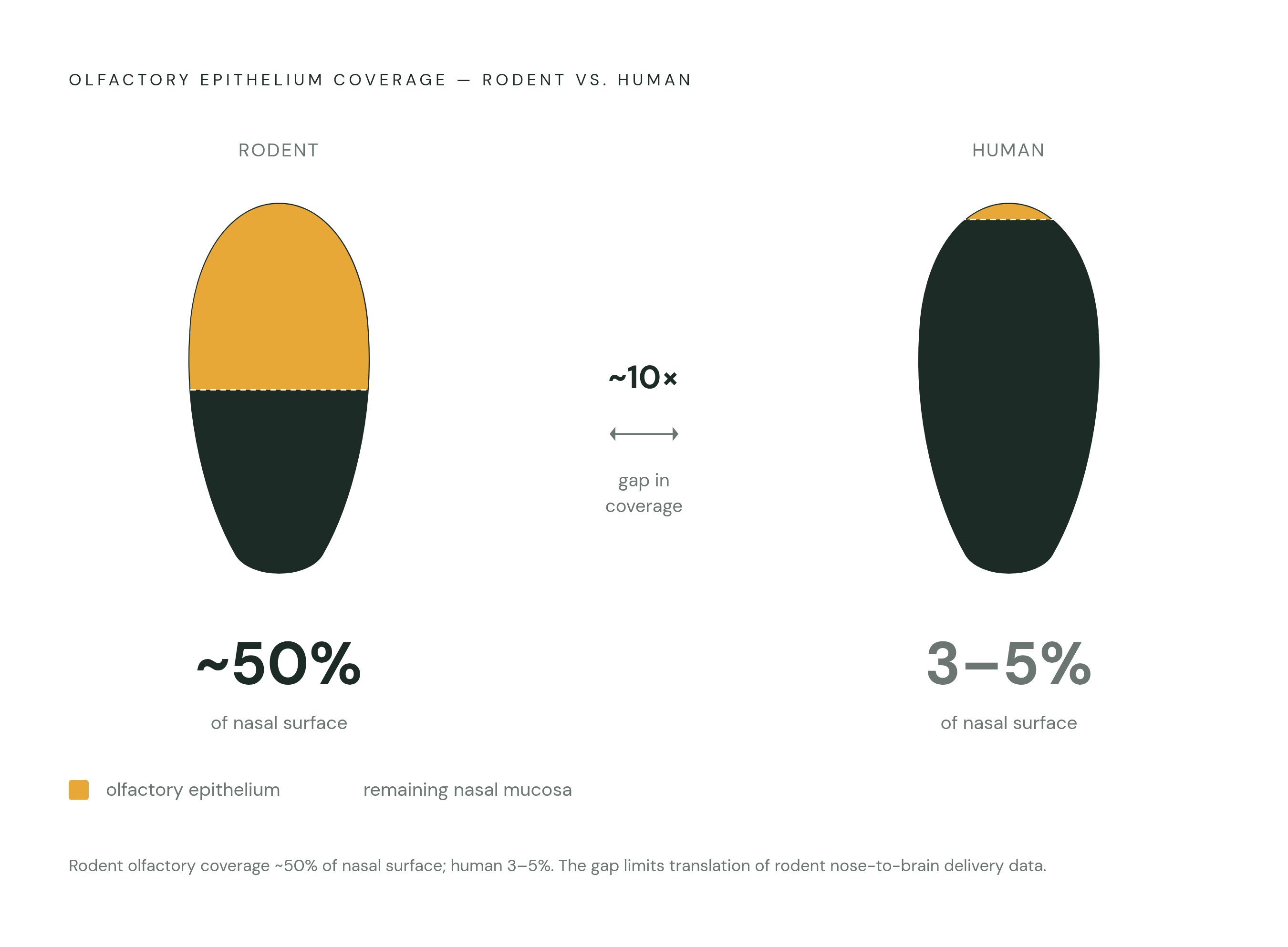
Go back to that 3 to 5% versus roughly 50% olfactory surface area gap between humans and rodents. It is a structural difference in the organ itself, not a footnote correction you apply after the fact. It is a structural difference in the organ itself.
Most preclinical nose-to-brain research runs in rodents, for all the usual reasons, cost, breeding time, tissue access. But when the tissue proportion that defines the entire direct-to-brain pathway differs by an order of magnitude between species, a rodent brain concentration result doesn't scale down cleanly to a human dose. A result that looks excellent in a mouse can represent a drug reaching a tissue that, proportionally, barely exists in a person's nose.
Species anatomy is only one piece of the translational gap. Human nasal cavities also have limited dose capacity, so there's a ceiling on how much formulation can even be administered per spray. Delivery is device-dependent in a way that is easy to underweight: where a spray actually deposits inside a human nasal cavity depends on device geometry, spray angle, and droplet size, so two devices delivering the "same" formulation can produce different exposure outcomes. On top of that, there's no standardized protocol yet for assessing nose-to-brain delivery, in either clinical or preclinical settings, which makes cross-study comparison genuinely difficult. And long-term tolerability and safety data for the newer excipients and carrier materials involved remains thin.
The GLP-1 brain penetration question makes this translational gap concrete rather than abstract. With semaglutide given subcutaneously or orally, meaningful brain penetration through current routes remains a significant unresolved challenge. For a molecule whose neurological upside depends entirely on reaching brain tissue, that is not a minor caveat buried in a methods section. It is close to the whole story.
Nanoparticle platforms, their effects on each barrier layer, and supporting evidence
Given three separate barriers, mucus clearance, epithelial permeability, and enzymatic degradation, it follows that no single mechanism fixes all of them. Nanoparticle platforms tend to work through three complementary strategies: mucoadhesion, mucopenetration, and permeation enhancement, each aimed at a different layer described above.
Polymeric nanoparticles built from PLGA, chitosan, and alginate offer tunable size and surface chemistry, decent drug-loading capacity, and controlled-release kinetics that stretch out nasal residence time well past what a free drug would get. Some are functionalized with cell-penetrating peptides to add targeting specificity on top of that. Lipid-based nanoparticles take a different angle, modifying surface properties specifically to get through mucosal barriers; the translational potential here looks real, though mucociliary clearance and getting the particle to prefer the right mucosal region over another remain open design problems. Mucoadhesive polymers attack the clearance barrier head-on, binding to mucus components to slow the sweep rate. Fast-dissolving and sustained-release polymer variants approach drug residence time from opposite kinetic directions, one favoring quick absorption before clearance, the other favoring a longer, steadier presence. Electrospun fibrous systems are a newer entrant into intranasal delivery, and a review spanning January 2010 through May 2026 tracks a growing body of work on how formulation characteristics shape drug-mucosa interactions in these systems. Exosomes and other extracellular vesicles, which naturally carry cargo and inherit some tissue tropism from their parent cells, show up as part of a newer, bio-inspired generation of platforms covered in a 2026 review out of NUS Synthetic Biology.
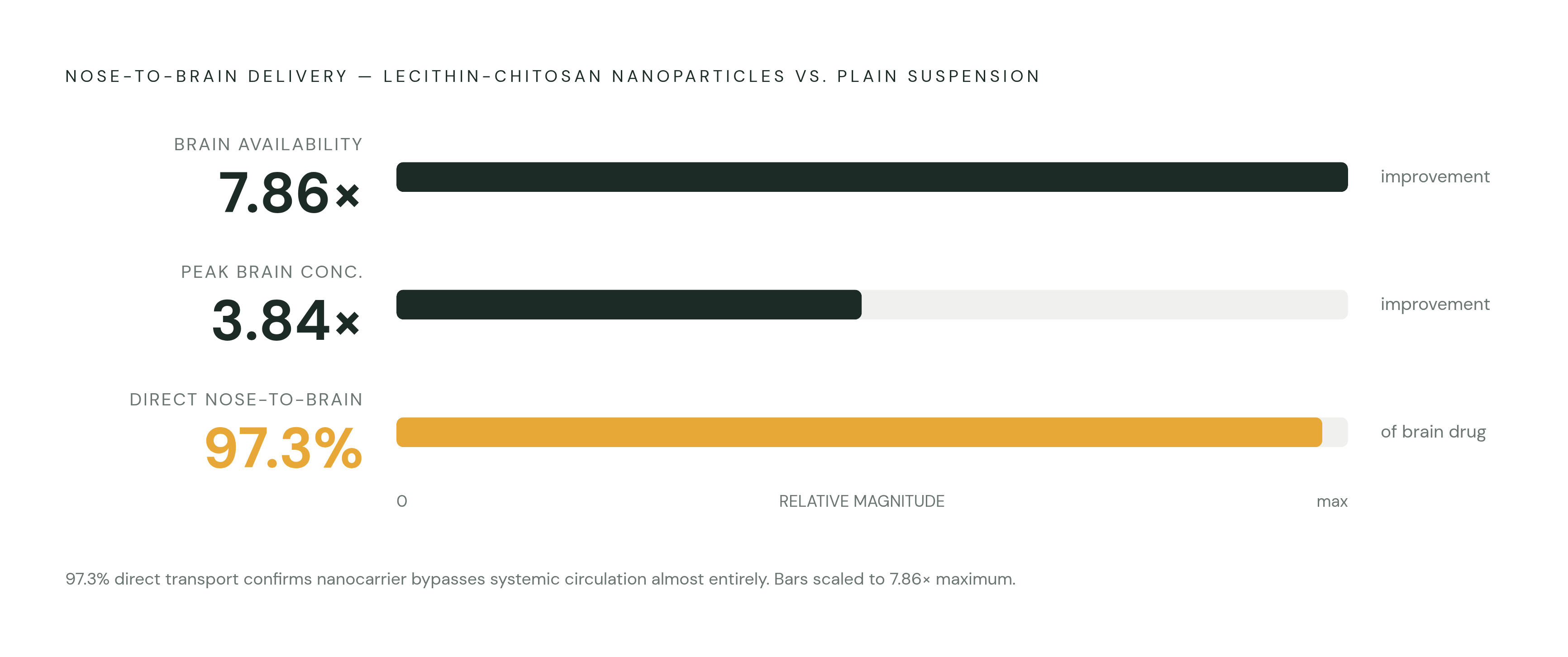
The most compelling preclinical number in this space comes from intranasal rotigotine delivered in lecithin-chitosan nanoparticles: a 7.86-fold improvement in brain availability of rotigotine, alongside a 3.84-fold increase in peak brain drug concentration, compared to an intranasal drug suspension without the nanoparticle carrier. Direct drug transport percentage came in at 97.3%, meaning almost all of the drug that reached the brain got there through the direct nose-to-brain pathway rather than by leaking through systemic circulation first. That is the scale of gain nanocarrier engineering is designed to produce, and it is a useful benchmark for what "working" looks like in this field.
None of that erases the practical hurdles. Polymer toxicity, biocompatibility across repeat dosing, and manufacturing that scales beyond a lab bench are all legitimate open problems. They are not reasons to abandon the approach, but they are the honest cost of the next stage of development.
GLP-1 peptides as among the most demanding molecules to deliver this way
GLP-1 peptides sit close to the worst possible case for everything covered so far. They are large and hydrophilic, well above the 1 kDa line where nasal bioavailability starts to fall off sharply, which puts them at the mercy of the same restrictive paracellular route that struggles with anything bigger than a small lipophilic molecule.
The enzymatic exposure compounds the difficulty caused by the molecule's size. GLP-1 degrades quickly in nasal mucus, and the chemical modifications built into injectable analogues to extend systemic half-life, the chemical modifications that give semaglutide a plasma half-life of around seven days when injected subcutaneously, for instance, don't automatically translate into stability against nasal mucosal enzymes. A modification engineered to survive the bloodstream is solving a different chemistry problem than one engineered to survive nasal mucus.
That stability gap connects directly back to the brain-penetration numbers from the section above. Given that only very limited brain penetration has been demonstrated with current subcutaneous or oral GLP-1 dosing, systemic injection looks like a weak strategy specifically for the neurological indications where GLP-1 receptor biology matters most. Those receptors turn up in the hippocampus, the frontal cortex, and the substantia nigra, regions tied to memory formation, executive function, and motor control, respectively. GLP-1 receptor agonists also interact with dopamine, serotonin, and glutamate signaling. That is not a peripheral metabolic footnote; it's a receptor distribution that points squarely at cognition, movement disorders, and reward circuitry, none of which a drug can influence if it never meaningfully reaches those tissues.
Requirements a formulation must accomplish simultaneously to clear every barrier layer
Every barrier covered in this piece interacts with the others, which is the detail that trips up formulations designed against only one of them. A mucoadhesive coating that stretches out nasal residence time accomplishes nothing if the particle still can't cross the epithelium once it gets there. A permeation enhancer that pries open tight junctions offers no protection at all against an enzyme that degrades the peptide before it ever reaches those junctions. Solve one layer in isolation, and the drug simply fails at the next one instead.
What falls out of that, then, is a fairly short list of things a formulation has to do at the same time, not in sequence. It needs to extend nasal residence time long enough to outlast mucociliary clearance, since a molecule swept into the gut has effectively left the game. And it needs to protect the drug payload from enzymatic degradation across both the mucus layer and the lamina propria, since chemical breakdown doesn't pause just because mucociliary clearance has been outlasted.
Put those requirements next to what's already known about GLP-1's size, its hydrophilicity, and its enzymatic vulnerability in the nasal environment, and the engineering challenge spans all three barriers at once. This is not a molecule that tolerates a partial fix. Every barrier examined here, the mucus, the epithelium, the enzymes, the human-rodent anatomical gap, has to be addressed at once, in a single formulation, for nose-to-brain delivery of a GLP-1 peptide to reach the receptors in the hippocampus and substantia nigra that make the entire approach worth pursuing, which is the problem Lionbio, a biotech developing intranasal nanoparticle-based GLP-1 therapeutics built on Columbia University delivery IP, is specifically engineered to solve.
Sources
- Full article: Differential targeting of olfactory epithelium and respiratory epithelium in nose-to-brain drug delivery
- Polymeric Nanocarrier-Based Drug Formulations for Enhancing Nose-to-Brain Delivery
- Intranasal drug delivery: Unlocking the nose-to-brain route for central nervous system therapies - ScienceDirect
- The Nasal–Brain Drug Delivery Route: Mechanisms and Applications to Central Nervous System Diseases
- The Nasal–Brain Drug Delivery Route: Mechanisms and Applications to Central Nervous System Diseases - Qiu - 2025 - MedComm - Wiley Online Library
- Nose-to-brain drug delivery: from bench to bedside | Translational Neurodegeneration | Springer Nature Link
- researchgate.net