Olfactory and Trigeminal Pathways as the Pharmacokinetic Bypass for BBB-Excluded Peptide Therapeutics
Nasal peptide delivery bypasses the blood-brain barrier through direct neural pathways.
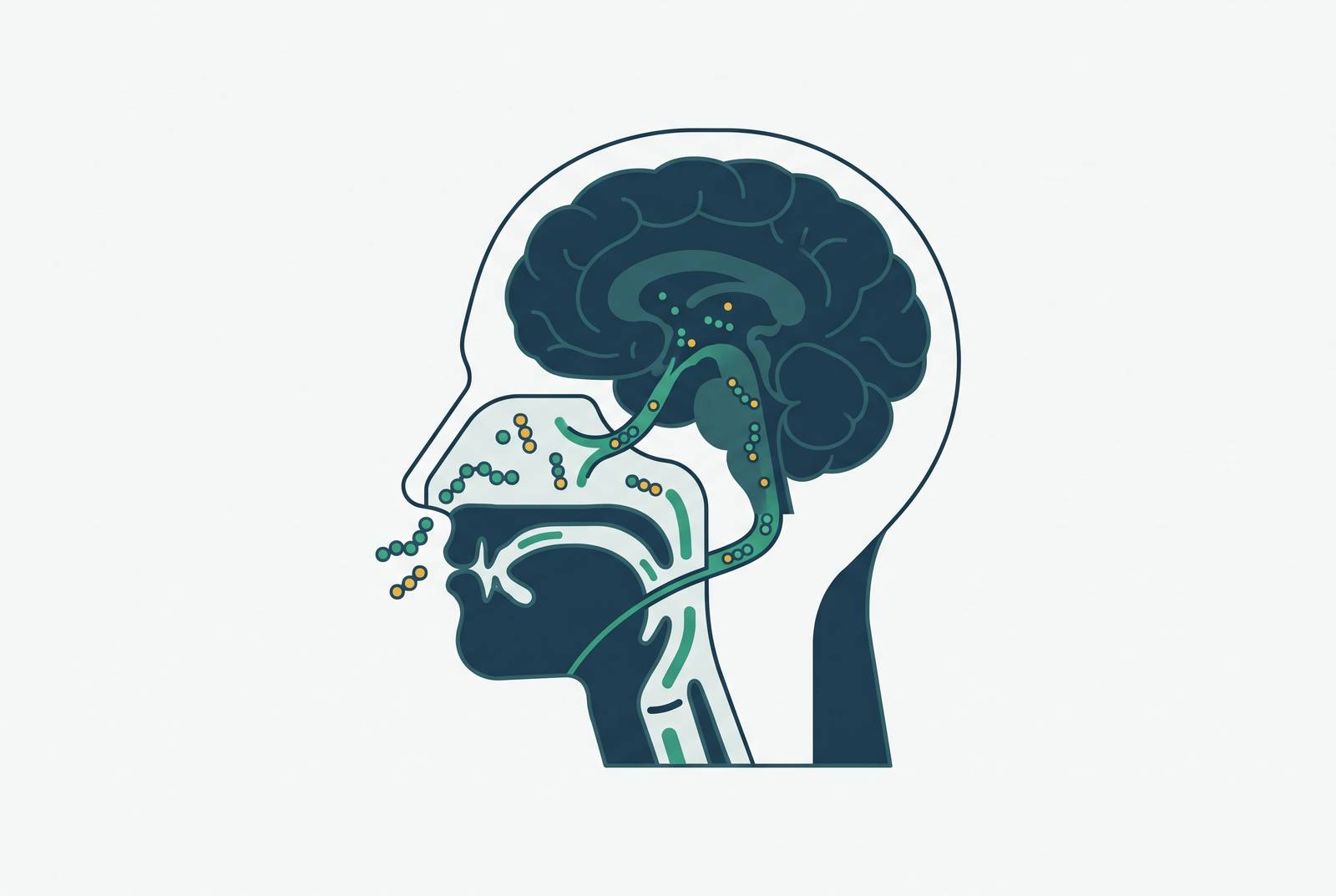
Nanoparticle nose-to-brain delivery for CNS peptide indications uses the olfactory and trigeminal pathways to bypass the blood-brain barrier. These anatomically distinct routes can connect nasal mucosa to CNS targets without first entering systemic circulation. Their promise depends on matching deposition and formulation to the intended pathway, while human evidence must still establish whether the resulting brain exposure is therapeutically useful.
Why the blood-brain barrier makes peptide CNS delivery a distinct engineering problem
The blood-brain barrier excludes more than 98% of small molecules and virtually all large molecules. Peptides are especially hard to deliver because they are large and polar and can break down quickly in systemic circulation. A dose reaching the bloodstream therefore does not establish that enough intact peptide reaches its CNS target. Systemic exposure is not the same as brain exposure.
Acylation and PEGylation can prolong a peptide’s systemic half-life while penalizing BBB penetration, so the modifications that support injection can work against brain access. What if the route itself bypasses the barrier entirely?
The anatomical basis of olfactory and trigeminal transport as a BBB-independent route
The olfactory pathway begins with receptor neurons whose cell bodies lie in the nasal mucosa. Their axons pass through the cribriform plate into the olfactory bulb, forming a physical link that serves the sense of smell. From the bulb, distribution can extend to the hippocampus, cortex, and deeper brain regions. This is an anatomical route. Its pharmacokinetic significance is that direct transport need not pass through blood before reaching the CNS.
Cranial nerve V innervates the respiratory epithelium, with axons projecting to the brainstem, including the pons and medulla, from which distribution can extend more broadly. But respiratory deposition alone does not show that direct trigeminal transport has occurred. The respiratory epithelium mainly supports systemic absorption, which must be told apart from transport along the nerves that supply it. A third route, through nasal blood vessels into circulation and then across the BBB, retains the central targeting constraint of injection.
How the two pathways differ in mechanism, reach, and practical relevance in humans
The human olfactory epithelium contains millions of receptor neurons but occupies approximately 12.5 cm². That makes it a small deposition target relative to the total nasal mucosa. Intracellular transport can take hours, while extracellular perineuronal transport can occur in minutes, depending on the peptide’s physicochemical properties. These transport modes are not exclusive to the olfactory pathway, and their relative contribution cannot be inferred from nasal administration alone.
Because the respiratory epithelium is much larger, most of the deposited drug first touches trigeminal-innervated tissue, though much of that dose may enter the blood through systemic absorption. Olfactory access is more directly aligned with bulb, hippocampal, and cortical targets, while trigeminal access leads first toward brainstem targets. Rodents complicate the comparison because their olfactory surface is proportionally larger than that of humans. A successful animal formulation may therefore benefit from an anatomical opportunity that is harder to exploit clinically.
Kamei et al. demonstrated in 2021 that L-penetratin shifted intranasal insulin and Exendin-4 distribution toward the olfactory mucosal pathway without stimulating transport through trigeminal nerves. Pathway selectivity is therefore an engineering variable. Which route dominates depends on where the dose lands, how its formulation interacts with the epithelium, and which CNS region is sought. Imprecise olfactory targeting and the absence of standardized transport models still limit how confidently those relationships can be measured.
What makes these pathways pharmacokinetically superior to injection for CNS-targeted peptides
For a BBB-excluded peptide, injection puts systemic survival and brain entry between administration and the intended CNS effect. Direct nose-to-brain transport can bypass both steps for the part of the dose that travels through neural pathways. A formulation that delivers more drug to the brain and lowers plasma exposure could act on CNS targets while causing less peripheral receptor activation. This is the central pharmacokinetic rationale for intranasal GLP-1 receptor agonists, whose superior clinical efficacy remains unproven.
The GLP-1 case makes that distinction especially important. Nausea and gastrointestinal distress motivate interest in reducing peripheral exposure, while restricted BBB penetration motivates interest in improving CNS exposure. Direct transport could address both sides of that mismatch, but whether it reduces symptoms in humans remains to be demonstrated. Preclinical intranasal Exendin delivery through the olfactory route improved brain bioavailability by four times compared with intravenous delivery. Potentially faster CNS onset, noninvasiveness, and ease of self-administration add practical advantages, although none establishes that a human nasal formulation will reproduce the animal result.
The adherence crisis with injectable GLP-1s and what it tells us about the delivery problem
A 2026 JAMA Network Open study of a large U.S. adult cohort found that only roughly a quarter remained persistent at 12 months, while fewer than a third met the standard adherence threshold. A Danish study in the same journal in August 2026 found that nearly half of the adults who started semaglutide for obesity stopped within a year. Discontinuation was higher among adults younger than 30, men, and those with histories of gastrointestinal or psychiatric medication use. Sustained treatment is plainly a substantial obstacle. These patterns make delivery a patient-level concern.
The causes, however, are not confined to injections. Gastrointestinal side effects, age, lower income, and lack of meaningful early weight loss all contribute to discontinuation, so the available findings do not isolate route as the dominant cause. A 2025 study in Obesity found real-world weight loss to be roughly half that seen in randomized trials, with early dropout contributing to the gap. Nausea, vomiting, diarrhea, abdominal pain, and constipation provide a mechanistic reason to investigate lower peripheral GLP-1 exposure. The evidence gives reason to test a different way to deliver the drug, but whether nasal administration alone would help people stay on treatment or keep its metabolic efficacy is still unknown.
The neurological frontier that injection cannot reach as effectively as nose-to-brain delivery
GLP-1 receptors are class B G protein-coupled receptors distributed through the central and peripheral nervous systems. Their presence in CNS regions involved in addiction, cognition, and neurodegeneration creates a therapeutic rationale beyond weight management. Receptor presence is only the starting point. Mechanistic evidence links GLP-1 receptor activation with reduced neuroinflammation, enhanced synaptic plasticity, reduced amyloid-beta accumulation, and altered tau phosphorylation. Inoue et al.’s target trial emulation using administrative claims found lower dementia incidence among GLP-1 receptor agonist users than comparators, with HR 0.81 and CI 0.71–0.93.
Short-term trials involving exenatide and lixisenatide showed promising motor and selected non-motor effects in Parkinson’s disease, but disease modification remains unproven. EVOKE and EVOKE+ did not significantly slow Alzheimer’s disease progression, sharpening the question of whether biological plausibility translates into treatment benefit. For peptides whose half-life modifications restrict BBB entry, direct nasal delivery offers a different exposure strategy. It could preserve a neuroprotective peptide sequence without relying on the systemic half-life engineering that compromises brain access, although that possibility still requires clinical testing.
Why RCT evidence for injectable GLP-1s in cognition has failed to match observational signals
EVOKE and EVOKE+ enrolled 3,808 participants and found no significant slowing of disease progression despite improvements in plasma hs-CRP and Alzheimer’s disease-relevant biomarkers. Pooled trials found no improvement in memory and cognition compared with placebo, with SMD –0.01 and low-certainty evidence. Biomarker change did not establish clinical benefit. Nor do observational associations with lower dementia incidence establish that GLP-1 treatment will improve cognition in people with established disease.
Could inadequate CNS exposure explain the discrepancy? This could explain it, because a drug can have peripheral biological activity without enough of it reaching the brain regions it needs to act on. The findings are consistent with a possible delivery problem. They also cannot establish that intranasal administration would produce a different cognitive outcome.
NLY01 illustrates the tension within the molecular-engineering approach. This PEGylated exendin-4 analogue was designed for extended half-life, while PEGylation limits rather than facilitates BBB penetration compared with the parent peptide. The alternative hypothesis is that changing the route can produce an exposure profile that systemic molecular optimization does not reliably provide. Its decisive test remains human CNS exposure and clinical benefit, rather than inference from unsuccessful trials using other delivery strategies.
How do nanoparticles make nose-to-brain delivery for CNS peptides viable?
Nasal deposition starts a short absorption window. Mucociliary clearance moves deposited material toward the throat within 15 to 20 minutes, while mucosal peptidases can cleave peptides before they reach the nerve-associated pathways. Poor epithelial permeability adds another barrier within that window. Nanocarriers address these linked constraints by protecting peptide cargo and, when engineered for mucoadhesion, extending residence time.
Chitosan illustrates how one material can address more than one constraint. Chitosan nanoparticles can increase permeability across the olfactory epithelium and temporarily modify tight junctions, complementing the protection and retention sought from the formulation. Preclinical intranasal rotigotine-loaded lecithin-chitosan nanoparticles improved brain availability of the non-peptide rotigotine by nearly eightfold. It demonstrates the potential magnitude of a formulation effect but cannot supply a quantitative prediction for GLP-1 delivery.
A formulation intended for cortical or hippocampal targets may need a different deposition and transport profile from one aimed first at the brainstem. The L-penetratin result shows why carrier selection can influence that distinction. Protection, residence time, permeability, and pathway selectivity must therefore be understood together. A higher brain concentration is informative, but the interpretation depends on how much arrived directly, where it distributed, and how much systemic exposure accompanied it.
Where the translational effort stands and what remains unresolved
Landmark Medicines Ltd., a UK pharmaceutical development company, announced in September 2026 that it planned to move its proprietary nasal drug-delivery platform toward a study in human volunteers, starting with GLP-1 receptor agonists. The programme aims to test nasal administration for therapeutically relevant peptide exposure. An announced study is not a demonstrated outcome. The available description also leaves unresolved whether Landmark’s platform uses nanoparticles and whether any resulting exposure would reflect direct CNS transport or systemic absorption.
As of 2026, no nose-to-brain peptide formulation has received FDA approval. Insulin and oxytocin are now in advanced clinical testing, while neuropeptide Y is still in early-phase trials. These programmes show that the route can be studied in clinical trials, but whether it works must still be tested. Sikich et al.’s 2021 trial of 290 children with autism found no improvement in social behavior with intranasal oxytocin. That result is a caution against treating encouraging preclinical transport as a substitute for randomized clinical outcomes.
Most delivery devices do not reliably deposit drug in the human olfactory region, and differences in epithelial receptors, lectins, enzymes, and surface area complicate translation from animals. Without standardized in vitro and in vivo transport models, comparisons between formulations also remain difficult. Precision nanoparticle platforms with decades of foundational IP, designed for this delivery challenge, are well-positioned to contribute through protection, retention, permeability control, and pathway targeting, but that foundation does not establish human efficacy. Can those engineering gains produce therapeutically relevant, reproducible CNS peptide exposure in humans without recreating the peripheral exposure the bypass is meant to avoid?
Sources
- Full article: Differential targeting of olfactory epithelium and respiratory epithelium in nose-to-brain drug delivery
- The Nasal–Brain Drug Delivery Route: Mechanisms and Applications to Central Nervous System Diseases
- Nanoemulsions for “Nose-to-Brain” Drug Delivery
- Nose-to-Brain Delivery of Therapeutic Peptides as Nasal Aerosols
- Advancements in Nanocarrier Systems for Nose-to-Brain Drug Delivery
- Intranasal Nanoemulsions for Direct Nose-to-Brain Delivery of Actives for CNS Disorders
- Emerging Frontiers in GLP-1 Therapeutics: A Comprehensive Evidence Base (2025)