Muscle and Lean Mass Loss During GLP-1 Therapy
High-dose GLP-1 drugs may spare muscle more than previously thought.

GLP-1 therapy causes lean mass loss, and the data backs that up. The question that actually matters is what portion of that loss is skeletal muscle, what drives it, and whether a patient and a clinician can do anything about it before it becomes a problem. As a rule of thumb, a meaningful share of total weight lost on any intervention, whether diet, pharmacotherapy, or bariatric surgery, comes from lean tissue. At ADA 2026, Ian Neeland, MD, noted that with higher-dose GLP-1 compounds, that share can climb well above what clinicians have come to expect from older weight-loss methods. But what if the number itself is misleading about where that lean tissue is actually coming from? UC Davis exercise physiologist Keith Baar has pointed out that a roughly 20% skeletal muscle loss figure is not meaningfully different from what caloric restriction alone produces, and that much of the larger lean-mass loss number reported in some studies is coming from the liver, not skeletal muscle. Liver mass and muscle mass have very different consequences for strength, mobility, and metabolic rate, so this distinction changes the entire conversation. One more detail grounds the whole discussion: GLP-1 receptors show minimal and inconsistent expression in human skeletal muscle, and their functional role there remains unsettled. Any effect on muscle has to run through indirect routes, appetite suppression, the resulting caloric deficit, hormonal shifts, or downstream metabolic changes, rather than a direct action of the drug on muscle tissue itself.
The mechanisms that drive lean mass loss on GLP-1 therapy
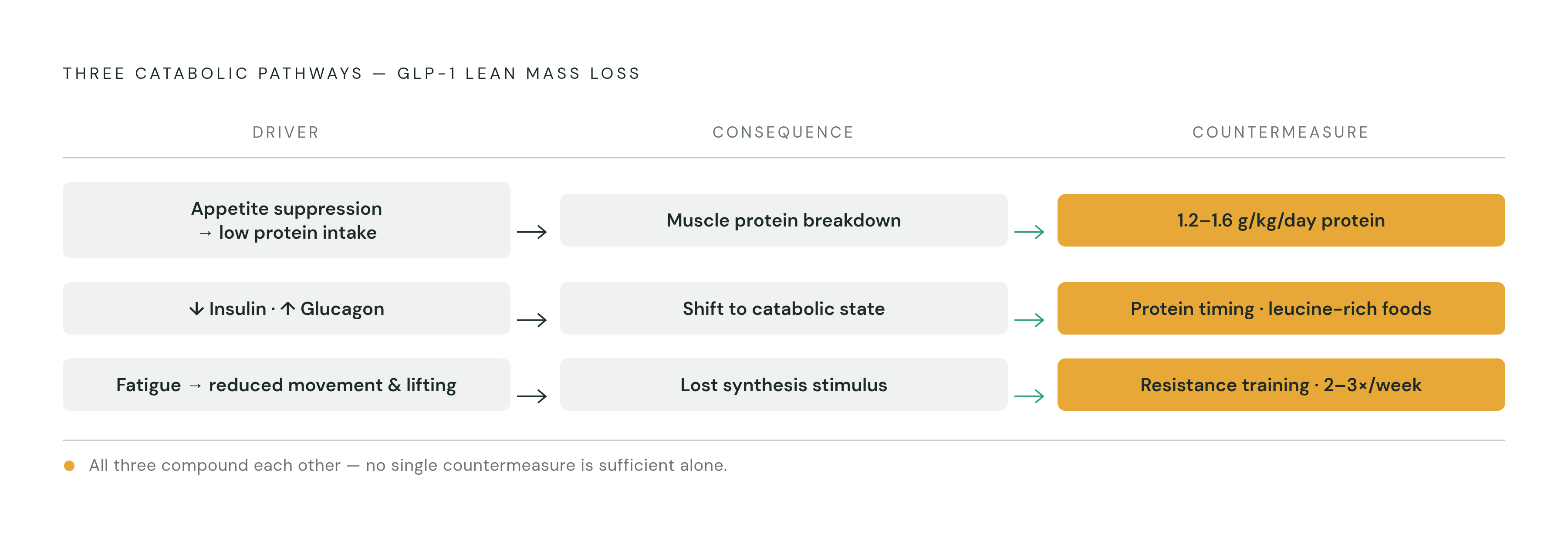
Several converging mechanisms drive the lean mass changes you see during GLP-1 therapy, and each one points to a specific, testable countermeasure. The first and most direct is simple: appetite suppression is the primary engine behind the weight loss these drugs produce, but as total food intake falls, protein intake tends to fall right along with it. When that happens, the body shifts toward breaking down muscle protein for fuel. Evidence presented at ADA 2026 supports a protein target of 1.2 to 1.6 grams per kilogram of body weight per day as the range that actually protects lean tissue, with returns diminishing above that ceiling. A second mechanism runs through hormones. When insulin drops and glucagon signaling rises, your body tilts toward breakdown over synthesis, so it works against muscle even if you keep protein intake reasonable. A third mechanism is behavioral rather than biochemical: rapid weight loss often brings fatigue and lower energy levels, and patients respond by moving less and lifting less, which removes one of the only stimuli that reliably triggers muscle protein synthesis. None of the available evidence establishes that one of these mechanisms dominates the others, and the honest position is that they operate together, compounding each other over the course of treatment. The stakes of letting this compounding effect run unchecked go beyond appearance. Neeland noted that each kilogram of muscle lost reduces resting energy expenditure by meaningfully more than a kilogram of fat lost would, which places lean mass preservation at the center of long-term metabolic health rather than at the periphery of it, as a cosmetic afterthought.
Risk factors for clinically meaningful muscle loss
Lean mass loss on GLP-1 therapy does not land evenly across every patient, and the risk of functional harm concentrates in groups that clinicians can actually identify ahead of time. Older adults stand out as a genuinely distinct risk category. For most people taking these drugs, mobility and functional capacity generally hold steady. But in a study of adults aged 65 and older taking semaglutide, muscle mass, handgrip strength, and gait speed all declined, and that pattern looks more like a trajectory toward sarcopenia than ordinary weight-loss adaptation. Grip strength in men in that study improved at first, but it declined later, so you should not read early trends as a stable outcome. If patients start treatment with low baseline muscle mass or existing sarcopenia, they face a second kind of compounded risk. A loss that would be clinically negligible in a well-muscled younger adult can push someone already close to a functional threshold over it. That raises an important question: how would a clinician even know when a patient has crossed that line? The field cannot yet say with precision. The incidence of clinically significant muscle wasting tied to GLP-1 therapy has not been defined, because trials to date have focused on weight and metabolic endpoints, treating lean mass reduction as a secondary measurement rather than a primary one, often without any standardized test of actual muscle function. Neeland flagged this gap directly, stating "I have not seen great large-scale trials looking at function of muscle," and noting that how muscle function should even be measured in everyday clinical practice remains unsettled. That gap in the evidence is not a minor footnote. It shapes everything the rest of this piece can and cannot claim about who needs the most aggressive countermeasures.
What resistance training and protein intake accomplish
Resistance training and adequate protein intake get recommended so often in weight-loss contexts that they can start to sound like boilerplate advice, interchangeable with any other wellness tip. The mechanisms discussed above suggest otherwise. Each of these two interventions targets a specific driver of lean mass loss identified earlier, and trial data back up that targeting with real numbers. The S-LITE trial (NCT04122716) combined liraglutide with supervised aerobic and circuit training and produced superior weight loss compared with medication alone, along with an outcome rarely seen in pharmacotherapy trials: patients in the exercise arm actually gained lean mass. That result lines up with the mechanism described earlier. Resistance training supplies the stimulus for muscle protein synthesis that appetite suppression and reduced activity take away, so it directly counters the behavioral driver of lean loss. A 2025 prospective cohort study of 200 adults combining GLP-1 medications with resistance training and individualized protein plans reinforces the same pattern outside a tightly controlled trial setting. That cohort lost substantial body weight and saw markedly smaller muscle mass loss over six months, so the combined protocol seems to hold up when you move from a research clinic into real-world conditions. Protein intake works through a separate but complementary channel. The 1.2 to 1.6 gram per kilogram per day target discussed in the mechanisms section is grounded in a straightforward rationale: adequate dietary protein keeps the raw material for muscle protein synthesis available even as total caloric intake falls under appetite suppression. If you distribute that protein evenly across meals and favor leucine-rich foods, you seem to optimize the signaling that drives muscle protein synthesis throughout the day instead of concentrating the benefit in one large meal. On the training side, the specifics determine the outcome: the general instruction to "exercise" is not enough. Evolving clinical guidance points to compound movements done with progressive overload, two to three sessions per week, as the core protocol, because you need a structured regimen, not incidental daily activity like walking. UC Davis researchers frame resistance training and high-quality protein intake as essential to muscle maintenance during GLP-1 therapy, not as optional add-ons to the drug regimen. But the mechanistic case built across the earlier sections suggests something sharper: these two interventions map directly onto the catabolic and behavioral pathways identified as drivers of lean loss, which is a different claim than saying exercise and protein are generally good for health.
Dose titration as a modifiable lever for lean mass preservation
How a GLP-1 dose gets started and escalated is a meaningful determinant of lean mass outcomes in its own right, placing prescribing strategy alongside training and nutrition as a genuine lever. GLP-1 intensity and lean mass loss follow a dose-response relationship, so if you start at the lowest effective dose and delay escalation when weight loss is already proceeding quickly, you can reduce the share of total weight lost as lean tissue. This is not a binary choice between treating and not treating. Dosing sits on a continuum that a clinician can adjust in response to how a given patient's body composition is actually responding, rather than following a fixed escalation schedule regardless of outcome. Evolving clinical guidance says to slow escalation when weight loss is already rapid, and to consider intermittent maintenance dosing once initial goals are met, because both aim to avoid the catabolic conditions that make lean loss worse. None of this works without monitoring, though. Routine tracking of muscle mass through bioelectrical impedance analysis or DXA scans every few months, paired with functional tests like grip strength, lets a clinician catch lean loss early and adjust the combination of dose, exercise, and protein intake in response. The alternative, discovering sarcopenic drift only after a patient has already lost meaningful function, is precisely what this kind of monitoring is designed to prevent. The SEMALEAN study, run out of Rouen University Hospital and published in 2025, offers one of the more systematic attempts to track this arc in real clinical practice. Researchers followed patients with obesity using DXA, handgrip strength testing, and resting energy expenditure measurements at baseline, 7 months, and 12 months, building a picture of how lean mass changes across the full span of treatment. Studies like this are what will eventually let dose titration move from an educated judgment call to a protocol backed by longitudinal data.
Pharmacological strategies for muscle preservation
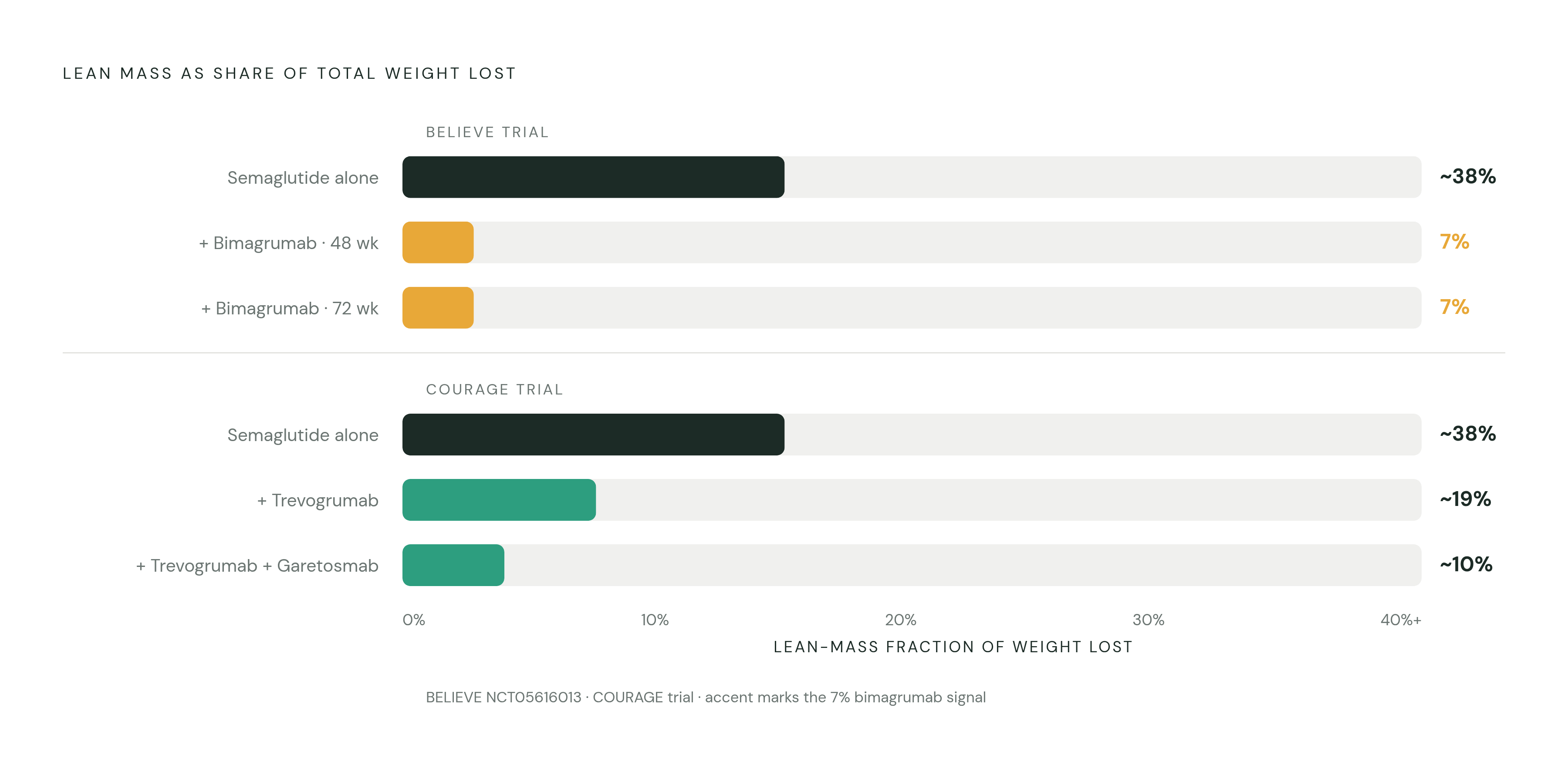
A newer line of research is approaching the same problem from a different angle: blocking the biological signals that drive muscle breakdown. The BELIEVE trial (NCT05616013), published in Nature Medicine, combined semaglutide with bimagrumab, an activin receptor type II antagonist that blocks both myostatin and activin A signaling, two pathways that normally restrain muscle growth. In adults with obesity, that combination cut the lean mass fraction of total weight loss to roughly 7% at both 48 and 72 weeks, and it still produced large reductions in total and visceral fat. That is a markedly different ratio than what GLP-1 therapy alone typically produces, and it suggests the myostatin-activin pathway is genuinely druggable for this purpose. The COURAGE trial, a Phase 2 study with results presented at EASD in September 2025, tested a related approach. Adding trevogrumab, which blocks myostatin, to semaglutide over 26 weeks cut lean mass loss by roughly half. A triplet arm that added garetosmab, which also blocks activin A, achieved substantially greater lean mass preservation still, with the results confirmed by MRI measurements of muscle volume and sustained through a full year of treatment. Why do blocking myostatin and activin A produce this effect? Both proteins function as natural brakes on muscle growth, so blocking them removes resistance to the muscle-building signals that resistance training and protein intake are already trying to generate, working through a mechanism distinct from, and additive to, those interventions. These findings show that the myostatin-activin pathway is a real pharmacological target for preserving lean mass when this class of weight-loss drug drives the weight loss. Neither trial has yet demonstrated that the lean mass these drugs preserve translates into meaningfully better strength, mobility, or functional outcomes for patients at scale, so it is important to be precise about what has and has not been shown. The data establish a body-composition effect. Whether that effect changes a patient's actual physical capacity remains an open question, and closing it will likely require the kind of functional testing that Neeland pointed out is still largely absent from the field.
GLP-1 delivery and long-term adherence
How these drugs get delivered into the body, and whether patients actually stay on them, directly affects lean mass preservation. Dose escalation and treatment continuity both affect muscle outcomes directly, as the earlier sections on titration established, and both are shaped by how burdensome the drug is to take in daily life. A large share of patients discontinue injectable GLP-1 therapy within the first year of use. Cold-chain storage requirements, the need for subcutaneous self-administration, and rigid dose-escalation schedules all contribute to that dropout rate. If patients stop abruptly, they often regain weight rapidly, and that compounds the metabolic cost of whatever lean mass they already lost during active treatment, turning a temporary setback into a more lasting one. Delivery method is central to the muscle-preservation conversation, not a side issue. The GLP-1 delivery landscape is shifting quickly: oral formulations, a newly approved small-molecule oral GLP-1 agonist, and intranasal approaches each offer a different answer to the burden that injections place on patients. Oral semaglutide has already shown higher adherence than injectable semaglutide at both 6 and 12 months. That adherence gap matters for lean mass preservation because sustained, steadily controlled therapy gives your body a more predictable metabolic environment to adapt to, compared with the stop-start cycling that injection fatigue tends to produce. The mechanisms, the risk groups, the training and nutrition protocols, the dosing strategy, and the pharmacological pipeline described across this piece all assume a patient who stays on therapy long enough for any of it to matter. Delivery method and adherence directly shape lean mass preservation. They are part of the same problem, because a drug a patient cannot sustain taking will never give resistance training, protein targets, or careful dose titration the time they need to do their work.
Sources
- UC Davis Health examines systemic impact of GLP-1–based therapies
- Impact of Semaglutide on fat mass, lean mass and muscle function in patients with obesity: The SEMALEAN study
- Muscle loss and GLP-1R agonists use - PMC
- Glucagon Like Peptide-1 Receptor Agonists for Sarcopenia and Muscle Wasting Disorders: A Systematic Review of Efficacy and Mechanisms
- GLP-1 receptor agonist therapy and skeletal muscle: A narrative review synthesizing adult evidence with implications for older adults - PMC