Why GLP-1 Patches Have Not Made It to Market
The physics of peptide size and skin chemistry make passive delivery impossible.
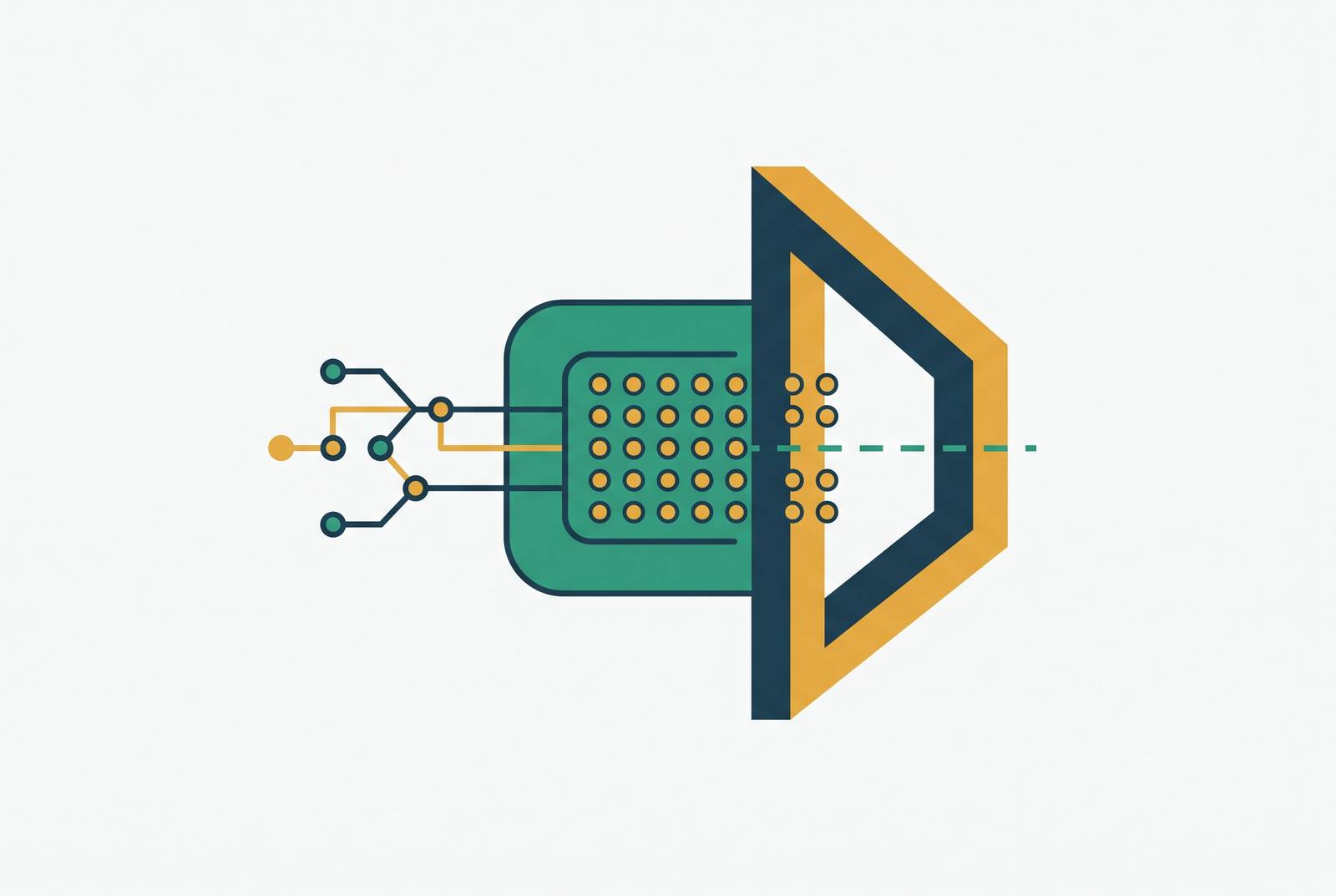
GLP-1 patches have not reached the market because the molecules themselves cannot cross intact skin in meaningful quantities. This is a physics problem before it is an engineering problem, and understanding the physics clarifies what any real alternative to injections would have to solve.
Why GLP-1 molecules cannot cross skin by passive absorption
A patch sounds simple: apply it to the skin, let the drug diffuse in, remove it when the dose is done. The stratum corneum, the skin's outermost layer, is built from dead keratinocytes packed in lipid lamellae, a barrier that evolved specifically to keep water-soluble and large molecules out of the body. Pharmaceutical science has quantified this barrier with what's generally called the 500 Dalton rule: above that molecular weight, passive diffusion through skin drops to therapeutically negligible levels. Every transdermal drug on the market today, nicotine, fentanyl, estradiol, testosterone, is comfortably under that threshold, small and lipophilic enough to slip between the lipid layers.
GLP-1 receptor agonists don't come close. Liraglutide is a similarly large peptide at 31 amino acids. Exenatide and tirzepatide are each 39-amino-acid peptides, with tirzepatide alone far heavier than the 500 Dalton threshold. These exceed the cutoff by a factor of roughly seven to ten, putting them in an entirely different size class than anything that has ever been successfully delivered through skin by passive diffusion.
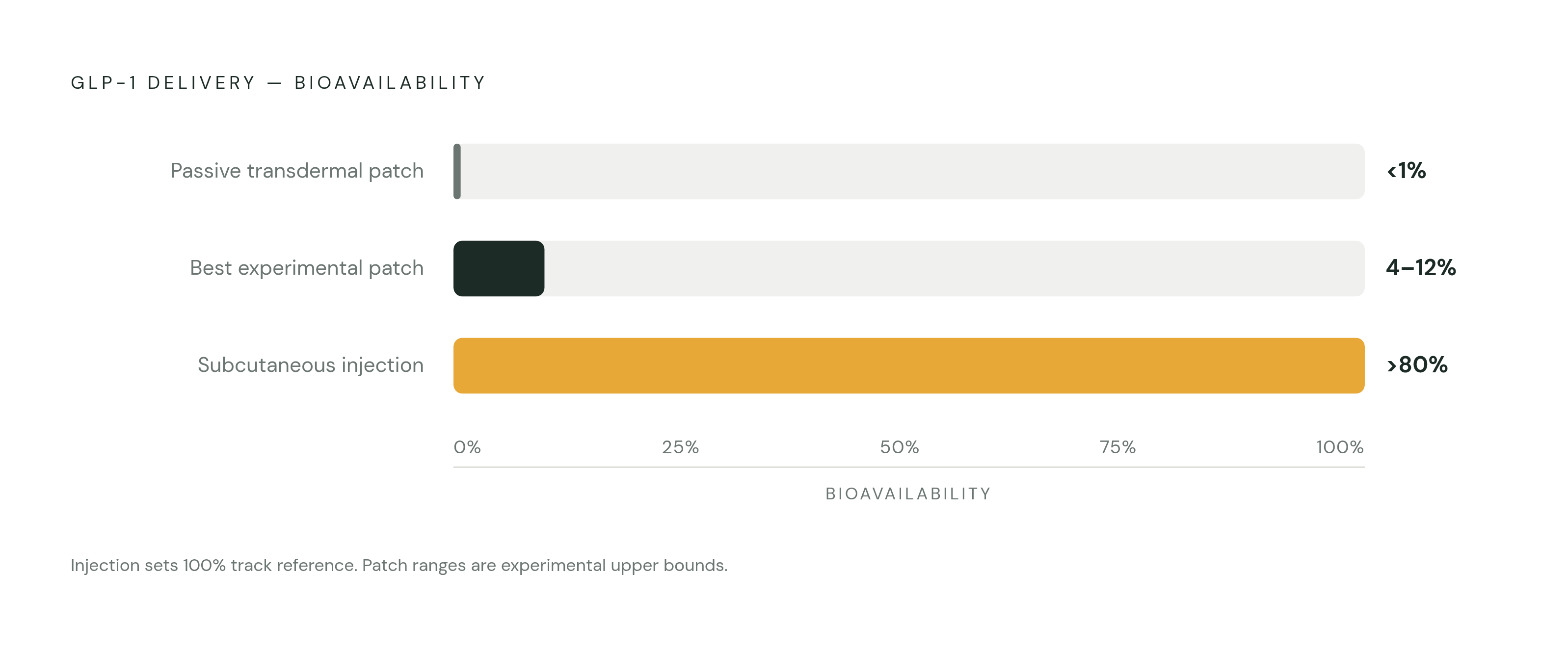
Size is only half the problem. GLP-1 peptides are hydrophilic, built to dissolve and circulate in blood, which puts them directly at odds with a barrier made of lipid. Combining the two properties, molecular weight an order of magnitude too high and a chemistry that repels the only path across, produces passive bioavailability that published experimental data places at well under one percent across human cadaver skin over a full day. That number doesn't describe a patch that needs refinement. It describes a molecule that is, by its basic physical identity, incompatible with passive transdermal delivery. No excipient or adhesive fixes that, because the problem isn't the formulation, it's the molecule.
Limits of Engineering Around the Skin Barrier
If passive diffusion is a dead end, the obvious next move is to force the issue, and the pharmaceutical field has tried several ways to do exactly that. Chemical penetration enhancers, solvents, surfactants, fatty acids, work by temporarily disrupting the lipid barrier to let larger molecules through. These enhancers top out well below the size of even the smallest GLP-1 analogs, so the compounds best suited to widen the gate are tuned for molecules far smaller than anything in this drug class.
Microneedle arrays take a different approach: rather than coax a molecule through the stratum corneum, they bypass it by physically puncturing to the dermis. Iontophoresis and related physical methods, ultrasound, ablation, can push larger molecules across the barrier using electrical current or mechanical disruption, but they require powered devices and bring their own tolerability issues, including skin irritation and the challenge of keeping current delivery consistent over time.
Even where these methods partially succeed, they don't close the gap that matters clinically. Published experimental GLP-1 patches have achieved roughly four to twelve percent bioavailability, compared with more than eighty percent for subcutaneous injection. If a patch delivers twelve percent of an injected dose, it isn't a weaker version of the same treatment. It functions as a sub-therapeutic dose of a different product altogether, one that happens to share a molecule with the approved drug but not its clinical effect.
Zealand Pharma's dapiglutide program shows how far the engineering has to go, and how much it still falls short. Dapiglutide was a serious scientific undertaking to re-engineer the molecule itself, not a cosmetic tweak to push an already-approved GLP-1 molecule through skin. And the published Phase 2 data still showed weight loss far below what injectable comparators achieved at the same timepoint. If re-engineering the molecule itself can't close the gap, it's hard to argue that a better adhesive or a cleverer enhancer blend will finish the job. The ceiling here looks structural, not incidental.
What the supplement "GLP-1 patch" market sells
The products most people encounter when they search for "GLP-1 patch" online have nothing to do with the research described above. Consumer patches marketed under names like "GLP-1 patch," "semaglutide patch," or "metabolic patch" contain no GLP-1 receptor agonist and are built to borrow the brand recognition of prescription GLP-1 drugs without any of the pharmacology that makes those drugs work.
Scan the ingredient lists and a pattern emerges. A smaller set imply they contain semaglutide itself, a claim that would be illegal under current US law for an over-the-counter product, since semaglutide is available only by prescription. But association isn't mechanism: berberine does not activate GLP-1 receptors, and it does not produce the kind of weight loss associated with GLP-1 receptor agonism.
The regulatory backdrop matters here. Under the federal law governing dietary supplements, supplement makers are barred from claiming their products treat, cure, or prevent disease, a line these patches run right up against with their marketing even when their ingredient lists stay technically compliant.
What explains the before-and-after photos circulating on TikTok and Instagram, the application videos that imply something pharmacological is happening? No peer-reviewed human trial has demonstrated that a consumer GLP-1 patch activates GLP-1 receptors, meaningfully changes appetite, or affects blood sugar through a GLP-1 mechanism. Social media doesn't need a mechanism to drive search volume. It only needs an image that looks like proof.
The adherence crisis and the clinical cost of a missing real patch
None of this would matter much if injectable GLP-1 therapy were working smoothly for the patients who start it. It isn't, and that gap in adherence is what makes the delivery engineering worth solving.
A population-based Danish registry study, tracking tens of thousands of first-time semaglutide users and presented at the 2025 European Association for the Study of Diabetes meeting in Vienna, found that most of them had stopped treatment within a year, with meaningful fractions dropping off at three, six, and nine months along the way. A 2025 IQVIA analysis found a similar pattern earlier in the process: a significant share of approved GLP-1 prescriptions are never even filled. Among obesity patients who had already cleared payer approval, fewer than one in three prescriptions made it to the pharmacy counter.
Why do so many patients abandon a drug class with this much clinical promise behind it? When you push the dose up to chase more weight loss, tolerability goes down. When physicians are asked why patients quit, they point to nausea and vomiting as the leading clinical reason. Patients surveyed about their own decisions say the same thing.
The bolus spike from injection is the pharmacokinetic trigger for those symptoms. If a delivery method delivered the same total dose without the spike, closer to a steady-state release, it could in principle remove the pharmacokinetic trigger for a large share of these dropouts. High dropout rates connect to GI side effects, GI side effects connect to the bolus spike that injection produces, and the bolus spike is precisely the kind of delivery feature a well-functioning patch would eliminate. Patients who quit early don't get a partial benefit they can resume later. A patch, if the engineering problem could be solved, would remove the bolus peak, eliminate the needle, remove injection anxiety and technique as barriers, and let a patient stop simply by peeling it off. Every one of those features maps onto a reason patients leave treatment. The patch concept remains so appealing precisely because the dropout data makes the cost of leaving delivery unsolved so visible.
Neurological Indications and the Meaning of "Viable Delivery
The adherence crisis shows that delivery affects a patient's quality of life. The neurological evidence reframes it again, this time as a question of reaching an entirely different organ.
GLP-1 receptor agonists have already cleared multiple clinical trials, and these establish their safety and efficacy for obesity, diabetes, and cardiovascular disease. A separate and newer body of evidence suggests these same molecules may affect neurodegenerative disease through mechanisms distinct from their metabolic effects: preclinical work points to reductions in amyloid-beta and tau pathology, suppression of neuroinflammation, and improved synaptic plasticity. Phase III trials EVOKE and EVOKE+ are now testing directly whether GLP-1 receptor agonists can slow cognitive decline in early symptomatic Alzheimer's disease.
A parallel line of research is underway in addiction. UCSF researcher Khaled Moussawi's work now centers on brenipatide, a dual GLP-1/GIP receptor agonist, for craving and drug use, building on observations that earlier-generation GLP-1 drugs appear to blunt the dopamine surge that fires when someone encounters a drug-related cue.
One might argue that none of this changes the delivery calculus, since a drug circulating in the bloodstream eventually reaches every organ anyway. But that argument misses what the blood-brain barrier actually does. For neurological applications, systemic blood levels aren't the relevant endpoint, because the brain imposes its own size and lipophilicity restrictions on what crosses from circulation into neural tissue, and these restrictions echo the same physics problem described in the skin barrier. Even a transdermal patch that somehow achieved full therapeutic blood levels would not preferentially send GLP-1 to the brain. It would simply add drug to the systemic pool, and the question of CNS penetration would stay exactly where it already stood, dependent on whatever fraction manages to cross the blood-brain barrier on its own.
A meta-analysis of randomized trials found that GLP-1 receptor agonists did not improve memory or cognition in Alzheimer's disease compared with placebo, and the certainty of that evidence was rated low. If EVOKE and EVOKE+ come back negative on cognitive endpoints, a significant share of the enthusiasm building around neurologically targeted delivery would need to cool. That's the most serious objection to the neurological case, and treating it as a footnote would understate it. The appropriate posture is caution while two Phase III trials are still running and the mechanistic groundwork, amyloid correlation, the ELAD brain-volume findings, remains genuinely suggestive and unsettled.
Why the nose-to-brain route addresses constraints that skin cannot
Three constraints have now stacked up across this piece: a molecular size barrier that skin cannot pass, a bioavailability gap that engineering has not closed, and a CNS target that circulating blood levels cannot reliably reach. Any delivery route serious about replacing injections has to answer all three, not just the first one.
The nasal mucosa is a fundamentally different barrier than skin. Where the stratum corneum is dead tissue arranged in lipid layers specifically to keep substances out, the nasal lining is living, vascularized epithelium, and it offers two distinct paths into the body: a systemic route through nasal blood vessels, and a direct route into the brain along the olfactory and trigeminal nerves. That second path is the one skin simply does not have. Neuropeptides, including GLP-1 and GLP-2 derivatives, have been shown to travel rapidly through trigeminal nerve axons after intranasal application in mouse studies, with the trigeminal pathway handling most of the transport for intact nanoparticles while the olfactory pathway tends to carry material already released from those carriers. In principle, that means a nasal formulation could deliver a drug to systemic circulation and directly toward the brain in the same application, something neither an injection nor a transdermal patch can do at once.
Getting a peptide the size of semaglutide or tirzepatide to survive the nasal mucosa and reach either destination still depends on carrier engineering. This is an active and fast-moving area of brain drug delivery research generally, so it isn't a niche pursuit. The NanoInBrain platform, developed by Conejos-Sánchez and colleagues and published in Biomaterials in 2025, combines a purpose-built polypeptide nanocarrier with a hyaluronic acid-poly-L-glutamate hydrogel designed to form a depot and bypass the blood-brain barrier through the olfactory route, though it has not yet entered human trials.
Clinical-stage work is beginning to move in the same direction. Landmark Medicines Ltd., a UK pharmaceutical development company, announced in September 2026 that it plans to advance its proprietary nasal GLP-1 delivery platform toward a human volunteer study, and GLP-1 receptor agonists will be its first application. The platform is formulation-agnostic and covered by multiple patent filings, and the company intends to pursue nose-to-brain delivery as a program distinct from systemic nasal absorption, treating the two as separate scientific questions.
What separates a credible program in this space from a conceptual pitch deck is the depth of nanoparticle science behind it: years of foundational work on how nanocarriers interact with mucosal surfaces, how to keep a peptide stable once it's loaded onto a carrier, and how to functionalize a particle's surface so it's taken up efficiently by olfactory tissue. You could in principle adapt the same nanoparticle architecture built for GLP-1 delivery for other peptides, for gene-editing cargo, or for regenerative medicine, which is part of why the approach draws interest beyond this one therapeutic area.
None of that preclinical promise erases the gap that remains. Intranasal peptide drugs still contend with low bioavailability and with the nasal mucosa's own physiological defenses, and as of now no nanoparticle-based peptide formulation for intranasal delivery has won FDA approval. The science has identified the right target and a mechanism that plausibly reaches it. Whether it can clear the clinical bar that dapiglutide and the experimental transdermal patches could not is still a question the data hasn't answered yet.