GLP-1 Patches Don't Exist Yet — Here's What the Side Effect Data Would Look Like
Transdermal delivery could reshape GLP-1 side effects by changing absorption kinetics.

GLP-1 patches do not yet exist as approved medicines, but their likely side effects are not a blank slate. A working patch would first have to move a large peptide through skin, then deliver enough drug at a tolerable rate. The route matters as much as the molecule because it shapes both side effects and therapeutic reach.
Why no GLP-1 patch exists yet, and why that matters for understanding the ones being built
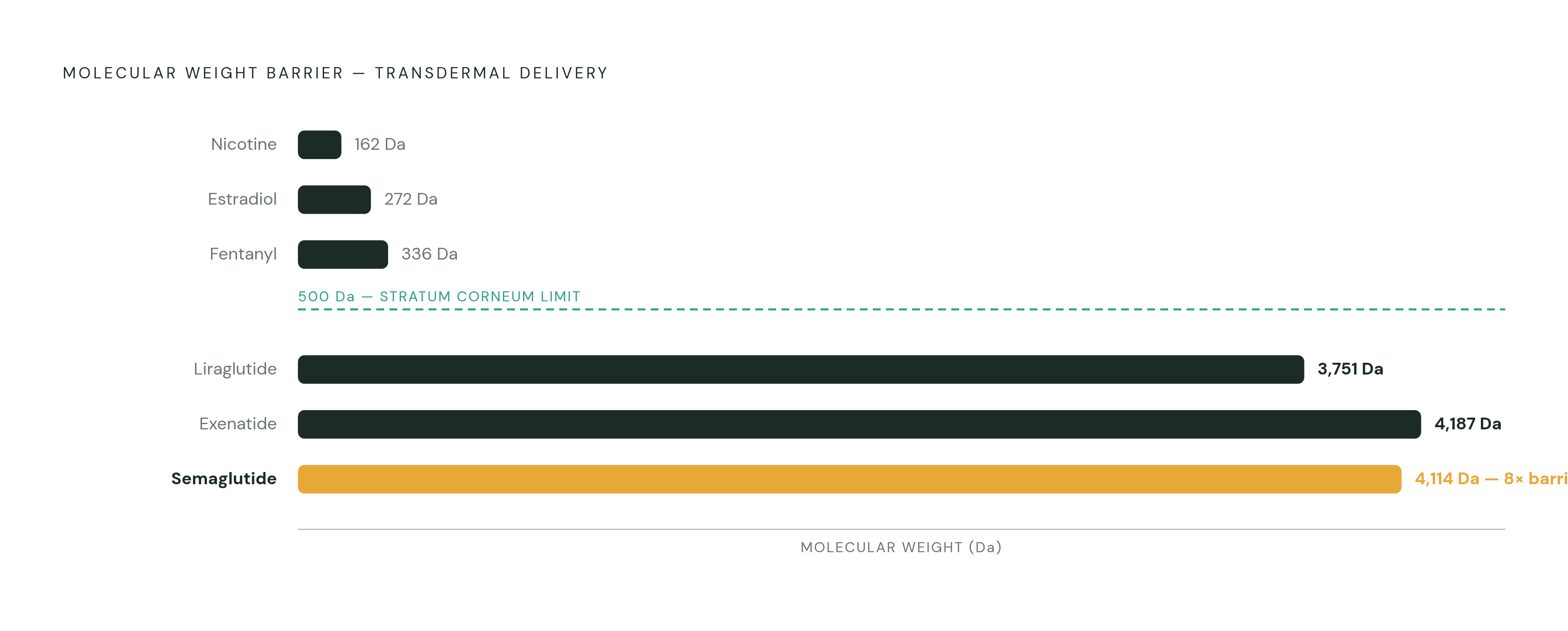
The skin’s outermost layer, the stratum corneum, blocks passive penetration by molecules larger than roughly 500 Da. Semaglutide weighs 4,113.58 Da and contains 31 amino acids. Liraglutide also has 31 amino acids, while exenatide has 39, so both are also far too large to cross that barrier. These peptides are also hydrophilic, which compounds the difficulty of crossing the skin’s lipid structure.
By contrast, familiar patch drugs including nicotine, fentanyl, and estradiol are small and lipophilic enough to cross passively. A passive permeability study using human cadaver skin found semaglutide penetration consistent with sub-therapeutic bioavailability. No patch delivering these peptide drugs has regulatory approval or is commercially available, and products currently sold as “GLP-1 patches” contain no actual receptor agonist of this class and are fraudulent. Research must therefore establish how an engineered system can get enough of the drug through the skin to have an effect before safety and efficacy can be tested.
What GLP-1 receptor pharmacology tells us about where side effects come from
Once the drug reaches circulation, another constraint takes over, namely where and how quickly it activates receptors. GLP-1 receptors in the gut and brainstem area postrema help explain why nausea, vomiting, and gastrointestinal distress accompany treatment. When systemic concentrations are high, those receptors receive the same drug that brings about the intended metabolic effects. Side effects are therefore not random additions to efficacy. They emerge from the interaction between dose, receptor distribution, and the course of exposure.
GLP-1 receptor agonists are modified to resist degradation by dipeptidyl peptidase-4, extending their half-life and sustaining receptor activation. Enhanced albumin binding can also slow renal elimination, supporting the long-acting profile that enables weekly dosing. That persistence brings convenience, but it also prolongs stimulation in gastrointestinal tissues. Subcutaneous delivery produces a rise in plasma concentration after administration, sustained exposure, and then a gradual decline. The height and speed of that rise matter because peak exposure can make acute nausea more likely.
With current subcutaneous and oral approaches, much of the drug reaches systemic circulation, but little reaches the brain directly. This distinction will matter for neurological indications, but it first establishes a narrower point about tolerability. If absorption kinetics help cause side effects, changing those kinetics could change the side effects even with the same molecule.
Why high dropout rates show that the current delivery paradigm has a real tolerance problem
Patient behavior shows why that possibility matters. Population-based data from Denmark found that roughly half of first-time semaglutide users stopped within one year, with discontinuation concentrated in the early months. That timing overlaps the period when gastrointestinal symptoms are most acute. A U.S. cohort study also found that most patients without type 2 diabetes stopped within the first year. Discontinuation was substantially higher in this group than among patients with diabetes, suggesting that tolerability weighs differently when metabolic urgency is lower.
These patterns do not establish that side effects caused every discontinuation. Real-world data do, however, show that gastrointestinal adverse events increased discontinuation risk while weight loss reduced it. Needle-related discomfort and inconvenience can add to that burden, making symptoms another reason to stop. A different delivery format would be valuable if it reduced the burden without weakening the benefit.
This is why a patch is more than a convenience proposal. In principle, it could change both the experience of administration and the rate at which drug enters circulation. Those are separate gains, however, and neither follows merely from replacing a syringe with something worn on skin.
The three engineering approaches trying to force GLP-1 peptides through skin, and how far each has gotten
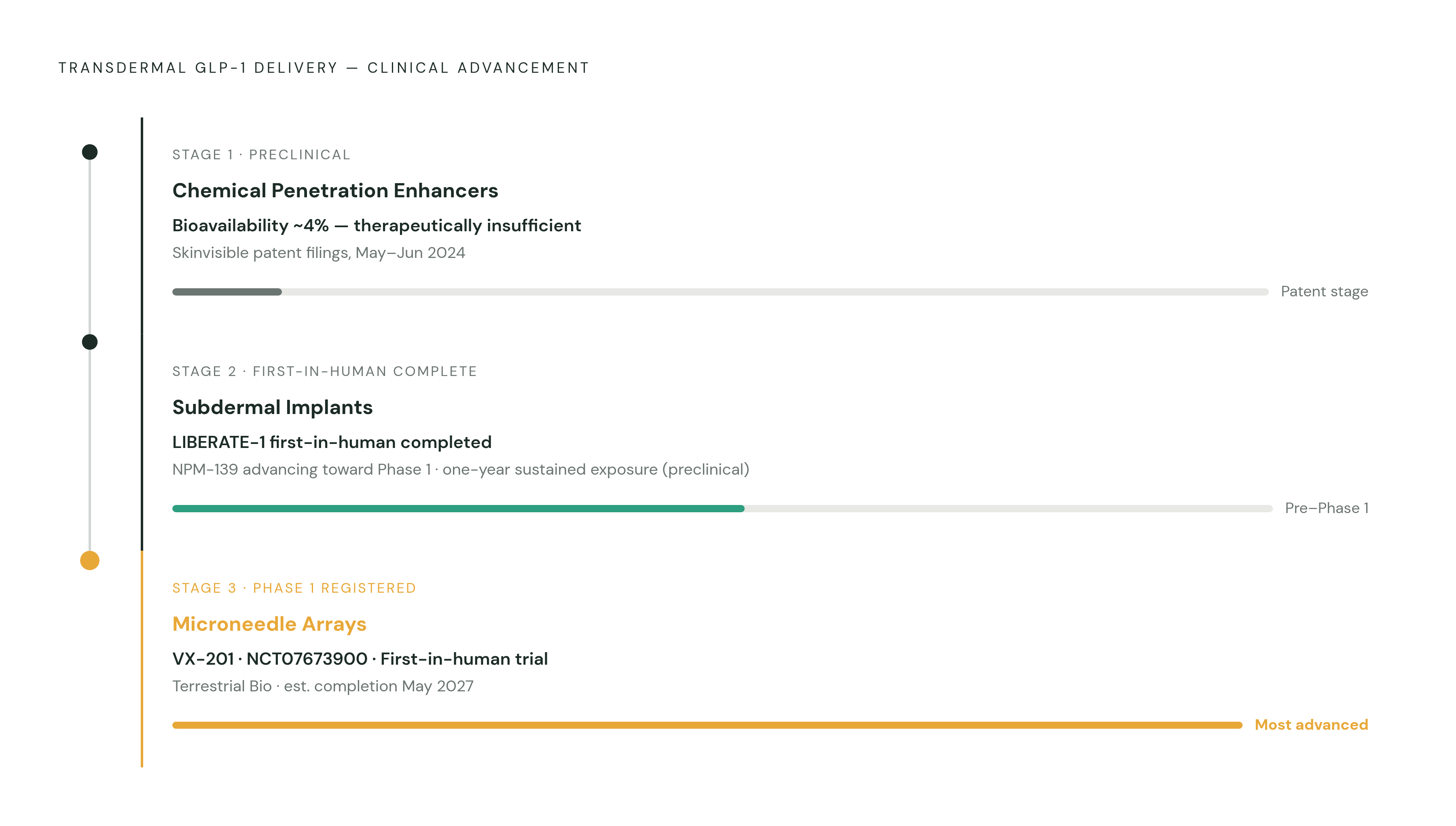
Chemical penetration enhancers such as fatty acids, alcohols, and surfactants attempt to open the barrier by temporarily disrupting stratum corneum lipids, allowing peptide diffusion through transient openings. Published research has reported bioavailability as low as 4%, leaving current formulations therapeutically insufficient. Skinvisible, Inc.’s June 2025 Form 10-Q documents development around provisional patent applications filed in May and June 2024 for transdermal GLP-1 receptor agonist formulations using Invisicare polymer technology. Patent activity establishes an engineering effort.
Microneedle arrays instead penetrate the stratum corneum mechanically and deposit drug in the viable epidermis or dermis. ClinicalTrials.gov records a June 2026 submission for Terrestrial Bio’s Phase 1 first-in-human VX-201 study, NCT07673900, with estimated completion in May 2027. The study compares epi-intradermal semaglutide delivery with subcutaneous administration in healthy overweight and obese participants. This approach is the most clinically advanced of the patch strategies described here. Its absorption curve will still depend on deposition depth and the drug matrix’s dissolution rate.
Subdermal implants extend the same effort toward continuous delivery. Vivani Medical’s 2026 Form 8-K reports completion of LIBERATE-1, the first-in-human NanoPortal platform study with exenatide. It also describes advancement of the semaglutide implant NPM-139 toward Phase 1, with results anticipated by the end of 2026. A single preclinical administration sustained semaglutide exposure and substantial sham-adjusted weight loss for a full year. Unlike intermittent skin delivery, this approach aims to remove recurring dosing peaks through sustained release.
Projecting the side effect profile a working patch would likely produce, based on what absorption kinetics predict
The following profile is a pharmacological projection. Its first condition is adequate bioavailability. A patch that delivers continuously could slow the rise in concentration and flatten the plasma curve, so fewer episodes of peak-related nausea would be expected. But a microneedle patch would not necessarily deliver continuously simply because it is called a patch. Rapid dissolution and slower release lead to different patterns of exposure, so the claim must rest on the actual curve.
Chemical-enhancer formulations pose a more basic interpretive problem. Low absorption could cause less nausea because too little drug reaches its targets. That same shortfall would blunt satiety signaling and metabolic effects, potentially sacrificing the weight loss that helps patients stay on treatment. Equivalent efficacy would require a much larger payload or substantially better delivery technology. Less nausea at a sub-therapeutic dose would not demonstrate a solution to intolerance.
Adequate absorption would also introduce patch-specific tolerability questions. Repeated chemical disruption of skin lipids could cause cumulative irritation, erythema, or sensitization. Microneedles create micro-perforations that must heal between applications, and their repeated-use tissue response remains unestablished in human clinical data. Patch removal could stop further delivery, providing control unavailable once an injection has been administered. It should not, however, be treated as proof that exposure already established in the body would disappear immediately.
The implant projection takes sustained delivery furthest. Its preclinical efficacy results suggest that continuous receptor activation can lead to substantial weight loss without repeated plasma spikes. That predicts less acute peak-related nausea. Sustained low-grade symptoms during adaptation remain plausible, while implant-site reactions and insertion and removal add separate burdens. Vivani Medical says reversibility is critical in cases that include pregnancy and certain procedures with high aspiration risk, and describes a design meant to let drug levels fall quickly when treatment must stop.
Why the delivery route may also determine which therapeutic indications a GLP-1 can reach
These projections raise a broader question about where the delivered drug can act. GLP-1 receptors occur beyond the pancreas and gut, including in the nucleus accumbens, ventral tegmental area, and nucleus of the solitary tract. These brain circuits bring reward, addiction, and neurodegeneration into the therapeutic discussion. Clinical trials have established benefits in obesity, diabetes, and cardiovascular conditions, while neurological applications remain emerging. A route that changes organ exposure could therefore change more than tolerability.
Two Phase 3 trials of oral semaglutide in early Alzheimer’s disease did not significantly slow progression on their primary endpoint, despite improvements in disease-associated biomarkers. But an Imperial College London liraglutide trial published in Nature Medicine in December 2025 found much less brain volume loss and meaningfully slower cognitive decline. Different pharmacokinetic profiles and resulting brain exposure offer one hypothesis for this divergence. The mixed findings do not establish delivery route as the explanation, because a comparison involving different molecules cannot isolate that variable.
WashU Medicine’s observational study of 524,817 people found GLP-1 use associated with reduced risk across multiple substance use disorders. Such associations are consistent with interest in mesolimbic reward circuits, but they do not establish treatment efficacy. With a standard transdermal patch, the drug would still pass through systemic circulation and have to cross the blood-brain barrier to reach the brain. Smoother plasma exposure alone would not solve that anatomical constraint.
How the nose-to-brain route changes both the side effect projection and the neurological opportunity
Olfactory and trigeminal pathways offer access to the brain that can bypass the blood-brain barrier and reduce reliance on plasma exposure. Animal models have shown transport of GLP-1 and GLP-2 derivatives through trigeminal axons after intranasal application. This makes the route a scientifically coherent alternative for brain-directed delivery. It does not yet establish a tolerable or effective human treatment.
Intact nanoparticles predominantly use the trigeminal pathway, whereas substances already released from nanoparticles are more likely to travel through the olfactory pathway. Nanoparticles between 10–100 nm are described as most effective for brain delivery applications. Animal studies have also shown that cell-penetrating peptide conjugation can substantially improve brain bioavailability compared with unconjugated peptides. The formulation therefore influences not only how much drug survives, but which neural pathway carries it.
MetP Pharma announced preclinical data in 2025 showing rapid, dose-dependent brain targeting of peptide-based drugs with its nasal technology. Intranasal semaglutide in rats produced brain-to-plasma ratios consistently greater than 1, supporting preferential CNS delivery in that setting. Landmark Medicines Ltd. announced plans in September 2026 to move its nasal platform toward a study in human volunteers, starting with GLP-1 receptor agonists. These are development signals rather than human proof of reduced nausea or neurological benefit.
If preferential brain delivery translated to humans, lower systemic peaks could reduce gastrointestinal exposure while increasing effects on appetite, reward, and neurological targets. That would be a different mechanism of tolerability improvement from simply flattening a systemic plasma curve. It would also bring questions about nasal mucosa tolerance, local irritation, and excessive brain receptor stimulation at high doses. A functioning carrier must protect the peptide from nasal enzymatic degradation, facilitate neural uptake, and release drug at the intended location. Spraying a molecule into the nose is not equivalent to engineering that sequence.
What the full comparison of delivery routes reveals about the real axis of GLP-1 innovation
The comparison separates two dimensions that the word “patch” can obscure, namely exposure over time and exposure across tissues. A successful transdermal system could improve the first while largely preserving the systemic receptor distribution of injections. An implant could make exposure steadier still, though the burdens of putting it in and taking it out, along with sustained receptor stimulation, would need to be assessed. Intranasal nanoparticle delivery aims to change the second dimension by directing more drug toward the CNS. These are different pharmacological propositions.
That distinction also clarifies what evidence would make a side effect claim persuasive. Lower nausea means little without adequate efficacy, and greater brain exposure does not by itself prove neurological benefit. Likewise, removing needle burden may help patients without resolving the gastrointestinal symptoms that drive discontinuation.
Future GLP-1 innovation therefore turns on delivery architecture as much as molecular design. The strongest advances may change receptor geography. What matters is not only how the drug enters the body, but where it goes and how its exposure unfolds.
Sources
- SKINVISIBLE, INC. - Form 10-Q - FY2025
- Vivani Medical, Inc. - Form 8-K - FY2026
- Semaglutide Delivered Epi-Intradermally by Microarray Patch (VX-201) Versus Subcutaneous Administration in Healthy Overweight and Obese Participants
- Intranasal delivery of glucagon-like peptide-1 to the brain for obesity treatment: opportunities and challenges: Expert Opinion on Drug Delivery: Vol 21 , No 7 - Get Access