How the Lungs Absorb Peptides and Where That Breaks Down for GLP-1s
Degradation and poor permeability make the lungs a dead end for GLP-1 drugs.
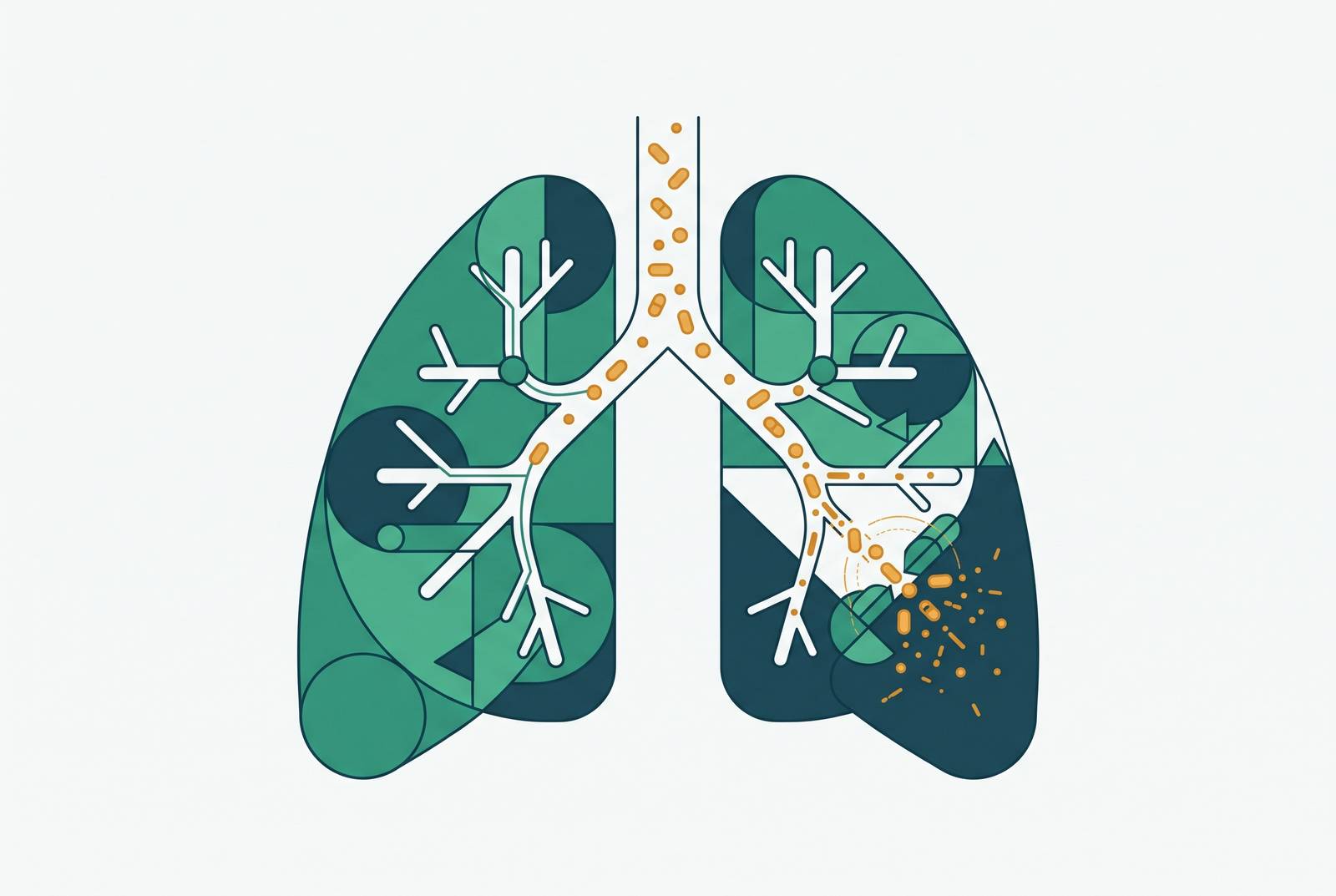
The lungs offer a compelling route for peptide absorption, but favorable anatomy does not guarantee delivery of an intact drug. For GLP-1s, clearance, degradation and limited permeability make that distinction decisive. Direct nose-to-brain delivery deserves attention for central nervous system applications because a delivery route must fit the molecule and its therapeutic target, though it has yet to become a clinical solution.
Why the lung seems like a promising route for peptide delivery
The anatomical case starts with an unusually large contact surface. The alveoli provide roughly 75–100 m² of absorptive area, dwarfing the nasal cavity by orders of magnitude. That area gives an inhaled peptide extensive opportunity to contact the epithelium. The barrier itself is also remarkably thin, at approximately 0.1–0.5 µm. Together, these features put a broad absorptive surface within a very short diffusion distance of the blood.
Rich vascularization strengthens that advantage. Once a peptide crosses the epithelium, blood flow carries it into systemic circulation, reducing the time it spends accumulating locally. Pulmonary absorption also bypasses the portal circulation and therefore avoids hepatic first-pass metabolism. Unlike an orally absorbed drug, a peptide entering through the lung does not have to pass through the liver before reaching peripheral plasma. For a molecule vulnerable to first-pass destruction, this changes the delivery opportunity substantially.
Inhaled insulin shows that these advantages can produce pharmacodynamically useful systemic exposure. Its pulmonary bioavailability reaches a range meaningfully higher than oral delivery can provide, establishing the lung as a useful route for peptide delivery. A peptide can cross this surface in quantities that have a therapeutic effect. This does not establish which other peptides can use the same route.
The gauntlet that dismantles most peptides before they reach circulation
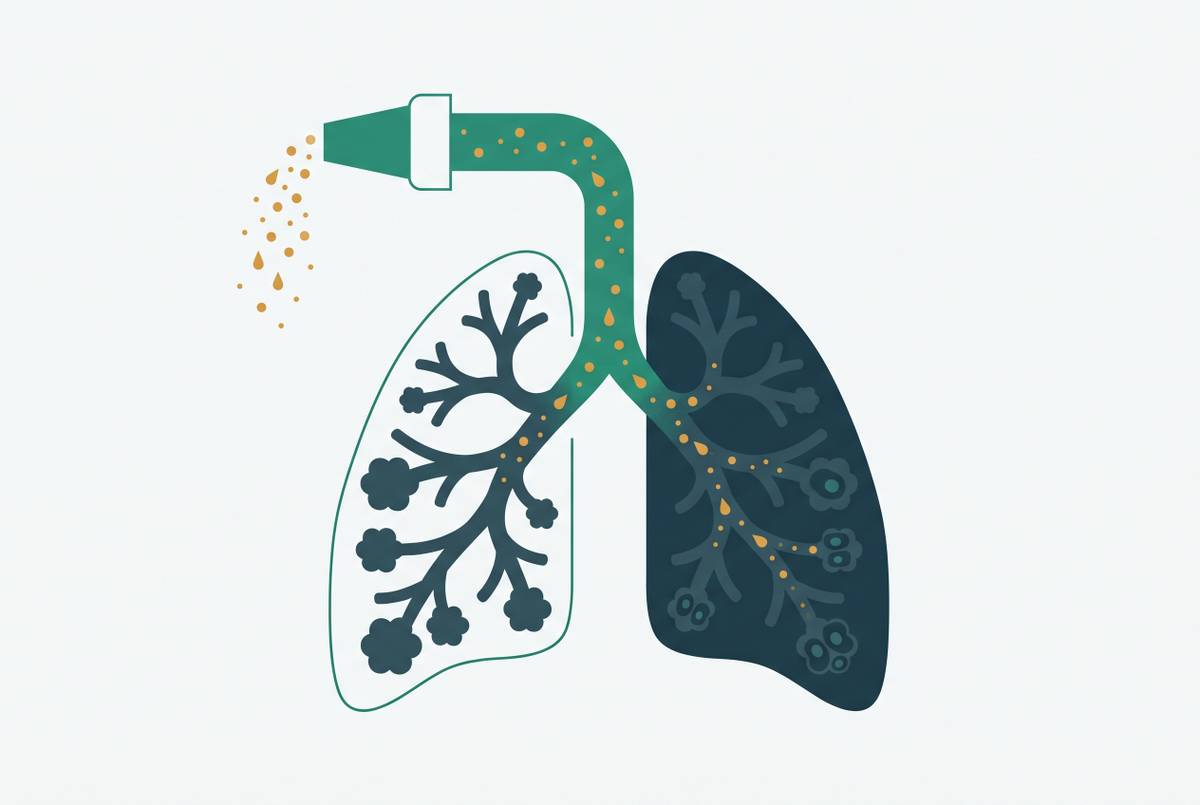
The first difficulty is reaching the absorptive surface at all. Mucus traps inhaled particles, and cilia in the conducting airways sweep them upward and out. A peptide can therefore be expelled before it reaches the alveolar region. Aerosol particles must be small enough to escape impaction and sedimentation in the upper airways.
Deposited peptides and proteins adsorb surfactant components from the alveolar lining layer, changing their surface properties. Those changes can affect clearance and movement across the barrier before enzymes act. The peptide that reaches the lining is consequently not interacting with an inert surface. Its local environment can alter what happens next.
Proteolysis then creates the dominant biochemical barrier. Alveolar epithelial cells carry enzymes that degrade peptides, with type II cells showing higher proteolytic activity than type I cells. Where a peptide lands therefore affects how quickly it is destroyed. Alveolar macrophages add an independent defense by engulfing deposited particles, so resistance to enzymes does not confer protection from cellular clearance.
Absorption enhancers attempt to accelerate passage across the epithelium before clearance wins. However, the enhancers studied for this purpose have not translated into commercial products. The concern is that they may irreversibly alter the epithelial membrane and make the lung more accessible to allergens and pathogens. Increasing permeability is therefore not simply a matter of increasing dose efficiency. It can also mean weakening a protective barrier.
Why GLP-1's molecular profile makes it a poor candidate to survive the pulmonary route
For GLP-1, the conflict begins with molecular pharmacology. Native GLP-1 has a short half-life because dipeptidyl peptidase-4 (DPP-4) and neprilysin cleave it rapidly. Pulmonary proteases add a local obstacle to the endogenous machinery that already limits its survival. The lung must therefore deliver an intact molecule before degradation removes its usefulness. Even with a large surface area, the molecule has no more time to survive.
Permeability creates a separate constraint. GLP-1 analogs are relatively large, charged peptides, and their polarity limits passive diffusion across the alveolar epithelium. These are also among the properties that make non-parenteral peptide delivery difficult more broadly. Surviving degradation leaves the molecule with a barrier it still has to cross. Conversely, improving passage does not by itself protect the payload from cleavage.
The absorbed fraction must therefore sustain useful plasma exposure. First-pass avoidance cannot compensate for low, highly variable absorption when sustained levels are needed. Oral semaglutide illustrates how unusual the enabling pharmacology can be. Its exceptional half-life of ~168 hours, very high potency and wide therapeutic window allow it to work at single-digit oral bioavailability.
Most GLP-1 analogs lack that constellation, and native GLP-1 lacks it entirely. Native hormone and modified agonists should therefore not be treated as pharmacologically interchangeable. A formulation must provide the exposure the molecule needs to work, beyond improving how much of it is absorbed. A clever excipient alone cannot establish that the pulmonary route is a suitable match.
What current research is actually trying to do about pulmonary GLP-1 delivery — and how far it has gotten
A 2025 zinc oxide morphology-engineering study showed that carrier geometry affects where particles land in the lung and how they interact with biological defenses. By changing carrier shape, researchers addressed inefficient aerosolization and macrophage clearance while obtaining therapeutically relevant systemic exposure for liraglutide. This establishes morphology as a practical delivery tool. It does not yet establish reproducible clinical pharmacokinetics.
A 2025 ACS Nano study approached the problem through liposome surface hydrophilicity. Low-hydrophilic liposomes carrying liraglutide and semaglutide enhanced trans-alveolar absorption by evading macrophage pinocytosis. Versions with higher hydrophilicity stayed in the lung longer. Surface chemistry therefore shifted the balance between systemic absorption and local retention. Those are distinct objectives, and improving one did not mean optimizing both.
The distinction is important when interpreting a promising experiment. Greater residence time matters only in relation to what the formulation is intended to achieve. For systemic GLP-1 delivery, keeping material in the lung is not equivalent to moving intact drug into circulation. Even when systemic exposure can be measured in a model, exposure across patients may still be hard to predict. Each result answers a narrower question than clinical viability.
Broader translation also remains constrained by interpatient variation in GLP-1 receptor expression, the absence of real-time imaging to guide dosing and incomplete understanding of immune responses to complex nanoparticles. The pulmonary strategies described have not reached clinical translation. Their results are advances on specific sub-problems. But solving those sub-problems has not yet produced a solved route.
What this means for patients on GLP-1 therapy today — the compliance problem the delivery route creates
Without a clinically translated pulmonary option, its promise does not relieve the burden of injectable treatment. Oral semaglutide is an important exception to any blanket claim that non-injectable GLP-1 therapy is unavailable. Its unusual pharmacology, however, does not provide a general solution for other constructs or for brain-directed treatment.
Nausea, vomiting, diarrhea and constipation are established class effects concentrated during initiation and dose escalation. Gastrointestinal adverse effects are a leading cause of discontinuation. Reporting nausea is not the same as stopping treatment because of it, but patients unable to tolerate escalation may never reach therapeutic doses. Delivery must consequently address both discomfort with injections and getting enough exposure for the drug to help.
That exposure creates a particular tension for emerging neurological and addiction applications. High systemic levels from subcutaneous injection contribute to gastrointestinal side effects, while systemic administration achieves central nervous system exposure poorly. With this approach, lowering peripheral exposure works against the aim of raising brain exposure. More drug in plasma does not necessarily mean an acceptable route to a brain target.
For weight management, regain after stopping treatment makes sustained benefit dependent on indefinite treatment. Injection burden and tolerability thus become long-term adherence issues. Delivery architecture shapes this burden by determining where the drug goes and the exposure needed to get it there. That is the structural reason to examine routes that change where the drug goes.
Why the nose-to-brain route addresses what pulmonary delivery cannot
Transport along olfactory and trigeminal nerve pathways can bring peptides to the central nervous system without requiring systemic absorption first. In principle, that permits brain exposure at lower plasma levels. Pulmonary delivery, by contrast, is being engineered here to move drug into blood. Its anatomical advantages do not themselves provide preferential brain targeting.
This distinction fits the distribution of GLP-1 receptors in the brain. Receptors occur in the hippocampus, cortex, hypothalamus and basal ganglia, on both neurons and glial cells. Direct access offers a mechanistic rationale for reaching that network without making high peripheral exposure the prerequisite. Systemic bioavailability alone would therefore be an incomplete measure of success. The relevant objective is distribution toward the central target.
MetP Pharma’s 2025 preclinical work reported brain-to-plasma ratios consistently greater than 1 after intranasal delivery in rats. That finding supports preferential central nervous system delivery in the studied animals rather than exposure explained only by systemic spillover. It is evidence for the intended distribution pattern. It is not evidence that the same pattern has been achieved in patients.
Landmark Medicines Ltd. in Loughborough, UK, announced in September 2026 that it planned to move its proprietary nasal drug-delivery platform toward a study in human volunteers. GLP-1 receptor agonists were the initial therapeutic application for the formulation-agnostic platform, which was the subject of multiple patent filings. The announcement places human evaluation as the next threshold. Neither planned testing nor patent activity establishes clinical readiness.
What the human data actually show — and where the intranasal route still has to prove itself
The strongest objection is that favorable rodent distribution has not established reliable human brain exposure. Winterdahl’s 2025 PET imaging study found low and variable human brain uptake after intranasal peptide administration. High concentrations observed in rodents are therefore unlikely to reproduce in humans without major formulation advances.
GLP-1 therapy shows observational signals in neurological conditions including dementia, Parkinson’s and addiction. However, observational associations do not establish that directly delivering a GLP-1 drug to the brain will improve a particular clinical outcome. Randomized evidence in Alzheimer’s has not yet confirmed direct cognitive benefit. A 2025 meta-analysis of multiple randomized controlled trials found no improvement in memory or cognition versus placebo, with low-certainty evidence.
Demonstrating brain uptake would establish access. Equally, an observational signal does not show that a nasal formulation delivers the exposure needed to test that signal. Both uncertainties matter, and neither can substitute for evidence on the other.
Nanoparticle-based intranasal approaches also face variation in receptor expression, missing real-time tools for personalizing dosing and unresolved immune-response questions. These limits define a demanding engineering and evaluation task. They do not establish a fundamental biological impossibility, but neither do they guarantee that formulation work will overcome it. The route has a rationale, while reproducible human delivery remains something it must prove.
What separates credible intranasal platform science from formulation speculation
Credible platform science starts by connecting each design choice to a delivery barrier. Particles must land in the right place in the anatomy, withstand enzymatic attack long enough to enter nerve pathways and release their payload at targets in the central nervous system. Those requirements form a chain. Improving surface chemistry is meaningful only if it contributes to that chain. Novelty alone does not show that the chain works.
A platform must be built around the payload’s pharmacology rather than retrofitting the molecule into a generic nasal spray. The formulation has to preserve the peptide and deliver an exposure suited to its intended action.
Substantive platform work is distinguished by understanding proteolysis, mucociliary clearance and the olfactory epithelium as an entry point. Patent coverage on the delivery mechanism and a record of translating academic nanoparticle science into engineered formulations can support that foundation. They cannot replace human evidence. The same architecture could, in principle, extend to other peptides and neurological indications as a platform possibility still requiring clinical evidence.
The lung’s promise ultimately shows why favorable anatomy is necessary but insufficient. For brain-directed GLP-1 therapy, the nasal route offers a different anatomical fit. There is a need to reduce the burden created by poorly matched exposure. Meeting that need takes a deep understanding of delivery science and then proof in humans, even with a novel formulation.
Sources
- Frontiers
- Frontiers
- The lung as a route for systemic delivery of therapeutic proteins and peptides - PMC
- Challenges and Strategies to Enhance the Systemic Absorption of Inhaled Peptides and Proteins - PMC
- Strategies to Enhance Drug Absorption via Nasal and Pulmonary Routes
- Intranasal delivery of glucagon-like peptide-1 to the brain for obesity treatment: opportunities and challenges: Expert Opinion on Drug Delivery: Vol 21 , No 7 - Get Access