Does Tirzepatide Suppress Appetite or Burn Fat Directly
The drug works through appetite suppression and also activates brown fat to burn energy.
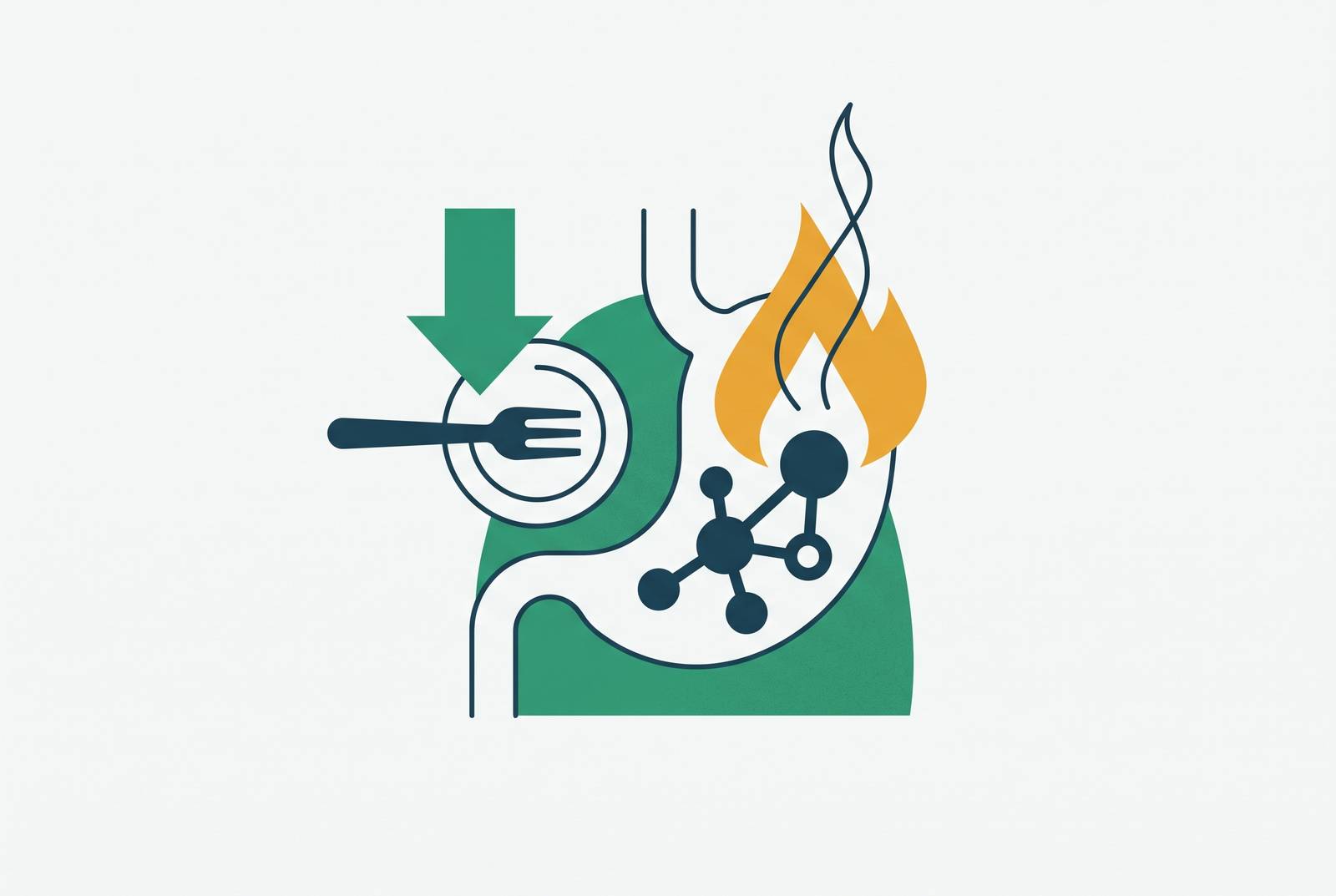
Tirzepatide's weight-loss results are large enough that the question of how it works has become a genuine clinical matter, not just a curiosity for pharmacology seminars. The standard explanation, that it simply kills appetite, captures part of the story but leaves out a body of evidence that the drug may also change how the body burns energy at the tissue level. The two ideas have mostly been treated as competing explanations: either tirzepatide suppresses hunger, or it burns fat directly, and whichever camp a given study falls into tends to claim the whole explanation. The TABFAT trial, presented at ENDO 2026, is the most recent data point forcing a revision of that framing. Working out which explanation holds more weight, and how much, means starting with the molecule itself, because its structure predicts both stories at once.
What makes tirzepatide structurally different from a standard GLP-1 drug
Tirzepatide is built differently from a single-target GLP-1 drug. It is a dual GIP and GLP-1 receptor agonist, engineered by taking the GIP peptide sequence and building GLP-1 activity into it. That order matters: GIP came first in the design, and GLP-1 activity was added on top of it, not the other way around.
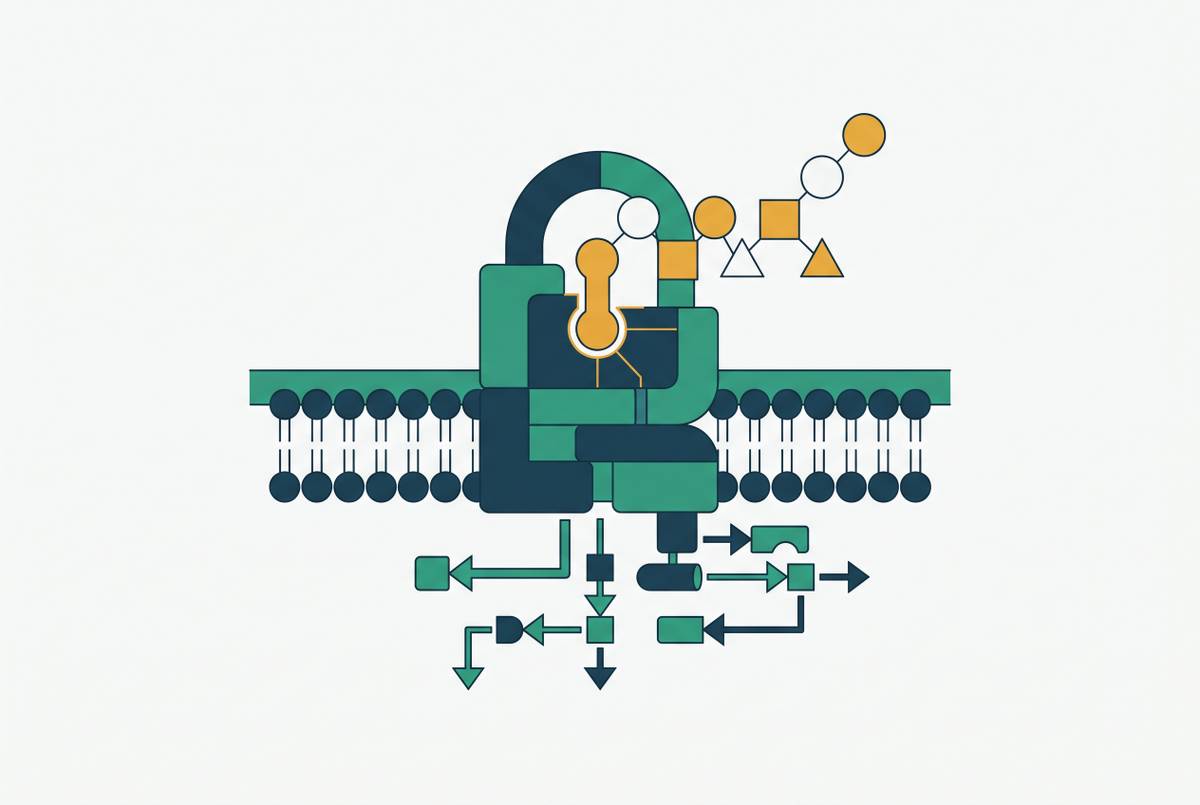
The resulting molecule is what researchers call an imbalanced agonist. It binds the GIP receptor (GIPR) with about the same affinity as the body's own native GIP, but binds the GLP-1 receptor (GLP-1R) at roughly five times weaker affinity than native GLP-1. That gap looks like a shortcoming on paper, but it was a deliberate choice in how the molecule was built. Pushing GLP-1R activation too hard tends to cause nausea and vomiting, while GIPR engagement doesn't carry that same side-effect burden, so dialing back the GLP-1 side let the GIP side do more of the work without costing tolerability.
The consequence is that GIP is not a secondary ingredient folded into a GLP-1 drug for extra credit: it is the receptor tirzepatide engages most strongly, and its biology sets off a chain of effects that a single-receptor framework simply doesn't account for. Everything in the sections that follow, appetite signaling in the brain, how energy expenditure changes, the BAT finding, and the behavior of fat cells themselves, traces back to this architecture. A drug built around two receptors with different jobs should be expected to produce two different downstream stories, and that's exactly what the evidence shows.
How tirzepatide suppresses appetite through two overlapping receptor systems in the brain
Appetite suppression is the best-supported piece of tirzepatide's weight-loss effect, and it happens through more than one channel. GLP-1 reduces food intake centrally, acting on the hypothalamus, and peripherally, by slowing how fast the stomach empties. Both mechanisms are well-documented and shared with single-agonist GLP-1 drugs, so neither one by itself explains why tirzepatide outperforms those drugs in head-to-head weight-loss results.
The GIP side of the molecule adds something those drugs don't have. GIP receptors are present in regions of the central nervous system that regulate food intake, and their distribution in the brain doesn't fully overlap with where GLP-1 receptors sit. They're covering different territory, which raises a question: if GIP receptors occupy their own neurological space, is their contribution additive, or just redundant backup for the GLP-1 signal?
The evidence points toward additive, and the distinction matters. Researchers have found that an intact GIP axis in the brain is necessary to get the full appetite-suppressing effect of dual GIPR and GLP-1R agonist treatment. Removing the GIP signal makes the appetite effect fall short, showing that the GIP component is a required part of the circuit rather than a redundant backup system sitting quietly behind GLP-1. That finding reframes why tirzepatide beats single-receptor drugs on weight loss: the gap isn't just about stronger GLP-1 receptor stimulation, it's about a second, necessary appetite pathway running in parallel in the brain.
Energy expenditure in human studies versus mouse data
Appetite suppression explains a lot, but it doesn't explain everything researchers have observed in animal models, and energy expenditure needs to be taken seriously as a separate mechanism. A translational study combining preclinical and clinical methods, led by Ravussin and colleagues and published in April 2025, set out to test whether tirzepatide changes how much energy the body burns, not just how much food a person eats.
The results split cleanly along species lines. In mice, tirzepatide blunted the usual drop in energy expenditure that happens during caloric restriction, a sign that something beyond appetite control was going on in the animal model. In humans, the same measurements told a different story: tirzepatide did not change energy expenditure beyond what would already be expected from changes in body composition. The human arm of the study used whole-room indirect calorimetry alongside a controlled dietary intervention, tools built to capture exactly this kind of whole-body energy accounting. But capturing brown adipose tissue activity specifically needs a different kind of imaging altogether, which this study didn't use.
That's an important caveat, because the concept of metabolic adaptation, the idea that the body dials down energy expenditure below what body composition alone would predict, is itself a contested measurement problem. How adaptation gets defined, when it's measured relative to a weight-loss timeline, and which prediction model gets used to set the baseline can all shift whether a study detects adaptation or not. A negative finding in one well-designed study doesn't settle the question for good.
The mouse-to-human divergence isn't a problem unique to tirzepatide. It occurs across obesity pharmacology more broadly, where a mechanism that looks compelling in rodents often fails to translate cleanly into people. That history is why a trial willing to go looking for a tissue-level effect directly in human imaging data carries so much weight: it tests the preclinical signal on the species that actually matters for the clinical outcome.
The TABFAT trial finding: tirzepatide activates brown adipose tissue in adult humans
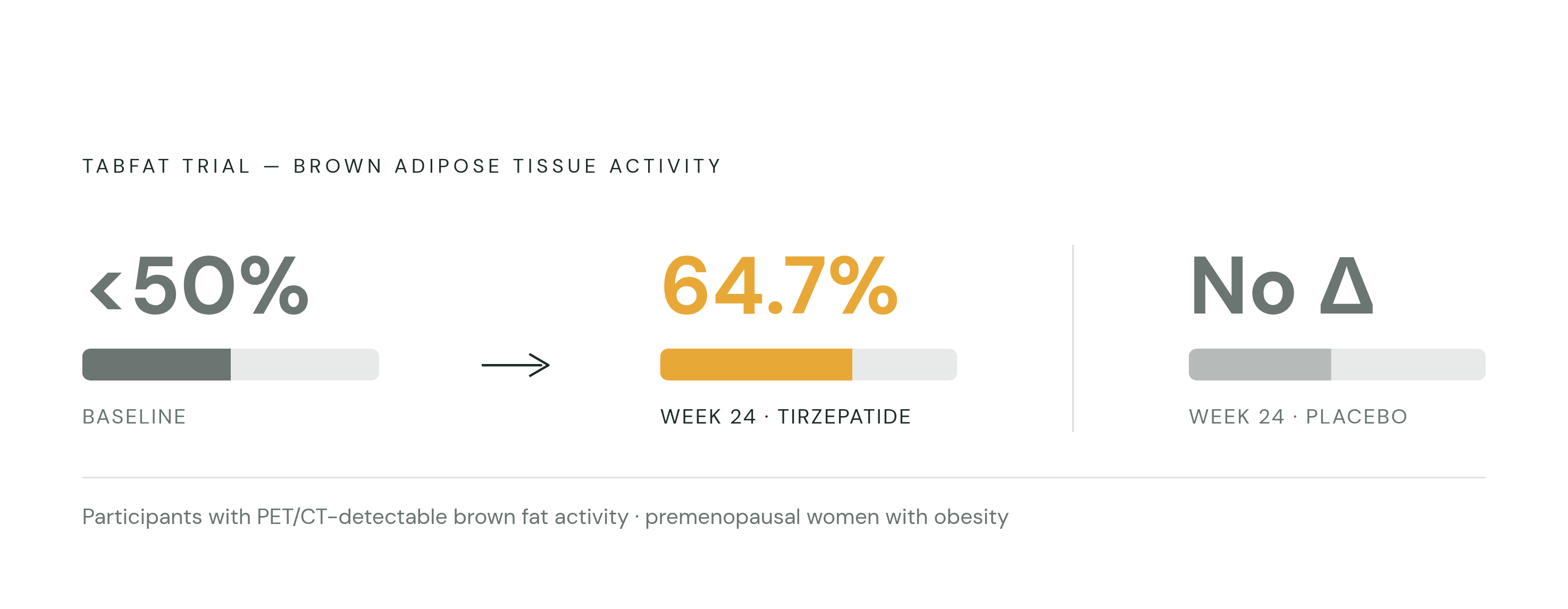
The TABFAT trial closes part of the gap the Ravussin study left open. Presented at ENDO 2026 by Rok Herman, M.D., of University Medical Centre Ljubljana, it is the first randomized, placebo-controlled trial to show that tirzepatide increases brown adipose tissue activity and volume in actual human subjects, a mechanism that had shown up in mice but never been confirmed in people before this.
The trial enrolled premenopausal women with obesity and tracked brown fat activity using cold-stimulated PET/CT imaging along with MRI scans, taken before treatment and again after 24 weeks on the drug. The numbers moved in a way that's hard to explain through appetite alone: the share of participants with PET/CT-detectable brown fat activity rose from under half at baseline to 64.7% after 24 weeks of tirzepatide, with no comparable shift in the placebo group. Herman and colleagues also saw signs that white subcutaneous fat, the ordinary fat that stores energy, was converting into "beige" fat, a more metabolically active tissue type related to but distinct from brown fat.
The finding carries weight because of what's known about brown fat's history as a research subject. For decades it was assumed to disappear after infancy, and its presence in adult humans wasn't confirmed until imaging studies in the late 2000s found it, and it's markedly suppressed in people with obesity; until the TABFAT results, moderate cold exposure was the strongest known way to activate it in humans. A drug doing that pharmacologically, at a scale a cold room can't replicate for most patients, is a genuinely new mechanism on the table.
Herman framed the result directly at ENDO 2026: "They are not only appetite suppressants, tirzepatide also appears to modulate energy expenditure at the tissue level, opening a plausible path toward future therapies that combine appetite regulation with thermogenic activation." That's a conference presentation, not a published, replicated body of work, and the sample was limited to premenopausal women with obesity, so it would be premature to treat brown fat activation as a settled, generalizable mechanism. As a signal that the either/or framing was too narrow from the start, it's the strongest evidence currently on the table.
The GIP receptor's separate role in making fat tissue healthier at the cellular level
A third mechanism operates independently of both appetite and brown fat activation, and it's the one patients are least likely to have heard about. GIP receptors are expressed directly on human fat cells, not just in the brain, and tirzepatide's engagement of those receptors appears to change how fat tissue behaves at a cellular level, independent of whether a person has lost a single pound.
Investigators have hypothesized that tirzepatide's metabolic benefits come from two separate tracks: weight loss driven by GLP-1 agonism, and a set of cellular and molecular changes in adipose tissue driven by GIP acting locally on fat cells. In animal models, GIP alone, or tirzepatide acting through the GIP receptor, has been shown to reduce inflammation in fat tissue, increase the tissue's capacity to buffer and store lipids safely, and improve how the body handles glucose. Those effects line up with reversing lipotoxicity, the condition in which fat cells become so overloaded with lipid that they start damaging the tissue around them.
A clinical trial registered as NCT05912621 tests whether this reversal of lipotoxicity and adipose tissue dysfunction holds up in humans with overweight or obesity, and it moves the animal-model hypothesis toward direct clinical evidence. If it holds, the implication is that some of tirzepatide's cardiometabolic benefit runs through fat tissue quality. A patient who loses a moderate amount of weight could still see meaningful metabolic improvement, because the fat cells that remain are functioning in a healthier way, less inflamed, better able to store lipid safely, less prone to spilling that damage into surrounding tissue.
What the three mechanisms together mean for weight loss and its composition
Put appetite suppression, brown fat thermogenesis, and adipose tissue remodeling together, and the resulting weight loss looks different from what caloric restriction alone produces, both in scale and in composition. Improved insulin sensitivity is one of the clearest downstream threads connecting these mechanisms: better insulin sensitivity reduces the body's tendency to shuttle excess calories into fat storage in the first place, which means some of the fat loss is happening through a metabolic channel rather than purely because a person is eating less.
The fat oxidation increase documented in human studies adds another layer to that logic. When the body shifts its fuel preference toward burning stored fat, even during a period of caloric restriction, that substrate-level change amplifies the fat-loss effect of reduced intake. The two effects compound: eating less creates the deficit, and burning a higher proportion of fat for fuel determines what that deficit actually costs the body in terms of tissue.
That distinction, what kind of tissue is lost, is the one that matters most for long-term outcomes. Losing muscle alongside fat slows metabolism and works against someone's ability to keep weight off over time, since muscle is metabolically active tissue the body relies on to burn calories at rest. A treatment that preserves lean mass while it accelerates fat loss changes the shape of what comes off rather than just producing a bigger number on the scale, and that shape is what determines whether the metabolic improvement holds up after the initial weight-loss period ends.
The Injection Model's Limits on Who Can Benefit
None of these mechanisms matter to a patient who stops treatment before they've had time to work, and real-world data suggests that happens often enough to count as a structural problem rather than a scattering of individual lapses. A retrospective analysis of FAERS data from 2022 through 2025 found that incorrect dose administration was the single most common adverse event reported for tirzepatide, ahead of injection-site pain and nausea. They are what happens predictably when a drug this sophisticated is delivered through a weekly subcutaneous injection at the scale tirzepatide is now prescribed.
The stakes of getting that delivery problem fixed are raised further by what's known about stopping treatment. Discontinuing tirzepatide after 36 weeks reverses most of the drug's benefits, a finding that turns the injection into something closer to a lifelong commitment for any patient who responds well to it. That's the condition under which the mechanism has to work, week after week, indefinitely.
A weekly injection, sustained for years, asks a lot of patients who have needle aversion, limited access to the healthcare infrastructure that supports ongoing prescriptions, or schedules that make a recurring clinical routine hard to maintain. None of that reflects on how well the drug works once it's administered. It reflects on how many people the current delivery method realistically reaches, regardless of how well-established the appetite, thermogenic, and cellular mechanisms turn out to be.
Nose-to-brain delivery as a path to tirzepatide's neurological mechanisms without the injection burden
The mechanisms described throughout this piece point toward a specific anatomical target: the central nervous system. Appetite regulation runs through the hypothalamus, the GIP-dependent neurological signal required for full appetite suppression operates in the brain, and the brown fat activation shown in TABFAT likely involves central signaling as well. The brain isn't a downstream beneficiary of tirzepatide's effects. It functions as the primary site where much of the drug's most consequential work happens, which makes the question of how a drug physically gets to the brain a pharmacological question in its own right, not just a matter of patient convenience.
Subcutaneous GLP-1 receptor agonists, tirzepatide included, reach the brain indirectly. The drug has to enter systemic circulation through an injection, then make its way across the blood-brain barrier, a route that is invasive by design, carries system-wide side effects beyond whatever is happening at the intended target, and asks patients to tolerate ongoing discomfort in exchange for a drug effect that, once it reaches the brain, works as described.
A nasal route to the brain would, in principle, shorten that path: intranasal delivery can reach the central nervous system more directly than a method that has to pass through full systemic circulation first. The physiological obstacles to making that work are real and significant. Mucociliary clearance moves material out of the nasal cavity before much of it can be absorbed, enzymes in the nasal mucosa can degrade a peptide before it ever gets where it's going, and tirzepatide's own physicochemical properties, its size and structure as a peptide, make it a harder molecule to move across that barrier than a small-molecule drug would be. Solving that engineering problem wouldn't just make tirzepatide easier to take. It would be the first delivery method built around where the drug's own mechanism says it needs to go.
Sources
- Tirzepatide may change how the body uses energy
- Tirzepatide: Reversal of Lipotoxicity and Adipose Tissue Dysfunction in Humans With Overweight/Obesity
- Unveiling Tirzepatide's Therapeutic Spectrum: A Dual GIP/GLP-1 Agonist Targeting Metabolic, Neurological, and Cardiovascular Health - PMC
- Tirzepatide is an imbalanced and biased dual GIP and GLP-1 receptor agonist - PMC