Licensing the Core Polymer Nanoparticle Peptide Delivery IP Means Tracing It Back to One Columbia Spinout
Exclusive Columbia licensing to one spinout concentrates platform control.
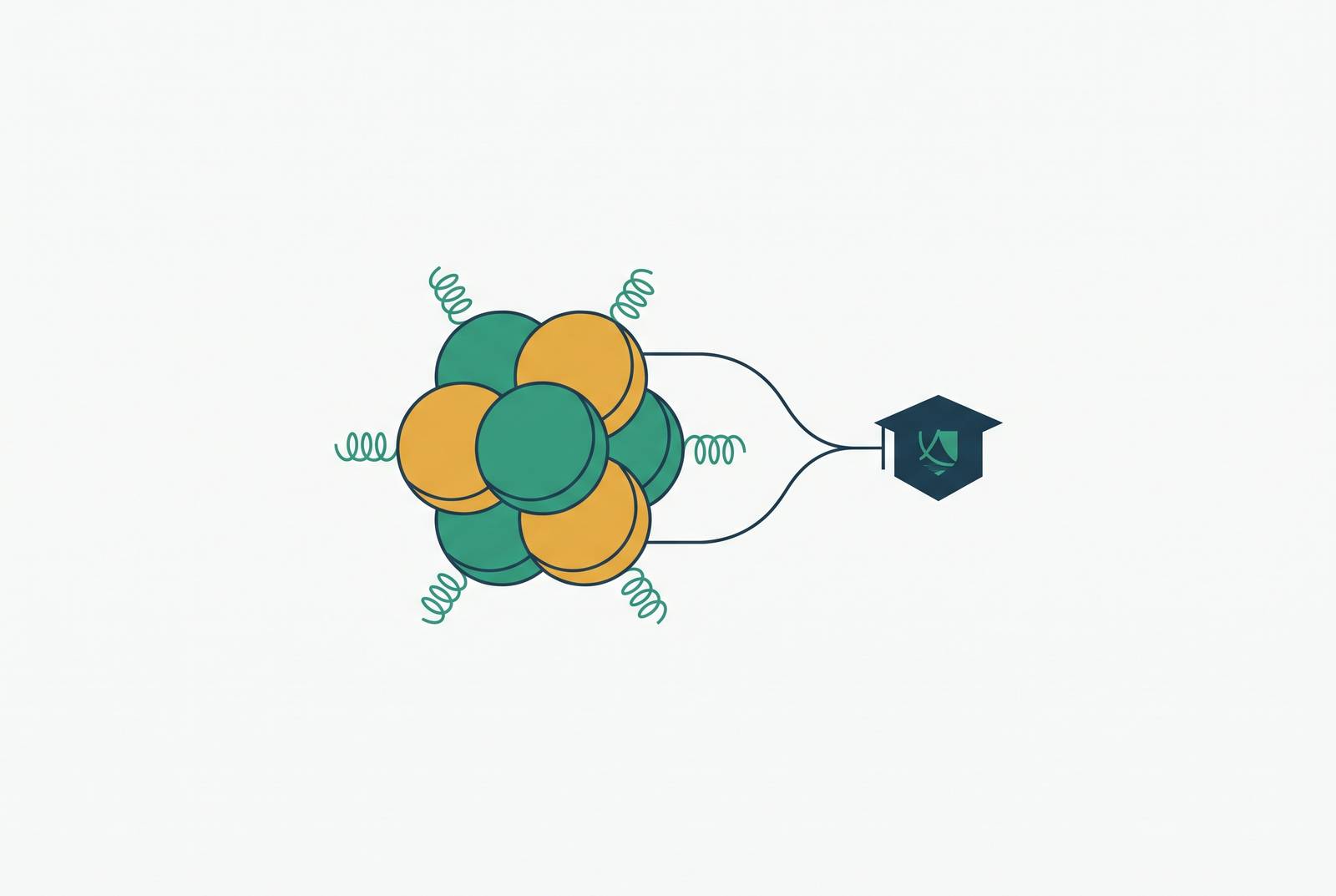
The Columbia University nanoparticle IP platform for peptide delivery traces to Kam Leong’s Biomedical Engineering lab and Lionbio, the Columbia spinout that exclusively licensed the core technology through Columbia Technology Ventures. Its significance lies in that chain of rights. For builders seeking access to this foundation, licensing a downstream formulation is not the same as securing rights to the platform beneath it.
Why polymer nanoparticle peptide delivery IP is harder to license than it looks
A peptide formulation can look like an invention that stands on its own while relying on production methods and polymer chemistry developed elsewhere. Encapsulation helps protect fragile biological cargo from enzymatic degradation before it reaches its target. Ionic interactions can package charged peptides, proteins, and nucleic acids, but that performance depends on specific formulation choices.
Downstream formulation licensing has a clear role because it can provide access to a particular formulation and its application-specific development. Its limit is that those rights do not, by themselves, establish access to underlying platform patents. For the Columbia lineage examined here, the practical question is who controls the methods for producing and adapting the particles, rather than simply who has developed a nasal formulation.
How university technology transfer concentrates platform IP in a single licensee
The Bayh-Dole Act gives universities the right to elect to own and license federally funded inventions, subject to conditions. A faculty inventor discloses an invention to the university’s technology transfer office, which manages patenting and licensing. An exclusive license can then place commercial rights to a platform with one entity, even when the underlying research supports many applications.
Columbia Technology Ventures, or CTV, handles this work at Columbia. The November 2024 Federal Register notice described NIAID’s contemplated grant of an exclusive, sublicensable patent license to The Trustees of Columbia University / Columbia Technology Ventures. Its purpose was to consolidate co-owned rights and expedite development “consistent with the goals of the Bayh-Dole Act codified as 35 U.S.C. 200–212”. That notice concerned Ebola peptide arrays and illustrates the licensing mechanism, with its scope limited to those arrays.
A spinout is one commercial vehicle for that licensing mechanism. It can bring together the people who lead the science and develop it for the market under an exclusive university license. Equity ownership in the company and ownership of the patents are different matters, however, and exclusivity does not itself establish that patent title has transferred. Downstream developers who want to use covered platform methods commercially need access to the original rights, within what the license covers.
The Columbia Biomedical Engineering lab where the foundational nanoparticle IP originated
Within this lineage, the origin point is Kam Leong’s lab in biomedical engineering at Columbia. Columbia Technology Ventures lists a scalable nanoparticle platform with Kam W. Leong, Ph.D. as lead inventor and Joan Martinez as licensing contact. That institutional record identifies an inventor and a licensing gateway. It gives the platform’s provenance a firmer basis than an application-level description of what a company hopes to deliver.
The platform encompasses nanoparticle production methods, formulation approaches, and delivery architectures for peptides, proteins, and nucleic acids. Flash nanocomplexation is among its components, enabling scalable production of uniform membrane-coated nanoparticles for drug and gene delivery. The stated physical range extends from 50 nm to 2 µm, with charge varying from −50 mV to +50 mV. Those adjustable parameters make the production method relevant to more than one cargo or target tissue.
Lionbio describes its scientific foundation as drawing on 30+ years of IP from the lab. That is the company’s characterization of the portfolio’s depth, which still requires examination of particular patent claims. The distinction that matters is between a point invention and a platform that supports changes in production, formulation, and delivery. An application-specific patent may protect one implementation, whereas foundational methods can remain relevant as the cargo and therapeutic purpose change.
How CTV's exclusive license to Lionbio concentrates the platform in one spinout
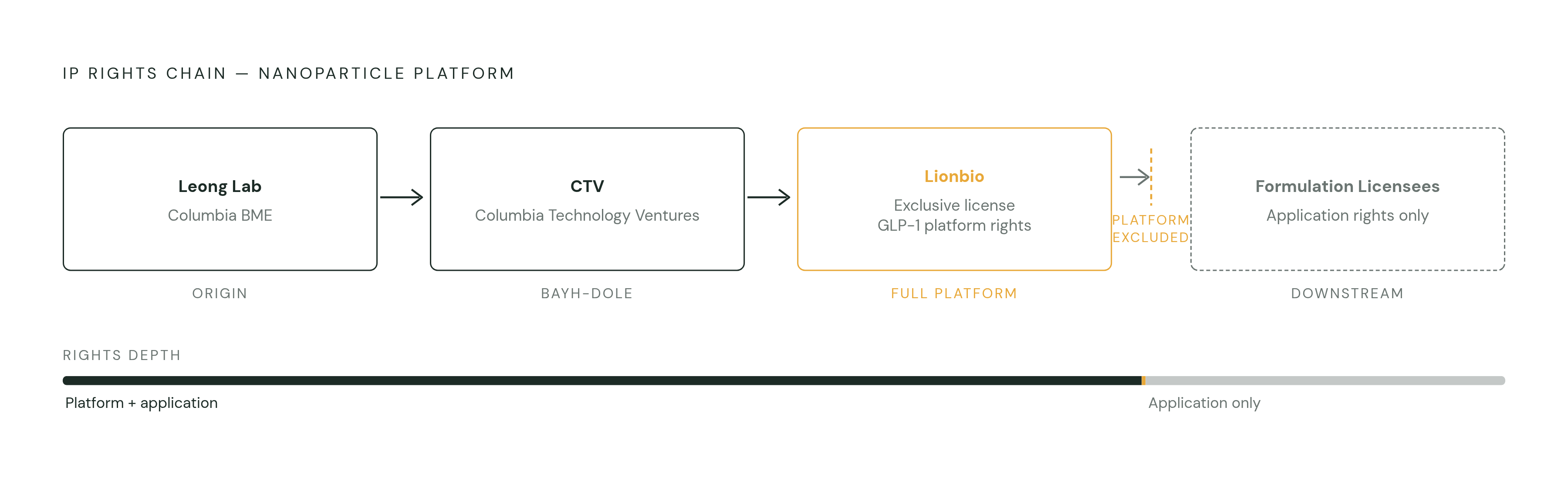
Lionbio is the Columbia spinout that exclusively licensed the core nanoparticle platform through CTV to develop GLP-1 therapeutics. The concentration becomes visible at the application layer, where an intranasal peptide program depends on rights originating in the university lab. For anyone seeking to commercialize covered methods, that chain matters as much as the formulation itself.
The founding structure brings together Dr. Kam Leong as the scientific originator, founding scientist Huiyi Liang, and Robin Guo as the commercial lead. Guo’s background includes Andreessen Horowitz and McKinsey & Company. The composition reflects the spinout model’s combination of originating science and commercial development. It does not establish clinical performance or determine the legal breadth of any patent.
Exclusive access also needs a precise reading. A downstream formulation license can address rights to a particular product without necessarily resolving rights to the core Columbia methods, while Lionbio’s license addresses that foundational layer. Any sublicensing route would depend on the governing agreement, and independently developing an application does not by itself settle rights to patented methods beneath it. Conversely, an exclusive license to this platform is not ownership of the whole field of polymer nanoparticle delivery. Freedom to operate turns on the relevant claims and licensed scope.
Why the particle physics of nose-to-brain delivery make this specific IP lineage decisive
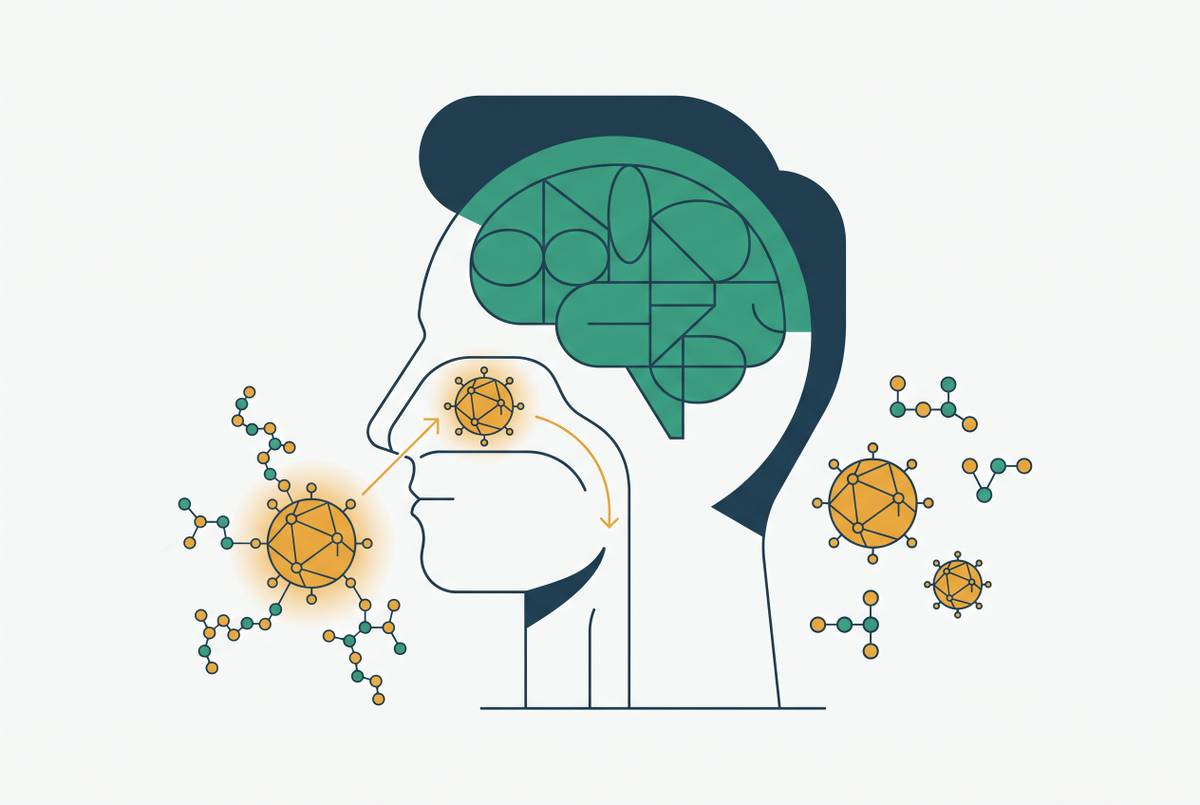
The origin of these rights matters because nose-to-brain delivery depends on physical choices made at the particle level. Intranasal administration can exploit the anatomical connections of the olfactory and trigeminal nerves to reach the brain without relying on passage across the blood–brain barrier from systemic circulation. Yet a nasal route alone does not define where an encapsulated peptide will travel. Particle size, charge, and release behavior help determine the delivery architecture.
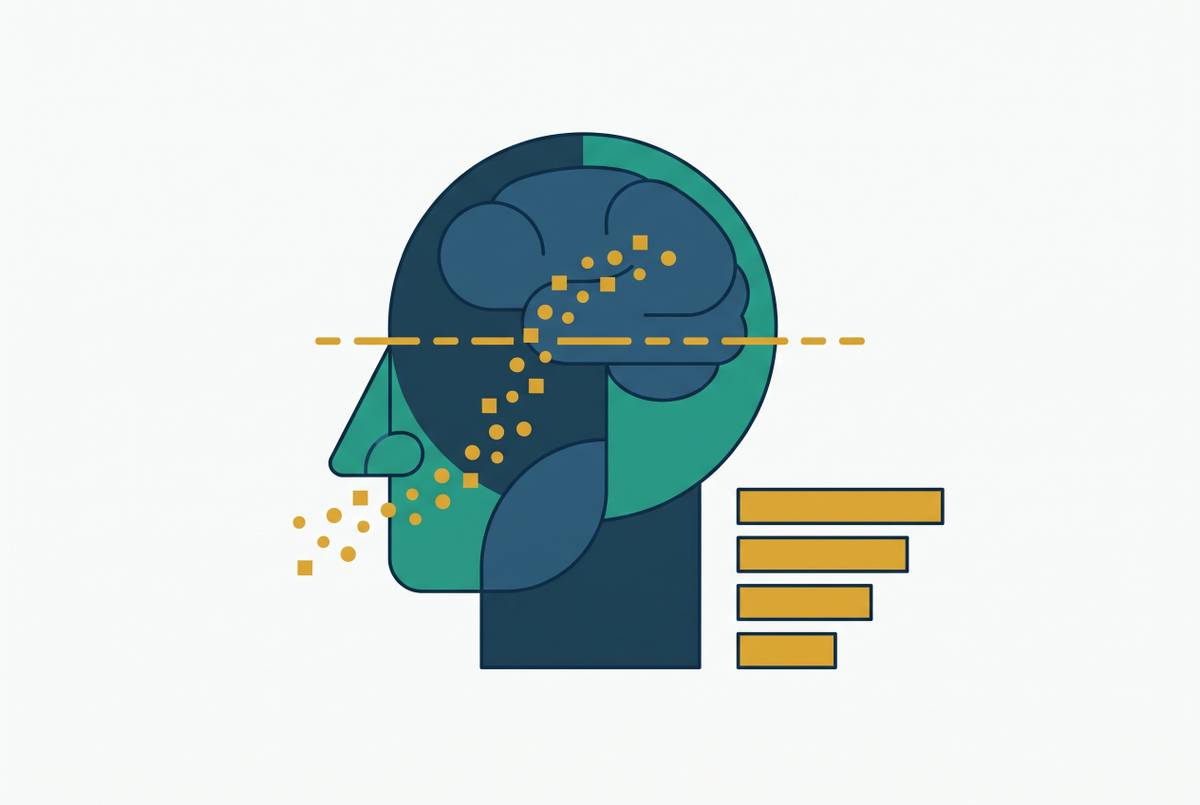
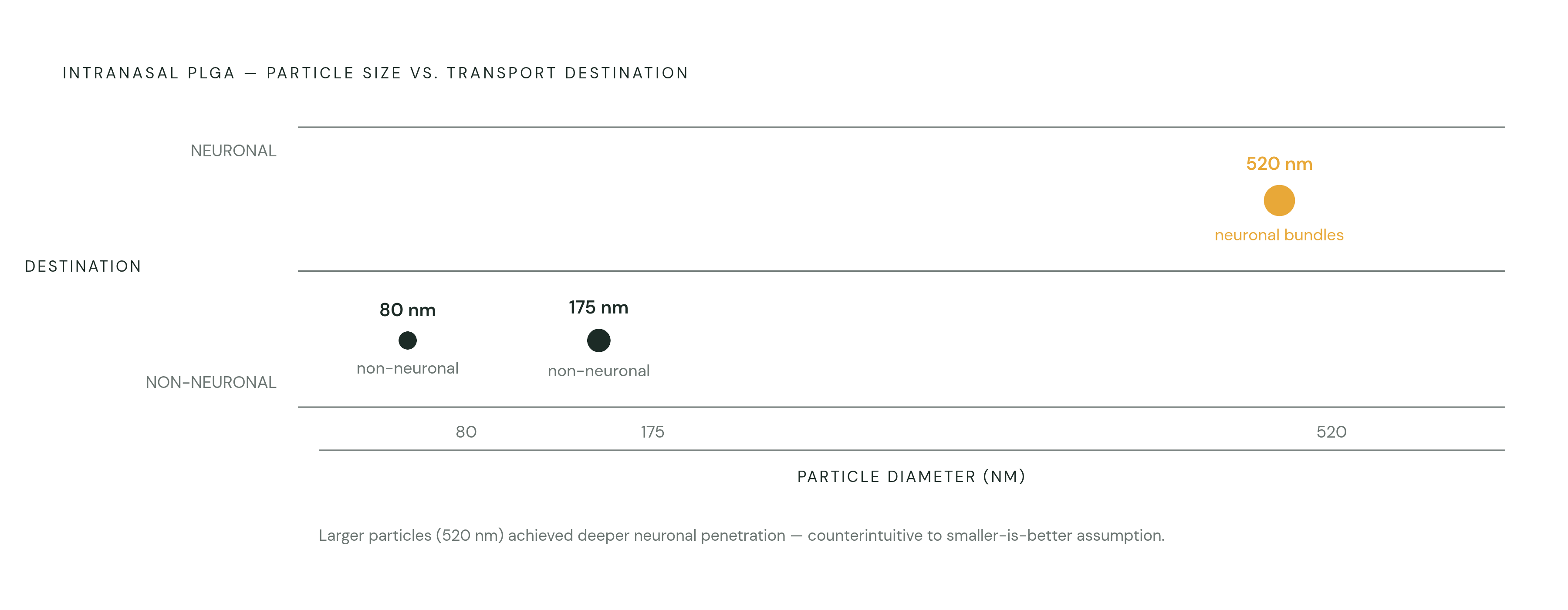
The size observations make that distinction concrete. After intranasal administration, 520-nm poly(lactic-co-glycolic acid) nanoparticles were detected in neuronal bundles, indicating transcellular and intracellular neuronal transport. By contrast, 80-nm and 175-nm particles were detected in other cell types, with more rapid but less neuronal distribution. Smaller therefore does not simply mean better for every brain-delivery objective. These observations establish the importance of size-dependent transport.
The pathways also differ in what they carry. The trigeminal pathway is the dominant route for intact nanoparticles, while the olfactory pathway more likely carries substances already released from them. Encapsulation, surface loading, and when release takes place can thus change which route a formulation uses. Preclinical models have also shown rapid transport of neuropeptides, including GLP-1 and GLP-2 derivatives with functional sequences, through trigeminal axons after intranasal application.
The Columbia platform’s size range and charge tunability provide a design space in which those transport requirements can be investigated. Scalable production matters because the relevant physical properties must be reproducible in the carrier. In situ gels and permeation enhancers can improve retention and bioavailability, but they address different obstacles to delivery. A nanoparticle formulation still depends on its particle-production methods even with these aids, and access to those methods alone does not show that it can reach the brain effectively.
What the GLP-1 adherence problem reveals about why delivery architecture, not just efficacy, determines market outcomes
More than half of first-time GLP-1 users stop within one year, with substantial dropout in the first months. Gastrointestinal side effects, principally nausea, are the most commonly cited clinical reason for stopping. Patients who cannot stay on a medicine miss out on its full benefit, even when it has been shown to work.
Changing the route is not automatically a solution. In oral peptide delivery, peptides can break down under digestive conditions and have low bioavailability, so doing away with an injection still leaves the challenge of getting the peptide where it needs to go. Cost, insurance barriers, and drug shortages also contribute to discontinuation. Those constraints cannot be treated as problems that nanoparticle engineering will itself solve. A different exposure profile might preserve efficacy while reducing side effects.
Intranasal delivery could combine systemic absorption with direct nose-to-brain transport. That combination provides a basis for investigating whether central delivery can reduce the peripheral GLP-1 exposure implicated in nausea while retaining therapeutic activity. Lionbio presents reduced nausea with high efficacy as a potential outcome of its platform that remains to be established clinically. Nevertheless, difficulty sustaining adherence explains why rights to delivery architecture can carry strategic weight beyond rights to a potent peptide.
The neurological frontier and why the EVOKE failure sharpens the nose-to-brain argument rather than ending it
Achieving an effective exposure profile becomes more demanding when the intended target is neurological disease. GLP-1 receptors are expressed in the brain, and epidemiological and cohort data associate GLP-1 receptor agonist use with reduced dementia incidence in populations with type 2 diabetes. Those links give researchers a reason to study the treatment further, but they do not show that it prevents dementia. It remains to be established whether engaging a plausible biological target can change clinical outcomes.
The Phase 3 EVOKE and EVOKE+ trials put that distinction into focus. They enrolled people aged 55–85 who had mild cognitive impairment or mild dementia due to Alzheimer’s disease confirmed by amyloid positivity. The tested GLP-1 formulation was no better than placebo at slowing progression on the primary Clinical Dementia Rating – Sum of Boxes (CDR-SB). Biomarker findings were mixed, with modest reductions in some CSF and neuroinflammation markers but no improvement, and slight worsening, in key plasma biomarkers such as GFAP and NfL.
One possible explanation is that brain exposure was insufficient to change the course of disease. The trials do not establish that explanation, however, and a biomarker signal without clinical benefit cannot isolate delivery as the cause of failure. What the result does sharpen is the distinction between testing a biological hypothesis and testing that hypothesis through a particular route of administration. Nose-to-brain delivery offers a way to investigate whether a different exposure profile can address the clinical failure.
Addiction is an adjacent, still preclinical case for this reasoning. Central GLP-1 receptor engagement has shown relevance to reward pathway modulation, while brain exposure remains a challenge for peripheral delivery. The Columbia-derived platform gives Lionbio a foundation for pursuing delivery architectures relevant to addiction and dementia, but the license is not evidence of neurological efficacy. The forward-looking argument is therefore mechanistic. A route that changes access to the brain may warrant investigation even when a systemic formulation has failed.
Why platform breadth — across peptides, gene editing, and beyond GLP-1 — is what the IP genealogy ultimately protects
The final implication extends beyond GLP-1 because the platform is a delivery architecture. Polymeric nanoparticles can carry small molecules, nucleic acids including DNA and siRNA, therapeutic proteins, and peptides. Encapsulation, controlled release, and targeted transport can all play a role with these types of cargo. The same design questions thus apply to gene editing, regenerative medicine, and immunotherapeutics, though each use has its own needs during development.
A platform may work with several types of cargo even when some uses fall outside the same claims, and working with one payload does not prove it will work with another. Lionbio’s stated long-term vision extends beyond a single GLP-1 product to a variety of peptides and biologics. Its exclusive access to the Columbia foundation is relevant to that ambition because production and formulation methods can remain central as applications change.
Regulatory strategy also reflects the distinction between a drug and its delivery system. The 505(b)(2) regulatory pathway allows a new formulation of an already-approved drug to rely on the FDA’s prior safety and efficacy findings. That can make delivery innovation a distinct development proposition, although it does not establish that a particular nanoparticle product qualifies or remove the need to demonstrate its performance.
For builders and licensors, the practical task is therefore to trace rights from the proposed application back through the formulation and production methods it uses. Downstream licensing can be valuable, but it answers only the rights questions within its scope. In the core Columbia nanoparticle lineage discussed here, that inquiry leads from Kam Leong’s lab through CTV to Lionbio. The genealogy matters because freedom to operate depends on the foundation a product actually uses.