Why Intranasal Nanoparticle Platforms Are Outpacing Injectable BBB-Bypass Strategies for Peptide CNS Programs
Intranasal nanoparticles bypass systemic barriers that injectable formulations cannot overcome.
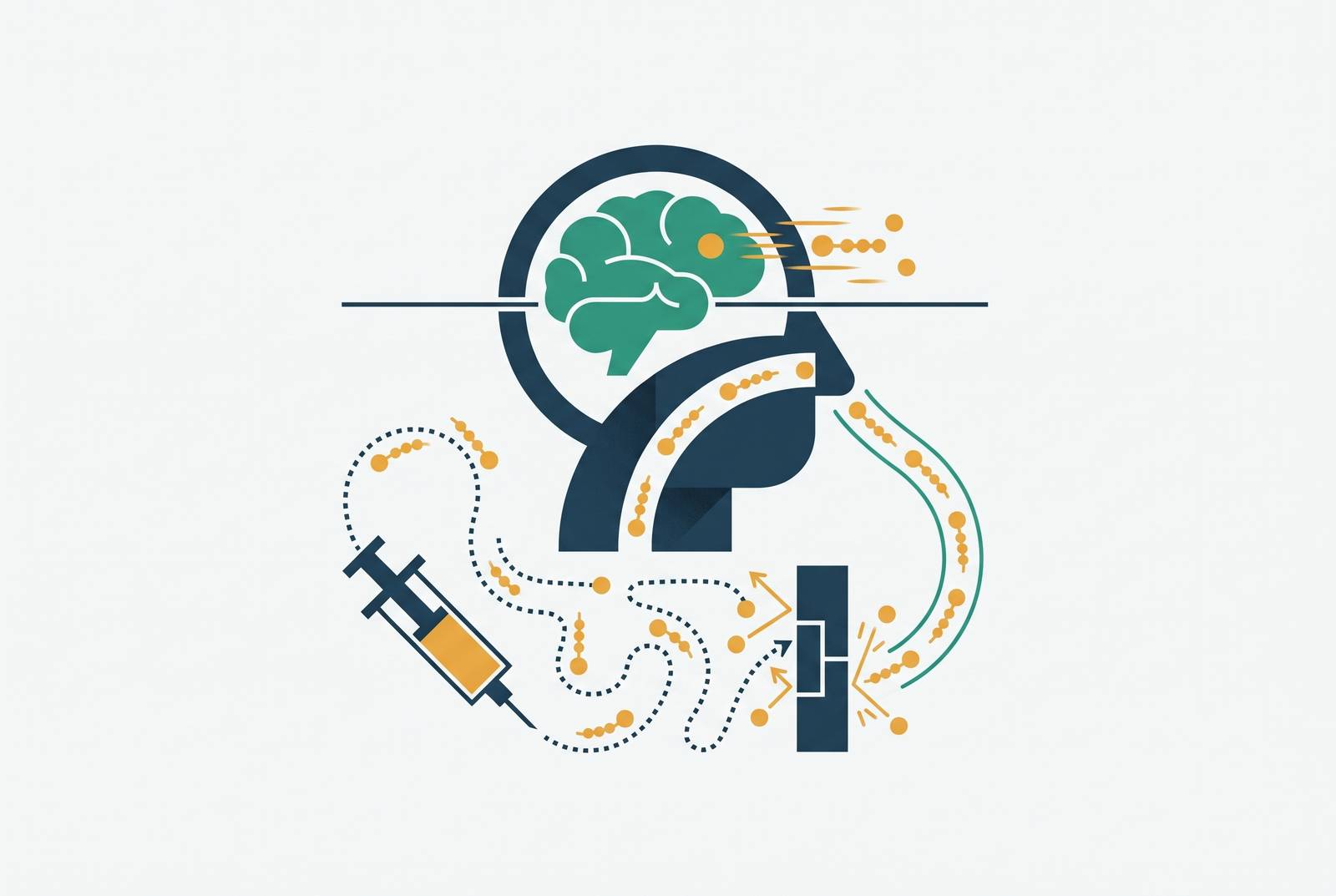
Nanoparticle nose-to-brain delivery for CNS peptide indications changes the route rather than asking a better injectable formulation to overcome the blood–brain barrier. It uses olfactory and trigeminal pathways while protecting peptides against nasal clearance and degradation. GLP-1 programs show this especially clearly because brain targeting and reduced peripheral exposure tackle delivery problems that are linked.
Why injectable BBB-bypass strategies cannot solve the brain-penetration problem for peptides by fixing their formulation
Injectable routes remain the default for peptide delivery and have attracted enormous engineering effort. The difficulty is not a lack of ingenuity. Large, hydrophilic peptides encounter enzymatic degradation in circulation, active efflux, and strong exclusion from brain parenchyma. The BBB’s tight junctions and efflux transporters form a selective biological membrane, whose properties do not change simply because a carrier receives a different surface coating.
An intravenous nanoparticle must therefore complete a demanding sequence, including colloidal stability in circulation, BBB penetration, lesion accumulation, and target-cell engagement. Failure compounds along this chain. Increasing circulating exposure does not necessarily increase selective accumulation in the relevant intracranial compartment, while clearance by the mononuclear phagocyte system and potential immunogenicity further constrain delivery. Even tumors, where the BBB may be disrupted, present uneven permeability between contrast-enhancing and non-enhancing regions. Access to one region does not guarantee distribution to infiltrative disease margins.
What, then, can formulation improvements actually accomplish? They can address individual delivery steps, but they do not remove the need to complete the sequence. That distinction is the structural weakness of injectable BBB-bypass strategies for peptides. Greater carrier sophistication still operates within a route that requires systemic survival before meaningful brain access can begin.
How the nasal route reframes the barrier problem rather than trying to solve the same one
Intranasal delivery changes the starting point of that sequence. Instead of approaching the brain from circulating blood, it uses anatomical connections between the nasal epithelium and the CNS. The olfactory and trigeminal nerve pathways provide routes that bypass the BBB and hepatic first-pass metabolism. CSF and perivascular transport provide additional contributors to distribution, so delivery need not depend on one pathway alone.
The distinction between bypassing the BBB and improving blood-side penetration answers a common question about getting large-molecule peptides across the BBB through nasal delivery. For the directly transported fraction, crossing that vascular barrier is not the task. However, a meaningful fraction of a nasal dose can also enter systemic circulation through the nasal vasculature. Intranasal administration therefore does not mean exclusively brain-directed exposure, and the balance between direct and systemic transport remains consequential.
Mucociliary clearance, local enzymatic degradation, epithelial permeability, and limited nasal cavity volume become the immediate constraints. Proximity and direct neuronal connections can allow drugs to reach cerebral tissues within minutes, but proximity alone cannot protect a fragile peptide. The mechanistic advantage depends on pairing the route with a formulation that can address these local obstacles.
Why bare peptides fail at the nasal mucosa and what nanoparticles fix
Bare peptides are poorly equipped for the nasal environment. Mucociliary clearance sweeps unprotected material toward the nasopharynx within minutes, limiting epithelial contact. Proteases in nasal secretions cleave peptide bonds and can inactivate the drug before absorption. Meanwhile, hydrophilic peptides are too large for easy passive diffusion through the tight-junction epithelium of the olfactory region. Simply replacing an injection with a nasal dose leaves all three problems unresolved.
Nanoparticles provide distinct design levers for these failures. Encapsulation shields the peptide from proteases, while mucoadhesive surface modifications, including chitosan coatings and hyaluronic acid conjugates, extend residence at the epithelium. Particle size and surface charge can be tuned to support cellular uptake and olfactory nerve internalization. These parameters give formulation development a specific task for each local failure mode.
The 2026 “NanoInBrain” polypeptide hybrid nanocarrier study illustrates the retention principle. Its hyaluronic acid-poly-L-glutamate cross-polymer prolonged nasal residence to approximately four hours and increased total brain accumulation. Chitosan-coated nanoemulsions and in situ gels offer a parallel approach, with nasal-temperature-triggered gel formation slowing mucociliary transport through increased retention.
Surface functionalization gives developers another way to control transport. Ligands targeting olfactory receptor neurons or trigeminal endings can support active targeting without first requiring systemic circulation. Lipid-based nanocarriers, polymeric nanoparticles, nanoemulsions, and extracellular vesicles pursue these goals through different material strategies. The relevant comparison is therefore not nasal spray versus injection, but a protected, locally engineered transport system versus a carrier that must first survive the systemic delivery cascade.
Why GLP-1 peptides make the strongest case for this delivery architecture
GLP-1 receptor agonists bring the brain-access question into unusually sharp focus. GLP-1 receptors are expressed in the hippocampus and cortex, with particularly high expression in the human frontal cortex. These regions are central to cognition and affected in Alzheimer’s and Parkinson’s disease. GLP-1 receptor activation also has mechanisms relevant to neurodegeneration, including reduced oxidative stress, prevention of neuronal apoptosis, and restoration of central insulin signaling.
In a meta-analysis of many trials, Seminer et al. reported significant reductions in dementia and cognitive impairment among people who used GLP-1 receptor agonists. An emulated trial also reported reduced rates across Alzheimer’s disease, Lewy body dementia, vascular dementia, and Parkinson’s disease. Early signs of reduced smoking and alcohol misuse also raise the question of whether the drugs engage brain reward circuits. These findings motivate research, but they do not establish efficacy for intranasal GLP-1 delivery in humans.
Researchers still debate whether current injectable formulations reach meaningful concentrations in the human brain and how much direct brain activation accounts for the neurological signals. If central receptor activation is necessary, strong peripheral metabolic activity may coexist with inefficient neurological dosing. Intranasal nanoparticle delivery is designed to test that gap by favoring CNS exposure while reducing peripheral receptor activation.
That exposure shift connects efficacy research with tolerability. Peripheral GLP-1 receptor activation in the gut and vagal system drives the nausea and gastrointestinal cascade associated with discontinuation. Reducing peripheral exposure is therefore not merely an extra feature of a brain-targeted formulation. It is part of the same proposed redistribution of the dose, although the resulting clinical benefit remains to be demonstrated.
The adherence collapse that makes delivery architecture a strategic imperative, not a refinement
The scale of GLP-1 discontinuation gives that exposure question a patient-outcome dimension. Nearly half of patients with type 2 diabetes and close to two-thirds of those without the condition discontinue GLP-1 receptor agonists within a year of starting treatment. Those figures describe a broad persistence problem. They also make sustained treatment a central requirement for delivery design.
Gastrointestinal side effects are the most commonly cited reason for discontinuation. Roughly half of users have nausea, while roughly one-third have diarrhea. Side-effect-driven discontinuation is substantially higher in real-world settings than in controlled trials, suggesting that trial populations underrepresent the tolerance profile of broader patient groups. Not every dropout can be attributed to the route, but peripheral tolerability is a substantial part of the problem.
Dose escalation does not remove that underlying mechanism. The 2025 STEP UP trial found gastrointestinal adverse events in a large majority of participants receiving ultra-high formulations, with most events mild to moderate. Increasing exposure can therefore take a toll on the body even when the molecule remains pharmacologically active. For CNS programs requiring sustained treatment, delivery architecture becomes inseparable from whether patients can remain on therapy. Intranasal targeting offers a mechanistic response to this problem.
What companies developing nose-to-brain GLP-1 delivery reveal about the field’s direction
Landmark Medicines Ltd. announced in September 2026 that it planned to move its proprietary nasal drug-delivery platform toward a study in human volunteers. The UK company chose GLP-1 receptor agonists for its first use in treatment and was assessing molecules including semaglutide before making its final choice. Its platform is formulation-agnostic and subject to multiple patent filings. The choice puts route development before commitment to a single GLP-1 molecule, treating delivery as reusable infrastructure.
Aptar Pharma, based in Louveciennes, France, is a subsidiary of AptarGroup in Crystal Lake, IL. In May 2026, it published three new international patent applications focused on enabling inhaled and nasal delivery of peptide-based therapies. Aptar’s broader biologics compatibility program assesses how nucleic acids, proteins, and their nanoparticle-based delivery systems interact with nasal and pulmonary delivery systems across formulations.
A planned volunteer study is not a demonstrated neurological outcome, and a patent application is not evidence of successful brain delivery. Nor do the announcements establish that every nasal GLP-1 candidate uses nanoparticle encapsulation or targets the CNS. Their relevance is narrower and still important, because independent developers are investing in alternatives to systemic peptide delivery and in the interfaces those alternatives require.
The genuine obstacles that remain and why they do not reverse the structural advantage
Clinical efficacy evidence for intranasal CNS peptide delivery remains sparse relative to injectable programs, and preclinical-to-human attrition is high across nanomedicine. This is the most serious unresolved objection. A 2025 systematic review and meta-analysis found that patients with Alzheimer’s disease who received GLP-1 receptor agonists had no improvement in memory and cognition compared with placebo, though the evidence was low-certainty. Greater brain penetration might improve outcomes, fail to change them, or introduce new toxicities. Insufficient brain exposure is a possible explanation for the null result.
Rodents and humans differ substantially in olfactory epithelial surface area and mucosal architecture, so rat brain-to-plasma ratios do not directly predict human results. Dosing uncertainty and mucosal safety concerns further limit what promising preclinical accumulation can establish. Nanoparticle engineering may address retention and transport, but it cannot substitute for evidence that the resulting human exposure is useful and tolerable.
Other obstacles concern the maturity of the field. Studies describe particle size, charge, and release kinetics in different ways, which makes them hard to compare and weakens the evidence they provide as a whole. Making products at scale, dealing with batch-to-batch variability, and meeting complex regulatory requirements add business risk, though other approved nanoparticle products show that these obstacles can be overcome. These are different problems from obtaining passage through a selective vascular barrier after systemic dosing.
Intranasal delivery avoids requiring every brain-directed payload to complete the intravenous cascade, while retaining its own biological and developmental risks. Whether that change leads to better clinical outcomes still needs to be tested.
Why the nose-to-brain route is a platform, not a single application, and what that means for CNS drug development
The same access logic extends beyond GLP-1 peptides. Lipid nanoparticles, polymeric nanoparticles, and biomimetic nanoparticles can protect cargo including siRNA, CRISPR-Cas9 components, immune agonists, and growth factors. Nose-to-brain development also encompasses proteins, antibodies, and neurotrophic factors, with nanocarriers serving as delivery systems. Glioma immunotherapy applies this logic to STING agonists, checkpoint-modulating agents, and combination payloads. Each use has different targeting needs, but every formulation must handle protection, retention, and transport.
GLP-1 neurological programs illustrate why reuse could be valuable. Addiction research asks whether preliminary smoking and alcohol signals reflect central reward-circuit engagement. Dementia research asks whether sustained brain-targeted exposure can produce benefit without the gastrointestinal burden that undermines long-term treatment. Neither question is settled by selecting the nasal route. Both lines of research, however, gain a way to study brain engagement without relying on peripheral dosing alone.
Platform development can also preserve what each program learns. Validation in one peptide CNS program could provide manufacturing infrastructure, regulatory precedent, and formulation know-how for subsequent programs. AI and machine learning are starting to be used for nanocarrier optimization, pharmacokinetic prediction, and patient stratification, giving developers more tools to apply that knowledge to new cargo. Reuse changes the economics from rebuilding a delivery system to refining an established one.
The durable case rests on that convergence. Anatomical access creates the mechanistic opportunity, tolerability gives it clinical urgency, and reusable nanocarrier engineering gives it platform value. Success is not contingent on any single GLP-1 molecule or indication, although each still requires proof. For peptide CNS development, the central advantage is a route whose immediate constraints offer formulation levers rather than another attempt to cross the same vascular wall.
Sources
- Full article: Can nanoparticle-based intranasal delivery systems revolutionize treatment of central nervous system diseases?
- Intranasal delivery of biotherapeutics utilizing nanocarriers: Advancements in surface engineering, clinical progress and the incorporation of artificial intelligence - ScienceDirect
- Navigating the Nose-to-Brain Route: A Systematic Review on Lipid-Based Nanocarriers for Central Nervous System Disorders
- Nanoparticle-Mediated Nose-to-Brain Delivery for Ischemic Stroke Therapy: Preclinical Insights
- Chitosan-Based Nanoparticles for Nose-to-Brain Drug Delivery: A Real Path toward Effective CNS Therapy? - PMC
- Intranasal drug delivery: Unlocking the nose-to-brain route for central nervous system therapies - ScienceDirect
- Nanocarrier-based intranasal drug delivery: A transformative strategy for brain-targeted epilepsy therapy - ScienceDirect
- Transnasal-brain delivery of nanomedicines for neurodegenerative diseases